Condition-Based analytics vs Predictive analytics for Power Plants
By Talon on June 10, 2026
Every power plant operations team faces the same strategic question when investing in reliability analytics: should we deploy condition-based monitoring that alerts us when parameters cross known thresholds, or should we invest in predictive analytics that forecasts failures weeks before they happen using machine learning models? The answer, as plant reliability engineers at combined-cycle, coal, and peaking facilities are increasingly discovering, is that the question itself reflects a false dichotomy.
70%
Of U.S. power plants still rely on calendar-based or runtime-based preventive maintenance rather than condition-driven strategies
25-30%
Average maintenance cost reduction when transitioning from preventive to condition-based maintenance programs
35-45%
Additional unplanned downtime reduction when predictive analytics is layered on top of condition-based monitoring
85%
Of unplanned power plant outages could be prevented or mitigated with integrated condition-based and predictive analytics
Understanding the Core Differences Between Condition-Based and Predictive Analytics
Condition-based analytics and predictive analytics are frequently grouped together under the umbrella of "smart maintenance," but they operate on fundamentally different data models, time horizons, and decision frameworks.Plant reliability directors who book a demo of iFactory's integrated analytics platform consistently report that understanding this distinction is the first step toward building a mature reliability analytics program that applies the right analytical approach to each asset class.
Gas Turbine Bearing Monitoring
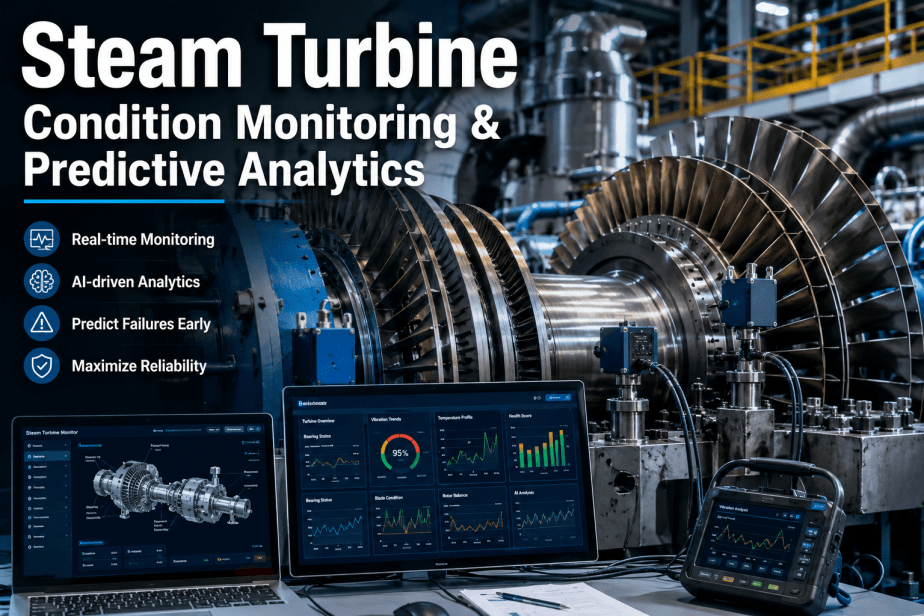
CBM tracks vibration and temperature against OEM limits in real time. PdM analyzes degradation curves across historical starts, load profiles, and ambient conditions to forecast remaining useful life 30-90 days in advance.
CBM + PdM
Generator Insulation Analysis
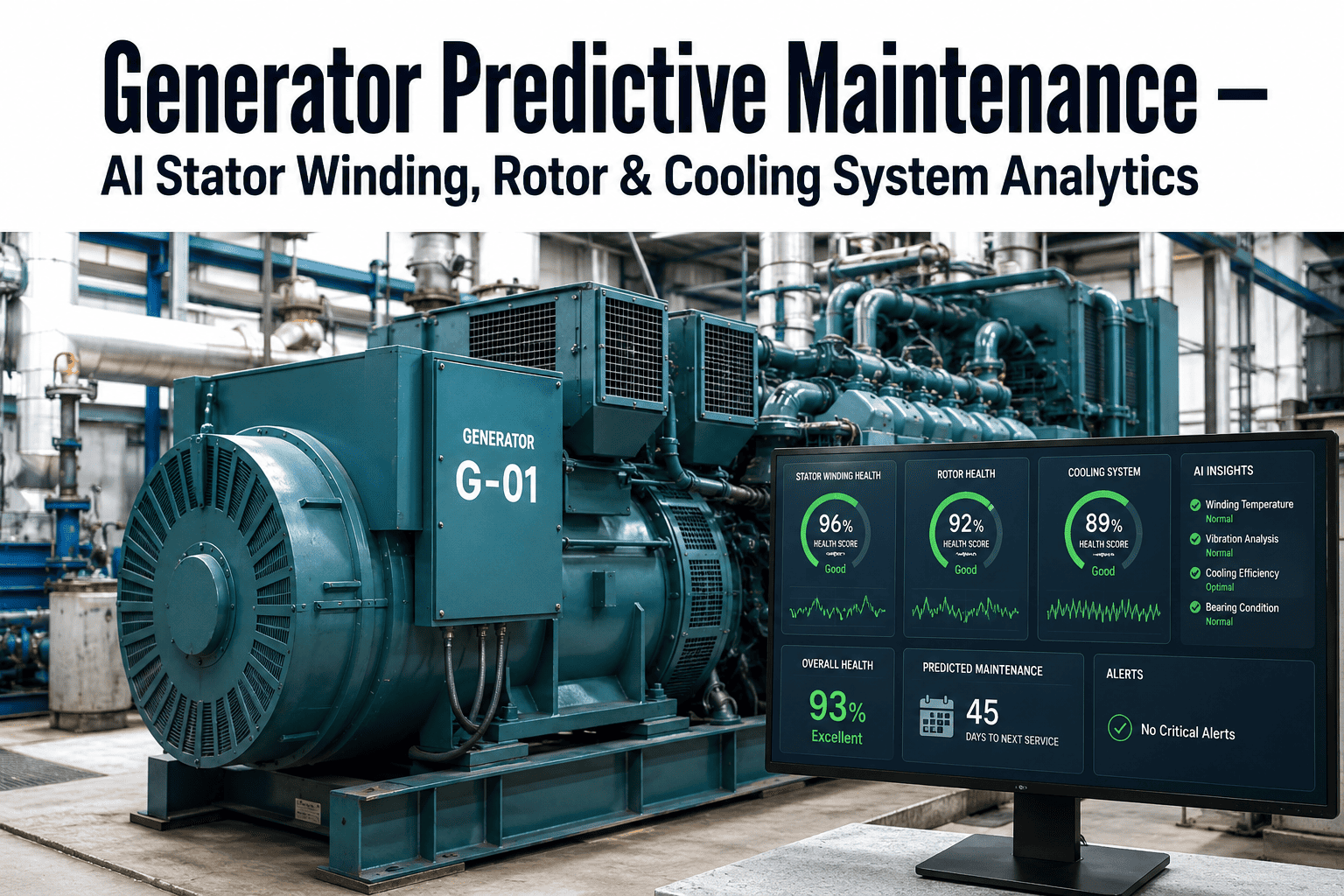
CBM monitors partial discharge levels, hydrogen purity, and stator winding temperature against alarm setpoints. PdM models correlate insulation degradation with starts, load cycles, and operating hours to predict failure probability.
PdM Priority
Transformer Dissolved Gas Analysis
CBM flags individual gas levels (H2, C2H2, CO) when they exceed IEEE C57.104 limits. PdM applies trend analysis and multi-gas ratio models to identify fault types and estimate time-to-failure with statistical confidence bands.
CBM + PdM
HRSG Tube Health Monitoring
CBM tracks drum level, temperature ramp rates, and blowdown conductivity against operating limits. PdM models correlate creep-fatigue interaction with start cycles, wall thickness trends, and water chemistry data to forecast tube life.
PdM Priority
Cooling Tower Performance
CBM monitors fan vibration, motor current, and basin water temperature against seasonal setpoints. PdM analyzes approach temperature trends, ambient wet-bulb correlation, and fouling rates to optimize cleaning schedules.
CBM Optimal
Boiler Feed Pump Diagnostics
CBM tracks suction pressure, discharge flow, motor winding temperature, and seal leak-off flow. PdM models pump degradation curves against operating hours and starts to forecast seal replacement windows and impeller wear.
CBM + PdM
Choosing the Right Analytics Strategy for Your Power Plant Assets
The decision framework depends on four factors: failure mode complexity, data availability, criticality, and economic crossover point. Plant reliability teams that book a demo during their analytics strategy assessment consistently achieve higher ROI by aligning analytical approach to asset failure characteristics rather than applying a single methodology across all equipment.
Decision Factor
Condition-Based Analytics (CBM)
Predictive Analytics (PdM)
Best For
Data Requirements
Real-time sensor data with defined thresholds. Requires historical baseline for alarm limit setting. Works with 1-3 sensor parameters per asset.
Historical data with failure events. Requires 12-24 months of clean labeled data. Typically needs 5-15 sensor parameters plus operational context.
CBM: Simple assets with limited sensor coverage PdM: Complex assets with rich historian data
Detection Lead Time
Minutes to hours — alerts trigger when threshold is breached. No forecasting capability beyond current value trending.
Days to months — forecasts remaining useful life with confidence intervals. Enables proactive outage planning and parts procurement.
Average annual savings from combined CBM+PdM program at a 500 MW combined-cycle plant
4:1
ROI ratio reported by power plants deploying integrated condition-based and predictive analytics platforms
85%
Reduction in unnecessary preventive maintenance tasks after transitioning from calendar-based to condition-driven strategies
Evaluating which analytics approach fits your plant's asset portfolio and reliability program maturity? Book a demo with iFactory's power plant reliability analytics team for a strategy assessment.
Building Your Analytics Maturity Roadmap from CBM to Predictive Analytics
The most successful power plant reliability programs do not attempt to deploy predictive analytics across all assets simultaneously. Instead, they follow a structured maturity progression that builds condition-based monitoring foundation first, then layers predictive analytics on assets where the economic case is strongest. This phased approach reduces implementation risk, builds organizational capability, and generates early ROI that funds subsequent expansion. Plants that book a demo during the roadmap planning phase consistently achieve faster time-to-value and avoid the most common pitfall: deploying predictive models before the data infrastructure and alarm management discipline required to support them is in place.
01
Asset Criticality Assessment and Sensor Gap Analysis
Classify all generating assets by failure consequence, failure mode complexity, and current sensor coverage. Identify high-criticality assets where condition data is available but not integrated into a centralized monitoring platform. Prioritize assets with well-understood failure modes and clear threshold indicators for initial CBM deployment.
02
Condition-Based Monitoring Foundation Deployment
Establish real-time data ingestion from DCS, PLC, and stand-alone sensors for priority assets. Configure threshold-based alarms aligned with OEM guidance and industry standards (API 670 for turbomachinery, IEEE C57.104 for transformers). Implement alarm management discipline to prevent alarm fatigue and ensure that condition alerts trigger defined maintenance response workflows.
03
Historical Data Aggregation and Labeling for Predictive Model Training
Aggregate 12-24 months of historical sensor data, maintenance records, and failure event logs for high-priority assets. Clean and label data to create training datasets that correlate sensor patterns with known failure modes. This phase typically reveals data quality issues that must be resolved before predictive models can deliver accurate forecasts.
04
Predictive Model Development and Validation for Priority Assets
Develop machine learning models for assets where the economic case is strongest — typically gas turbines, generators, and main transformers. Train models on labeled historical data, validate against holdout datasets, and benchmark predictive accuracy against existing condition-based alert performance. Deploy models in parallel with CBM monitoring to build confidence before transitioning decision authority.
05
Integrated CBM+PdM Workflow and Continuous Model Improvement
Combine condition-based alerts and predictive forecasts into a single reliability dashboard with unified work order generation. Implement model monitoring to detect prediction accuracy degradation and trigger automated retraining. Expand predictive coverage to additional asset classes as data maturity and organizational capability grow. Target full CBM coverage across all critical assets with PdM on 30-50% of high-value asset classes.
How Condition-Based and Predictive Analytics Work Together in Practice
The most effective power plant reliability analytics programs do not treat CBM and PdM as alternatives — they integrate them into a unified decision framework that applies each analytical method at the point where it delivers maximum value. Condition-based analytics provides the always-on safety net that catches rapid-onset failures and operating limit violations. Predictive analytics provides the forward-looking intelligence that enables proactive outage planning, optimized parts inventory, and maintenance scheduling aligned with market conditions and generation dispatch forecasts. Together, they form a reliability analytics architecture that covers the full spectrum of failure timelines from seconds to months. Plant reliability engineers who book a demo of iFactory's integrated platform consistently highlight the unified alert-to-action workflow as the feature that transforms raw analytics output into maintenance decisions.
Key Integration Points for Combined CBM and Predictive Analytics Programs
Unified Asset Health Dashboard: Combine CBM threshold status and PdM remaining useful life forecasts into a single traffic-light view per asset. Green indicates within limits with adequate remaining life, yellow indicates developing concern, red indicates immediate action required.
Progressive Alert Escalation: PdM forecasts generate advisory-level notifications 30-90 days before expected failure. As the asset approaches the predicted failure window, CBM thresholds tighten automatically to provide confirmatory real-time monitoring that validates or refines the prediction.
Maintenance Window Optimization: Use PdM forecasts to schedule interventions during planned outages or low-market-price periods. CBM confirms that the asset can safely operate until the scheduled maintenance window and provides early warning if condition accelerates faster than predicted.
Continuous Model Learning Loop: When CBM alerts trigger maintenance events, the findings (actual vs. predicted degradation, root cause, repair action) are fed back into the PdM model training pipeline. Each maintenance event improves model accuracy for the next prediction cycle.
Spare Parts and Resource Planning: PdM forecasts feed into supply chain and workforce planning systems, enabling just-in-time parts procurement and skilled trades scheduling. CBM provides the safety confirmation that assets can operate safely until planned interventions.
Avoided Outage Documentation: Every failure prediction that enables proactive intervention is documented with before-and-after condition data, predicted vs. actual failure timeline, and cost impact. This evidence library builds the business case for program expansion and demonstrates ROI to plant leadership.
Deploy Integrated CBM and Predictive Analytics at Your Power Plant
iFactory's unified reliability analytics platform combines real-time condition-based monitoring with AI-driven predictive models in a single architecture — delivering the full spectrum of failure detection, from immediate threshold alerts to 90-day remaining useful life forecasts for gas turbines, steam turbines, generators, transformers, and balance-of-plant equipment.
Expert Review: What Plant Reliability Leaders Say About CBM vs Predictive Analytics
The biggest mistake I see plant reliability teams make is treating predictive analytics as a replacement for condition-based monitoring rather than as a complement. CBM catches the fast-developing failures that PdM models cannot predict because there is not enough historical data on that specific failure mode. PdM catches the slow-developing degradation that CBM thresholds miss because the change is too gradual to trigger an alarm. When I audit reliability programs, the plants with the best outage records are the ones that run both systems in parallel, with PdM telling them where to look and CBM telling them when to act. I have seen too many plants invest heavily in predictive models for every asset class while neglecting the CBM foundation — and then wondering why operators ignore the alerts because they do not trust the data coming from sensors they never properly configured in the first place.
Reliability Engineering Director
Combined-Cycle and Coal Generation Practice, 22 Years — CMRP Certified
The question I hear most often from plant managers is whether they should skip condition-based monitoring entirely and go straight to predictive analytics. My answer is always the same: would you rather know that your turbine bearing is at 98°C right now, or that it will reach 100°C in six weeks? The correct answer is both. CBM tells you the current state so you can make safe operating decisions today. PdM tells you the future state so you can plan maintenance for next month. A reliability program that lacks either one is flying blind in one direction along the timeline. The real strategic question is not CBM versus PdM — it is which assets need which analytical approach at which stage of your program maturity, and how quickly you can build the data infrastructure and organizational capability to run both effectively.
Senior Asset Management Consultant
Power Generation Reliability and Analytics, 18 Years — CRL, CRE Certified
Measured Outcomes at Power Plants Using Integrated CBM and Predictive Analytics
60%
Reduction in Forced Outage Rate
At combined-cycle plants deploying integrated CBM+PdM programs with coverage across gas turbine, steam turbine, generator, and HRSG asset classes over 24 months.
$1.8M
Annual Avoided Outage Cost
Average annual savings from prevented forced outages and optimized maintenance scheduling at 500 MW-class facilities running combined analytics programs.
90 Days
Predictive Lead Time Achieved
Average detection lead time for gas turbine hot gas path degradation using ML models trained on 18+ months of operational and maintenance data.
40%
Preventive Maintenance Reduction
Unnecessary calendar-based PM tasks eliminated after transitioning to condition-driven strategies with predictive failure forecasting at mature analytics sites.
12 Mo
Average Payback Period
Time to positive ROI for integrated CBM+PdM platform deployment at plants with 300+ MW capacity and 3+ asset classes under analytics coverage.
3.5:1
Maintenance Spend Efficiency
Ratio of avoided failure cost to analytics program cost achieved by plants with mature integrated CBM+PdM programs running for two or more years.
CBM
Real-Time Alerting
Threshold-based monitoring for immediate failure detection across all critical assets
PdM
Failure Forecasting
ML-based remaining useful life predictions for high-value generation assets
Unified
Single Platform
One integrated dashboard, one data model, one maintenance workflow for all analytics outputs
Ready to build your plant's integrated CBM and predictive analytics program? Book a demo with iFactory's power plant reliability team.
Frequently Asked Questions
No. Predictive analytics and condition-based monitoring serve complementary functions and neither can fully replace the other. PdM excels at forecasting slow-developing degradation patterns weeks to months in advance, but it requires sufficient historical failure data to train accurate models and cannot predict failures it has never seen before. CBM catches rapid-onset failures, operating limit violations, and anomalies that fall outside the model training distribution.
Most power plant predictive analytics applications require a minimum of 12-24 months of historical sensor data with associated maintenance and failure event records. The exact data requirements depend on the asset type, failure mode complexity, and model approach. For gas turbines, 18 months of data with 3-5 recorded maintenance events per asset class typically produces usable predictive accuracy. For assets with very few historical failures — such as large power transformers — transfer learning approaches that use industry-wide failure data combined with plant-specific condition data can reduce the data requirement. The most important data quality factors are consistent sensor calibration, accurate time-stamping across data sources, and complete maintenance event documentation that captures actual failure modes and root causes. iFactory's deployment team conducts a data readiness assessment during the pre-deployment phase to identify gaps and develop a data accumulation plan for assets that do not yet meet the minimum threshold.
The ROI timeline follows a two-phase pattern. Phase one — CBM deployment — typically delivers positive ROI within 3-6 months through reduced unnecessary preventive maintenance, early detection of developing faults, and elimination of alarm nuisance that previously caused operator desensitization. Phase two — PdM layering — typically achieves payback within 6-18 months depending on asset class and model maturity. Most plants achieve combined program payback within 12 months. The primary ROI drivers are (1) avoided forced outage costs, which average $300,000-800,000 per event for a 500 MW combined-cycle plant, (2) reduced maintenance labor and materials from eliminating unnecessary PMs, and (3) extended maintenance intervals enabled by condition-driven rather than calendar-driven replacement decisions.
The assets that benefit most from predictive analytics are those with (1) high failure consequence, (2) complex or slowly progressing failure modes, and (3) rich historical data availability. Gas turbines are the highest-value target — hot gas path degradation, combustion dynamics shifts, and bearing wear patterns are all well-suited to predictive modeling and carry multi-million-dollar failure consequences. Generator insulation systems and main power transformers are the second priority tier — partial discharge trends, dissolved gas evolution, and winding temperature patterns provide strong predictive signals. HRSG tube health monitoring is a growing application area where predictive models can forecast creep-fatigue interaction and corrosion rates. Assets that are well-served by condition-based monitoring alone include motor-operated valves, cooling tower fans, centrifugal pumps, and heat exchangers — assets with simple failure modes, clear threshold indicators, and lower failure consequence where the additional cost of predictive model development is not economically justified.
iFactory's platform ingests real-time sensor data from DCS, PLC, and stand-alone monitoring systems through standard OPC-UA, Modbus TCP, and PI Interface connections. CBM threshold analytics run continuously on the ingested data stream, generating alerts when parameters exceed configured limits. Predictive ML models operate on the same data pipeline, analyzing historical patterns and current trends to generate remaining useful life forecasts and failure probability scores. Both CBM alerts and PdM forecasts are displayed in a unified asset health dashboard with traffic-light status indicators for every monitored asset. When an alert or forecast triggers a maintenance action, the platform generates a work order directly in the plant's CMMS (SAP, Oracle, Maximo, or standard API integration) with all supporting condition data attached
Integrated CBM and Predictive Analytics — Full Capability, One Platform
iFactory's reliability analytics platform combines real-time condition-based monitoring with AI-driven predictive models in a single architecture purpose-built for power generation. Deploy the analytical approach that fits each asset class — threshold-based alerts for fast-developing faults, ML-powered forecasts for slow-developing degradation — without managing separate platforms, data pipelines, or maintenance workflows.
Conclusion: The Future of Power Plant Reliability Analytics Is Integrated, Not Either-Or
The question of condition-based versus predictive analytics has dominated power plant reliability conversations for the past decade, but the industry is reaching a consensus that the choice is neither necessary nor productive. Condition-based monitoring provides the real-time safety net that catches rapid-onset failures and operating limit violations with no data latency and no model uncertainty. Predictive analytics provides the forward-looking intelligence that enables proactive outage planning, optimized parts procurement, and maintenance scheduling aligned with market conditions. They are not competing methodologies — they are complementary layers of a comprehensive reliability analytics architecture that covers the full spectrum of failure timelines from seconds to months.
Power plants that have built mature integrated analytics programs consistently outperform their single-methodology peers on every meaningful metric: fewer forced outages, lower maintenance cost per megawatt-hour, longer intervals between major inspections, and stronger regulatory compliance records. The analytics technology to deploy both approaches in a unified platform exists today, at cost structures that deliver positive ROI within the first year, without requiring plants to choose between real-time safety monitoring and predictive intelligence. The right analytics partner delivers both capabilities in a single architecture — designed for the operating conditions, data environment, and reliability requirements of power generation.