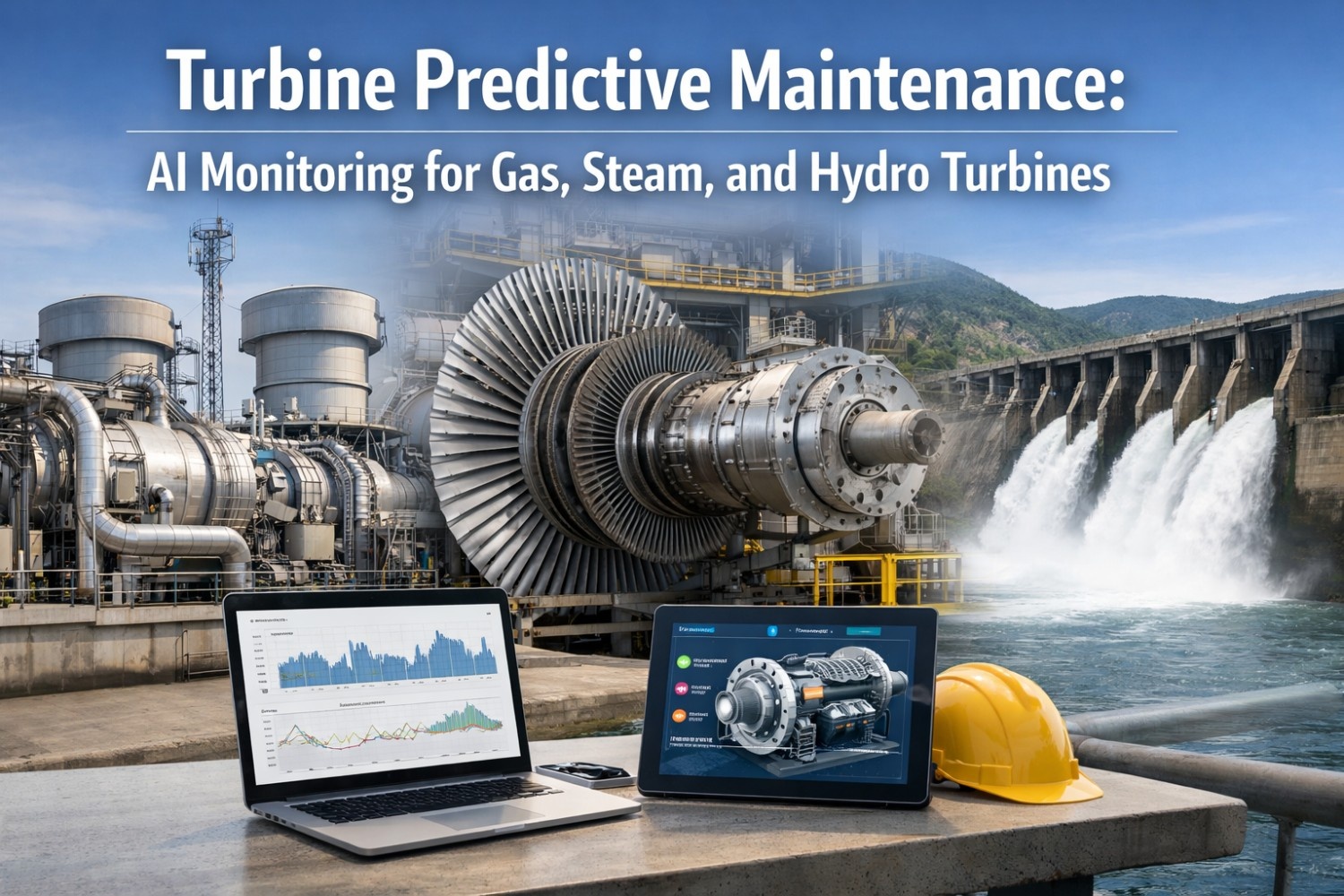
Turbine Predictive Maintenance: AI Monitoring for Gas, Steam, and Hydro Turbines

By shreen on March 9, 2026

turbine-predictive-maintaiance

A single unplanned turbine trip can cost a power plant $200,000 per day in lost generation, emergency repairs, and replacement power purchases. Across gas, steam, and hydro fleets worldwide, predictive AI monitoring is now preventing 40–70% of these failures — detecting bearing wear, blade fatigue, and rotor imbalance weeks before catastrophic breakdown. This guide covers the sensor technologies, AI models, and CMMS integration workflows that leading operators use to keep turbines running at peak availability. If your maintenance strategy still relies on fixed-interval overhauls and post-failure diagnostics, you are overspending and underperforming. Sign up free to connect your turbine fleet to iFactory's AI monitoring platform and start converting sensor data into maintenance intelligence today.

AI-Powered Turbine Intelligence for 2026

Turbine Predictive Maintenance

Real-Time AI Monitoring for Gas, Steam, and Hydro Turbines — From Sensor Data to Work Order Automation

70% Of turbine failures are predictable with continuous monitoring
45% Average reduction in unplanned turbine downtime
10:1 Typical ROI on predictive maintenance investment
6 mo Average payback period for AI monitoring deployment
Why This Matters Now
The global installed base of gas, steam, and hydro turbines exceeds 25,000 units — and the average age of the thermal fleet is climbing past 20 years. Aging turbines generate more frequent anomalies, but fixed-interval maintenance programs cannot adapt to individual asset degradation curves. AI monitoring fills this gap by learning each turbine's unique operating signature and flagging deviations that signal emerging failures. Operators who deploy AI-driven predictive maintenance report 30–45% reductions in total maintenance costs within the first 12 months — not from cutting corners, but from eliminating unnecessary overhauls and catching faults at their lowest-cost-to-fix stage.
Turbine Types and Failure Profiles

Why Each Turbine Type Needs a Different AI Monitoring Approach

Gas, steam, and hydro turbines fail in fundamentally different ways. Effective AI monitoring must be calibrated to the specific failure modes, operating environments, and degradation patterns of each turbine class.

Gas Turbines
Operating at temperatures exceeding 1,300°C and rotational speeds of 3,000–15,000 RPM, gas turbines face extreme thermal cycling, hot gas path degradation, and combustion dynamics instability. AI monitoring detects compressor fouling, combustion anomalies, and hot section creep progression weeks before performance deteriorates.
Hot gas path degradation Compressor fouling Combustion dynamics Bearing wear
$1.5M+ Average cost of an unplanned gas turbine overhaul
Steam Turbines
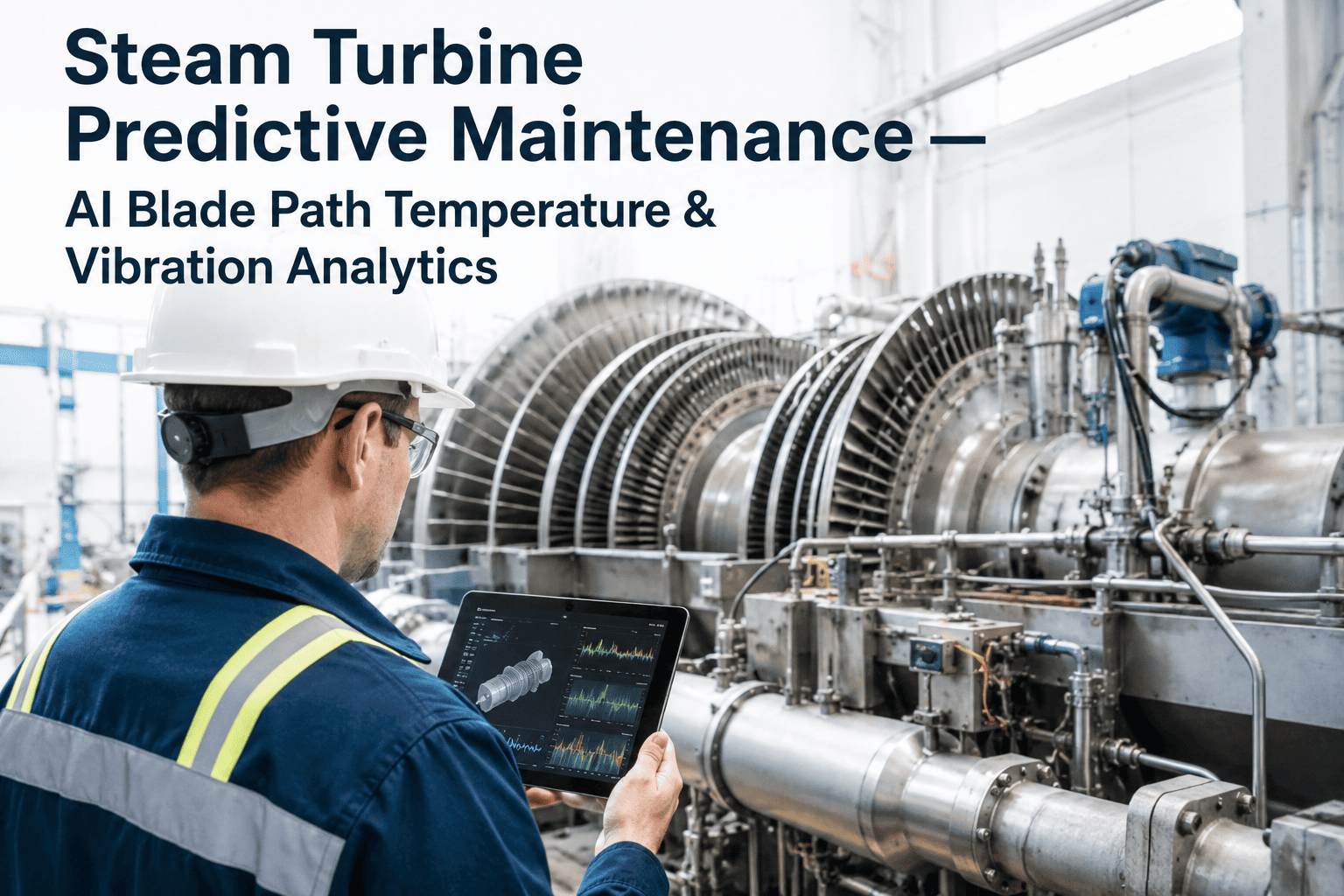
Steam turbines endure massive thermal stresses during startup and load changes. Blade erosion from wet steam, rotor bowing from uneven heating, and seal degradation are the primary failure drivers. AI models trained on exhaust temperature spreads and vibration spectra identify blade damage and rotor eccentricity long before manual inspection could detect them.
Blade erosion and fatigue Rotor bowing Seal degradation Thermal stress cracking
52% Of thermal plant outages originate from boiler-turbine systems
Hydro Turbines
Hydro turbines operate in harsh submerged environments where cavitation, sediment erosion, and wicket gate wear are constant threats. With lifespans exceeding 50 years, many units are now operating far beyond their original design parameters. AI monitoring tracks cavitation signatures, runner vibration patterns, and generator winding temperatures to prevent failures that could require complete unit dewatering and months of repair.
Cavitation damage Runner erosion Wicket gate wear Generator winding faults
50+ yr Average age of hydro fleet — far beyond original design life

Traditional vs. AI-Powered Turbine Maintenance

This comparison reflects documented outcomes from power plants that transitioned from calendar-based overhaul schedules to AI-integrated condition monitoring over a 12–24 month period.

Performance Dimension Comparison
Dimension Calendar-Based Overhauls AI Predictive Monitoring Impact
Failure Detection Lead Time 0 days (post-failure) 30–90 days advance notice Full predictive window
Unplanned Outage Rate Baseline (100%) 55–70% of baseline 30–45% reduction
Maintenance Cost per MW $15–18/MWh $9–12/MWh 30–40% lower
Overhaul Interval Extension Fixed OEM schedule Condition-based, 20–40% longer Significant deferral
Spare Parts Inventory High safety stock, emergency orders Demand-forecasted, lean inventory 25% inventory reduction
Mean Time to Repair 7–21 days (emergency scope) 2–5 days (planned scope) 70% faster
Turbine Availability 88–92% 95–98% 5–8% improvement
Compliance Documentation Manual logs, audit prep Automated, continuous records Near-zero audit prep
Monitoring Technology Stack

What AI Turbine Monitoring Actually Measures

Effective predictive maintenance requires continuous data from multiple sensor types working in concert. Each sensor layer detects a different class of failure mode — and AI correlates signals across all layers to produce accurate, actionable alerts.

Vibration Analysis
Accelerometers and proximity probes capture shaft displacement, bearing condition, blade pass frequencies, and rotor balance. AI models detect sub-millimeter changes in vibration signatures that indicate bearing race defects, blade fatigue cracks, and misalignment — typically 60–90 days before audible symptoms.
Detects: bearing wear, blade cracks, rotor imbalance, misalignment
Thermal Monitoring
Thermocouples, RTDs, and infrared sensors track exhaust temperature spreads, bearing oil temperatures, generator winding temperatures, and hot gas path component conditions. Temperature deviations as small as 5°C from baseline can signal developing combustion issues or cooling system failures.
Detects: hot spots, combustion anomalies, cooling failures, insulation breakdown
Oil Condition Analysis
Online oil particle counters and moisture sensors provide continuous insight into lubricant health. Metallic particle counts indicate gear mesh or bearing wear rates. Water contamination flags seal failures or cooler leaks. AI trending eliminates the delays of periodic lab analysis and catches degradation in real time.
Detects: gear wear, bearing degradation, seal leaks, contamination
Performance Analytics
AI models correlate power output, heat rate, pressure ratios, and flow rates against ambient conditions and load profiles. Deviations from expected performance curves reveal compressor fouling, turbine section efficiency losses, and control system malfunctions that do not trigger conventional alarms.
Detects: efficiency degradation, fouling, control issues, capacity loss
Acoustic Emission Monitoring
High-frequency acoustic sensors detect stress waves from crack propagation, cavitation events in hydro turbines, and partial discharge in generator windings. These ultrasonic signatures are invisible to vibration analysis and provide the earliest possible warning of structural failures.
Detects: crack growth, cavitation, partial discharge, stress fractures
SCADA and DCS Integration
AI ingests existing control system data — startup sequences, load ramp rates, trip logs, and alarm histories — to build operational context around sensor readings. This integration means no new hardware is required for the first layer of predictive intelligence on most turbines.
Detects: operational stress patterns, control anomalies, startup damage
See AI Turbine Monitoring in Action
Watch iFactory Detect a Bearing Defect 52 Days Before Scheduled Overhaul
In our 30-minute demo, we walk through real turbine monitoring data — vibration trend analysis, anomaly scoring, automated work order generation, and the ROI dashboard that quantifies every dollar saved from prevented failures.

How AI Turbine Monitoring Works: From Sensor to Work Order

This is the continuous intelligence loop that converts raw turbine data into prioritized maintenance actions — running 24/7 across every monitored unit in your fleet.


Step 01
Continuous Multi-Parameter Data Ingestion
Vibration, thermal, oil condition, acoustic emission, and SCADA data streams from every monitored turbine into the AI platform at intervals as short as 100ms. This creates a real-time digital health profile that no periodic inspection can replicate.

Step 02
Machine Learning Baseline and Anomaly Detection
AI models build unique behavioral baselines for each individual turbine — not generic OEM specs, but your specific unit running your specific fuel at your specific site conditions. Any deviation from baseline receives an anomaly score that improves in accuracy as operational history accumulates.

Step 03
Graded Alert Generation with Failure Mode Diagnosis
When anomaly scores breach defined thresholds, the platform generates graded alerts — informational, warning, or critical — with the predicted failure mode, estimated time to failure, and recommended intervention. Alerts are ranked by production impact and repair cost, ensuring the most consequential risks are addressed first.

Step 04
Automated Work Order and Outage Scheduling
The CMMS automatically generates a work order assigned to the right maintenance crew, pre-populated with the fault diagnosis, required tooling, safety procedures, and parts requirements. Repairs are scheduled during the next planned outage window — not as an emergency shutdown. The entire response cycle happens without a single manual touchpoint.

Documented Results from AI-Monitored Turbine Fleets

These figures represent verified outcomes from gas, steam, and hydro operators running AI predictive maintenance platforms for 12 months or more.

45%
Reduction in unplanned turbine outages
35%
Total maintenance cost reduction in year one
30%
Extension of major overhaul intervals
97%
Turbine fleet availability with predictive monitoring
Sign up free and start generating measurable results on your turbine fleet. Most operators detect their first actionable anomaly within 30 days of deployment.
The Financial Case

Why Every Prevented Turbine Trip Pays for Years of Monitoring

Cost of One Unplanned Gas Turbine Outage
Lost generation revenue (14 days) $840,000
Emergency repair and crane mobilization $520,000
Replacement power at spot market rates $380,000
Regulatory penalties and capacity fines $160,000
Total single-event cost $1.9M+
Cost of AI Monitoring That Prevents It
Annual AI platform subscription $60,000–$120,000
Sensor installation (one-time) $25,000–$50,000
Planned repair during next outage $80,000–$150,000
Revenue preserved (zero downtime) $840,000+
Net savings from one prevented event $1.5M+
We deployed iFactory's AI monitoring on our three gas turbine units after a $2.1 million forced outage. Within six months, the system caught a developing compressor blade crack 47 days before our next scheduled boroscope. The planned repair cost $85,000. Without the alert, we were looking at another $1M+ emergency overhaul. The platform paid for itself three times over on a single event. Our forced outage rate dropped 38% in the first year.
VP of Generation Operations Combined-Cycle Power Plant, Southeast U.S. — 800MW facility

iFactory Platform Capabilities for Turbine Fleets

Purpose-built for power generation — not a generic maintenance platform with turbine features bolted on. Sign up to explore the full feature set with your own turbine data.


Multi-Turbine Fleet Dashboard
Unified health view across gas, steam, and hydro units with asset-level anomaly scoring, fleet-wide trend comparisons, and drill-down to individual sensor readings — all from one interface.
Fleet Management

Automated Work Order Generation
Critical anomalies automatically generate prioritized work orders with fault diagnosis, repair procedures, required parts, and technician assignments — no manual intervention required.
Workflow Automation

Overhaul Optimization Engine
AI analyzes degradation rates to recommend optimal overhaul timing — extending intervals when condition data supports it, accelerating them when risk warrants early action.
Cost Optimization

Regulatory Compliance Engine
Timestamped, audit-ready maintenance records generated automatically. NERC GADS reporting, OSHA documentation, and insurance compliance records are always current and always complete.
Compliance

Start Preventing Turbine Failures This Quarter

iFactory AI Turbine Monitoring — Every Unit, Every Parameter, Full Visibility

iFactory gives power plant operators a unified AI monitoring platform that connects to your existing turbine instrumentation, detects failures weeks before they occur, automates work order generation, and delivers the compliance documentation your regulators require. No rip-and-replace. No lengthy commissioning. Connect your first turbine in under 10 minutes and start generating the intelligence that prevents unplanned outages.

AI anomaly detection across gas, steam, and hydro turbines
Automated work order generation and outage scheduling
Real-time cost impact dashboard and ROI tracking
NERC GADS and regulatory compliance documentation

Frequently Asked Questions

How quickly does AI turbine monitoring start delivering ROI?
Most operators identify their first actionable anomaly within 30–60 days of deploying continuous monitoring. Quick wins typically come from discovering turbines that are being over-maintained (allowing overhaul deferral) and catching one or two early-stage faults that would have become costly forced outages. Sign up free and connect your first turbine today — payback typically occurs after preventing just one event.
Does AI monitoring work with our existing control systems and instrumentation?
Yes. iFactory integrates with all major DCS and SCADA platforms including GE Mark VIe, Siemens T3000, ABB Symphony, Emerson Ovation, and Honeywell Experion. The first layer of predictive intelligence often requires zero new hardware — AI models learn from the sensor data your control system already collects. Additional sensors can be added incrementally for deeper monitoring as ROI is proven.
What types of turbine failures can AI detect that manual inspection misses?
AI catches the failure modes that develop gradually below human perception thresholds — early-stage bearing race defects (60–90 days before audible symptoms), compressor blade micro-cracks, rotor eccentricity from thermal bowing, generator winding insulation degradation, and seal wear causing efficiency losses. These conditions are nearly invisible to periodic boroscope inspections because symptoms only become obvious when damage is already severe.
Can AI monitoring extend the interval between major overhauls?
This is one of the highest-value outcomes. When continuous monitoring confirms that turbine components are still within acceptable degradation limits, operators can safely extend overhaul intervals by 20–40% beyond OEM recommendations. For a gas turbine where a hot gas path inspection costs $3–5 million, even a 6-month deferral represents significant capital reallocation. Sign up to see how condition-based overhaul scheduling works for your fleet.
How does AI monitoring handle different operating modes and load profiles?
This is where AI outperforms fixed-threshold alarms most dramatically. Machine learning models learn operational context — they understand that a gas turbine at full load on a 40°C day has a different normal vibration profile than the same turbine at 60% load in winter. Anomaly detection accounts for ambient temperature, load level, fuel type, and startup/shutdown transients, dramatically reducing false alarms while improving detection accuracy for genuine degradation.
What is the minimum fleet size where AI turbine monitoring makes financial sense?
There is no minimum fleet size. A single gas turbine generating $200,000+ per day of revenue justifies AI monitoring at virtually any cost. The business case depends on the cost of downtime per hour relative to the monitoring cost, not fleet size. Start with your highest-value or highest-risk unit and expand as you prove ROI. Book a demo to see the economics for your specific turbine configuration.

Share This Story, Choose Your Platform!