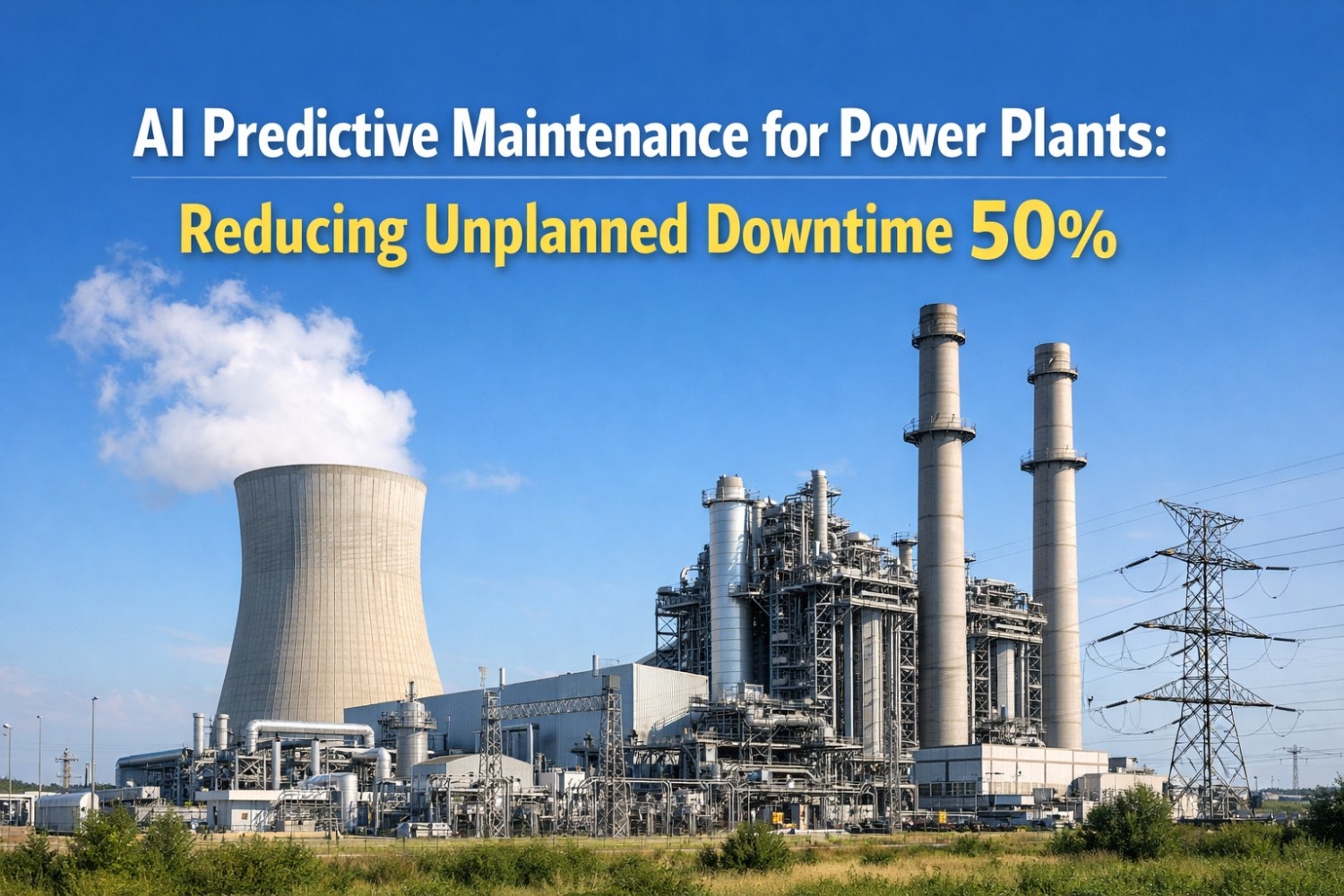
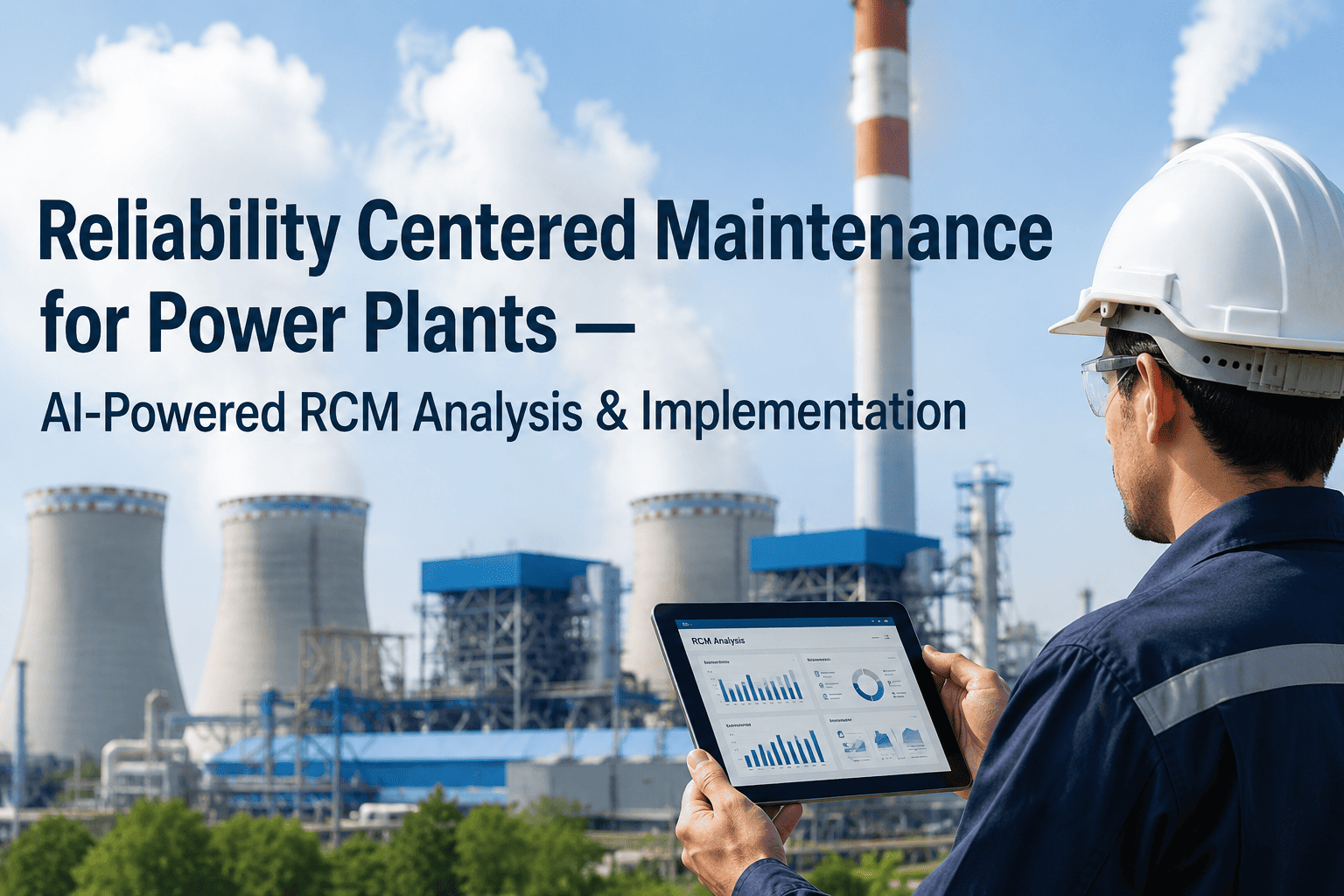
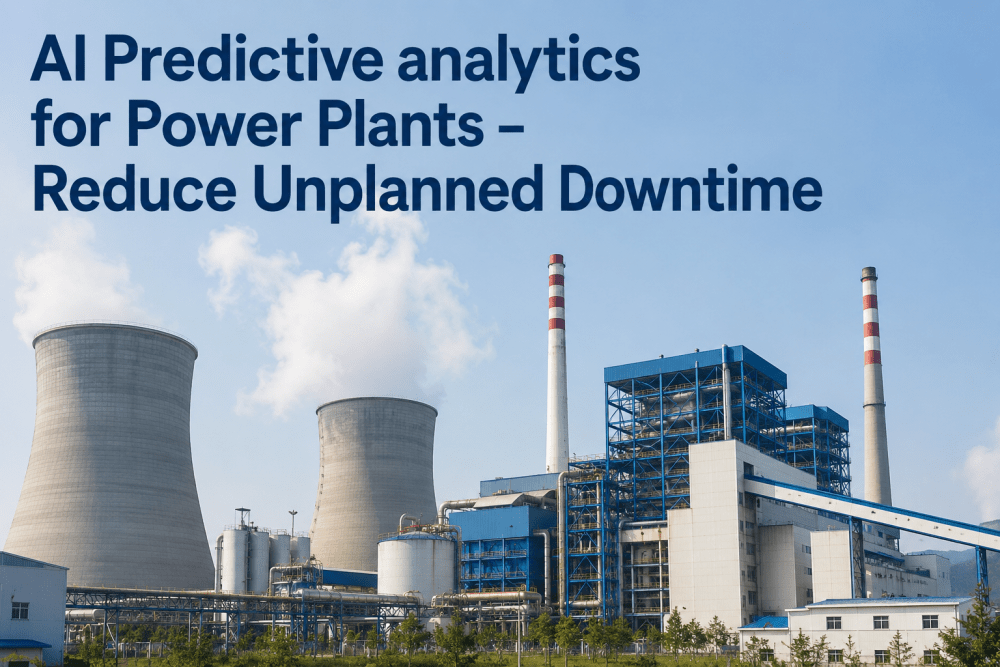
AI Predictive Maintenance for Power Plants: Reducing Unplanned Downtime 50%
By shreen on March 9, 2026
A single unplanned shutdown at a mid-size power plant burns through $200,000 per day in lost generation, emergency repairs, and replacement power purchases — and the average U.S. thermal plant now experiences 5–8 forced outages per year. AI-powered predictive maintenance is cutting that number in half for plants that deploy it, turning invisible equipment degradation into weeks of advance warning and converting emergency shutdowns into scheduled service windows. This guide breaks down exactly how AI predictive maintenance works inside power plants, which systems deliver the fastest ROI, and what real operators are reporting after 12+ months on AI-integrated platforms. Sign up free to connect your first critical assets and see where your plant is losing availability.
AI-Powered Plant Intelligence for 2026
Predictive Maintenance for Power Plants
Reduce Unplanned Downtime by 50% — From Boiler Tubes to Gas Turbines, One Platform Covers Every Critical Asset
50%
Reduction in Unplanned Downtime
10:1
Average ROI on Predictive Investment
$60M
Annual Savings — Single U.S. Utility Fleet
43%
Of Forced Outages Are Preventable
The Real Cost of Reactive Maintenance
What a Single 14-Day Forced Outage Costs a 500MW Plant
These are not theoretical estimates. This is the documented cost structure of one unplanned shutdown at a mid-size thermal generation unit — the kind of event that AI monitoring prevents 40–50% of the time.
Lost Generation Revenue$1,680,000
Emergency Repairs and Parts$520,000
Replacement Power Purchase$380,000
Regulatory and SAIFI Penalties$220,000
Total Financial Impact — One Event$2.8 Million
Why 2026 Is the Inflection Point
NERC's latest reliability report confirms forced outage metrics at their highest since 2021. Coal plant WEFOR rates now exceed 12%, gas plants cycle more aggressively than ever, and the average U.S. coal unit is 39 years old. At the same time, the cost of deploying AI condition monitoring has dropped below the cost of a single emergency turbine bearing replacement. The math now favors prevention at every plant size and fuel type — and every month you wait is another month of avoidable exposure to a seven-figure outage event.
Where Forced Outages Originate — and What AI Catches First
Focusing AI monitoring on the top three failure systems covers 77% of all mechanical forced outages. These are the components that produce detectable warning signals weeks before catastrophic breakdown — if you are listening.
52%
Boiler Tube Failures
Waterwall leaks, superheater and reheater tube damage, and economizer corrosion. The single largest cause of forced outages at thermal plants — driven by fatigue, creep, and thermal stress that AI vibration and acoustic sensors detect 30–60 days before rupture.
AI Detection: Acoustic emission + thermal anomaly
15%
Balance of Plant
Pumps, fans, valves, and auxiliary systems that keep the generation cycle running. These failures cascade quickly — a single feedwater pump trip can force a full unit shutdown within minutes. AI monitors current draw, vibration signatures, and pressure differentials continuously.
AI Detection: Vibration baseline deviation
13%
Steam Turbine
Blade fatigue, erosion, bearing wear, and rotor alignment drift. Turbine failures are the most expensive single-event outages — often exceeding $1M in repairs alone. AI models trained on your specific turbine's operational profile catch degradation months before critical thresholds.
AI Detection: Vibration spectrum + temperature trend
12%
Generator Issues
Winding insulation breakdown, rotor eccentricity, and cooling system degradation. Generator failures cause the longest outage durations because replacement components have 8–16 week lead times. Early detection is the only realistic mitigation strategy.
AI Detection: Partial discharge + thermal imaging
Head-to-Head Comparison
Reactive / Scheduled Only
What Most Plants Still Do
Run equipment until it fails or service it on fixed calendar intervals regardless of actual condition. Technicians respond to alarms, not predictions. Parts are procured at emergency premiums. The maintenance budget is consumed by firefighting instead of prevention — and every unplanned outage erodes availability metrics, capacity market standing, and regulatory compliance scores.
$17–18per HP/year maintenance cost
5–8forced outages per year average
0 daysfailure advance warning
AI Predictive Maintenance
What Leading Plants Are Doing Now
Continuous sensor monitoring feeds AI models that learn each asset's unique behavioral baseline. Anomalies are scored, alerts are prioritized by production impact, and work orders are generated automatically — assigned to the right technician with the right parts before the failure window opens. Maintenance shifts from reactive cost center to strategic availability driver.
$7–13per HP/year maintenance cost
2–4forced outages per year average
30–90 daysfailure advance warning
How It Works — From Sensor to Savings
The AI Predictive Maintenance Loop for Power Plants
This is the continuous cycle that converts raw equipment data into prevented outages and documented cost savings — running 24/7 across every connected asset in your generation fleet.
01
Continuous Data Ingestion
IoT sensors on turbines, boilers, generators, pumps, and auxiliaries stream vibration, temperature, pressure, acoustic, and electrical data at intervals as short as 100ms. The system integrates with existing DCS/SCADA feeds — no rip-and-replace required.
02
AI Baseline and Anomaly Scoring
Machine learning models build unique behavioral profiles for each individual asset — not generic OEM specs, but your specific turbine running your specific fuel at your specific load profile. Any deviation from baseline receives a severity-weighted anomaly score that improves with every hour of operational data.
03
Prioritized Alert Generation
When anomaly scores breach thresholds, the platform generates graded alerts — informational, warning, or critical — with predicted failure mode, estimated time to failure, and recommended intervention. Alerts are ranked by generation impact so your team addresses the costliest risks first, not just the newest notification.
04
Automated Work Order and Parts Trigger
The CMMS automatically generates a work order assigned to the right technician, pre-loaded with fault diagnosis, required tools, safety procedures, and a parts request. If the part is not in stock, procurement receives a purchase request at standard lead time — not overnight emergency pricing. The entire response cycle happens without a manual touchpoint.
See It Working on Real Plant Data
Watch iFactory Detect a Turbine Bearing Anomaly 52 Days Before Failure
In our 30-minute demo, we walk through the full Monitor–Score–Alert–Act loop using actual generation facility data. You will see anomaly scoring in real time, automated work order creation, and the cost-avoidance dashboard that quantifies every prevented outage in dollars — not estimates.
Reactive vs. AI Predictive: What the Numbers Show Across 12 Months
This comparison reflects documented outcomes from thermal and combined-cycle power plants that transitioned from manual or scheduled-only maintenance to AI-integrated predictive platforms.
Performance Comparison — 500MW Generation Unit
Metric
Reactive / Scheduled
AI Predictive
Impact
Forced Outage Rate (EFOR)
10–12% (coal) / 3–5% (gas)
5–6% (coal) / 1.5–2.5% (gas)
50% reduction
Mean Time to Repair
8–14 days average
3–5 days average
60% faster
Maintenance Cost per MW
Baseline (100%)
65–75% of baseline
25–35% lower
Emergency Parts Orders
Frequent, +40% premium
Rare, standard lead time
70% fewer rush orders
Failure Detection Window
0 days (reactive)
30–90 days advance notice
Full lead-time advantage
Availability Factor
85–90%
93–97%
5–8 point gain
Compliance Documentation
Manual, audit-risk
Automated, NERC-ready
Near-zero audit prep
Annual Cost Avoidance (500MW)
—
$2M–$6M per unit
Documented savings
Documented Results from AI-Powered Generation Facilities
These figures are drawn from utilities and independent power producers operating AI predictive maintenance platforms for 12 months or more — verified across coal, gas, and combined-cycle fleets.
50%
Reduction in forced outage events
36%
Unplanned outage reduction — Duke Energy fleet
30%
Overall maintenance cost reduction
95%
Of adopters report positive ROI within 18 months
Sign up free and start building your plant's equipment baselines today. Most facilities detect their first actionable anomaly within the first 30 days of sensor deployment.
What iFactory Monitors Across Your Generation Fleet
One platform, every critical asset class. iFactory deploys sensor intelligence and AI analytics across the full range of power plant equipment — with pre-built models for the failure modes that cause 90%+ of forced outages.
Gas and Steam Turbines
Vibration spectrum analysis, bearing temperature trending, blade path monitoring, and rotor alignment tracking with 30–90 day failure prediction windows.
Partial discharge monitoring for winding insulation health, stator and rotor vibration analysis, and hydrogen cooling system integrity tracking — the components with the longest replacement lead times in any plant.
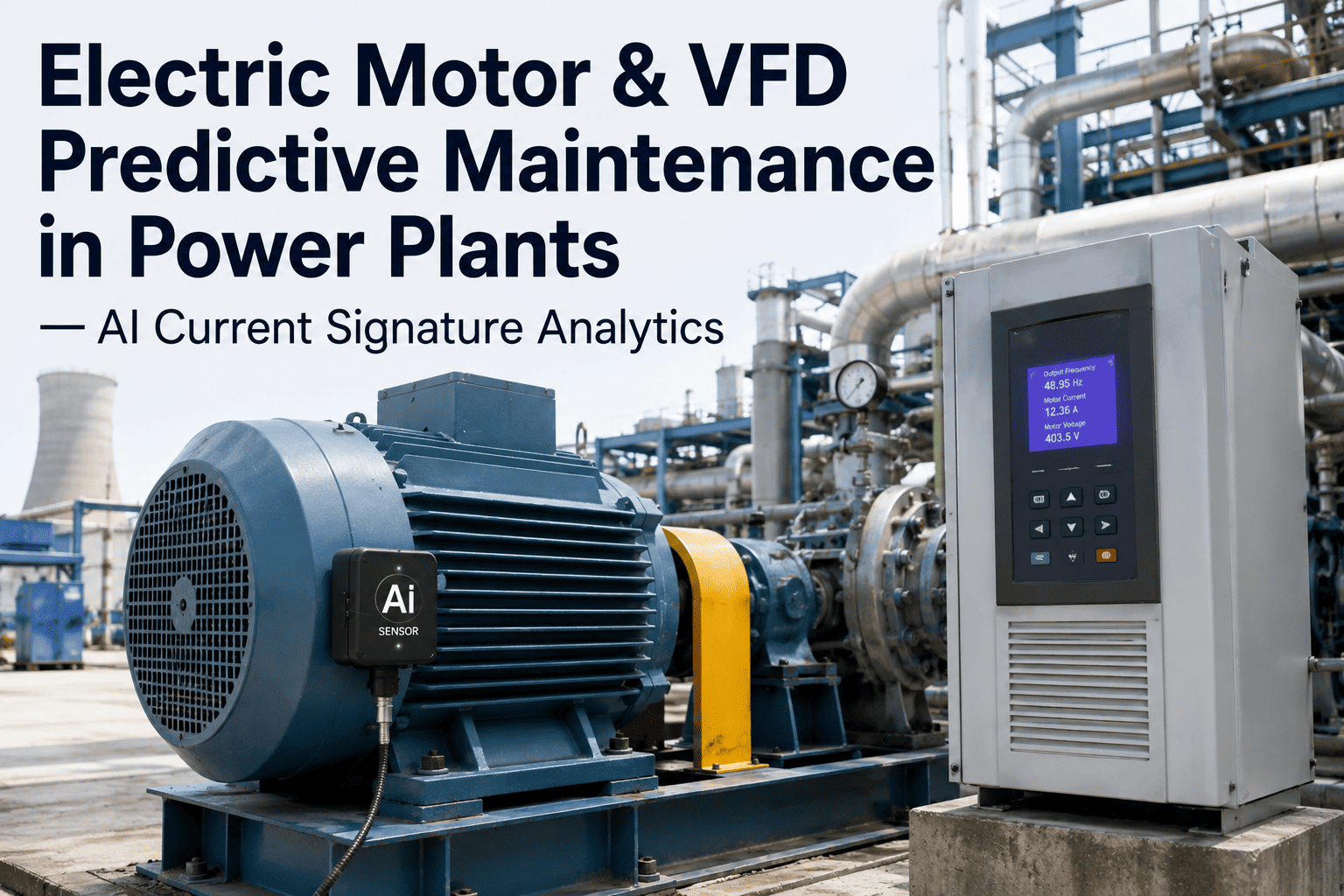
Feedwater pumps, condensate systems, fans, and valve actuators — the auxiliary equipment that causes 15% of forced outages. Current draw monitoring and vibration baselines catch bearing wear and impeller degradation months early.
Prevents: Pump trips, fan failures, valve seizure
HRSG and Heat Exchangers
Combined-cycle heat recovery steam generators monitored for tube fouling, attemperator spray valve cycling, and stack temperature anomalies that indicate efficiency degradation or imminent tube failure.
Prevents: HRSG tube leaks, thermal fatigue, efficiency loss
Compliance and Reporting
Every sensor reading, anomaly score, alert, and work order is logged with timestamps for full NERC GADS compliance. Audit-ready reports are generated automatically — eliminating the documentation burden that consumes 15–20% of maintenance managers' time.
Delivers: NERC-ready records, SAIFI documentation
We deployed AI monitoring on our two combined-cycle units and three legacy steam turbines. In the first eight months, the platform caught a generator rotor eccentricity trend that would have resulted in a 21-day forced outage and $1.4M in repair costs. We scheduled the repair during a planned maintenance window at a fraction of the cost. The system has also cut our emergency parts orders by 65%. We were targeting a 30% outage reduction — we hit 47% in year one.
VP of Generation OperationsIndependent Power Producer — 1,200MW Combined Fleet, Southeast U.S.
The Hidden Multiplier: How Outage Costs Escalate Hour by Hour
Direct repair costs are just the visible portion. Every hour of unplanned downtime triggers a cascade of escalating financial penalties that AI monitoring prevents by converting emergency events into planned interventions.
Hour 0
Unit Trips Offline
Revenue loss begins immediately — $5,000–$10,000/hour for a 500MW unit
Hour 4
Spot Power Procurement Activated
$85,000/day at premium market rates to fulfill delivery obligations
Day 2
Emergency Parts Rush Orders
+40% premium on expedited components — if available at all
Day 7
Contract Non-Delivery Penalties Activate
$50,000/day in PPA or capacity market fines
Day 14+
SAIFI Regulatory Fines and Reputation Damage
$100,000–$1,000,000 per incident + long-term capacity auction impact
Frequently Asked Questions
How quickly does AI predictive maintenance start preventing outages?
Most plants identify their first actionable anomaly within 30–60 days of deploying continuous monitoring. The quick wins come from two sources: discovering assets being over-maintained on fixed schedules that can be safely stretched, and catching early-stage degradation trends that would have become forced outages within the quarter. Sign up free and connect your first critical assets today — baseline data begins building immediately.
What is the ROI timeline for AI maintenance in power plants?
95% of adopters report positive ROI within 18 months. For most plants, payback occurs after preventing just one major forced outage — an event that typically costs $1M–$3M. A large U.S. utility deploying AI across 67 generation units documented $60M in annual savings. The DOE estimates predictive maintenance eliminates 70–75% of equipment breakdowns entirely.
Does AI monitoring integrate with our existing DCS and SCADA systems?
Yes. Modern AI platforms including iFactory are designed for integration, not replacement. Standard protocols (OPC-UA, Modbus, PI Historian connectors) allow sensor intelligence to layer on top of your existing control systems. Your operators keep their familiar interfaces while gaining predictive analytics and automated work order generation underneath. Book a demo to see integration options for your plant's specific architecture.
Which equipment should we monitor first for maximum impact?
Start with turbines, boilers, and generators — the three asset categories responsible for 77% of all mechanical forced outages. Within boilers, prioritize waterwall tubes, superheaters, and reheaters. For turbines, focus on bearings, blades, and shaft alignment. This targeted deployment delivers the fastest ROI while building the data foundation for expanding to auxiliary systems.
Do we need to replace our maintenance team with AI?
No — and this misconception costs plants that delay adoption. AI predictive maintenance amplifies your team's effectiveness. Technicians gain hours back from low-value scheduled rounds and shift that time to high-impact interventions that actually prevent failures. The AI provides intelligence and priority ranking; humans provide judgment, physical access, and execution. Plants consistently report higher technician satisfaction after adoption because work becomes purposeful rather than reactive.
How does AI handle cycling and variable load operations?
This is where AI outperforms fixed-schedule maintenance most dramatically. Machine learning models learn operating context — they understand that a gas turbine at 95% load during a summer peak has a different normal vibration profile than the same unit at 40% load during shoulder season. Anomaly detection accounts for load, ambient conditions, and cycling patterns, dramatically reducing false alarms while improving detection accuracy for genuine degradation. Sign up to see how iFactory adapts to your plant's specific operating profile.
Stop Paying the Price of Unplanned Outages
iFactory AI Predictive Maintenance — One Platform, Every Generation Asset, Full Visibility
iFactory gives power plant operators a unified AI maintenance platform that connects to your existing DCS/SCADA infrastructure, detects equipment degradation weeks before failure, automates work order generation, and delivers the NERC-compliant documentation your regulators require. No rip-and-replace. No 18-month implementation. Connect your first critical assets in under 10 minutes and start building the data foundation that cuts forced outages in half.
AI anomaly detection across turbines, boilers, generators, and BOP
Automated work orders with fault diagnosis and parts procurement
Real-time cost-avoidance dashboard and availability tracking
NERC GADS compliant documentation generated automatically