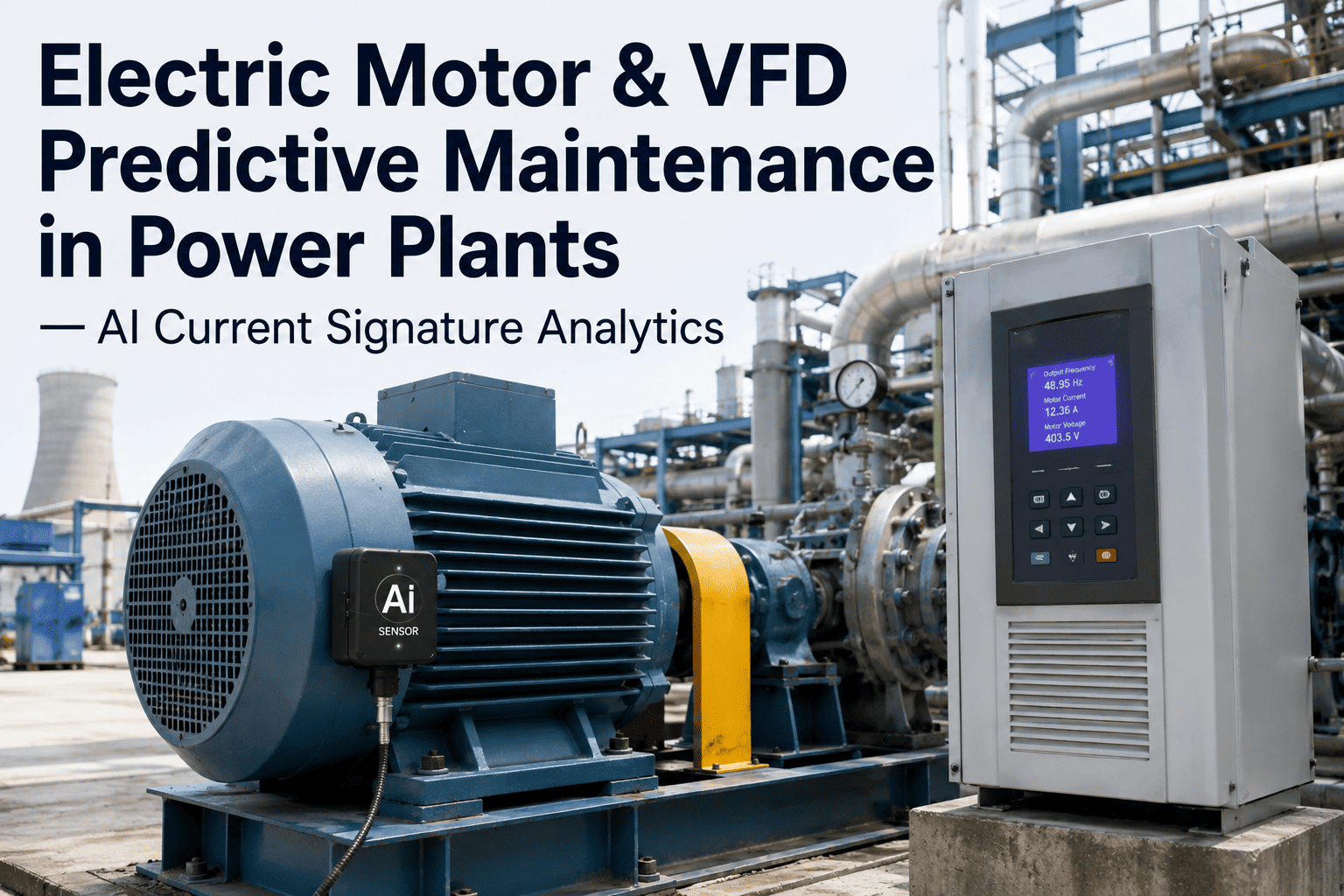
Somewhere between 45 and 60 percent of the electricity a power plant consumes internally is spent driving electric motors — pumps, fans, conveyors, compressors, and mills all run on them, and most plants have hundreds of these motors sitting on switchgear and MCC buses with no continuous health monitoring at all. Industry data shows the majority of motor failures are only detected after the motor has already stopped, turning a bearing fault or a cracked rotor bar into an unplanned trip. The current every motor draws carries a complete diagnostic signature of its internal condition, and that signature can be read without ever touching the motor shaft. See how current-based diagnostics work for your fleet at iFactory.
AI-Driven · Motor Current Signature Analysis · MCC & VFD Diagnostics
Electric Motor & VFD Predictive Maintenance: Detect Rotor Bar, Bearing, and Winding Faults From the Current Signal Alone
iFactory's AI-driven current signature analysis monitors every AC induction motor and VFD-driven drive from the MCC — no shaft sensors, no scheduled downtime for installation — catching rotor bar cracks, bearing degradation, and stator winding faults weeks before a motor stops running.
82%
Of industrial motor failures detected only after the motor has already stopped running
$15K–$50K
Typical cost per unplanned motor failure incident, including production impact
60–70%
Reduction in unplanned motor failures reported by facilities using current-based condition monitoring
Reading the Current Signature
Every Motor Fault Leaves a Fingerprint in the Current Waveform — Here's the Detection Window for Each One
Motor current signature analysis identifies characteristic frequency patterns in the stator current spectrum that correspond to specific mechanical and electrical faults, each with its own typical warning window before failure.
Broken Rotor Bar
8–10 weeks ahead
Bearing Defect Signature
4–6 weeks ahead
Air Gap Eccentricity
Detected at onset, tracked to severity
Stator Winding Degradation
Trended continuously before fault escalation
Shaft Misalignment
Confirmed with vibration cross-check
Why MCSA Over Vibration Alone
No Shaft Sensors. No Downtime to Install. Full Fleet Coverage From the Switchgear Room.
Sensorless Installation
Current sensors connect at the motor control center or VFD output rather than on the motor itself, meaning hundreds of motors across the plant can be brought under monitoring without accessing a single shaft or bearing housing.
Earlier Than Vibration Alone
Rotor bar cracks and stator winding faults are electrical in nature and often show up in the current spectrum before they produce a vibration signature large enough for a standard vibration route to catch.
Works Through the VFD
Motors driven by variable frequency drives can be monitored using the drive's own current feedback, extending diagnostic coverage to auxiliary and process motors that were previously outside any monitoring program.
Runs While the Motor Runs
Analysis is performed online while the motor operates normally, so there is no need to schedule downtime, remove the motor, or interrupt production to collect a diagnostic reading.
Hundreds of Motors. One Current-Based Health Record for Every One of Them.
iFactory brings AI-driven MCSA to your full motor fleet — critical drives and auxiliary motors alike — without new shaft hardware or planned downtime for installation.
Field Case
A Boiler Feedwater Pump Motor Caught Weeks Before Rotor Bar Failure
A thermal power plant implemented current signature analysis to monitor its boiler feedwater pump motors, a set of critical assets running continuously with no tolerance for unplanned stoppage. Within weeks of deployment, the current-based analysis detected early signs of rotor bar degradation developing in one of the motors — a fault type that would not typically be visible until vibration levels rose enough to trigger a conventional alarm. Because the deviation was caught while the motor was still fully operational, the plant was able to schedule a planned replacement during an available maintenance window rather than reacting to a failure. The proactive replacement avoided a costly unplanned shutdown of a critical feedwater asset, saving the plant more than $100,000 in potential downtime and repair costs from that single early detection.
$100K+Downtime and repair cost avoided
WeeksAdvance warning before failure
1Planned replacement instead of forced outage
Before vs. After
Motor Fleet Reliability — Reactive Repairs vs. iFactory Current Signature Analysis
Fault Type
Without Current Analytics
With iFactory MCSA
Rotor Bar Cracks
Discovered when the motor trips or fails to start under load, mid-shift
Sideband amplitude trend flags crack propagation 8–10 weeks ahead
Bearing Degradation
Caught by a vibration route or heard as noise once wear is already advanced
Current modulation at bearing frequencies flags defect 4–6 weeks earlier
Stator Winding Faults
Identified only after insulation breakdown causes a ground fault trip
Negative-sequence current trend flags degradation before fault escalation
Monitoring Coverage
Limited to the handful of critical motors on a scheduled vibration route
Every motor on the MCC or VFD bus monitored continuously from one point
Measured Outcomes
What Maintenance Teams See After Deploying Current Signature Analysis
60–70%
Fewer Unplanned Motor Failures
Facilities combining MCSA with CMMS-integrated condition monitoring report reductions in this range within the first year.
35–45%
Lower Motor Maintenance Cost
Condition-based replacement schedules cut unnecessary teardown and parts spend on motors that were still healthy.
8–10 wks
Rotor Bar Fault Lead Time
Sideband amplitude ratio trending in the current spectrum surfaces rotor bar cracks this far ahead of adjacent-bar propagation.
Zero
New Sensors on the Shaft
Diagnostics run entirely from current sensors at the MCC or VFD, with no installation downtime required per motor.
Frequently Asked Questions
Motor & VFD Predictive Maintenance — What Maintenance Managers Ask First
Do we need to stop the motor or access the shaft to install current signature monitoring?
No. Current sensors are installed at the motor control center or at the VFD output rather than on the motor itself, which means monitoring can be added to a running motor without any shaft access, coupling disassembly, or scheduled downtime for installation. This is one of the primary advantages of current-based diagnostics over vibration monitoring, which typically requires mounting an accelerometer directly on the motor bearing housing. For plants with hundreds of motors across multiple MCC buses, this sensorless approach is what makes full-fleet coverage practical rather than limited to a handful of critical assets.
Contact support to review your MCC configuration.
Can iFactory monitor motors that run on variable frequency drives?
Yes. For VFD-driven motors, iFactory analyzes the current feedback already available from the drive itself, extending the same fault detection capability — rotor bar defects, bearing degradation, eccentricity, and winding faults — to motors that operate at variable speed. The analysis accounts for the changing fundamental frequency and slip conditions that come with variable speed operation, which a fixed-frequency current analysis method would not handle correctly. This means auxiliary and process motors running on VFDs, which are often excluded from vibration-based monitoring programs, can be brought into the same fleet-wide health record.
How does current signature analysis compare to vibration monitoring for motor diagnostics?
Vibration analysis and current signature analysis detect overlapping but not identical fault types, and the two methods are complementary rather than substitutes for each other. Electrical faults such as rotor bar cracks, stator winding degradation, and air gap eccentricity often appear in the current spectrum earlier than they produce a vibration signature large enough to register on a standard route. Mechanical faults such as shaft misalignment are typically confirmed more reliably with vibration data. iFactory uses current analysis as the primary continuous monitoring layer across the full motor fleet and cross-references vibration data where it is available for additional confirmation on critical assets.
How many motors can be monitored from a single current sensor installation point?
Coverage depends on the electrical configuration of the MCC or switchgear, but current sensors installed on individual motor feeder circuits can bring an entire bus of motors under monitoring from a single point of physical access, rather than requiring separate sensor installation at each individual motor. This is a significant part of why current-based monitoring scales more cost-effectively across a plant with hundreds of motors than vibration monitoring, which requires an accelerometer at each bearing location being tracked.
Book a Demo to scope coverage for your specific MCC layout.
How long does it take to get motor current analytics running across the plant?
For a standard MCC configuration, iFactory's current signature analysis module goes live in 10 to 14 days, covering current sensor installation at the feeder or MCC level, baseline configuration for each motor using nameplate data and available run history, and validation of fault-frequency detection against known operating conditions. Larger plants with multiple MCC rooms or a mix of fixed-speed and VFD-driven motors typically take a few additional weeks to bring full fleet coverage online, with baseline profiling running concurrently with the installation work rather than extending the timeline.
Every Motor in Your Plant Is Already Telling You Its Condition Through the Current It Draws.
AI-driven current signature analysis for rotor bar, bearing, winding, and eccentricity faults — sensorless, running while the motor runs, and live across your fleet in as little as 10 days.