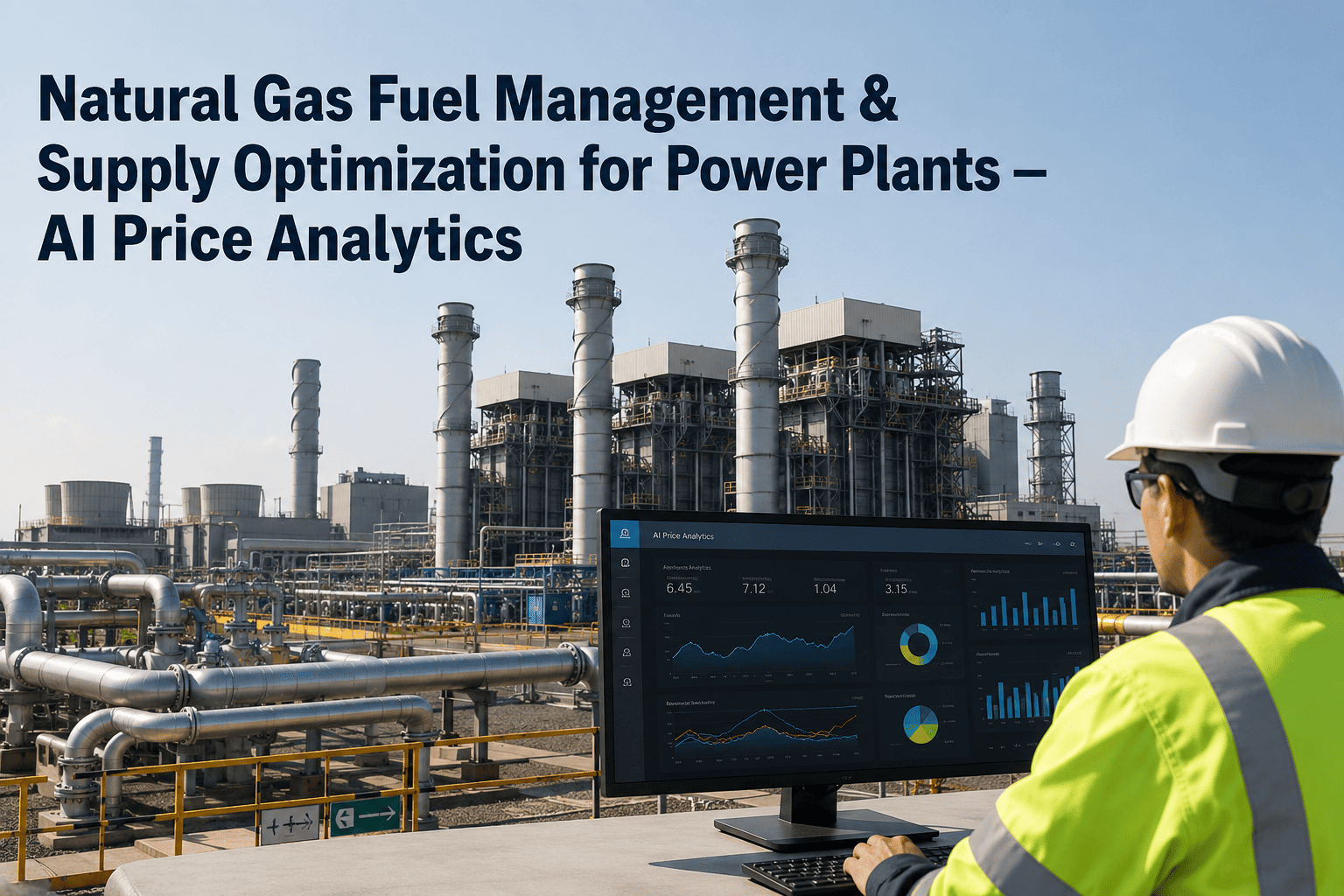
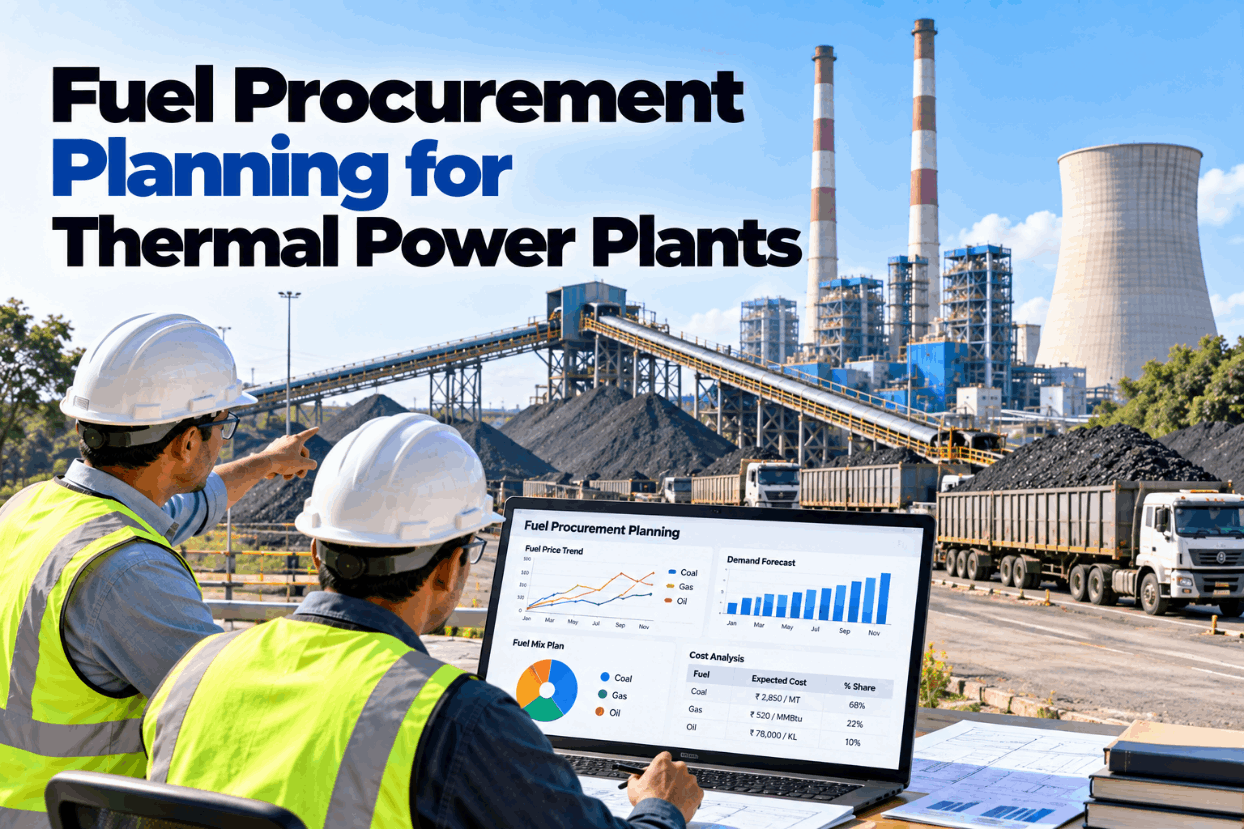
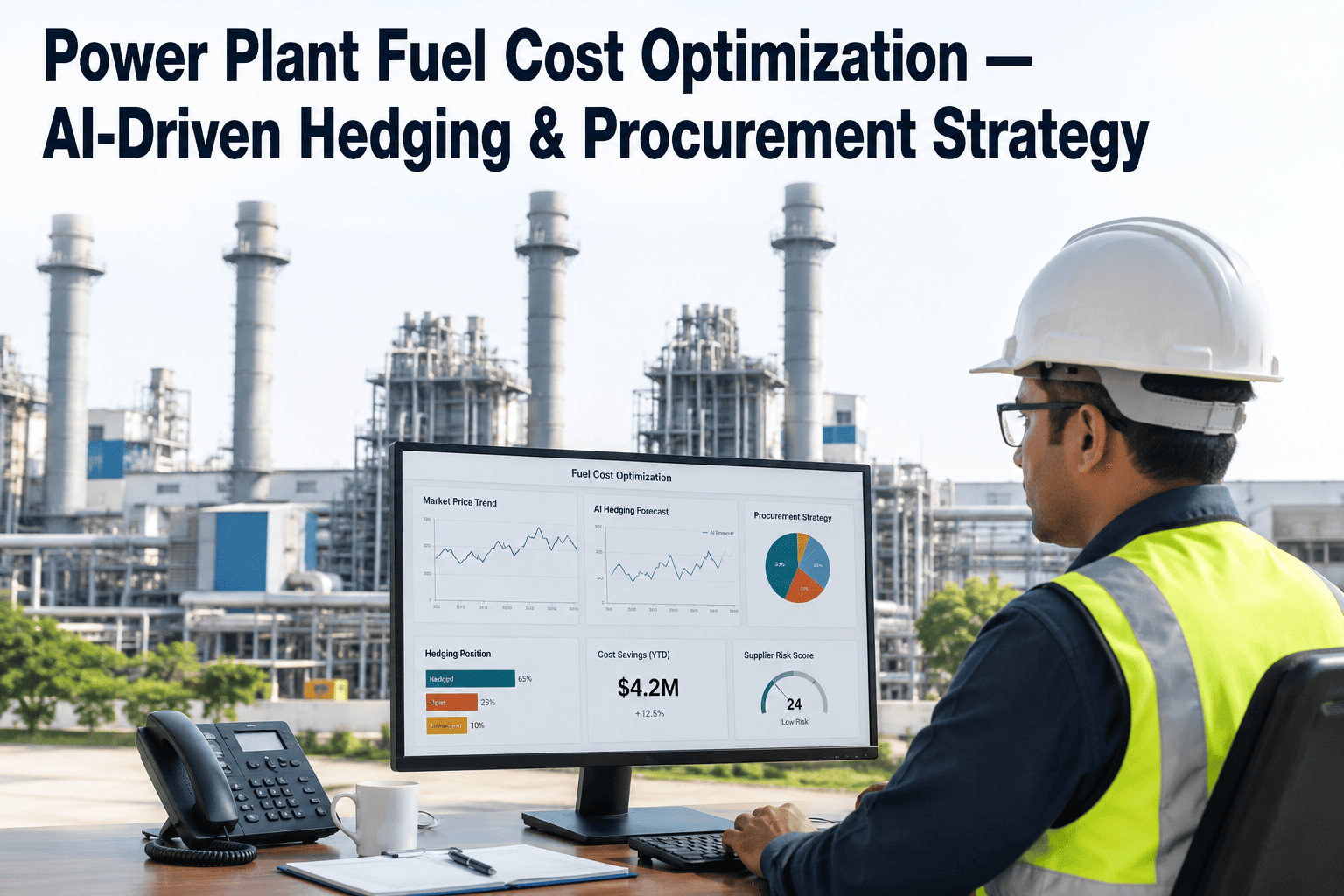
Natural gas is the single largest line item on most gas-fired power plant operating budgets — fuel alone accounts for more than half the cost of every megawatt-hour produced. Yet at many plants, the fuel procurement workflow still runs on spreadsheets, phone calls, and gut instinct: a trader locks in a price based on yesterday's market read, a scheduler manually enters nomination volumes across five daily pipeline cycles, and nobody finds out about a constraint upstream until the pipeline operator cuts the scheduled flow and the plant scrambles for backup supply. Every hour spent reacting instead of anticipating is margin lost to a market that moves faster than manual processes can follow. AI-driven fuel management replaces that reactive loop with continuous price forecasting, automated nomination optimization, and real-time pipeline monitoring — book a demo to see it working against your own supply data.
Fuel Management · AI Analytics
AI-Powered Natural Gas Fuel Management for Power Plants
Forecast price swings before they hit your P&L, automate nomination scheduling across every pipeline cycle, and catch supply constraints before they become generation shortfalls.
50-63%
Share of total plant operating cost attributable to fuel procurement
5 Cycles
Daily FERC nomination windows that schedulers must manage manually
8-12%
Typical fuel cost savings reported after switching to AI-optimized procurement
Where Your Operating Budget Actually Goes
For a combined-cycle gas plant, fuel is not just the biggest expense — it dwarfs everything else combined. Capital recovery, staffing, maintenance, emissions compliance, and water treatment together rarely exceed what the plant spends buying and transporting natural gas in a single year. That makes fuel procurement the highest-leverage optimization target on the entire balance sheet.
Fuel Procurement
55%
Capital
22%
O&M
15%
Other
8%
Approximate cost distribution for a 500 MW combined-cycle gas plant at current Henry Hub pricing levels
Five Nomination Cycles, Five Chances to Get It Wrong
FERC-regulated pipelines operate on a strict daily schedule of nomination windows. Each cycle is a deadline a scheduler cannot miss, a volume that must match actual plant burn, and an opportunity to either optimize transportation costs or eat an expensive imbalance penalty. Most scheduling desks still manage this with spreadsheets and manual pipeline portal entries.
Timely Cycle
Primary day-ahead nomination. The scheduler forecasts tomorrow's burn based on dispatch schedules and weather, then submits volumes to every pipeline serving the plant.
Evening Cycle
First revision window. Updated load forecasts and market changes require adjustments before gas day begins. Interruptible nominations can be bumped here.
Intraday 1
Gas is already flowing. Actual burn diverges from the forecast, and the scheduler races to adjust nominations before the confirmation deadline at 2:30 PM.
Intraday 2
Second intraday correction. If a turbine trips or load changes sharply, volumes must be rebalanced before the window closes and remaining capacity is locked.
Intraday 3
Final no-bump cycle. Last chance to fine-tune for the remainder of the gas day. Any imbalance left after this window becomes a settlement penalty.
AI automates volume calculations across all five cycles, continuously recalculating nominations against real-time plant burn, weather shifts, and pipeline capacity data — replacing manual spreadsheet work with optimized, deadline-aware submissions.
A scheduler managing five overlapping deadlines on spreadsheets is one missed cycle away from an imbalance penalty. AI nomination optimization runs continuously, recalculating volumes the moment plant conditions or pipeline capacity change, and submitting before every deadline without human intervention.
What AI Watches Inside Your Fuel Supply Chain
The system ingests data from pipeline electronic bulletin boards, SCADA flows, weather services, ISO dispatch signals, and wholesale gas indices — then translates all of it into actionable decisions before your scheduling team even opens their first spreadsheet of the day.
Price Forecasting
Predictive
LSTM neural networks trained on years of Henry Hub, regional basis, and hub-to-burner-tip spread data generate multi-day price forecasts. The model adapts to geopolitical supply shocks, LNG export demand shifts, and seasonal storage patterns — giving procurement teams a forward view that manual market-watching cannot match.
Nomination Optimization
Automated
The optimizer calculates the least-cost transportation path across firm, secondary, and interruptible capacity tiers, factors in fuel loss rates published by each pipeline, and auto-submits nominations timed to each FERC cycle deadline. When plant burn deviates from forecast, intraday corrections are recalculated and resubmitted without manual intervention.
Pipeline Constraint Alerts
Real-Time
Continuous scraping of pipeline EBB postings and operational flow orders flags maintenance events, force majeure declarations, and capacity restrictions before they result in nomination cuts. The system re-routes supply through alternate receipt points or triggers spot purchases to maintain uninterrupted fuel delivery.
Imbalance Prevention
Continuous
Real-time comparison of metered gas flow against scheduled delivery volumes catches developing imbalances before the settlement window closes. The system recommends volume adjustments or park-and-loan transactions to keep the plant within tolerance and avoid cash-out penalties at end of month.
Manual Fuel Management vs. AI-Optimized Procurement
Turnkey AI Deployment — Rack It, Plug It, Optimize
Every fuel management AI deployment ships as a pre-configured hardware-and-software bundle: a rack-mounted NVIDIA AI server with all optimization, forecasting, and pipeline monitoring software pre-loaded and tested before it leaves the facility. Your team does not need to build anything from scratch.
Phase 1
Weeks 1-2
Site Assessment
Map existing SCADA, historian, pipeline contracts, and nomination workflows. Identify data feeds for price indices, EBB postings, and ISO dispatch signals.
Phase 2
Weeks 3-6
Integration and Training
Rack the server, connect power and Ethernet, integrate with plant historian and pipeline portals. Train forecasting models on your historical gas purchase and burn data.
Phase 3
Weeks 7-12
Live Optimization
AI goes live in advisory mode, then transitions to automated nomination and procurement recommendations. Operator training and 24/7 remote monitoring included.
Gas prices spiked overnight and our evening nomination locked in volumes at yesterday's rate. What should I do for the ID1 cycle?
Your ID1 window opens at 10:00 AM. Based on current spot pricing and your turbine load forecast, I recommend reducing your scheduled volume by 1,200 dekatherms and shifting to your secondary firm capacity on the alternate pipeline — the basis differential saves $0.18/MMBtu. I have pre-staged the nomination for your review. Approve to auto-submit before the 10:00 AM deadline.
1,000+
Clients across industrial operations
99.9%
Platform uptime guarantee
6-12 Wks
From rack to live optimization
Expert Insight
The plants that treat fuel procurement as a back-office function are the ones that bleed the most margin. Natural gas is not a commodity you set and forget — it is a volatile, time-sensitive input that changes price multiple times a day, moves through pipelines with capacity limits, and penalizes you financially when your nominations do not match your burn. The operations directors I work with who have moved to AI-optimized procurement do not just save on fuel cost — they stop losing money on imbalance penalties, they catch pipeline constraints before the cuts hit, and they finally have a forward view of price risk instead of reacting to yesterday's index every morning.
Sandra Okonkwo — Energy Procurement Strategist, 16 years advising gas-fired generators on fuel supply optimization and pipeline risk
Frequently Asked Questions
How does the AI price forecasting model work, and what data does it use?
The forecasting engine uses long short-term memory (LSTM) neural networks trained on historical Henry Hub spot prices, regional basis differentials, LNG export volumes, storage injection and withdrawal reports, and weather data. It generates multi-day forward price curves with confidence intervals, allowing procurement teams to time purchases during predicted price troughs rather than locking in at the morning index. The model retrains continuously as new market data arrives, adapting to seasonal patterns, geopolitical shifts, and demand-side changes like data center buildouts that are reshaping gas market fundamentals.
Book a demo to see a live forecast running against your regional pricing basin.
Can the system integrate with our existing pipeline nomination portals?
Yes. The platform connects to major interstate pipeline electronic nomination systems and electronic bulletin boards through standard API and EDI interfaces. It reads your existing firm and interruptible transportation contracts, maps receipt and delivery points, and calculates fuel loss rates published by each pipeline. Nominations are pre-staged for each FERC cycle and can be submitted automatically or held for scheduler approval before the deadline. The goal is to replace the manual spreadsheet-to-portal workflow without requiring your scheduling team to learn a new system from scratch.
Contact support to discuss integration with your specific pipeline operators.
What happens when a pipeline posts a constraint or force majeure?
The system continuously monitors electronic bulletin board postings from every pipeline in your supply path. When an operational flow order, maintenance event, or force majeure is posted, the platform immediately evaluates the impact on your scheduled volumes, identifies alternate receipt or delivery points with available capacity, and recalculates nominations to maintain supply. If no alternate pipeline path exists, it triggers a spot purchase recommendation on the next available pricing window. The entire response happens within minutes of the posting, well ahead of the next nomination cycle deadline.
Book a demo to walk through a constraint scenario using your actual pipeline network.
How does the platform reduce imbalance penalties?
Imbalance penalties occur when actual gas consumption does not match scheduled delivery volumes over a settlement period — hourly, daily, or monthly depending on the pipeline. The platform compares metered gas flow against nominations in real time, calculates the developing imbalance position, and recommends corrective actions during the intraday nomination cycles before the settlement window closes. For plants with park-and-loan agreements, it can also stage storage transactions to absorb temporary mismatches. The result is a tighter match between burn and nominations, which directly reduces the cash-out exposure that accumulates when imbalances are discovered only at the end of the month.
Contact support to review your current imbalance history and estimate potential savings.
What kind of ROI can we expect, and how quickly?
Plants deploying AI-optimized fuel management typically see measurable savings within the first full quarter of operation. The savings come from three sources: lower average procurement cost through better-timed purchases, reduced imbalance and cash-out penalties through tighter nomination accuracy, and fewer supply disruptions through proactive constraint monitoring. For a 500 MW combined-cycle plant operating at typical capacity factors, even a single-digit percentage reduction in fuel cost per MMBtu translates to substantial annual savings given that fuel is the majority of total operating expense. The turnkey deployment model — hardware shipped pre-configured, live in 6-12 weeks — means the system starts generating returns well before a traditional IT integration project would even finish scoping.
Book a demo to build an ROI estimate based on your plant's actual fuel spend and nomination history.
Stop Paying More for Gas Than Your Plant Needs To
Turn fuel procurement from your biggest uncontrolled cost into your most optimized one — with AI that forecasts prices, automates nominations, and catches supply constraints before they reach your turbines.