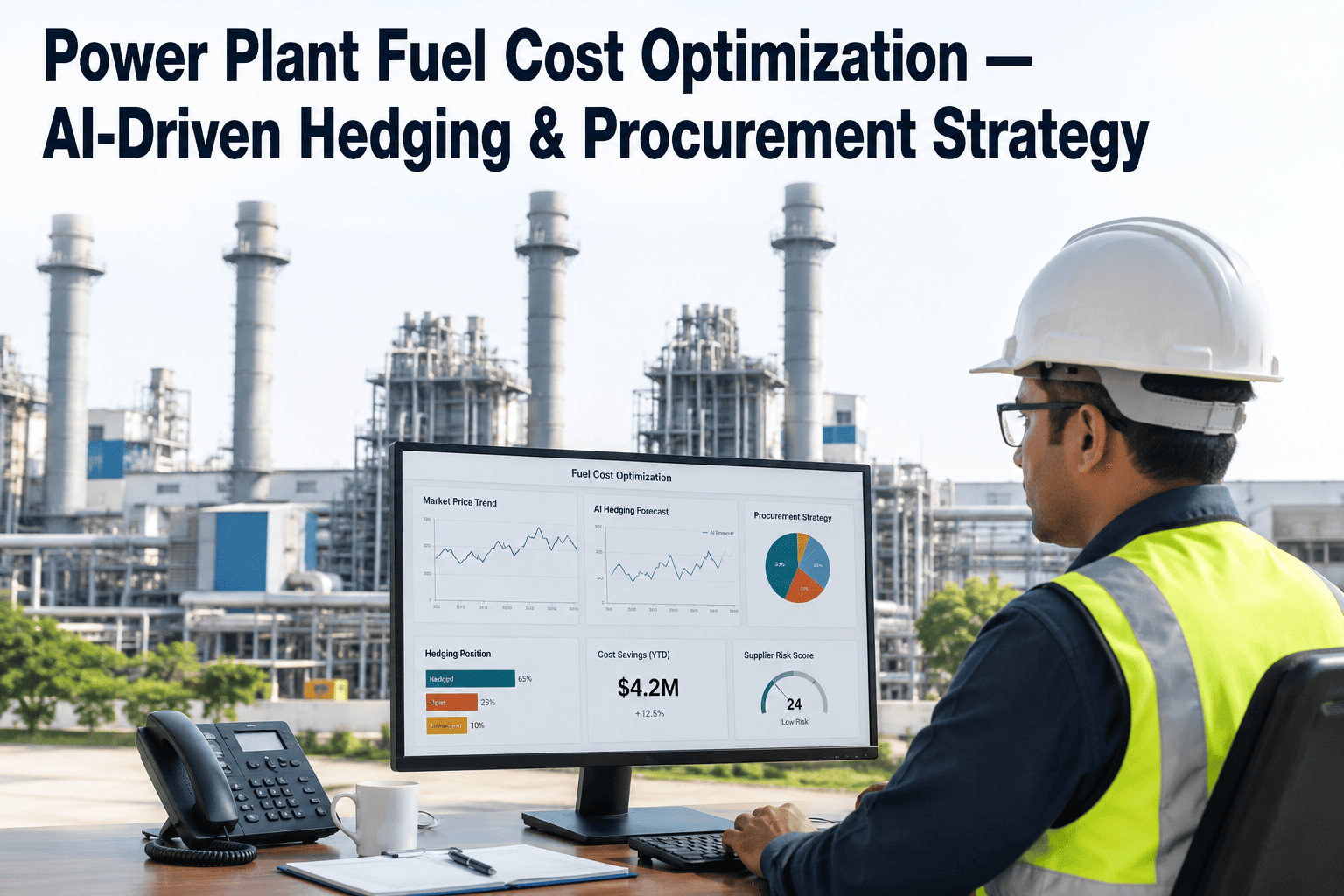
Henry Hub natural gas hit $7.72/MMBtu in January 2026 during a cold snap, then fell below $3.00 by spring — a swing that moved millions of dollars across the fuel budgets of gas-fired generators in a matter of weeks. Coal prices carry their own regional basis volatility. Fuel oil sits in tanks accruing storage and degradation costs. And every plant that runs on more than one fuel source faces an optimization problem that changes faster than any spreadsheet model can follow: which fuel to burn, when to buy it, how much to hedge forward, and how to structure procurement contracts that protect margins without locking out upside. AI-driven fuel cost optimization replaces the morning index check and quarterly hedge review with continuous multi-fuel price forecasting, scenario modeling, and automated procurement timing — book a demo to see it modeling your actual fuel portfolio.
Fuel Economics · AI Strategy
AI-Driven Fuel Cost Optimization, Hedging and Procurement for Power Plants
Model every fuel source, forecast every price curve, stress-test every hedge position, and time every purchase decision — before the market moves past you.
$7.72
Henry Hub peak, Jan 2026
$2.83
Henry Hub Q2 2026 average
173%
Price swing in under 90 days
A Decade of Fuel Price Volatility — and Why Spreadsheets Cannot Keep Up
Natural gas prices have traced an arc from a pandemic low of $1.63/MMBtu in 2020, to a 14-year high of $9.85 in 2022 on supply disruption fears, back below $2.00 in early 2024, then up to $7.72 in January 2026 before collapsing again. Every one of those moves repriced the fuel budget of every gas-fired generator in the country — and the plants that were hedged into the wrong position paid for it in real margin.
$1.63
Jun 2020
Pandemic demand collapse
$9.85
Aug 2022
Global supply disruption
$1.90
Mar 2024
Supply glut, warm winter
$7.72
Jan 2026
Record cold, storage draws
$2.83
Q2 2026
Production rebound, mild weather
AI price forecasting models trained on this exact volatility history — combined with storage data, LNG export schedules, weather signals, and production trends — generate multi-day forward curves that outperform static index-based purchasing by timing buys into predicted price troughs.
Four Fuel Markets, One Optimization Engine
Most power plants do not operate on a single fuel — and even those that do are exposed to substitute fuel economics through dispatch competition and capacity market dynamics. The AI optimizer models all four fuel types simultaneously, calculating the lowest-cost generation mix at every hour of the planning horizon.
Natural Gas
Price driverHenry Hub spot + regional basis
VolatilityHigh — weather, LNG exports, storage
Hedge instrumentsNYMEX futures, basis swaps, options
AI forecast horizon1-30 days forward with confidence bands
Coal
Price driverRegional indices, rail/barge transport
VolatilityModerate — contract-heavy, quality-variable
Hedge instrumentsFixed-price contracts, index-linked supply
AI forecast horizonWeekly blend cost + quality optimization
Fuel Oil
Price driverCrude oil correlation, refinery margins
VolatilityHigh — geopolitics, shipping disruptions
Hedge instrumentsCrack spreads, WTI/Brent swaps
AI forecast horizonInventory cost + readiness optimization
Renewable PPAs
Price driverPPA contract structure, curtailment risk
VolatilityLow fixed price — volume uncertainty
Hedge instrumentsShape risk management, balancing costs
AI forecast horizonGeneration forecast + dispatch integration
A fuel budget built on last year's average price is already wrong the day it's approved. AI scenario modeling stress-tests your budget against hundreds of price paths — cold winters, LNG demand spikes, pipeline constraints, production surges — so you know your exposure range before the board asks.
What the AI Optimizes Across Your Fuel Portfolio
The platform connects market data feeds, plant dispatch schedules, fuel contract terms, and hedge positions into a single decision engine — replacing the fragmented workflow of traders reading indices, schedulers estimating burn, and risk managers updating spreadsheets in different time zones.
Price Forecasting
LSTM neural networks ingest Henry Hub, regional basis differentials, coal indices, crude oil benchmarks, EIA storage reports, NOAA weather data, and LNG export schedules to generate multi-day forward price curves with confidence intervals — giving procurement teams a view of where prices are likely headed, not just where they are right now.
Procurement Timing
The optimizer identifies predicted price troughs across the forward curve and recommends purchase timing windows. Rather than locking all volumes at a single price point, it layers purchases incrementally across multiple market entries — the energy equivalent of dollar-cost averaging — to reduce timing risk and smooth budget outcomes.
Hedge Position Management
Every existing hedge — futures, options, basis swaps, fixed-price contracts, PPAs — is modeled against current and forecast market conditions. The system calculates net exposure, marks positions to market continuously, recommends hedge ratio adjustments when the forward curve shifts, and flags positions that are over-hedged or under-hedged relative to expected burn.
Scenario Stress Testing
Monte Carlo simulation runs hundreds of price paths — incorporating weather extremes, LNG demand shocks, pipeline constraints, production disruptions, and regulatory changes — to calculate value-at-risk, budget confidence intervals, and worst-case exposure. The output is a probability-weighted range, not a single-point estimate that will be wrong.
Multi-Fuel Dispatch Optimization
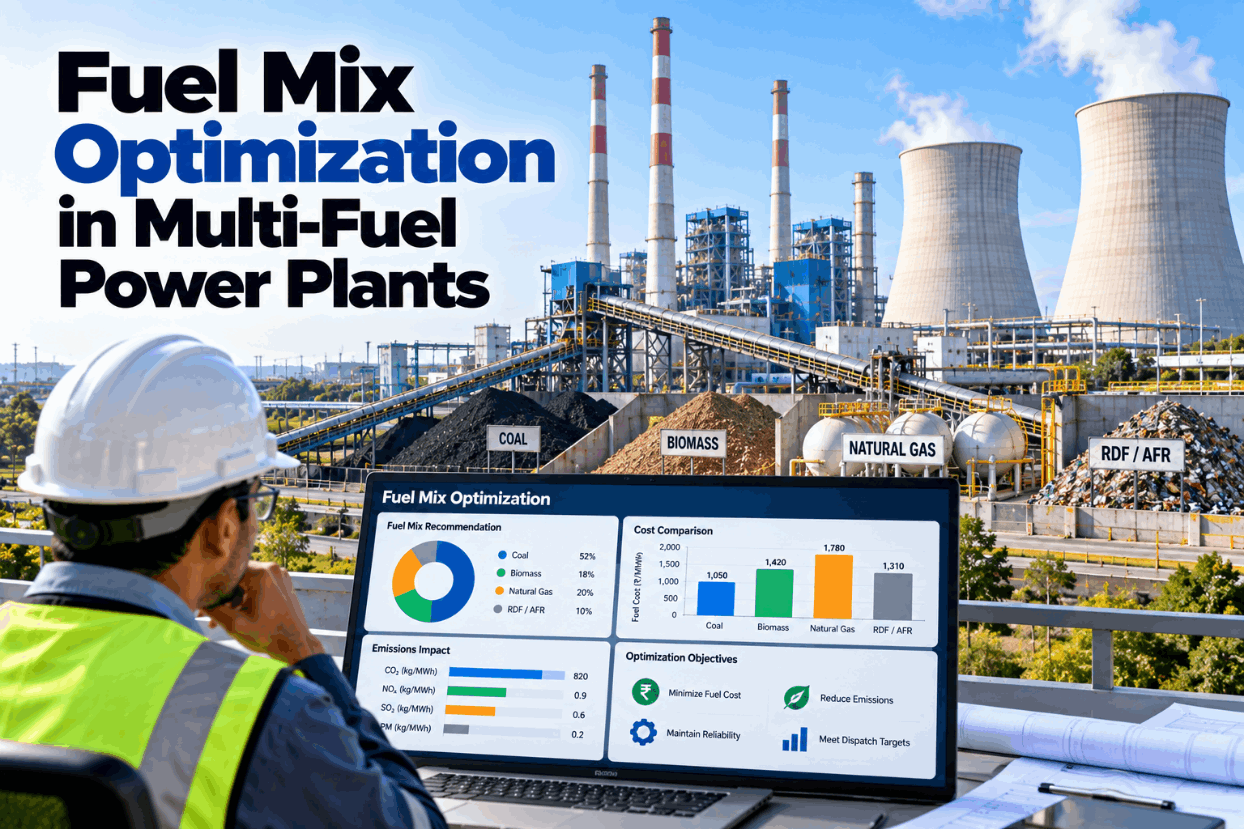
For plants with access to more than one fuel source — gas/oil dual-fuel turbines, coal-to-gas switching capability, or renewable PPA integration — the optimizer calculates the lowest-cost dispatch mix at every hour, factoring in fuel prices, heat rates, emissions costs, take-or-pay contract minimums, and grid operator dispatch signals.
How Scenario Modeling Protects Your Fuel Budget
| Scenario |
Gas Impact |
Coal Impact |
Budget Effect |
AI Response |
| Severe cold winter |
Hub spikes above $6/MMBtu |
Flat — contract-priced |
Gas budget overrun 40-60% |
Pre-positioned call options limit upside exposure |
| LNG export surge |
Basis widens at delivery points |
Marginal uplift from gas switching |
Regional premium adds 8-15% |
Basis swaps locked ahead of facility startups |
| Production glut |
Hub falls below $2.50/MMBtu |
Coal dispatch disadvantaged |
Gas savings offset by coal take-or-pay |
Triggers coal contract flexibility provisions |
| Pipeline maintenance |
Delivery point basis spikes |
Unaffected |
Short-notice supply premium |
Alternate pipeline paths pre-staged in nominations |
| Carbon price increase |
Gas advantage grows vs coal |
Dispatch cost rises sharply |
Fleet mix shift required |
Optimal fuel switching schedule recalculated |
Layered Hedging — Timing Risk Reduced, Not Eliminated
The most expensive mistake in fuel procurement is locking all volume at a single price point. If the market drops after you hedge, you overpaid. If it rises before you hedge, you are exposed. Layered hedging spreads purchases across multiple market entries over the procurement window, reducing the probability that any single bad timing decision dominates the budget.
25%
Layer 1 — 12 months ahead
25%
Layer 2 — 9 months ahead
25%
Layer 3 — 6 months ahead
25%
Layer 4 — 3 months ahead
AI adjusts each layer's timing and volume based on forward curve shape, implied volatility, and seasonal demand patterns — accelerating purchases when forecast models predict a trough and deferring when a spike is expected to resolve.
Turnkey AI Deployment — Live in 6-12 Weeks
Every fuel cost optimization deployment ships as a pre-configured NVIDIA AI server with all forecasting, hedging analytics, and procurement optimization software pre-loaded. Rack it, plug power and Ethernet, connect market data feeds and plant historian, and the system starts building forward curves within days.
Henry Hub just dropped 12% in two days and my forward hedge is 60% filled at $4.10. Should I accelerate the remaining 40% or wait?
Current spot is $3.18/MMBtu. My 7-day forecast shows a 72% probability of prices holding below $3.30 through end of week, driven by strong production data and above-average storage. I recommend filling 20% of remaining volume now at $3.18 and holding the final 20% for next week's EIA storage report. If storage comes in above consensus, prices likely dip further. If not, your blended cost is still $3.73 — well below your budget cap of $4.25.
1,000+
Industrial clients
6-12 Wks
Rack to live optimization
Expert Insight
The operations directors I work with who have the best fuel cost outcomes are not the ones who predict the market correctly — they are the ones who structure their procurement so that being wrong about the market does not blow up their budget. That is what AI-driven hedging really does: it does not guarantee the lowest price, it guarantees that the range of outcomes stays within what the business can absorb. The difference between a plant that hedges 100% at one price point and a plant that layers purchases across the curve using AI-optimized timing is the difference between a budget that depends on luck and a budget that depends on math. In a market that swung from $7.72 to $2.83 in ninety days, the math-based approach is the only one that survives.
James Whitfield — Energy Risk and Procurement Advisor, 20 years advising generators on fuel hedging strategy, derivatives structuring, and budget risk management
Frequently Asked Questions
How accurate are the AI price forecasts, and what data do they use?
The forecasting models use LSTM neural networks trained on years of historical price data from Henry Hub, regional basis differentials, EIA weekly storage reports, NOAA weather forecasts, LNG export flow data, and production estimates. Multi-day forward curves are generated with confidence intervals rather than single-point predictions, so procurement teams can see the range of likely outcomes and time purchases accordingly. Accuracy improves with more plant-specific data — burn patterns, dispatch schedules, and contract structures — which the system incorporates as it calibrates to your specific fuel portfolio over the first few weeks of operation. No forecast is perfect, but the goal is to consistently outperform static index-based purchasing over time.
Book a demo to see a live forecast running against current Henry Hub data.
Can the system manage hedging across multiple fuel types simultaneously?
Yes. The platform models natural gas, coal, fuel oil, and renewable PPA economics in a single optimization engine. For each fuel type, it tracks existing hedge positions (futures, options, basis swaps, fixed-price contracts), calculates net exposure, and recommends adjustments based on current and forecast market conditions. For dual-fuel or multi-fuel plants, it also optimizes the dispatch mix — calculating when to switch between fuels based on relative pricing, heat rate differences, emissions costs, and contract minimums. The system marks all positions to market continuously, so your risk team always has a current view of total portfolio exposure rather than waiting for a monthly reconciliation.
Contact support to discuss how the optimizer would work with your specific fuel mix.
How does scenario stress testing work, and what scenarios does it model?
The system runs Monte Carlo simulations that generate hundreds of price paths for each fuel type, incorporating correlated risk factors including weather extremes, LNG demand shocks, pipeline constraints, production disruptions, geopolitical events, and carbon price changes. For each scenario, it calculates the impact on your fuel budget, hedge positions, and dispatch economics — producing a probability-weighted range of outcomes rather than a single deterministic forecast. This gives operations directors and CFOs a clear picture of budget confidence intervals, value-at-risk at various confidence levels, and worst-case exposure under tail scenarios. The output directly supports board-level budget presentations and risk committee reporting.
Book a demo to run a stress test against your current fuel budget assumptions.
What is layered hedging and why is it better than locking in a single price?
Layered hedging spreads fuel purchases across multiple market entry points over the procurement window — typically in four to eight tranches over twelve months — rather than committing all volume at a single price. This reduces timing risk because no single purchasing decision dominates the blended cost. The AI optimizer enhances this approach by using forward price forecasts and implied volatility data to adjust the timing and size of each layer: accelerating purchases when models predict a trough and deferring when a price spike is expected to resolve. The result is a procurement process that consistently delivers blended costs closer to the period average than either all-at-once hedging or pure spot purchasing. For a market that moved from $7.72 to $2.83 in ninety days, this discipline is the difference between a budget that holds and one that breaks.
Contact support to review how layered hedging would apply to your current procurement structure.
What ROI does AI fuel cost optimization deliver?
The ROI comes from three sources: lower average fuel procurement cost through better-timed purchases, reduced budget variance through more effective hedging, and fewer missed opportunities from delayed decision-making. For a 500 MW gas-fired plant burning fuel that represents 50-60% of total operating cost, even a 3-5% improvement in average procurement price translates to substantial annual savings measured in millions of dollars. The budget certainty benefit — knowing your exposure range rather than hoping the market cooperates — often carries as much value to senior leadership as the direct cost savings. The turnkey deployment model means the system is live and generating value within 6-12 weeks, with ROI typically realized within the first full quarter of operation.
Book a demo to build an ROI estimate using your actual fuel spend and hedge history.
Stop Guessing Where Fuel Prices Are Going
Replace the morning index check and quarterly hedge review with AI that forecasts prices continuously, times purchases into predicted troughs, and stress-tests your budget against every scenario that could break it.