Coal combustion residuals — the fly ash, bottom ash, boiler slag, and flue gas desulfurization materials left behind after every ton of coal is burned — do not stop being a regulatory obligation when they leave the boiler. They accumulate in landfills and surface impoundments that require structural integrity assessments, groundwater monitoring, fugitive dust controls, and eventually closure and decades of post-closure care. The EPA CCR Rule, substantially expanded through 2024 legacy impoundment requirements and amended again in 2026, governs every stage of this lifecycle with deadlines that shift, documentation requirements that compound, and enforcement actions that increasingly second-guess self-implementing compliance decisions made years earlier. Missing a groundwater sampling deadline, filing an inspection report late, or failing to post required data to a public website can trigger enforcement — even when the underlying ash management is technically sound. AI-powered compliance tracking turns this sprawling regulatory burden into a managed workflow with automated deadlines, structured records, and real-time monitoring — book a demo to see it tracking a live CCR compliance program.
Emissions and Environmental · CCR Compliance AI
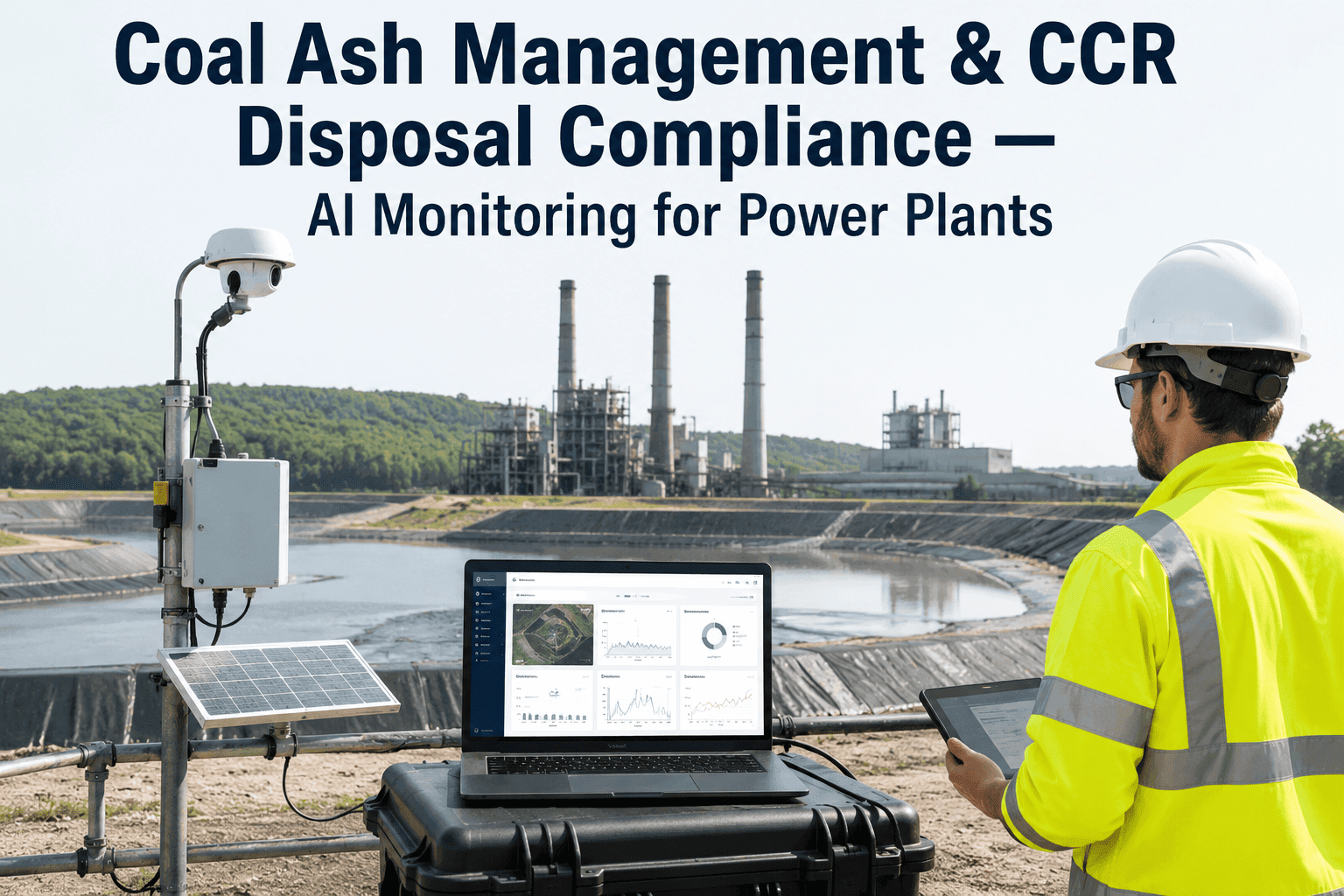
AI-Powered Coal Ash Management and CCR Disposal Compliance for Power Plants
Track every impoundment, every monitoring well, every deadline, and every required public posting across your entire CCR program — with AI that knows the rule better than any binder on a shelf.
100M+
Tons of CCR generated annually by U.S. coal-fired power plants
2024-2029
Rolling compliance window for legacy impoundment and CCRMU requirements
30+ Years
Post-closure monitoring obligation for units closed with waste in place
What Coal Combustion Residuals Actually Are
CCR is not a single material — it is a family of byproducts, each with different chemical characteristics, disposal requirements, and beneficial use potential. Every type falls under the same EPA regulatory umbrella, but the management challenges and environmental risks vary significantly.
~55% of total CCR volume
Fine particulate captured by electrostatic precipitators and baghouses. Contains silica, alumina, and trace metals. Highest beneficial use potential as cement replacement in concrete, but also the most mobile contaminant source when improperly stored in unlined impoundments.
~20% of total CCR volume
Coarser material that falls to the bottom of the boiler furnace. Less chemically reactive than fly ash but still subject to full CCR Rule requirements when disposed in landfills or impoundments. Used as aggregate substitute in road base and structural fill.
~20% of total CCR volume
Flue gas desulfurization sludge and synthetic gite produced by SO2 scrubbers. High moisture content creates handling and disposal challenges. Beneficial use in wallboard manufacturing, but disposal in wet form requires surface impoundment management.
~5% of total CCR volume
Glassy, granular material from wet-bottom and cyclone boilers. Lower environmental risk profile than fly ash but still regulated under the CCR Rule when disposed at the facility. Used as blasting grit and roofing granule substitute.
The Regulatory Timeline EHS Managers Must Track
The CCR Rule is not a single compliance event — it is a rolling series of deadlines that span years, with the 2024 Legacy Rule and 2026 amendments adding new obligations for previously unregulated impoundments and CCR management units. Missing any one of these deadlines can trigger enforcement even when the underlying program is technically sound.
Apr 2015
Original CCR Rule Published
Established groundwater monitoring, structural integrity, closure, and post-closure care requirements for active CCR landfills and surface impoundments under RCRA Subtitle D.
May 2024
Legacy CCR Rule Finalized
Extended federal requirements to previously unregulated legacy impoundments and CCR management units. Required facility evaluation reports, groundwater monitoring, and closure plans for historic disposal areas.
Feb 2026
CCRMU Deadline Extensions Finalized
EPA extended compliance deadlines for facility evaluation and groundwater monitoring requirements, citing contractor shortages and implementation challenges reported by facilities nationwide.
Apr 2026
2026 Amendments Proposed
EPA proposed site-specific permit pathways for groundwater monitoring, revised beneficial use definitions, and new closure certification options for facilities that completed legacy closures under state oversight.
2027-2029
CCRMU Compliance Window
Facility Evaluation Part 2, groundwater monitoring installation, corrective action initiation, and closure planning deadlines for newly identified CCR management units arrive in sequence through 2029.
A CCR compliance program managed in spreadsheets and filing cabinets is one missed deadline away from an enforcement action. AI tracks every obligation, every sampling date, every reporting window, and every public posting requirement across your entire ash management program — and alerts your team before anything is due, not after it is overdue.
Every Obligation the CCR Rule Puts on Your Plant
The CCR Rule generates a continuous stream of required actions — inspections, sampling, assessments, reports, public postings, and notifications. AI organizes every obligation by category, tracks due dates automatically, and maintains the complete record in a format that satisfies EPA inspectors and state environmental agency reviewers on demand.
Install upgradient and downgradient monitoring wells at every regulated unit
Annual sampling for Appendix III constituents during detection monitoring
Transition to Assessment Monitoring if downgradient concentrations exceed background
Initiate corrective action if Appendix IV constituents exceed groundwater protection standards
Annual inspections by qualified personnel for all surface impoundments
Periodic safety factor assessments by a qualified professional engineer
Emergency action plans maintained and updated for impoundments with hazard potential
Inflow design flood evaluation and structural stability documentation
Closure by removal — all CCR excavated and disposed in lined facility or beneficially used
Closure with waste in place — final cover system, grading, and 30-year post-closure care
Post-closure groundwater monitoring for the full 30-year period minimum
Financial assurance for closure and post-closure care costs
Publicly accessible website with all CCR compliance data posted within required timeframes
Annual groundwater monitoring reports and corrective action progress reports
Inspection records, structural assessments, and closure progress documentation
Facility evaluation reports for legacy impoundments and CCR management units
Two Closure Paths — Each with a Decades-Long Documentation Trail
When a CCR unit ceases receiving waste, the facility must close it under one of two regulatory pathways. Each has distinct technical requirements, timelines, and long-term obligations that define the compliance documentation your program must support for decades.
All CCR and CCR-contaminated soil excavated from the unit
Material disposed at a lined CCR landfill or beneficially used
Underlying soil demonstrated free of contamination
Groundwater monitoring continues until clean closure certification
Final cover system installed — low-permeability layer plus erosion protection
Grading and drainage to prevent infiltration and run-on
30-year minimum post-closure care period with ongoing monitoring
Groundwater sampling, cover maintenance, and reporting for full post-closure period
Turnkey AI Deployment — Compliance from Day One
Every CCR compliance deployment ships as a pre-configured NVIDIA AI server with all deadline tracking, document management, groundwater data analysis, and public posting automation software pre-loaded. Rack it, connect to your environmental data systems, and the platform builds your complete compliance calendar within days.
Our Appendix III groundwater results from the Q2 sampling round show arsenic at 0.012 mg/L in MW-4 — the downgradient well at Ash Pond 2. Background at MW-1 is 0.008 mg/L. Do we have a statistically significant increase?
MW-4 arsenic at 0.012 mg/L exceeds the MW-1 background of 0.008 mg/L, but a single exceedance does not automatically trigger Assessment Monitoring. The CCR Rule requires a statistically significant increase determined using one of four approved methods. Based on your historical data, I have run an inter-well prediction interval test — the result does not show a statistically significant increase at the 95% confidence level given the background variability at MW-1. However, I have flagged MW-4 arsenic for priority resampling next quarter and generated a trending alert. If the next round confirms the increase, I will prepare the Assessment Monitoring transition notification.
1,000+
Industrial clients
6-12 Wks
Rack to live compliance
Expert Insight
The CCR Rule was written to be self-implementing, which meant facilities were supposed to make their own compliance decisions without EPA oversight. What we have seen since 2024 is that EPA is now retroactively reviewing those decisions — and finding gaps. Plants that made good-faith interpretations five or six years ago are discovering that their groundwater well placement, their statistical methods, or their closure documentation does not meet the standard EPA is now applying. The facilities that survive this scrutiny are the ones that documented everything in real time, with timestamped records, qualified professional certifications, and data that can be audited without reconstructing anything from memory. That is what AI compliance tracking provides — a record that is built as you go, not assembled after an inspector shows up.
David Hargrove — Environmental Compliance Director, 17 years advising coal-fired generators on CCR disposal, groundwater monitoring, and closure planning under RCRA Subtitle D
Frequently Asked Questions
What changed with the 2024 Legacy CCR Rule and 2026 amendments?
The May 2024 Legacy CCR Rule extended federal requirements to previously unregulated legacy surface impoundments and CCR management units — disposal areas where coal ash was historically placed but not covered by the original 2015 rule. Facilities must now conduct facility evaluation reports to identify and delineate these units, install groundwater monitoring wells, and prepare closure and post-closure care plans. The February 2026 rule extended several of these compliance deadlines after facilities reported challenges meeting the original timelines due to contractor shortages, permitting delays, and the complexity of reviewing decades of historical records. The April 2026 proposed amendments would create site-specific permit pathways and revise beneficial use definitions.
Book a demo to see how the platform tracks all current and upcoming CCR deadlines for your specific units.
How does the AI handle groundwater monitoring data and statistical analysis?
The platform ingests groundwater sampling results from every monitoring well, calculates background statistics from upgradient wells, and runs the CCR Rule's approved statistical methods — inter-well prediction intervals, control charts, tolerance intervals, or inter-well t-tests — to determine whether downgradient constituent concentrations represent a statistically significant increase over background. When an increase is confirmed, the system automatically generates the notifications required to transition from Detection Monitoring to Assessment Monitoring and begins tracking the expanded Appendix IV sampling requirements. All statistical calculations, data inputs, and results are stored as timestamped records that can be audited without manual reconstruction.
Contact support to review how the statistical analysis module maps to your current groundwater monitoring program.
Can the system manage compliance for multiple CCR units across multiple sites?
Yes. The platform is designed for fleet-level CCR compliance management, tracking every landfill, surface impoundment, legacy impoundment, and CCR management unit across all facility locations in a single dashboard. Each unit carries its own regulatory profile — monitoring wells, sampling schedules, structural assessment dates, closure status, and post-closure obligations — and the system generates site-specific compliance calendars, consolidated fleet reports, and cross-site analytics that identify which units are approaching deadlines or trending toward exceedances. For utilities managing dozens of CCR units across multiple states with different approved CCR permit programs, this fleet view is the difference between proactive compliance management and reactive fire-fighting.
Book a demo to see the fleet dashboard configured for a multi-site CCR program.
How does the platform handle the public posting requirements?
The CCR Rule requires facilities to maintain a publicly accessible website with specific compliance documents posted within defined timeframes — groundwater monitoring reports, inspection records, structural assessments, closure progress reports, and notification letters. The platform tracks every posting requirement, alerts your team before the posting deadline, and maintains a complete audit trail showing when each document was posted, by whom, and in what format. For facilities that have been managing this obligation manually — often through a separate compliance website maintained by a different team — the automated posting workflow eliminates the risk of late or missing posts that EPA has cited in enforcement actions.
Contact support to discuss integration with your existing CCR public website.
What ROI does AI CCR compliance tracking deliver?
The ROI comes from three sources: avoided enforcement costs (a single CCR Rule violation can result in penalties and consent decree obligations that dwarf the cost of the compliance platform), reduced consulting spend (automated statistical analysis, deadline tracking, and document management reduce reliance on external environmental consultants for routine compliance tasks), and labor efficiency (the EHS staff hours currently spent manually tracking deadlines, assembling reports, and maintaining the public website are redirected to higher-value environmental management work). For facilities in the closure or post-closure phase, the platform also supports the 30-year documentation obligation that will outlast every current staff member — ensuring institutional knowledge is preserved in the system rather than lost to turnover.
Book a demo to estimate the compliance cost reduction for your specific CCR program.
Compliance Is Not Optional — But It Does Not Have to Be Manual
Replace the binders, spreadsheets, and calendar reminders with AI that tracks every CCR obligation, every sampling deadline, and every public posting requirement across your entire ash management program.