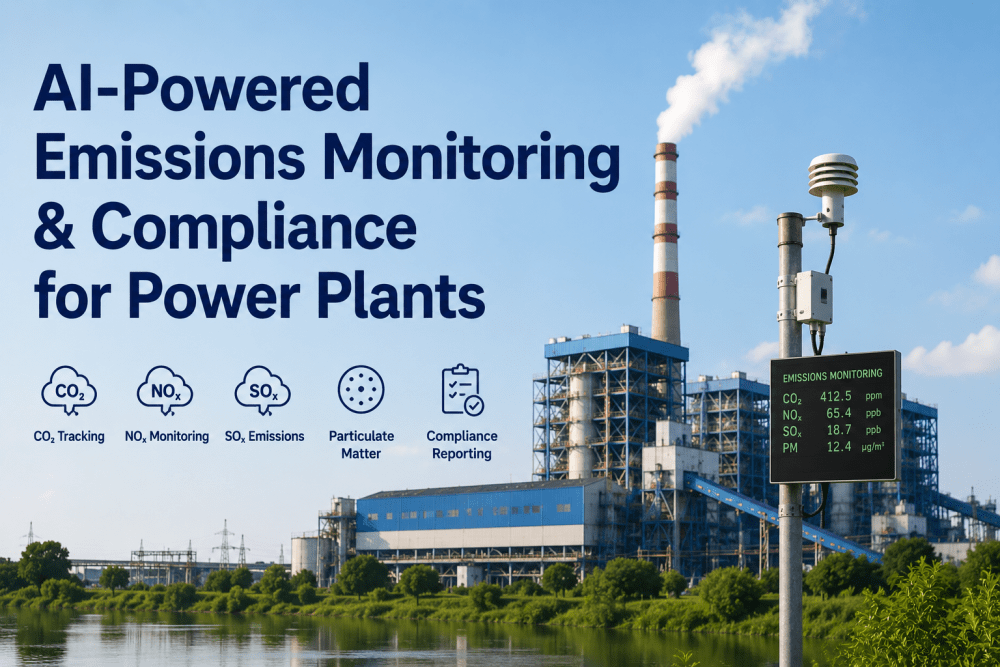
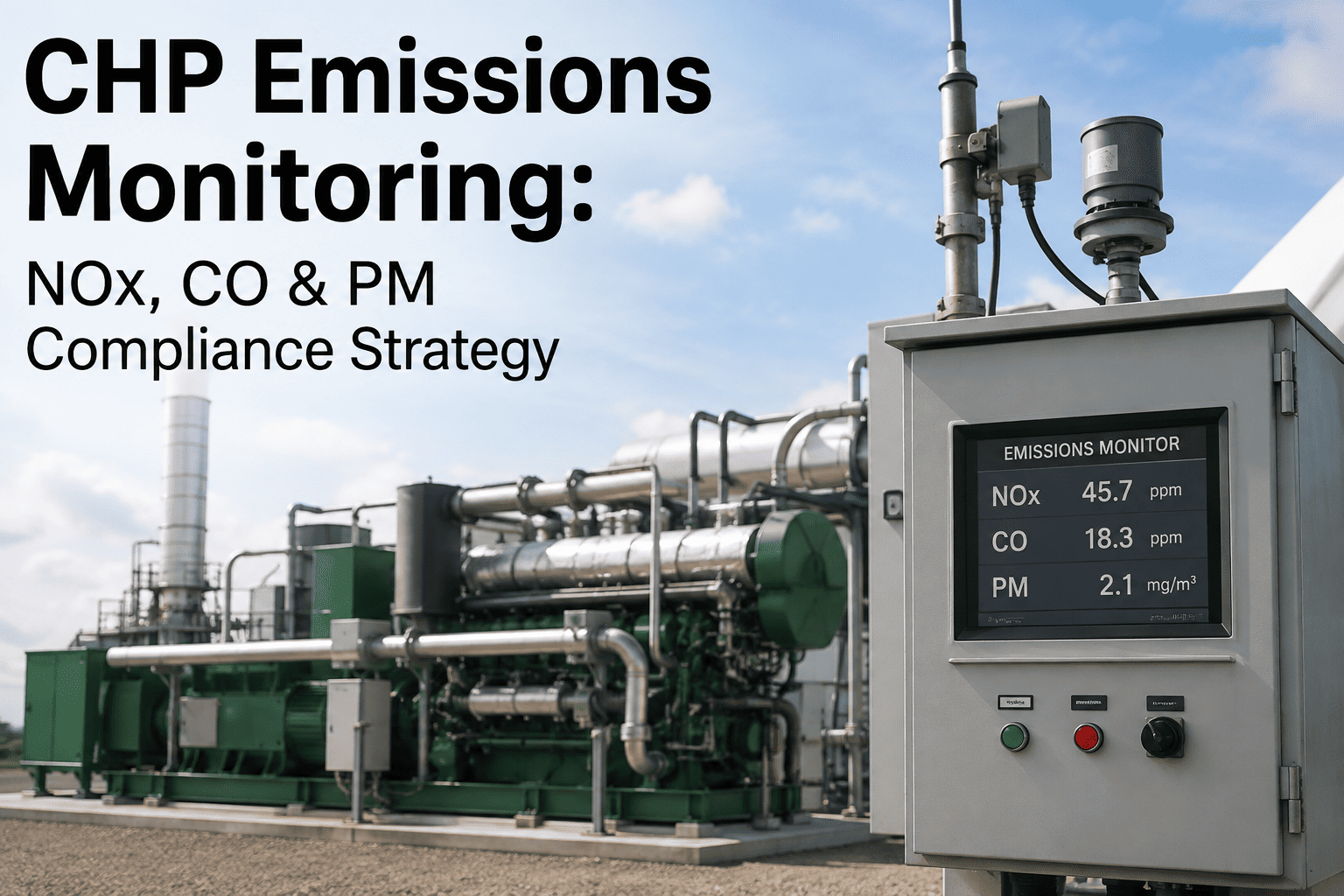
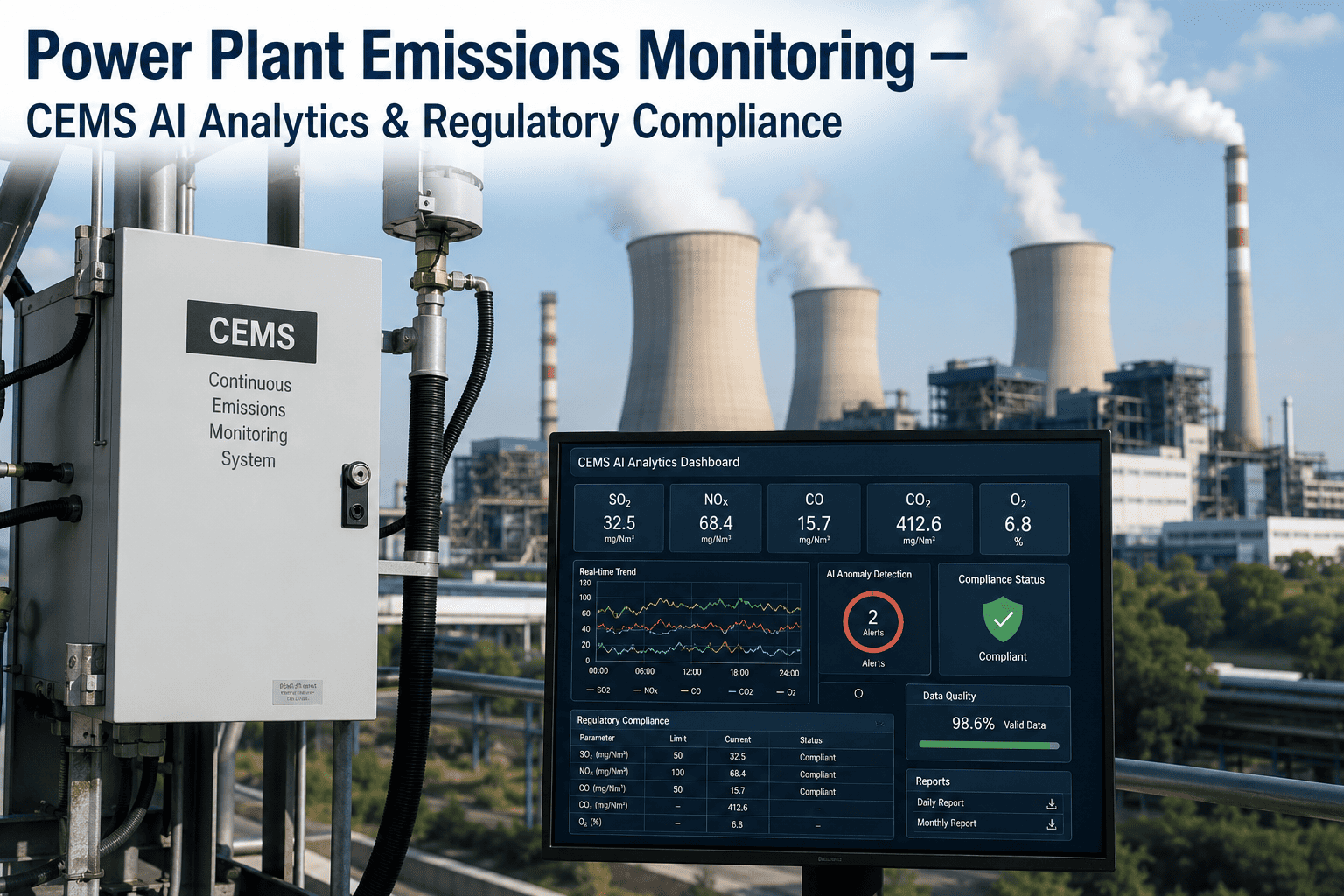
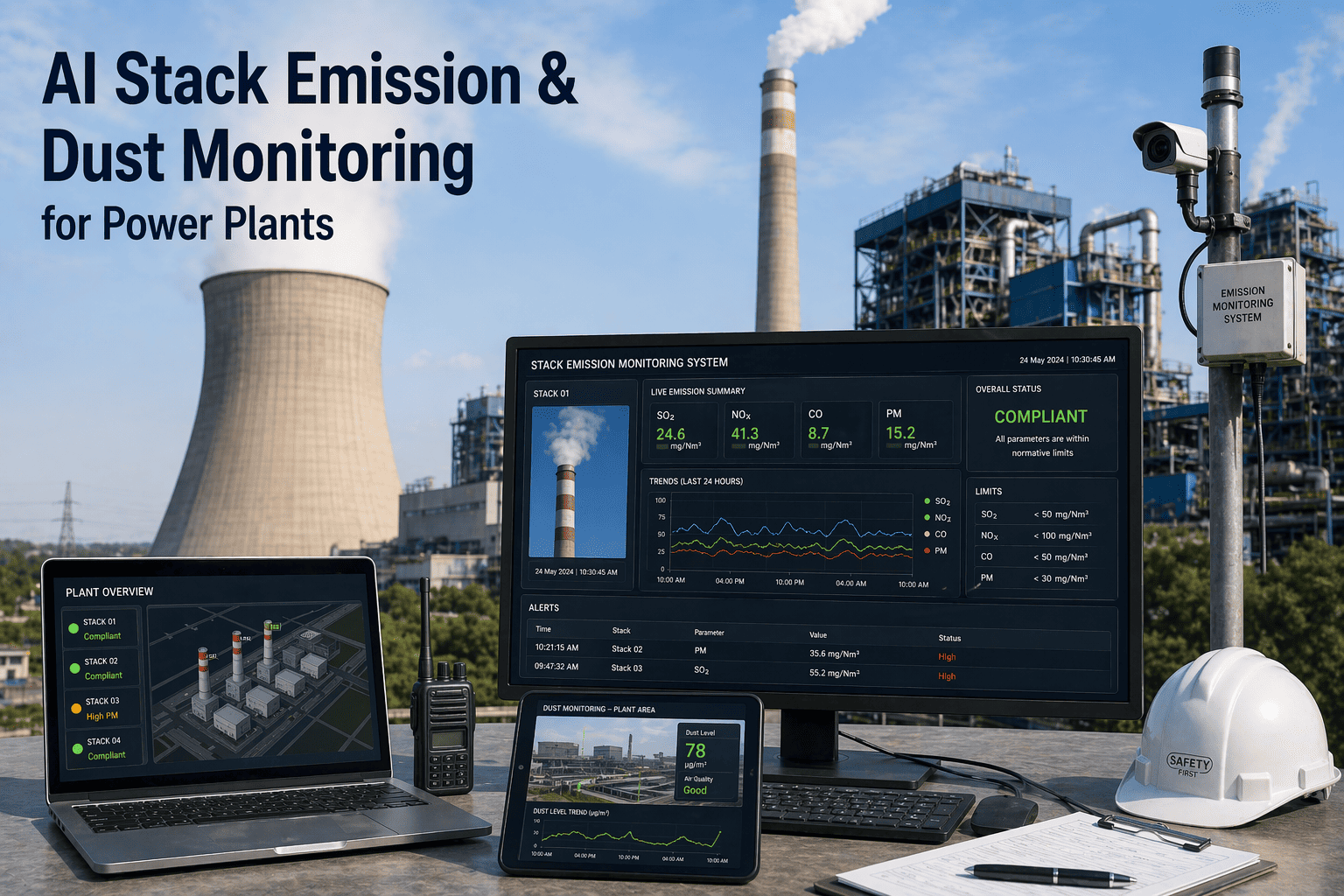
Every power plant environmental compliance team knows the monthly rhythm: pull CEMS data from the continuous emissions monitoring system, reconcile it against DCS load logs, cross-reference fuel quality records, calculate emission rates, and compile the EPA report before the regulatory deadline. AI-powered emissions monitoring platforms solve this by ingesting every emissions data stream into a single analytics layer that tracks compliance status continuously, predicts exceedance risk before it materializes, and generates audit-ready EPA reports automatically. This guide explains how AI-driven emissions monitoring transforms power plant environmental compliance from a reactive reporting burden into a proactive strategic capability.
iFactory Emissions Intelligence
AI-Powered Emissions Monitoring and Compliance Platform for Power Plants
The unified emissions intelligence platform that connects CEMS analyzers, DCS data, fuel management systems, and EPA reporting requirements into a single real-time compliance view — so your team detects exceedances before they happen and closes reporting cycles in hours, not weeks.
10,000+
Emissions data points collected per hour from a typical combined-cycle plant
83%
Faster EPA report generation with automated data aggregation and validation
94%
Exceedance events detected before regulatory notification deadline with AI alerts
60%
Reduction in engineering hours spent on manual compliance data reconciliation
Why Power Plants Need AI-Powered Emissions Monitoring
The regulatory landscape for power plant emissions has never been more demanding. EPA's Cross-State Air Pollution Rule, Mercury and Air Toxics Standards, and the upcoming Greenhouse Gas Reporting Program updates require continuously monitored, quality-assured, and auditable emissions data across CO2, NOx, SOx, and particulate matter. At the same time, the volume of data generated by modern CEMS analyzers has outpaced the manual processes most plants still rely on for compliance management. Environmental compliance teams that book a demo of iFactory's AI-powered emissions platform consistently report that the gap between data volume and manual processing capacity is the primary driver of compliance risk at their facilities.
AI Emissions Monitoring Platform
CEMS Analyzers
CO2, NOx, SOx, O2, CO continuous readings with QA/QC status
DCS / Plant Systems
Load, heat rate, combustion temp, steam flow, unit operating mode
Fuel & Feedstock Data
Fuel type, consumption rate, heating value, sulfur content, moisture
EPA Regulatory Framework
40 CFR Part 60/75 limits, CS-NoR deadlines, emissions trading rules
Stack & Duct Sensors
Stack temperature, velocity, pressure, opacity, particulate loading
Ambient Conditions
Temperature, humidity, barometric pressure, wind speed and direction
Anatomy of an AI-Powered Emissions Monitoring Platform
An AI-powered emissions monitoring platform is not simply a dashboard connected to CEMS analyzers — it is an operational intelligence layer that ingests, validates, models, and reports emissions data across every regulatory requirement your plant faces. Here are the seven core layers that make it work, from raw data ingestion to automated EPA submission.
01
Real-Time CEMS Data Ingestion and Validation
Continuous ingestion from all CEMS analyzers via OPC-UA, Modbus, or direct API connections. Automated QA/QC checks apply EPA Protocol Gas and relative accuracy test audit criteria to every data point, flagging suspect readings before they corrupt compliance reports.
02
AI-Driven Predictive Emissions Modeling
Machine learning models trained on historical CEMS, DCS, and fuel data predict emission rates 15-60 minutes ahead of current conditions. Early warning of approaching exceedance thresholds enables operators to adjust combustion parameters before a violation occurs.
03
Compliance Limit Monitoring with Smart Alerts
Real-time tracking of all applicable emission limits — lb/MWh rates, ppm concentrations, opacity percentages, and mass emission caps. Smart alerts distinguish between measurement noise and genuine exceedance risk using AI pattern recognition, reducing nuisance alarms.
04
Automated EPA Report Generation
Self-building EPA reports — including emissions summary, excess emissions monitoring reports, and compliance certifications — populated directly from validated CEMS data. Reports are generated in EPA-accepted formats and ready for review in hours instead of days.
05
Emissions Performance Trend Analytics
Long-term trend analysis of emission rates by unit, fuel type, load range, and operating mode. Identify degradation in combustion efficiency or post-combustion control equipment before it results in an exceedance event or compliance notice.
06
Multi-Unit and Fleet Emissions Dashboard
Unified view of emissions performance across all generating units at a single plant or across an entire fleet. Compare compliance status, emission rates, and reporting completeness at a glance — with drill-down to individual CEMS analyzer diagnostics.
07
Carbon Accounting and Sustainability Reporting
Automated CO2 mass emission calculations aligned with EPA GHG Reporting Program requirements and voluntary sustainability frameworks. Generate Scope 1 carbon inventories, emission intensity metrics, and sustainability report inputs from the same validated data stream.
Want to see these seven layers working together in a live power plant environment? Book a demo of iFactory's emissions monitoring platform.
Key Emissions KPIs and Compliance Benchmarks
An AI-powered emissions monitoring platform is only as valuable as the metrics it tracks with regulatory accuracy. These are the twelve KPIs that power plant compliance teams monitor in real time — and the benchmarks that separate proactive compliance management from reactive reporting.
Role-Based Views for Emissions Compliance Management
An emissions monitoring platform that shows the same screen to everyone serves no one well. The power of a centralized compliance dashboard is that it provides role-specific views — giving each stakeholder exactly the information they need to act, without noise from irrelevant data layers.
Sees: Fleet-wide compliance status, emission rate trends across all units, excess event trajectory, quarterly EPA report readiness score, carbon intensity vs. corporate sustainability targets
Decides: Capital allocation for emissions control upgrades, compliance staffing priorities, strategic response to evolving EPA rulemaking, sustainability investment decisions
Sees: Real-time emission limits status per unit, CEMS QA/QC calendar and aging, open exceedance events with root cause analysis, EPA report generation progress, audit readiness score
Decides: Exceedance reporting to regulatory agencies, CEMS maintenance scheduling, report submission timing, corrective action prioritization for emissions-related issues
Sees: Live emission rates vs. limits per unit, AI-predicted exceedance probability for next hour, combustion tuning recommendations, CEMS health status and data validity indicators
Decides: Immediate combustion adjustments to avoid exceedance, load dispatch coordination during emission-constrained periods, notification escalation for CEMS data quality issues
Sees: CEMS analyzer status per stack, calibration due dates and history, RATA scheduling calendar, data validation flags with suspect readings, component replacement intervals
Decides: Analyzer calibration timing, component replacement priorities, data certification for regulatory reporting, RATA scheduling coordination with unit outages
What Environmental Compliance Leaders Say
The shift from manual compliance management to AI-powered emissions monitoring is transforming how power plant environmental teams operate. Here is what industry professionals with decades of combined regulatory experience have to say about the transition. Plant compliance directors who book a demo consistently report that seeing a unified platform connect their CEMS data to their EPA reporting workflow for the first time fundamentally changes their understanding of what compliance automation can deliver.
"The most dangerous assumption in power plant environmental compliance is that your CEMS data is accurate just because the analyzers are calibrated. We discovered data validation gaps between our CEMS and DCS that had been silently inflating our reported NOx rates for over a year before we deployed an integrated platform. The AI layer caught discrepancies our manual QA process never would have found — timing offsets between CO2 and stack flow readings, load bin misclassification during startups, and fuel quality interpolation errors. Our compliance risk dropped dramatically within the first month, and our EPA report generation time went from five days to four hours. The ROI calculation was not marginal — it was immediate and unambiguous."
Environmental Compliance Director
Combined-Cycle and Coal Generation Fleet, 24 Years in Power Plant Compliance
"The paradigm shift that AI-powered monitoring brings is not just speed — it is the ability to predict exceedances before they happen. In the old model, you detect a NOx exceedance when the CEMS data crosses the limit, you back-correlate with DCS data to find the cause over the next several hours, and you document the event for the EPA report weeks later. With predictive modeling, the platform tells the operator 'based on current load ramp rate, combustion temperature, and NOx trend, you will exceed your limit in 22 minutes if no action is taken.' That change — from reactive documentation to proactive prevention — is the single largest risk reduction we have seen in our compliance program in two decades. It transforms the compliance team from historians of what went wrong into engineers of what will go right."
Senior Air Quality Engineer
Power Generation Environmental Practice, 18 Years — QEP Certified
How AI Improves Emissions Detection and Response Time
The value of an AI-powered emissions monitoring platform is measured in the gap between an emissions event occurring and the compliance team knowing about it — and acting. Here is how response times compare between traditional manual compliance management and an AI-driven unified platform.
Emissions exceedance detected
4-24 hours (next CEMS data review)
Root cause identified
4-8 hours (cross-system manual analysis)
Minutes (correlated data)
EPA exceedance report compiled
3-7 days (manual data gathering)
Corrective action initiated
1-3 days (manual workflow)
Compliance audit file completed
3-5 days (data reconciliation)
Manual Compliance Process
AI-Powered Platform
Ready to close the gap between emissions event and compliance action? Book a demo with iFactory's power plant emissions team.
Frequently Asked Questions
What CEMS analyzers and protocols does the platform support for data integration?
The platform connects to all major CEMS analyzer brands — including Thermo Scientific, Teledyne, Siemens, ABB, and Emerson — via OPC-UA, Modbus TCP, and direct API connections. It ingests data from CO2, NOx, SOx, O2, CO, opacity, and particulate matter analyzers using standard EPA Protocol Gas and Part 75 data formats. The platform also supports direct integration with most plant DCS systems (Emerson Ovation, Siemens PCS 7, ABB Symphony, GE Mark VI) for load and combustion data correlation, eliminating manual data reconciliation between CEMS and operations systems.
How does the platform handle EPA Part 75 and Part 60 compliance reporting requirements?
The platform is pre-configured with 40 CFR Part 60 (NSPS) and 40 CFR Part 75 (CEMS) reporting frameworks. It auto-generates all required reports — including electronic emissions data files for Part 75, excess emissions monitoring reports, and compliance certifications — in EPA-accepted XML and spreadsheet formats. Reports are populated directly from validated CEMS data with complete QA/QC audit trails, eliminating manual data transcription errors and reducing report preparation time by over 80%. The platform also tracks regulatory deadlines and notifies the compliance team when report submission dates are approaching.
Can the platform predict emissions exceedances before they happen, and how much lead time does it provide?
Yes. The platform's AI models are trained on 12-24 months of historical CEMS, DCS, and fuel data to predict emission rates 15-60 minutes ahead of current conditions. The predictive models learn how emission rates respond to specific operating parameters — load ramps, combustion temperature changes, fuel switching events, ambient condition shifts — and provide operators with actionable lead time to adjust combustion controls or dispatch decisions before a limit is breached. Typical prediction accuracy for NOx and CO2 exceedance risk exceeds 92% in validated deployments, with false positive rates below 5%.
How does the platform support multi-unit plants and fleet-wide compliance management?
The platform is designed for multi-unit, multi-site deployments with role-based access controls. Individual unit compliance managers see their unit's real-time status. Plant-level environmental managers see all units at their facility with fleet-wide comparisons. Corporate compliance directors get an enterprise-wide view of compliance status, emission rate trends, and reporting completeness — all from the same platform with no duplicate data entry. The unified architecture ensures that fleet-wide emission rate averages, mass emission totals, and compliance spreadsheets are automatically calculated from validated unit-level data without manual consolidation.
What data does the platform require to start generating AI-powered emissions predictions?
The platform can begin providing value from day one with live CEMS data ingestion and real-time compliance monitoring. AI-powered predictive models typically require 12-18 months of historical CEMS, DCS, and fuel data to train accurate emission rate prediction models.
Conclusion: The Future of Power Plant Emissions Compliance Is Proactive and AI-Driven
The economics of power plant emissions compliance have shifted. Regulatory complexity is increasing, reporting requirements are expanding, and the consequences of non-compliance — from EPA penalty exposure to stakeholder scrutiny on greenhouse gas emissions — have never been higher. The traditional approach of manual CEMS data management, spreadsheet-based compliance reporting, and reactive exceedance management is no longer sustainable for plants that need to manage compliance risk while optimizing generation economics. AI-powered emissions monitoring platforms address all of these pressures simultaneously: they reduce the engineering hours spent on manual data reconciliation, they detect and predict exceedance events before they result in regulatory notifications, they generate audit-ready reports at a fraction of the current cycle time, and they provide the data foundation for carbon accounting and sustainability reporting that is becoming a boardroom-level priority.
Regulatory Confidence. Operational Intelligence.
Your Emissions Data Exists. Your Compliance Platform Does Not. Fix That Before Your Next Report Cycle.
iFactory's AI-powered emissions monitoring platform unifies every CEMS data stream, compliance requirement, and EPA report into a single real-time intelligence layer. From analyzer to regulatory submission, your team sees the truth — and acts on it before exceedances happen.
Real-Time
CEMS data across every generating unit
12 KPIs
Emissions and compliance metrics tracked
1-Click
Audit-ready EPA report generation
94%
Exceedance detection before notification deadline