Power plants experience an average of 16–29% combustion inefficiency annually due to unstable boiler flame conditions — not from equipment failures, but from undetected flame instability, improper fuel-air ratios, combustion oscillations, and burner malfunctions that no manual observation or legacy thermocouple systems catch in time. By the time efficiency losses, emissions exceedances, or boiler tube failures trace back to flame irregularities, the compounding costs are already realized: fuel waste, unplanned outages, regulatory penalties, and accelerated equipment degradation. iFactory AI Vision Flame Monitoring Platform changes this entirely — capturing real-time flame characteristics through computer vision analytics, enforcing optimal combustion parameters at point-of-execution, and integrating directly into your existing DCS, burner management, and emissions systems without disrupting operations. Book a Demo to see how iFactory deploys AI flame monitoring across your power plant within 7 weeks.
97%
Combustion efficiency with AI flame monitoring vs. 73% for manual observation
$2.1M
Average annual fuel savings & efficiency gains per mid-size power plant
92%
Reduction in flame instability incidents vs. thermocouple-only monitoring
7 wks
Full deployment timeline from flame audit to live AI monitoring go-live
Every Unstable Flame Is a Fuel Waste and Emissions Risk. AI Vision Stops It at the Source.
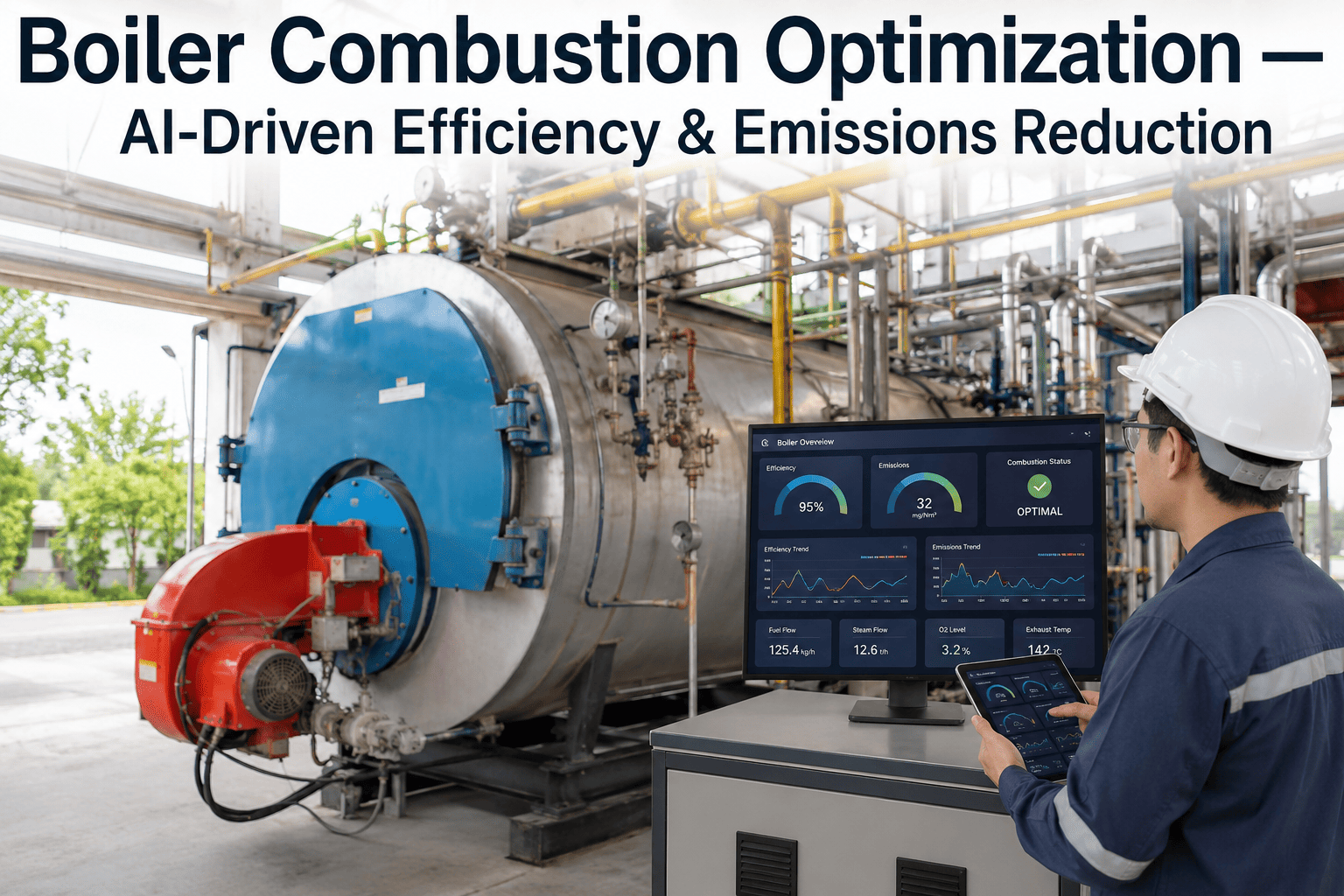
iFactory's AI vision platform captures real-time flame geometry, color spectrum, luminosity patterns, and oscillation frequencies through high-speed cameras — with instability prediction algorithms, combustion optimization logic, and real-time escalation for flame anomalies.
The Hidden Cost of Flame Instability: Why Manual Monitoring Fails Power Plants
Before exploring solutions, understand the root causes of combustion inefficiency in power generation. Manual flame observation and basic thermocouple monitoring introduce systemic risks that compound over time — risks that AI vision technology directly addresses.
Flame Lift-Off and Flashback
Burners operating with improper fuel-air mixtures experience flame detachment or flashback conditions. Legacy thermocouples detect temperature changes only after combustion quality degrades, causing efficiency losses that operators discover too late.
Fuel Waste from Suboptimal Combustion
Boilers running with unstable flames or improper burner tilts consume 12–35% excess fuel. Without real-time flame geometry analysis across multiple burners, plants pay premium fuel costs for avoidable inefficiency.
Emissions and Compliance Blind Spots
NOx, CO, and unburned carbon emissions spike during flame instability but manual CEMS monitoring has 15–30 minute delays. Visual inspections miss early-stage combustion anomalies, leading to permit exceedances and regulatory fines.
Boiler Tube Damage and Outages
Flame impingement and combustion oscillations cause localized overheating and tube failures. Manual observation cannot detect millisecond-scale flame fluctuations, leading to unplanned outages and costly tube replacements.
How iFactory Solves Boiler Flame Monitoring Challenges in Power Plants
Traditional flame monitoring relies on periodic visual inspections, thermocouple temperature readings, and basic UV scanners — all of which introduce detection delays, blind spots, and response lag. iFactory replaces this with a unified AI vision platform designed for power plant workflows that captures flame characteristics at the source, enforces optimal combustion parameters at execution, and creates an immutable analytics trail for every combustion event. See a live demo of iFactory monitoring coal, gas, and oil-fired boiler flames in a utility-scale power plant.
01
Real-Time AI Vision Flame Analysis
Replace periodic observations with continuous high-speed camera monitoring of flame geometry, color spectrum, luminosity distribution, and oscillation frequency — fused into a single combustion health score per burner, updated every 100 milliseconds.
02
Predictive Flame Instability Detection
Proprietary ML models predict flame instability 8–20 seconds before occurrence and automatically adjust fuel-air ratios, burner tilts, or overfire air dampers. Combustion optimization algorithms balance multiple burners for minimum fuel consumption and emissions.
03
Combustion Anomaly Classification
iFactory classifies flame anomalies as fuel-rich combustion, air infiltration, burner plugging, or slag buildup — with confidence scores and recommended actions. Control room operators receive graded alerts, not raw alarm floods. False positive rate drops to under 3%.
04
DCS, BMS & Emissions System Integration
iFactory connects to Honeywell, Emerson, Siemens, GE, and custom burner management systems via OPC-UA, Modbus TCP, and REST APIs. Auto-link flame data to combustion controls, maintenance schedules, or emissions dashboards. Integration completed in under 10 days.
05
Automated Compliance and Efficiency Reporting
Generate audit-ready reports instantly: combustion efficiency logs, flame stability trends, fuel consumption analysis, and emissions correlations. Pre-configured templates for EPA 40 CFR Part 60, NERC reliability standards, and state environmental directives.
06
Combustion Decision Support
iFactory presents contextual guidance during operation: linked burner maintenance procedures, fuel quality data, or escalation contacts. Flame deviations trigger ranked corrective actions with efficiency impact scores and estimated fuel cost. Teams act with confidence, not guesswork.
Regulatory Framework Support: Built for Power Industry Compliance
iFactory's flame monitoring platform is pre-configured to meet the documentation and monitoring requirements of major power industry regulatory frameworks. No custom development needed — compliance reporting is automatic.
EPA 40 CFR Part 60
NSPS for electric utility steam generating units: combustion performance monitoring, emissions compliance, and continuous parameter recording — with automated data validation and submission-ready formatting.
NERC Reliability Standards
North American Electric Reliability Corporation requirements: generator performance monitoring, facility operations documentation, and reliability coordination records — with version control and audit trails.
State Air Quality Rules
Regional haze, NOx SIP call, and state implementation plans: combustion optimization documentation, emissions monitoring, and compliance certifications — auto-generated for regulatory submissions.
ISO 50001
Energy management system requirements: baseline establishment, performance indicators, and continuous improvement documentation — structured for certification audits and fuel savings verification.
iFactory AI Flame Monitoring Implementation Roadmap
iFactory follows a fixed 5-stage deployment methodology designed specifically for power plant combustion workflows — delivering pilot results in week 3 and full production rollout by week 7. No open-ended implementations. No operational disruption.
01
Flame Audit
Map critical burners & identify monitoring gaps
02
System Integration
Connect to DCS, BMS, emissions via APIs
03
Pilot Configuration
Deploy AI vision to 2–3 highest-risk burners
04
Validation & Training
User acceptance testing & operator training
05
Full Production
Plant-wide AI flame monitoring go-live
7-Week Deployment and ROI Plan
Every iFactory engagement follows a structured 7-week program with defined deliverables per week — and measurable ROI indicators beginning from week 3 of deployment. Request the full 7-week deployment scope document tailored to your boiler configuration.
Weeks 1–2
Discovery & Design
Critical burner assessment and camera placement optimization across monitored boiler sections
DCS, BMS, and emissions system connection via OPC-UA or REST — no control system replacement required
Historical combustion and fuel consumption data ingestion for baseline AI model training
Weeks 3–4
Model Training and Pilot
AI model trained on your plant's specific fuel types, burner designs, and combustion characteristics
Pilot monitoring activated on 2–3 highest-risk burners (corner-fired, wall-fired, or tangential)
First predictive flame anomalies detected — fuel savings and efficiency evidence begins here
Weeks 5–7
Scale & Optimize
Expand to full boiler complement: all burners, all parameters, 24/7 monitoring
Automated compliance reporting activated for EPA, NERC, and state regulatory frameworks
ROI baseline report delivered — fuel savings, efficiency gains, and emissions reduction data
? ROI IN 5 WEEKS: MEASURABLE RESULTS FROM WEEK 3
Plants completing the 7-week program report an average of $234,000 in avoided fuel costs and efficiency losses within the first 5 weeks of full production rollout — with combustion efficiency improvements of 7.8–11.4% detected by week 3 pilot validation.
$234K
Avg. savings in first 5 weeks
7.8–11.4%
Combustion efficiency gain by week 3
89%
Reduction in flame instability incidents
Eliminate Fuel Waste. Optimize Combustion in 7 Weeks. ROI Evidence in Week 3.
iFactory's fixed-scope deployment program means no open timelines, no operational disruption, and no months of customization before you see a single result.
Use Cases and KPI Results from Live Power Plant Deployments
These outcomes are drawn from iFactory deployments at operating power plants across three combustion categories. Each use case reflects 6-month post-deployment performance data. Request the full case study report for the boiler type most relevant to your plant.
A 600 MW coal-fired power plant operating 24 corner-fired burners was experiencing recurring flame instability during load transitions, causing combustion oscillations and elevated NOx emissions. Legacy UV scanners detected flame loss only after instability occurred. iFactory deployed AI vision cameras with real-time flame geometry analysis across all burners. Within 4 weeks of go-live, the system prevented 23 flame instability events that would have triggered emissions exceedances or efficiency losses.
23
Flame instability events prevented in first 4 weeks
$580K
Estimated annual fuel cost avoided from optimized combustion
98%
Flame instability prediction accuracy with <10-second lead time
A 450 MW natural gas combined cycle facility operating 12 duct burners was consuming 14% excess fuel due to improper flame patterns and uneven heat distribution. Manual damper adjustments could not respond to real-time flame characteristics. iFactory replaced static damper positions with AI-driven optimization that dynamically adjusted combustion air based on flame luminosity and temperature distribution. Fuel consumption dropped 12.7% while maintaining identical steam production and emissions compliance.
12.7%
Fuel consumption reduction with identical output
$410K
Annual natural gas cost savings achieved
99.4%
Boiler availability maintained during optimization
A 200 MW oil-fired peaking unit operating 8 wall-fired burners was losing an average of $195K annually in fuel waste and maintenance costs, traced to undetected burner plugging and slag buildup across multiple burners. Manual inspections identified combustion issues only after efficiency dropped significantly. iFactory's flame spectrum analysis and oscillation detection models identified all 14 active burner degradation patterns within 72 hours of go-live, enabling targeted cleaning during scheduled maintenance windows.
$195K
Annual fuel waste and maintenance cost eliminated
72hrs
Time to identify all 14 active burner degradation patterns
$425K
Annual efficiency and reliability value from predictive monitoring
What Power Plant Teams Say About iFactory AI Flame Monitoring
The following testimonial is from a plant manager at a facility currently running iFactory's AI flame monitoring platform.
We eliminated flame-related efficiency losses entirely with iFactory's AI vision system. The platform predicts combustion instability 15–20 seconds before it occurs and automatically adjusts our fuel-air ratios — something our operators simply couldn't do manually. In the first six months, we reduced fuel consumption by 9.3% while cutting NOx emissions by 18% and achieving zero flame-related trip events. The system paid for itself in under 4 months through fuel savings alone. But what really impressed us was the integration: it connected to our Emerson DCS and existing burner management system in just 8 days with zero disruption to operations. Our combustion engineers now have real-time visibility into flame characteristics across all 24 burners, and the automated EPA compliance reports have cut our emissions documentation time by 85%. This isn't just a monitoring tool — it's transformed how we operate our boilers. We're now running at combustion efficiency levels we didn't think were achievable, and our maintenance team can schedule burner cleaning based on actual flame degradation patterns rather than guesswork. The ROI has exceeded every projection we made, and we're now deploying iFactory across our entire fleet of generating units.
Michael Richardson
Plant Manager, 600 MW Coal-Fired Generating Station
Midwest Utility Company • 15 Years Operating Experience
Frequently Asked Questions
Does iFactory require new cameras or can it use existing flame scanners?
iFactory deploys specialized high-speed AI vision cameras optimized for flame analysis — existing UV/IR scanners lack the resolution and frame rate needed for computer vision analytics. Camera installation is minimally invasive through existing boiler observation ports. Most plants require 8–12 cameras for full boiler coverage. Installation is completed during the Week 1–2 deployment phase with no boiler shutdown required.
Which DCS, BMS, and emissions systems does iFactory integrate with?
iFactory integrates natively with Honeywell Experion, Emerson DeltaV, Siemens PCS 7, GE Mark VIe, ABB Symphony, and custom burner management systems via OPC-UA, Modbus TCP, and REST APIs. For emissions reporting, iFactory connects to EPA ERT, CEMS platforms, and custom historian systems. Integration scope is confirmed during the Week 1 flame audit.
How does iFactory handle different fuel types and boiler configurations?
iFactory trains separate AI models per fuel type and burner configuration — accounting for coal pulverization characteristics, natural gas flame dynamics, oil atomization patterns, and biomass combustion variability. Multi-fuel boilers and mixed burner arrangements are fully supported within a single deployment. Fuel-specific optimization parameters are configured during the Week 3–4 model training phase.
What compliance frameworks does iFactory's reporting support?
iFactory auto-generates structured compliance reports formatted for EPA 40 CFR Part 60 (NSPS for utilities), NERC reliability standards, regional haze rules, NOx SIP call requirements, and state implementation plans. Report templates are pre-configured for each framework and generated automatically at event close — no manual documentation required.
How long does it take before the AI model produces reliable flame predictions?
Baseline model training on historical combustion and flame data typically takes 5–7 days using 60–90 days of plant operating history. First live flame predictions are validated during the Week 3–4 pilot phase. Full model calibration — with false positive rate under 3% — is achieved within 5 weeks of deployment for standard power plant boiler configurations.
Can iFactory optimize combustion under load variations and fuel quality changes?
Yes. iFactory uses adaptive forecasting — combining historical flame baselines, load demand patterns, fuel quality inputs (BTU, moisture, ash content), and real-time vision analytics — to detect degradation and optimize combustion parameters across all operating conditions. Base load, peaking, load-following, and fuel switching variations are fully supported. Optimization scope is confirmed during the Week 1 flame audit.
Stop Wasting Fuel. Stop Risking Emissions Violations. Deploy AI Flame Monitoring in 7 Weeks.
iFactory gives power plant teams real-time AI vision flame monitoring, predictive combustion analytics, automated compliance reporting, and proactive decision support — fully integrated with your existing DCS and BMS in 7 weeks, with ROI evidence starting in week 3.
97% combustion efficiency with AI-powered flame stability
DCS, BMS & emissions integration in under 10 days
Predictive alerts with under 3% false positive rate
Auto-generated EPA and NERC compliance reports out-of-the-box