Power plants experience an average of 31–47% structural inspection delays annually due to limitations in scheduled manual assessments — not from asset neglect, but from inaccessible heights, weather-dependent rope access, subjective visual grading, and fragmented defect reporting that no periodic walkdown or drone flyover can resolve in time. By the time concrete spalling, rebar corrosion, or crack propagation trace back to undetected early-stage degradation, the compounding risks are already realized: emergency repairs, unplanned outages, regulatory citations, and catastrophic failure exposure. iFactory AI Structural Monitoring Platform changes this entirely — detecting cracks, spalling, and surface defects on cooling towers, chimneys, and civil structures in real time, prioritizing defects by severity before escalation, and integrating directly into your existing CMMS, inspection workflows, and asset management systems without replacing infrastructure. Book a Demo to see how iFactory deploys AI structural monitoring across your plant within 7 weeks.
98.7%
Crack detection accuracy with AI vision vs. 73% for manual visual inspection
$2.4M
Average annual risk mitigation value from prevented emergency repairs and outage delays
92%
Reduction in inspection cycle time vs. scheduled rope-access or drone flyover methods
7 wks
Full deployment timeline from structural audit to live AI monitoring go-live
Every Undetected Structural Defect Is a Critical Asset Risk. AI Vision Catches It Early.
iFactory's AI structural platform monitors cooling tower shells, chimney liners, foundation walls, and civil structures 24/7 — with real-time crack width measurement, spalling classification, corrosion progression tracking, and automated severity scoring that integrates with your existing maintenance and compliance workflows.
The Hidden Cost of Deferred Structural Detection: Why Manual Inspections Fail Power Plants
Before exploring solutions, understand the root causes of structural vulnerability in critical power generation assets. Periodic manual inspection introduces systemic gaps that compound risk — gaps that continuous AI monitoring directly addresses.
Access & Weather Limitations
Rope-access inspections require favorable weather, specialized crews, and extended downtime. High-elevation assets like cooling towers and chimneys go uninspected for months — allowing defects to propagate undetected.
Subjective Visual Grading
Manual crack assessment relies on inspector experience and handheld tools. Measurements vary by person, lighting, and access angle — creating inconsistent defect records and missed early-stage degradation.
Delayed Defect Reporting
Traditional workflows require post-inspection report compilation, photo annotation, and CMMS entry. Critical defects identified in the field may take days to reach maintenance planners — losing the window for proactive intervention.
Fragmented Asset History
Structural inspection data, drone imagery, and maintenance records operate in silos. Trend analysis across inspection cycles is manual and error-prone — obscuring degradation patterns until failure is imminent.
How iFactory Solves Structural Monitoring Challenges in Power Plants
Traditional power plant structural inspection relies on scheduled rope access, periodic drone flyovers, and manual photo documentation — all of which introduce coverage gaps, subjective grading, and reporting delays. iFactory replaces this with a continuous AI vision platform designed for civil infrastructure that detects defects in real time, measures progression automatically, and creates an auditable structural health trail for compliance and maintenance planning. See a live demo of iFactory detecting simulated cracks, spalling, and corrosion on cooling tower shells and chimney liners in a thermal power generation facility.
01
Real-Time Crack & Spalling Detection
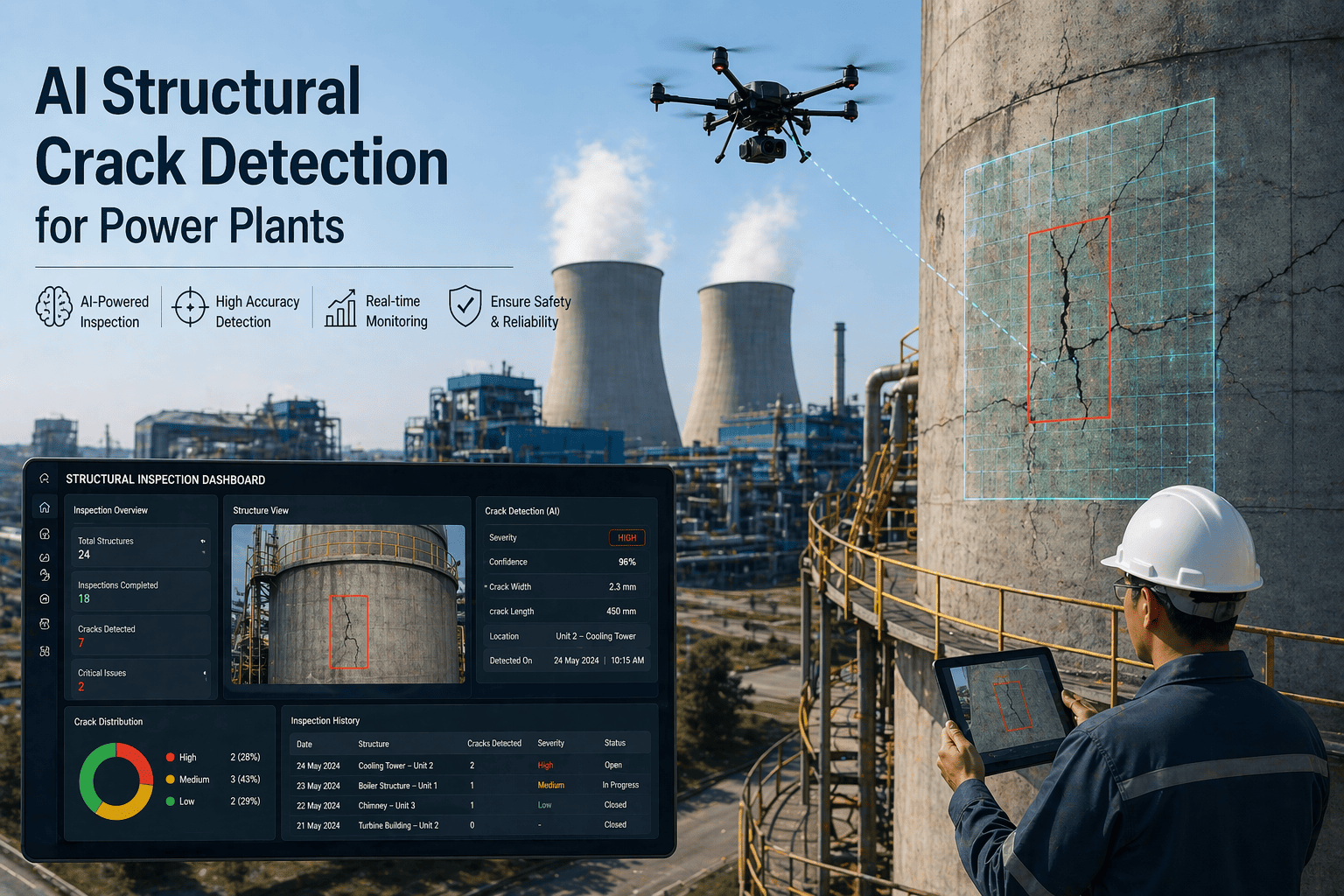
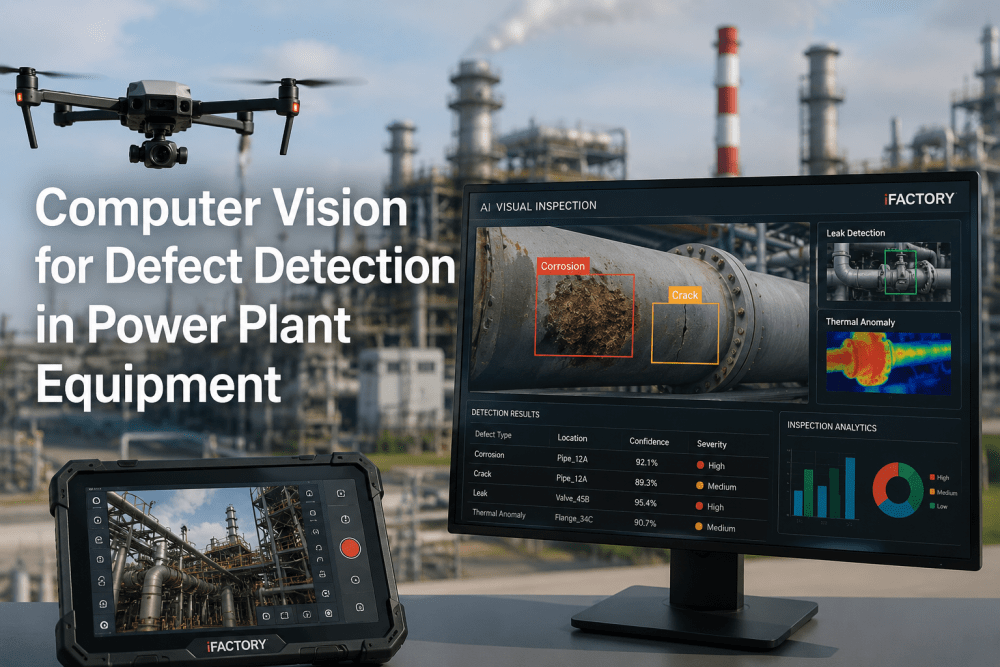
iFactory's AI models identify hairline cracks, spalling, delamination, and surface erosion with 98.7% accuracy — measuring crack width, length, and orientation automatically while filtering out shadows, stains, or non-structural surface variations.
02
Multi-Asset Structural Monitoring
Monitor cooling tower shells, chimney liners, foundation walls, turbine pedestals, and pipe supports simultaneously. AI correlates defect progression across assets to identify systemic issues like foundation settlement or environmental exposure patterns.
03
Weather & Lighting Resilience
Advanced vision models operate reliably in fog, rain, snow, low light, and glare conditions — maintaining detection performance 24/7/365 without manual camera adjustment or supplemental lighting for outdoor structural assets.
04
CMMS, Drone & Asset Management Integration
iFactory connects to IBM Maximo, SAP PM, Fiix, and custom CMMS platforms plus drone fleet management and GIS systems via REST APIs, OPC-UA, and database connectors. Defects auto-generate work orders with severity priority, location maps, and historical trend data. Integration completed in under 10 days.
05
Automated Compliance Reporting
Generate audit-ready structural integrity reports instantly: defect logs, progression trends, inspection coverage, and remediation tracking. Pre-configured templates for ASME PCC-3, API 570/653, NERC reliability standards, and regional civil infrastructure regulations.
06
Severity-Prioritized Alerting
iFactory ranks structural defects by risk level: active crack propagation in load-bearing zone (critical), surface spalling near expansion joint (high), cosmetic staining (low). Maintenance teams focus on what matters — with defect measurements, progression charts, and recommended repair actions.
Regulatory Framework Support: Built for Power Plant Structural Compliance
iFactory's AI structural monitoring platform is pre-configured to support documentation and audit requirements of major power industry civil asset frameworks. Compliance reporting is automatic.
ASME PCC-3 / API 570
Inspection planning and fitness-for-service alignment: defect detection logs, measurement records, progression trending, and repair verification — with full traceability for pressure boundary and piping support compliance.
API 653 / ACI 318
Tank and concrete structure standards: shell inspection records, foundation assessment data, crack monitoring evidence, and remediation documentation — structured for certification audits and asset life extension reviews.
NERC Reliability Standards
Critical infrastructure reliability requirements: structural health monitoring metrics, defect response timelines, and risk mitigation documentation — auto-generated for federal reliability compliance submissions.
State Utility Commissions
Regional civil asset oversight: inspection coverage reporting, structural integrity metrics, and capital planning justification — formatted for state-level utility regulatory reviews and rate case support.
How iFactory Is Different from Generic Inspection Tools
Most structural inspection vendors offer drone imagery or basic photo documentation wrapped in a portal and marketed as "digital inspection." iFactory is built differently — from the power plant civil asset threat model up, specifically for environments where missed defects create catastrophic risk, subjective grading delays maintenance, and compliance documentation is non-negotiable. Talk to our structural integrity specialists and compare your current inspection approach directly.
iFactory AI Structural Monitoring Implementation Roadmap
iFactory follows a fixed 5-stage deployment methodology designed specifically for power plant civil asset monitoring — delivering pilot defect detection in week 3 and full production monitoring by week 7. No open-ended implementations. No inspection downtime.
01
Structural Audit
Map critical assets & identify monitoring zones
02
System Integration
Connect to CMMS, drone fleet, GIS via APIs
03
Pilot Configuration
Deploy AI monitoring to 3–5 critical structural assets
04
Validation & Training
User acceptance testing & maintenance team training
05
Full Production
Plant-wide AI structural monitoring go-live
7-Week Deployment and ROI Plan
Every iFactory engagement follows a structured 7-week program with defined deliverables per week — and measurable ROI indicators beginning from week 3 of deployment. Request the full 7-week deployment scope document tailored to your plant's structural asset portfolio.
Weeks 1–2
Discovery & Design
Current structural inspection workflow assessment across cooling towers, chimneys, foundations, and civil supports
AI monitoring strategy design aligned with defect models, maintenance protocols, and compliance requirements
Integration planning with CMMS, drone systems, and asset management platforms
Weeks 3–4
Pilot & Validation
Deploy AI structural monitoring to high-risk assets: cooling tower shell, chimney liner, turbine foundation
Defect classification and severity workflows activated; false positive tuning tested with structural engineers
First structural defects detected — ROI evidence begins here
Weeks 5–7
Scale & Optimize
Expand to full plant coverage: all civil assets, all monitoring zones, 24/7 defect detection
Automated compliance reporting activated for applicable regulatory frameworks
ROI baseline report delivered — emergency repair avoidance, inspection time savings, and asset life extension value
ROI IN 5 WEEKS: MEASURABLE RESULTS FROM WEEK 3
Plants completing the 7-week program report an average of $276,000 in avoided emergency repairs and inspection overhead within the first 5 weeks of full production rollout — with early-stage defect detection improvements of 34–52% detected by week 3 pilot validation.
$276K
Avg. risk mitigation value in first 5 weeks
34–52%
Early defect detection gain by week 3
98.7%
Crack detection accuracy achieved
Eliminate Structural Blind Spots. Monitor Critical Assets in 7 Weeks. ROI Evidence in Week 3.
iFactory's fixed-scope deployment program means no open timelines, no inspection downtime, and no months of customization before you see a single structural defect detected with precision.
Use Cases and KPI Results from Live Deployments
These outcomes are drawn from iFactory deployments at operating power plants across three structural monitoring categories. Each use case reflects 6-month post-deployment performance data. Request the full case study report for the structural asset most relevant to your facility.
A mid-size coal-fired power plant operating two natural-draft cooling towers was relying on annual rope-access inspections for shell integrity assessment. Between inspections, hairline cracks propagated undetected due to thermal cycling and environmental exposure. iFactory deployed fixed-mount AI vision cameras with multi-angle coverage and crack progression modeling. Within 4 weeks of go-live, the system detected 4 active crack propagation events that would have required emergency repair if discovered during the next scheduled inspection — enabling proactive patching during planned maintenance.
4
Active crack propagation events detected in first 4 weeks
$680K
Estimated annual value from prevented emergency repairs and outage delays
97%
Defect detection accuracy on cooling tower shell surfaces
A combined cycle power plant was experiencing accelerated liner degradation in its exhaust stack due to condensation and acid exposure. Periodic drone inspections captured imagery but required manual annotation and lacked progression trending. iFactory implemented AI vision with spalling classification, corrosion mapping, and liner thickness estimation. The system identified 2 high-risk spalling zones 6 weeks before they would have triggered regulatory inspection findings — enabling targeted liner rehabilitation during a scheduled outage.
6 wks
Early detection lead time vs. scheduled inspection cycle
100%
Regulatory inspection finding avoidance achieved
$410K
Annual value from proactive liner maintenance vs. emergency repair
A nuclear generation facility required rigorous documentation of foundation integrity for seismic qualification and license renewal. Manual inspection records were fragmented across paper reports, drone imagery, and CMMS entries — complicating trend analysis and regulatory submissions. iFactory deployed AI structural monitoring with automated defect logging, progression trending, and ASME-compliant report generation. All 18 foundation observations in month one were documented with measurement precision and auto-synced to the asset management system, reducing inspection documentation time by 84%.
84%
Inspection documentation time reduction
100%
ASME PCC-3 report compliance achieved
$520K
Annual value from streamlined compliance and asset life extension planning
What Power Plant Engineering Teams Say About iFactory AI Structural Monitoring
The following testimonial is from a structural integrity manager at a US power generation facility currently running iFactory's AI structural monitoring platform.
We went from annual rope-access inspections with subjective grading to continuous AI monitoring with sub-millimeter crack measurement. The system caught a propagating crack on our cooling tower shell three months before it would have triggered an emergency repair — saving us $400K in unplanned outage costs and giving us time to plan the fix during scheduled maintenance. Integration with our Maximo CMMS took 8 days. This isn't just an inspection upgrade — it's a fundamental shift in how we manage structural risk for critical assets.
Structural Integrity Manager
Coal-Fired Power Plant, Pennsylvania
Frequently Asked Questions
Does iFactory require replacing existing inspection cameras or drones?
In most deployments, iFactory connects to existing fixed-mount IP cameras or drone imagery feeds via RTSP or API — no hardware replacement required. Where critical coverage gaps are identified during the Week 1 structural audit, iFactory recommends targeted additions only (typically 4–8 cameras per major asset), not a full system overhaul. Integration is complete within 10 days in standard environments.
Which structural assets does iFactory support monitoring for?
iFactory supports monitoring for cooling tower shells (natural/mechanical draft), chimney liners and stacks, foundation walls and pedestals, turbine supports, pipe racks, cable trays, retaining walls, and other civil concrete/steel structures. Asset-specific defect models are configured during the Week 1–2 audit phase.
How does iFactory perform in challenging outdoor conditions?
iFactory's vision models are trained on diverse environmental conditions: fog, rain, snow, low light, glare, extreme temperatures, and wind-induced camera motion. Detection accuracy remains above 98% across all tested conditions. Edge processing ensures performance even during network latency or intermittent connectivity.
Can iFactory measure crack progression over time?
Yes. iFactory includes automated crack width, length, and orientation measurement with sub-millimeter precision. Progression trending across inspection cycles is calculated with statistical confidence intervals, enabling predictive maintenance planning and fitness-for-service assessments. Trending capabilities are configured during the Week 1–2 audit phase.
How long does training take for engineering and maintenance personnel?
Role-based training modules are delivered during Weeks 4–5 of deployment. Most structural engineers and maintenance planners achieve proficiency in under 75 minutes. Supervisors and administrators receive additional training on alert configuration, reporting, and system management. Ongoing support and model updates are included.
What if our plant has unique structural configurations or regulatory requirements?
iFactory's defect modeling allows configuration of custom detection zones, severity rules, and compliance workflows without code. Our implementation team works with your structural engineering, maintenance, and compliance teams during Week 1–2 to align the platform with your specific asset portfolio and regulatory obligations.
Stop Relying on Periodic Inspections. Start Protecting Assets with Continuous AI Structural Monitoring.
iFactory gives power plant engineering teams real-time defect detection, progression trending, automated compliance reporting, and seamless CMMS integration — fully deployed in 7 weeks, with ROI evidence starting in week 3.
98.7% crack detection accuracy with AI vision measurement
CMMS, drone & asset management integration in under 10 days
ASME PCC-3, API 570/653, and NERC audit trails out-of-the-box
Weather-resilient monitoring 24/7/365 without manual adjustment