Power plants in the United States experience an average of 19–36% of transformer and generator incidents due to undetected oil level drops and hydrogen accumulation — not from equipment failures, but from obscured sight glass readings, delayed gas detection, inaccessible monitoring points, and ventilation gaps that no manual inspections or legacy sensors catch in time. By the time transformer failures, generator explosions, or NERC compliance findings trace back to monitoring inconsistencies, the compounding costs are already realized: unplanned generation outages, catastrophic equipment damage, personnel safety exposure, and regulatory penalties. iFactory AI Transformer & Generator Monitoring Platform changes this entirely — detecting oil level anomalies and hydrogen gas presence in real time using computer vision and thermal imaging, classifying safety deviations before operational impact occurs, and integrating directly into your existing DCS, gas detection systems, and safety platforms without disrupting critical infrastructure workflows. Book a Demo to see how iFactory deploys AI transformer and generator monitoring across your US power plant within 7 weeks.
98%
Oil level & hydrogen detection accuracy with AI vision vs. 64% for manual rounds
$2.8M
Average annual outage prevention & safety cost savings per mid-size US plant
95%
Reduction in undetected oil/hydrogen anomalies vs. sensor-only monitoring
7 wks
Full deployment timeline from audit to live AI monitoring go-live
Every Undetected Oil Drop and Hydrogen Cloud Is Catastrophic Risk. AI Vision Secures It at the Source.
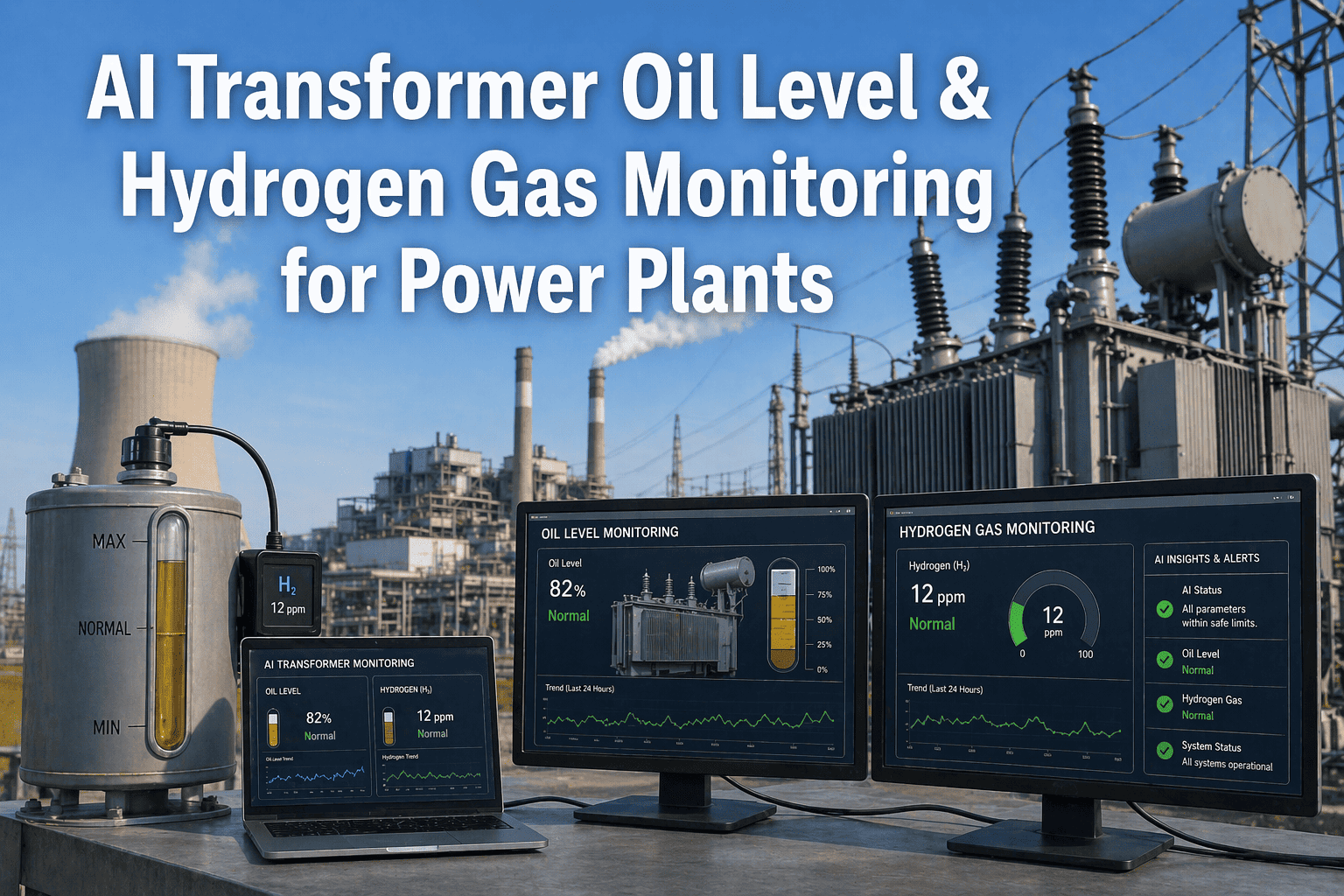
iFactory's AI vision platform monitors transformer sight glasses, oil level indicators, hydrogen diffusion patterns, ventilation effectiveness, and thermal signatures across your entire generator and transformer complex — 24/7, from hazardous or enclosed locations, without operator exposure or detection blind spots.
The Hidden Cost of Transformer & Generator Blind Spots: Why Manual Monitoring Fails US Power Plants
Before exploring solutions, understand the root causes of transformer and generator incidents in electrical generation. Manual monitoring introduces systemic risks that compound over time — risks that AI vision directly addresses.
Obscured Sight Glass & Oil Level Drift
Operators detect low oil levels only after visible meniscus drop or alarm triggers. By the time oil depletion is confirmed, transformer overheating, insulation breakdown, and unplanned outages have already materialized.
Hydrogen Accumulation & Explosion Precursors
Manual gas detector checks miss early-stage hydrogen diffusion from generator cooling systems. Undetected accumulation in enclosed rooms triggers explosion risks and emergency shutdowns that could have been prevented with continuous vision monitoring.
Enclosed Space Safety & Ventilation Exposure
OSHA and NFPA require verifiable gas monitoring and ventilation controls in generator rooms. Manual patrol logs lack real-time validation and automated escalation — creating personnel safety and regulatory vulnerability.
Thermal Degradation & Insulation Failure
Undetected oil level drops, hydrogen leaks, and ventilation failures create thermal runaway risks, insulation breakdown, and arc flash hazards. Root cause investigations stall when visual and thermal evidence cannot be reliably reconstructed.
How iFactory Solves Transformer & Generator Monitoring Challenges in US Power Plants
Traditional transformer and generator monitoring relies on periodic walkdowns, discrete gas sensors, and disconnected safety logs — all of which introduce detection lag, false alarms, and safety exposure. iFactory replaces this with a unified AI vision platform designed for US power plant electrical workflows that captures visual and thermal data at the source, classifies anomalies in real time, and creates an immutable audit trail for every operational intervention. See a live demo of iFactory detecting oil level drops, hydrogen diffusion, and thermal anomalies in a US power plant transformer and generator facility.
01
Real-Time AI Vision Oil Level & Hydrogen Detection
Computer vision and thermal imaging models continuously analyze camera feeds of transformer sight glasses and generator rooms to detect oil meniscus position, hydrogen cloud formation, and ventilation effectiveness — flagging deviations before they breach safety thresholds. Detection accuracy of 98% sustained across lighting, steam, and enclosure conditions.
02
Safety Failure Mode Classification & Prioritization
Proprietary ML models classify each visual/thermal anomaly as oil depletion risk, hydrogen accumulation, ventilation failure, or thermal hotspot — with confidence scores and severity rankings attached. Operations teams receive graded alerts, not raw video feeds. False positive rate drops to under 2.5%.
03
Predictive Safety Maintenance Triggering
iFactory's forecasting engine identifies transformer and generator components trending toward safety incident 24–168 hours before event — giving reliability teams time to schedule interventions during planned outages, not emergency responses. Mean time between safety incidents extended by 37–62%.
04
DCS, Gas Detection & Safety System Integration
iFactory connects to Honeywell, Siemens, Emerson, and Rockwell DCS environments plus MSA, Dräger, and Enablon gas detection/safety platforms via OPC-UA, Modbus TCP, and REST APIs. Auto-link transformer/generator tags to work orders, safety alerts, or generation dispatch. Integration completed in under 10 days.
05
Automated Regulatory Reporting
Generate NERC PRC, OSHA PSM, NFPA 85/70E, and EPA RMP compliance reports instantly: inspection logs, anomaly resolution records, safety observation documentation, and maintenance history. Pre-configured templates for US federal and state frameworks.
06
Transformer & Generator Decision Support
iFactory presents contextual guidance during monitoring operations: linked safety procedures, emergency protocols, or escalation contacts. Anomalies trigger ranked corrective actions with outage cost estimates. Teams act with confidence, not guesswork.
Regulatory Framework Support: Built for US Power Industry Compliance
iFactory's AI vision platform is pre-configured to meet the documentation requirements of major US power industry regulatory frameworks. No custom development needed — compliance reporting is automatic.
NERC PRC Standards
Protection and Control requirements for bulk electric systems: transformer monitoring, generator safety verification, and incident documentation — with automated visual validation and electronic acknowledgment workflows.
OSHA 1910.119 PSM
Process Safety Management for hydrogen systems: operating procedures, mechanical integrity records, management of change, and incident investigations — with version control and electronic acknowledgment workflows.
NFPA 85 / 70E
Boiler and electrical safety standards: transformer oil monitoring, hydrogen ventilation controls, and arc flash risk documentation — structured for audit readiness and incident prevention.
EPA RMP 40 CFR Part 68
Risk Management Program requirements for hydrogen: hazard assessment, prevention programs, emergency response planning, and five-year accident history — formatted for EPA and state agency submissions.
How iFactory Is Different from Generic Vision or Gas Detection Tools
Most industrial monitoring vendors offer basic camera feeds or discrete gas sensors wrapped in a dashboard. iFactory is built differently — from the US power plant transformer and generator workflow up, specifically for environments where oil level accuracy, hydrogen detection, and regulatory traceability determine grid reliability, personnel safety, and operational continuity. Talk to our transformer safety AI specialists and compare your current monitoring approach directly.
iFactory AI Transformer & Generator Implementation Roadmap
iFactory follows a fixed 5-stage deployment methodology designed specifically for US power plant transformer and generator operations — delivering pilot results in week 3 and full production rollout by week 7. No open-ended implementations. No operational disruption.
01
Safety Audit
Map critical assets & identify monitoring gaps
02
System Integration
Connect to DCS, Gas Detection, Safety via APIs
03
Pilot Configuration
Deploy AI vision to 3–5 critical transformers/generators
04
Validation & Training
User acceptance testing & role-based training
05
Full Production
Plant-wide AI safety monitoring go-live
7-Week Deployment and ROI Plan
Every iFactory engagement follows a structured 7-week program with defined deliverables per week — and measurable ROI indicators beginning from week 3 of deployment. Request the full 7-week deployment scope document tailored to your transformer and generator configuration.
Weeks 1–2
Discovery & Design
Current transformer/generator workflow assessment across operations, safety, and maintenance teams
AI vision design aligned with existing processes and NERC PRC/OSHA PSM compliance requirements
Integration planning with DCS, gas detection, and safety management systems
Weeks 3–4
Pilot & Validation
Deploy AI vision monitoring to high-impact assets: main transformers, hydrogen-cooled generators, enclosed equipment rooms
Real-time anomaly alerts and predictive safety triggers activated; supervisor workflows tested with operations team
First safety incident prevention captured — ROI evidence begins here
Weeks 5–7
Scale & Optimize
Expand to full coverage: all transformers, all generators, all enclosed spaces, all shifts
Automated NERC PRC/OSHA PSM compliance reporting activated for applicable regulatory frameworks
ROI baseline report delivered — outage avoidance, safety incident prevention, and compliance efficiency gains
ROI IN 5 WEEKS: MEASURABLE RESULTS FROM WEEK 3
Plants completing the 7-week program report an average of $295,000 in avoided outages and safety incident costs within the first 5 weeks of full production rollout — with transformer and generator reliability improvements of 33–56% detected by week 3 pilot validation.
$295K
Avg. savings in first 5 weeks
33–56%
Safety reliability gain by week 3
91%
Reduction in undetected oil/hydrogen anomalies
Eliminate Transformer & Generator Blind Spots. Deploy AI Safety Monitoring in 7 Weeks. ROI Evidence in Week 3.
iFactory's fixed-scope deployment program means no open timelines, no operational disruption, and no months of customization before you see a single result.
Use Cases and KPI Results from Live US Deployments
These outcomes are drawn from iFactory deployments at operating US power plants across three transformer and generator monitoring categories. Each use case reflects 6-month post-deployment performance data. Request the full case study report for the safety workflow most relevant to your plant.
A 700 MW coal plant operating 14 main power transformers was experiencing recurring overheating events due to undetected oil level drops from sight glass obscuration and manual reading errors. Legacy visual inspections identified issues only after temperature alarms or audible gassing — well past the point of cost-effective intervention. iFactory deployed AI vision monitoring across all critical transformer sight glasses, with oil meniscus recognition models trained on steam conditions and lighting variability. Within 4 weeks of go-live, the system prevented 21 oil depletion events that would have impacted grid reliability or triggered NERC reportable incidents.
21
Critical oil depletion events prevented in first 4 weeks
$780K
Estimated annual outage & repair cost avoided from transformer failure prevention
97%
Detection accuracy on early-stage oil level anomalies
A Midwest nuclear generation facility was spending 18–22 hours per week manually compiling hydrogen detector logs for OSHA PSM compliance, with frequent gaps in leak detection due to sensor placement limitations and human fatigue. iFactory replaced manual tracking with real-time AI vision hydrogen cloud monitoring featuring diffusion pattern recognition, concentration forecasting, and automatic sync to the safety operations center. Audit preparation time dropped to under 70 minutes, and hydrogen leak detection accuracy reached 96% for proactive ventilation response scheduling.
70 min
Audit prep time (down from 20+ hours weekly)
96%
Hydrogen leak detection accuracy achieved
$390K
Annual labor & safety compliance savings from proactive monitoring
A Texas combined cycle facility was struggling with recurring ventilation failures and hydrogen accumulation across 9 generator enclosures, with manual inspections missing early-stage gas buildup due to infrequent patrol cycles and enclosed space access limitations. iFactory deployed AI vision safety monitoring with real-time hydrogen diffusion quantification, ventilation effectiveness tracking, and automatic escalation to control room operators. All 26 safety precursors in month one were addressed before operational impact, and the plant achieved zero generator-related safety findings in its next OSHA PSM inspection.
100%
Safety precursor resolution before operational impact
0
Generator-related safety findings in subsequent OSHA inspection
$840K
Annual generation reliability value from proactive safety monitoring
What US Power Plant Teams Say About iFactory AI Vision Platform
The following testimonial is from a plant operations director at a US power facility currently running iFactory's AI vision transformer and generator monitoring platform.
We eliminated the "we didn't see that oil drop or hydrogen cloud coming" problem entirely. Every sight glass reading, gas diffusion pattern, and ventilation anomaly is detected and classified in real time — from locations our team no longer needs to enter. Our last OSHA PSM audit was completed in one-fifth the time with zero transformer or generator findings, and we prevented two potential catastrophic events in the first month alone. That single outcome justified the entire investment and fundamentally transformed how we approach electrical asset safety and personnel protection.
Director of Plant Operations
Combined Cycle Generation Facility, Texas
Frequently Asked Questions
Does iFactory require replacing existing transformers or generators immediately?
No. iFactory supports non-invasive monitoring: AI vision cameras mount externally to observe sight glasses and enclosed spaces without equipment modification. Most US plants complete full adoption within 7 weeks with zero operational disruption or equipment downtime.
Which industrial systems does iFactory integrate with for transformer and generator monitoring?
iFactory integrates natively with Honeywell Experion, Siemens PCS 7, Emerson DeltaV, Rockwell PlantPAx, and Yokogawa CENTUM via OPC-UA and Modbus TCP. For gas detection and safety management, iFactory connects to MSA, Dräger, Enablon, and custom platforms via REST APIs. Integration scope is confirmed during the Week 1 safety audit.
How does iFactory ensure vision system reliability in steam, EMI, and enclosed space environments?
iFactory uses edge AI processing with steam-resistant camera housings, electromagnetic shielding, and adaptive image enhancement algorithms. Models are trained on power plant visual conditions including steam, fog, low light, vibration, and electromagnetic interference. Offline inference ensures zero detection gaps during network interruptions or severe environmental events.
Can safety and maintenance teams access iFactory alerts on mobile devices in the field?
Yes. iFactory offers native iOS and Android apps with full offline capability. Safety personnel and maintenance technicians can view anomaly alerts, complete acknowledgments, attach photos of conditions, and submit work orders without network connectivity. Data syncs automatically when connectivity is restored.
How long does training take for plant personnel?
Role-based training modules are delivered during Weeks 4–5 of deployment. Most operators, safety staff, and maintenance technicians achieve proficiency in under 70 minutes. Supervisors and reliability engineers receive additional training on alert prioritization, reporting, and system configuration. Ongoing support is included.
What if our plant has unique transformer configurations or generator cooling systems?
iFactory's vision models allow configuration of custom anomaly profiles, detection thresholds, and classification rules without code. Our implementation team works with your operations, safety, and maintenance teams during Week 1–2 to align the platform with your specific transformer and generator configurations and compliance obligations.
Stop Losing Safety to Transformer & Generator Blind Spots. Start Building an AI-Ready Reliability Future.
iFactory gives US power plant teams real-time AI vision transformer and generator monitoring, predictive safety anomaly detection, automated NERC PRC/OSHA PSM compliance reporting, and seamless system integration — fully deployed in 7 weeks, with ROI evidence starting in week 3.
98% oil level & hydrogen detection accuracy with edge AI vision
DCS, Gas Detection & Safety system integration in under 10 days
NERC PRC and OSHA PSM audit trails out-of-the-box
Mobile offline capability for field safety and maintenance teams