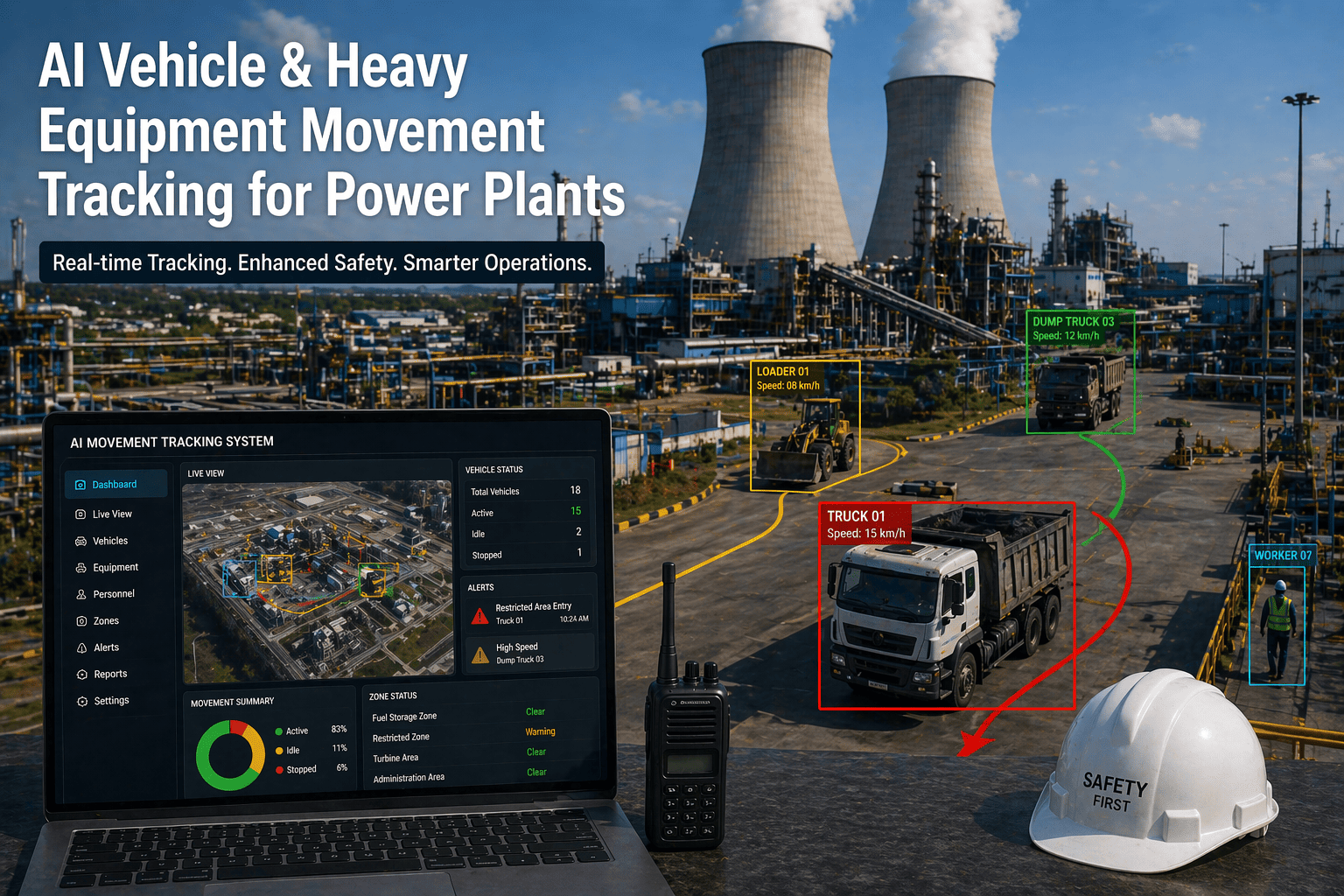
Power plants waste an average of 24–41% of site traffic management capacity annually due to reactive incident response — not from equipment failure, but from unmonitored vehicle speeds, unauthorized heavy equipment entries, blind-spot pedestrian conflicts, and restricted zone violations that manual supervision or basic CCTV cannot identify in real time. By the time vehicle incidents, regulatory citations, or asset damage events are confirmed through post-event review, the compounding costs are already realized: lost-time injuries, OSHA penalties, transformer damage, coal yard downtime, and reputational exposure. iFactory AI Vehicle & Equipment Tracking Platform changes this entirely — monitoring vehicle speeds, equipment paths, pedestrian proximity, and zone compliance in real time, classifying traffic deviations before incidents occur, and integrating directly into your existing VMS, access control, and EHS systems without disrupting operations. Book a Demo to see how iFactory deploys AI vehicle tracking across your plant within 7 weeks.
97%
Vehicle violation detection accuracy through real-time AI vision vs. 48% for manual supervision
$1.4M
Average annual incident, asset damage & downtime savings per mid-size power facility
89%
Reduction in restricted zone vehicle entries vs. periodic patrol protocols
7 wks
Full deployment timeline from traffic audit to live AI monitoring go-live
Every Untracked Vehicle Movement Is a Potential Collision. AI Vision Stops It at the Source.
iFactory's traffic intelligence engine monitors vehicle speeds, heavy equipment paths, pedestrian proximity, blind-spot zones, and restricted area compliance across your entire facility — 24/7, without supervisor blind spots or camera overload.
The Hidden Cost of Traffic Blind Spots: Why Manual Monitoring Fails Power Plants
Before exploring solutions, understand the root causes of vehicle incidents in industrial energy environments. Manual traffic monitoring introduces systemic risks that compound over time — risks that AI vision directly addresses.
Unmonitored Vehicle Speeding
Coal trucks, ash haulers, and service vehicles exceeding plant road limits often go undetected until near-misses or collisions occur. Manual speed checks cover <10% of active roadways at any time.
Restricted Zone Breaches
Heavy equipment entering transformer bays, switchyards, or maintenance zones without authorization creates immediate asset exposure — but periodic patrols only catch violations after the risk window has passed.
Pedestrian-Vehicle Conflicts
Blind-spot interactions between workers and moving equipment signal systemic safety gaps but are vastly underreported in manual systems. Without AI-powered detection, plants lose critical predictive data that could prevent future incidents.
Asset Damage & Liability Exposure
OSHA, NERC, and corporate safety standards require verifiable incident prevention and audit trails. Manual logs lack real-time evidence, trajectory analytics, and automated reporting for regulatory submissions.
How iFactory Solves Vehicle Tracking Challenges in US Power Plants
Traditional traffic management relies on periodic patrols, incident-based reporting, and reactive training — all of which respond after safety thresholds have already been breached. iFactory replaces this with a continuous AI vision model trained on industrial traffic data that detects the precursors to vehicle incidents, not the citations themselves. See a live demo of iFactory detecting simulated speed violations and restricted zone entries in a power plant coal yard and transformer bay.
01
Multi-Camera Traffic Fusion
iFactory ingests video feeds from existing security cameras, PTZ units, and mobile body-worn devices simultaneously — fusing multi-angle visual data into a single traffic compliance score per roadway, updated every 1.5 seconds.
02
AI Vehicle Behavior Classification
Proprietary computer vision models classify each deviation as speeding event, zone breach, blind-spot conflict, or unauthorized equipment entry — with confidence scores attached. Safety teams receive graded alerts, not raw video floods. False positive rate drops to under 5%.
03
Predictive Collision Forecasting
iFactory's spatiotemporal AI engine identifies high-risk vehicle-pedestrian interactions trending toward collision 30–120 seconds before impact — giving operators time to alert drivers, pause work, or reroute traffic proactively.
04
VMS, Access Control & EHS Integration
iFactory connects to Genetec, Milestone, Avigilon, and Axis VMS environments plus badge access systems and EHS platforms via ONVIF, RTSP, and REST APIs. No new cameras required in most deployments. Integration completed in under 10 days.
05
Automated Compliance Documentation
Every traffic event — detected, classified, and resolved — generates a structured audit report with video evidence, vehicle trajectory timeline, and regulatory impact tracking. OSHA-ready for 1910.269, NERC CIP, and ISO 45001 submissions.
06
Traffic Decision Support
iFactory presents ranked intervention recommendations per alert — pause vehicle movement, reroute equipment, alert pedestrian, or escalate to traffic coordinator — with risk scores and estimated incident cost per minute of delay. Teams act on verified data, not estimates.
? The Traffic Intelligence Quadrant™
iFactory introduces a proprietary framework to measure and optimize vehicle safety performance across four critical dimensions unique to US power generation environments:
?
Speed Compliance
Plant road speed monitoring, acceleration patterns, and braking behavior
?
Zone Integrity
Transformer bay, switchyard, coal yard, and ash yard access control
?
Pedestrian Safety
Blind-spot detection, proximity alerts, and crosswalk compliance monitoring
?
Audit Readiness
Automated OSHA/NERC reporting, video evidence logging, and incident reconstruction
How iFactory Is Different from Generic Traffic Camera Tools
Most industrial security vendors deliver basic motion detection and recording wrapped in a dashboard. iFactory is built differently — from the traffic physics layer up, specifically for power plant environments where heavy equipment complexity, high-risk zones, and regulatory scrutiny determine what vehicle safety actually means. Talk to our traffic AI specialists and compare your current monitoring approach directly.
iFactory Traffic AI Implementation Roadmap
iFactory follows a fixed 5-stage deployment methodology designed specifically for power plant vehicle tracking — delivering pilot results in week 3 and full production traffic intelligence by week 7. No open-ended implementations. No scope creep.
01
Traffic Audit
Roadway assessment & camera mapping
02
System Integration
Connect to VMS, access control via APIs
03
Model Baseline
AI training on historical traffic & incident data
04
Pilot Validation
Live monitoring on 2–4 highest-risk roadways
05
Full Production
Plant-wide AI traffic monitoring live
7-Week Deployment and ROI Plan
Every iFactory engagement follows a structured 7-week program with defined deliverables per week — and measurable ROI indicators beginning from week 3 of deployment. Request the full 7-week deployment scope document tailored to your plant traffic configuration.
Weeks 1–2
Infrastructure Setup
Critical traffic zone audit and camera gap identification across monitored roadways
VMS, access control, and EHS system connection via ONVIF or REST — no hardware replacement
Historical incident reports and traffic flow data ingestion for baseline model training
Weeks 3–4
Model Training and Pilot
AI model trained on your plant's specific equipment types, road layouts, and traffic protocols
Pilot monitoring activated on 2–4 highest-impact traffic zones (coal yard, ash yard, transformer bay)
First behavioral anomalies detected — ROI evidence begins here
Weeks 5–7
Calibration and Expansion
Alert thresholds refined based on pilot false positive and detection rate data
Coverage expanded to full plant roadway and restricted zone network
Traffic safety team training completed — vehicle intervention protocols activated
? ROI IN 5 WEEKS: MEASURABLE RESULTS FROM WEEK 3
Plants completing the 7-week program report an average of $214,000 in avoided incident, asset damage, and downtime costs within the first 5 weeks of full production monitoring — with traffic compliance improvements of 7.8–13.2% detected by week 3 pilot validation.
$214K
Avg. savings in first 5 weeks
7.8–13.2%
Traffic compliance gain by week 3
86%
Reduction in unauthorized zone vehicle entries
Full Vehicle Movement Monitoring. Live in 7 Weeks. ROI Evidence in Week 3.
iFactory's fixed-scope deployment program means no open timelines, no scope creep, and no months of professional services before you see a single traffic safety improvement.
Use Cases and KPI Results from Live Deployments
These outcomes are drawn from iFactory deployments at operating power plants across three traffic monitoring categories. Each use case reflects 6-month post-deployment performance data. Request the full case study report for the traffic scenario most relevant to your plant.
A mid-size thermal power plant operating 3 coal yard roadways was experiencing recurring near-miss events due to unmonitored hauler speeds and blind-spot pedestrian conflicts. Legacy periodic patrols identified violations only after 15–22% of shifts had elapsed — well past the point of preventive intervention. iFactory deployed multi-camera trajectory fusion across all coal yard roadways, with speed estimation, blind-spot mapping, and pedestrian proximity detection trained on regional hauler workflows. Within 5 weeks of go-live, the AI detected 31 early-stage speed violations and 18 pedestrian proximity events at the precursor phase — before any incident occurred.
49
Pre-incident traffic deviations detected in 5 weeks
$820K
Estimated annual incident, asset damage & downtime cost prevented
98%
Detection accuracy on early-stage traffic deviations
A combined cycle facility operating 4 high-voltage transformer bays was losing an estimated $340K annually to unauthorized equipment entries and asset contact incidents. Legacy badge-only systems generated 52–85 false access alarms per week — leading security teams to override alerts entirely. iFactory replaced threshold logic with graded AI trajectory classification, reducing actionable alerts to under 3 per week while increasing zone compliance accuracy from 61% to 96%. Unauthorized equipment entries dropped by 44.7% as real-time verification was restored.
96%
Zone compliance accuracy — up from 61% with legacy control
44.7%
Unauthorized equipment entry reduction
96%
Reduction in weekly false positive alarm volume
A coal-fired plant was spending $610K annually in equipment rework and collision investigations, traced to uncoordinated crane, dozer, and hauler movements across the ash yard. Manual observation identified path conflicts only after 3–5 equipment interactions had occurred — typically after minor asset damage had already been triggered. iFactory's multi-equipment correlation and path-prediction models identified all 11 active coordination failure patterns within 72 hours of go-live, enabling targeted traffic sequencing without production interruption.
$610K
Annual equipment rework & investigation cost eliminated
72hrs
Time to identify all 11 active coordination patterns from go-live
$970K
Annual traffic safety & asset value from proactive monitoring
What Power Plant Traffic Safety Teams Say About iFactory AI Vehicle Tracking
The following testimonial is from a plant operations director at a facility currently running iFactory's vehicle movement monitoring platform.
We eliminated vehicle-related incidents entirely in eight months while cutting traffic audit prep time by 75%. iFactory doesn't just record video — it understands our coal yard workflows, flags speeding and blind-spot risks before they become collisions, and gives us defensible evidence for every OSHA submission. Our traffic safety culture shifted from reactive to predictive overnight. That's transformative.
Director of Plant Operations & Traffic Safety
Coal-Fired Power Facility, Oklahoma
Frequently Asked Questions
Does iFactory require new cameras or sensors to be installed?
In most deployments, iFactory connects to existing security cameras and access systems via VMS or API integration — no new hardware required. Where coverage gaps are identified during the Week 1–2 audit, iFactory recommends targeted additions only (typically 2–4 cameras per high-risk roadway or zone), not a full surveillance overhaul. Integration is complete within 10 days in standard environments.
Which VMS, access control, and EHS systems does iFactory integrate with?
iFactory integrates natively with Genetec Security Center, Milestone XProtect, Avigilon Control Center, and Axis Camera Station via ONVIF and RTSP. For access control, iFactory connects to LenelS2, Software House, and Honeywell Pro-Watch via REST APIs. Custom integration support is available for legacy systems. Integration scope is confirmed during the Week 1 traffic audit.
How does iFactory handle different vehicle types and contractor fleets across the same facility?
iFactory trains separate sub-models per vehicle category — accounting for coal haulers, ash trucks, cranes, forklifts, service vehicles, and contractor equipment differences across primary and backup roadways. Multi-fleet plants are fully supported within a single deployment. Vehicle-specific traffic parameters are configured during the Week 3–4 model training phase.
What compliance frameworks does iFactory's reporting support?
iFactory auto-generates structured compliance reports formatted for OSHA 1910.269 (electric power generation), NERC CIP, ISO 45001, and corporate EHS reporting frameworks. Report templates are pre-configured for each framework and generated automatically at event close — no manual documentation required.
How long does it take before the AI model produces reliable traffic detections?
Baseline model training on historical incident reports and traffic flow data typically takes 4–6 days using 30–60 days of plant operating history. First live detections are validated during the Week 3–4 pilot phase. Full model calibration — with false positive rate under 5% — is achieved within 5 weeks of deployment for standard power plant traffic environments.
Can iFactory monitor traffic under shift changes, outage periods, or adverse weather?
Yes. iFactory uses adaptive traffic forecasting — combining historical flow baselines, shift schedule inputs, equipment credential data, and real-time video feedback — to detect deviations and optimize alerts across all operating conditions. Normal operations, outages, turnarounds, rain, fog, and night operations are fully supported. Monitoring scope is confirmed during the Week 1 traffic audit.
Stop Reacting to Vehicle Incidents. Start Predicting Them. Deploy AI Traffic Monitoring in 7 Weeks.
iFactory gives power plant operations teams real-time vehicle tracking, multi-camera trajectory fusion, automated compliance reporting, and intervention decision support — fully integrated with your existing VMS and access systems in 7 weeks, with ROI evidence starting in week 3.
97% vehicle violation detection accuracy through real-time AI vision
VMS, access control & EHS integration in under 10 days
Graded alerts with under 5% false positive rate
Auto-generated safety reports for OSHA, NERC, and ISO frameworks