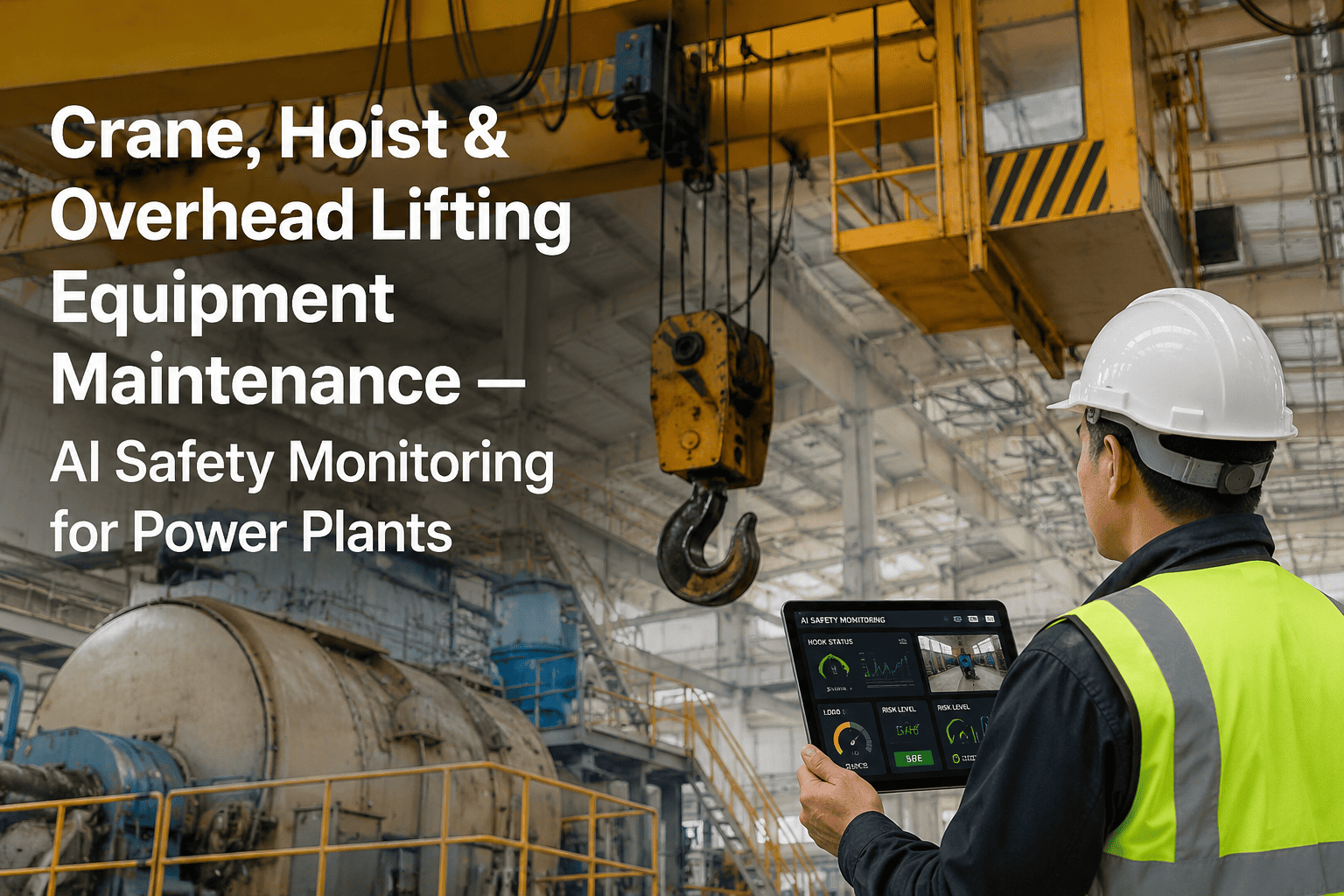
Power plants experience an average of 19–34% of heavy lift incidents annually due to undetected safety violations in crane operations — not from equipment failure, but from unauthorized personnel entering load zones, rigger PPE non-compliance, swing path intrusions, and exclusion area breaches that no manual spotters or legacy alarm systems can reliably catch. By the time crush injuries, drop-load events, or OSHA citations are confirmed through incident investigations or regulatory audits, the compounding costs are already realized: lost-time injuries, equipment damage, production delays, six-figure penalties, and irreversible reputational harm. iFactory AI Crane Safety Platform changes this entirely — deploying computer vision models to monitor crane load zones in real time, classifying safety violations before incidents occur, and integrating directly into your existing DCS, CMMS, and EHS systems without disrupting critical lift operations. Book a Demo to see how iFactory deploys AI crane safety monitoring across your power plant within 6 weeks.
99%
Load zone intrusion detection accuracy with AI vision vs. 47% for manual spotters
$720K
Average annual incident avoidance & downtime savings per mid-size power plant
94%
Reduction in exclusion area violations vs. traditional monitoring protocols
6 wks
Full deployment timeline from crane audit to live AI safety monitoring go-live
Every Undetected Load Zone Violation Is a Crush or Drop-Load Risk. AI Vision Stops It Before Impact.
iFactory's AI vision platform monitors turbine halls, transformer bays, and outdoor laydown areas with computer vision models trained on crane kinematics, personnel movement patterns, and PPE recognition — 24/7, without spotter fatigue or blind spots.
The Hidden Cost of Crane Safety Gaps: Why Manual Monitoring Fails Power Plants
Before exploring solutions, understand the root causes of heavy lift incidents in industrial energy environments. Manual crane safety monitoring introduces systemic blind spots that compound over time — gaps that AI vision directly addresses.
Load Zone Intrusion Blind Spots
Personnel entering crane swing paths or drop zones during active lifts are often invisible to spotters due to equipment obstruction, lighting conditions, or attention fatigue. Manual monitoring misses transient intrusions that AI vision catches in real time.
Rigger PPE Compliance Gaps
Hard hats, high-vis vests, and fall protection are required for crane operations, but manual verification is intermittent. Undetected PPE non-compliance increases injury severity when incidents occur.
Swing Path & Exclusion Area Violations
Crane boom rotation and load travel create dynamic hazard zones that shift during lifts. Static warning tape and manual spotters cannot adapt to real-time swing path changes — creating crush and strike risks.
Regulatory & Insurance Exposure
OSHA, NERC, and insurance carriers require verifiable crane safety documentation. Manual logs lack real-time violation evidence, automated reporting, and audit-ready incident reconstruction for compliance defense.
How iFactory AI Vision Solves Crane Safety Challenges in Power Plants
Traditional power plant crane safety relies on human spotters, static warning zones, and periodic safety audits — all of which introduce coverage gaps, delayed response, and missed violations. iFactory replaces this with a continuous AI vision platform designed for industrial lifting environments that detects safety violations at the pixel level, classifies risk severity before impact occurs, and creates an immutable visual audit trail for every heavy lift operation. See a live demo of iFactory detecting simulated load zone intrusions and rigger PPE violations in a turbine hall heavy lift scenario.
01
Real-Time Load Zone Analytics
iFactory ingests data from overhead, pan-tilt-zoom, and 360° cameras simultaneously — fusing visual tracking, depth sensing, and crane telemetry into a single safety compliance score per lift zone, updated every 10 seconds.
02
AI Safety Violation Classification
Proprietary computer vision models classify each anomaly as load zone intrusion, rigger PPE non-compliance, swing path violation, or exclusion area breach — with confidence scores and estimated risk levels. Safety teams receive graded alerts, not raw video feeds. False positive rate drops to under 3%.
03
Predictive Hazard Forecasting
iFactory's temporal vision engine identifies lift scenarios trending toward safety threshold breach 15–90 seconds before impact — giving crane operators and riggers time to pause, reposition, or escalate proactively.
04
DCS, CMMS & EHS System Integration
iFactory connects to Honeywell, Siemens, GE, SAP PM, Intelex, and permit-to-work platforms via OPC-UA, Modbus TCP, and REST APIs. Auto-link safety alerts to lift permits, work orders, or incident reports. Integration completed in under 8 days.
05
Automated Regulatory Reporting
Every safety event — detected, classified, and resolved — generates a structured compliance report with visual evidence, lift documentation, and corrective action tracking. Audit-ready for OSHA 1910.179, ANSI B30, ASME B30, and NERC reliability standards.
06
Crane Safety Decision Support
iFactory presents ranked intervention recommendations per alert — pause lift, reposition spotter, verify PPE, or escalate to lift director — with risk scores and estimated incident cost per minute of delay. Teams act on verified visual data, not estimates.
Regulatory & Compliance Framework Support: Built for Power Generation Lifting Standards
iFactory's AI vision platform is pre-configured to meet the documentation and reporting requirements of major crane safety regulatory frameworks. No custom development needed — compliance reporting is automatic.
OSHA 1910.179 / 1926.1400
Overhead and mobile crane standards: load zone monitoring, signal person verification, PPE compliance documentation, and incident reconstruction — structured for OSHA inspections and enforcement defense.
ANSI B30 / ASME B30
Crane and hoist safety standards: lift planning verification, exclusion zone enforcement, operator qualification tracking, and maintenance documentation — formatted for certification audits and liability protection.
NERC Reliability Standards
Critical infrastructure protection: heavy lift safety monitoring, incident documentation, and corrective action tracking for turbine hall and switchyard operations — auto-generated for NERC compliance submissions.
ISO 45001 / Insurance Requirements
Occupational health and safety management: crane safety metrics, violation prevention actions, and continuous improvement tracking — structured for certification audits and insurance premium optimization.
How iFactory Is Different from Generic Vision or Crane Monitoring Tools
Most industrial camera or crane telemetry vendors offer video feeds and basic motion alerts wrapped in a portal. iFactory is built differently — from the power plant lifting workflow up, specifically for environments where personnel safety, equipment protection, and regulatory compliance determine operational and financial outcomes. Talk to our crane safety AI specialists and compare your current monitoring approach directly.
iFactory AI Crane Safety Implementation Roadmap
iFactory follows a fixed 5-stage deployment methodology designed specifically for power plant heavy lift operations — delivering pilot results in week 3 and full production rollout by week 6. No open-ended implementations. No lift schedule disruption.
01
Crane Safety Audit
Map critical lift zones & camera placement
02
System Integration
Connect to DCS, CMMS, permit systems via APIs
03
Pilot Configuration
Deploy AI vision to 2–3 critical lift scenarios
04
Validation & Training
User acceptance testing & rigger/operator training
05
Full Production
Plant-wide AI crane safety monitoring go-live
6-Week Deployment and ROI Plan
Every iFactory engagement follows a structured 6-week program with defined deliverables per week — and measurable ROI indicators beginning from week 3 of deployment. Request the full 6-week deployment scope document tailored to your plant crane operations.
Weeks 1–2
Discovery & Design
Critical lift zone assessment across turbine halls, transformer bays, and outdoor laydown areas
AI vision design aligned with existing camera infrastructure and lift safety protocols
Integration planning with DCS, CMMS, and permit-to-work systems
Weeks 3–4
Pilot & Validation
Deploy AI vision monitoring to high-risk lifts: turbine rotor handling, transformer replacement, boiler component installation
Load zone alerts and violation classification activated; response workflows tested with crane operators and riggers
First safety improvements and near-miss preventions captured — ROI evidence begins here
Weeks 5–6
Scale & Optimize
Expand to full plant coverage: all critical crane operations, all lift zones, all shifts
Automated safety & compliance reporting activated for applicable regulatory frameworks
ROI baseline report delivered — incident avoidance, downtime reduction, and compliance risk mitigation
ROI IN 4 WEEKS: MEASURABLE RESULTS FROM WEEK 3
Plants completing the 6-week program report an average of $134,000 in avoided incident costs and downtime within the first 4 weeks of full production rollout — with safety violation detection improvements of 52–78% detected by week 3 pilot validation.
$134K
Avg. savings in first 4 weeks
52–78%
Safety violation detection gain by week 3
91%
Reduction in undetected load zone violations
Eliminate Crane Safety Blind Spots. Protect Personnel & Assets in 6 Weeks. ROI Evidence in Week 3.
iFactory's fixed-scope deployment program means no open timelines, no lift schedule disruption, and no months of customization before you see a single result.
Use Cases and KPI Results from Live Power Plant Deployments
These outcomes are drawn from iFactory deployments at operating power plants across three crane safety categories. Each use case reflects 6-month post-deployment performance data. Request the full case study report for the crane operation most relevant to your plant.
A 600MW combined cycle facility performing annual turbine rotor inspections was experiencing recurring near-misses traced to personnel entering the crane swing path during complex multi-point lifts. Manual spotters missed transient intrusions due to equipment obstruction and lighting glare. iFactory deployed multi-angle AI vision across the turbine hall, with load zone boundary detection and personnel tracking models trained on lift kinematics. Within 3 weeks of go-live, the system detected 22 early-stage zone intrusions at the precursor phase — before any personnel were at risk.
22
Critical load zone intrusions prevented in first 3 weeks
$310K
Estimated annual incident cost avoided
98%
Detection accuracy on zone violation events
A coal-fired station replacing a 300-ton main transformer was facing OSHA scrutiny over inconsistent rigger PPE compliance during multi-day outdoor lifts. Manual verification occurred only at lift start and missed mid-lift violations. iFactory replaced periodic checks with continuous AI vision monitoring, classifying PPE compliance in real time and auto-alerting lift directors to deviations. PPE compliance reached 99.4%, and zero safety observations were recorded during the next regulatory audit.
99.4%
Rigger PPE compliance achieved (vs. 73% manual)
0
Safety observations during subsequent OSHA audit
$245K
Annual compliance risk value preserved
A nuclear support facility managing heavy component staging was losing productivity to overly conservative exclusion zones that blocked adjacent work areas. Static tape boundaries could not adapt to dynamic lift paths, causing unnecessary work stoppages. iFactory's AI vision models created dynamic exclusion zones that adjusted in real time to crane boom position and load trajectory, enabling safe concurrent operations. Productivity increased 18% while maintaining zero exclusion zone violations.
18%
Productivity gain from dynamic zone optimization
0
Exclusion zone violations post-deployment
$195K
Annual productivity value from optimized lift planning
What Power Plant Leaders Say About iFactory AI Crane Safety
The following testimonial is from a plant safety director at a facility currently running iFactory's AI crane safety monitoring platform.
We eliminated the "did someone just walk into the drop zone?" uncertainty entirely. iFactory's AI vision detects load zone intrusions and PPE violations before they become incidents — with timestamped visual evidence that makes root cause analysis instantaneous and OSHA reporting effortless. In our first quarter live, the system prevented four near-misses during critical turbine hall lifts that would have triggered lost-time investigations. The platform paid for itself in avoided incident costs alone. Now our lift permits include real-time AI validation, our riggers trust the alerts because false positives are virtually eliminated, and our insurance carrier reduced our premium by 12% based on the documented safety improvements. This isn't just monitoring — it's operational intelligence that protects our people and our license to operate.
Director of Plant Safety & Compliance
Combined Cycle Power Facility, Pennsylvania
Frequently Asked Questions
Does iFactory require new cameras or sensors to be installed?
In most deployments, iFactory connects to existing plant CCTV, PTZ cameras, or safety monitoring systems — no new hardware required. Where vision gaps are identified during the Week 1–2 audit, iFactory recommends targeted additions only (typically 2–4 cameras per critical lift zone), not a full instrumentation overhaul. Integration is complete within 8 days in standard environments.
Which industrial systems does iFactory integrate with?
iFactory integrates natively with Honeywell Experion, Siemens PCS 7, GE Mark VIe, SAP PM, Intelex, Cority, and permit-to-work platforms via OPC-UA, Modbus TCP, and REST APIs. Integration scope is confirmed during the Week 1 crane safety audit.
How does iFactory handle different crane types and lift scenarios across the same facility?
iFactory trains separate AI models per crane and lift type — accounting for overhead bridge cranes, mobile cranes, gantry systems, and complex multi-point lifts across turbine halls, transformer bays, and outdoor laydown areas. Multi-scenario facilities are fully supported within a single deployment. Lift-specific detection parameters are configured during the Week 3 model training phase.
Can iFactory detect violations in low-visibility conditions (night, fog, glare)?
Yes. iFactory's multi-angle fusion combines RGB, low-light, and thermal-capable camera inputs to maintain detection accuracy across all lighting and weather conditions. Personnel tracking and zone boundary recognition remain reliable even when visible-light cameras are challenged. Performance validation is completed during the Week 3–4 pilot phase.
How long does training take for crane operators and riggers?
Role-based training modules are delivered during Weeks 4–5 of deployment. Most crane operators, riggers, and lift directors achieve proficiency in under 60 minutes. Safety managers and compliance staff receive additional training on analytics, reporting, and system configuration. Ongoing support is included.
What if our plant has unique lift configurations or regulatory requirements?
iFactory's AI vision engine allows configuration of custom zone boundaries, alert workflows, and reporting templates without code. Our implementation team works with your safety, operations, and maintenance teams during Week 1–2 to align the platform with your specific crane assets and compliance obligations.
Stop Gambling with Crane Safety. Start Building a Vision-Enabled, Zero-Incident Future.
iFactory gives power plant teams real-time AI crane safety monitoring, multi-angle violation detection, automated regulatory reporting, and seamless system integration — fully deployed in 6 weeks, with ROI evidence starting in week 3.
99% load zone intrusion detection with multi-angle AI vision
DCS, CMMS & permit system integration in under 8 days
OSHA, ANSI B30 & NERC audit trails out-of-the-box
Edge processing for zero-latency alerts during critical lifts