A single overhead crane lift in a power plant can carry a turbine rotor, a generator stator, or a transformer worth more than the maintenance budget for the entire year, and OSHA's crane and hoist regulations exist because that failure mode has played out in industrial facilities for decades. Most maintenance teams already run the frequent and periodic inspections required under ASME B30.2, but a checklist only records what a qualified person saw at that exact moment — a wire rope can lose measurable diameter, a brake can start drifting, or a hook throat can begin to open weeks before the next scheduled inspection catches it. That gap between inspections is where most preventable lifting incidents originate, and it is the gap that continuous AI monitoring is built to close. Book a demo to see how AI monitoring layers directly onto the crane inspection program you already run.
MAINTENANCE MANAGER GUIDE · CRANE & HOIST SAFETY · AI CONDITION MONITORING
Every Power Plant Crane Lift Carries a Six-Figure Risk — AI Monitoring Catches the Failure Before the Load Does
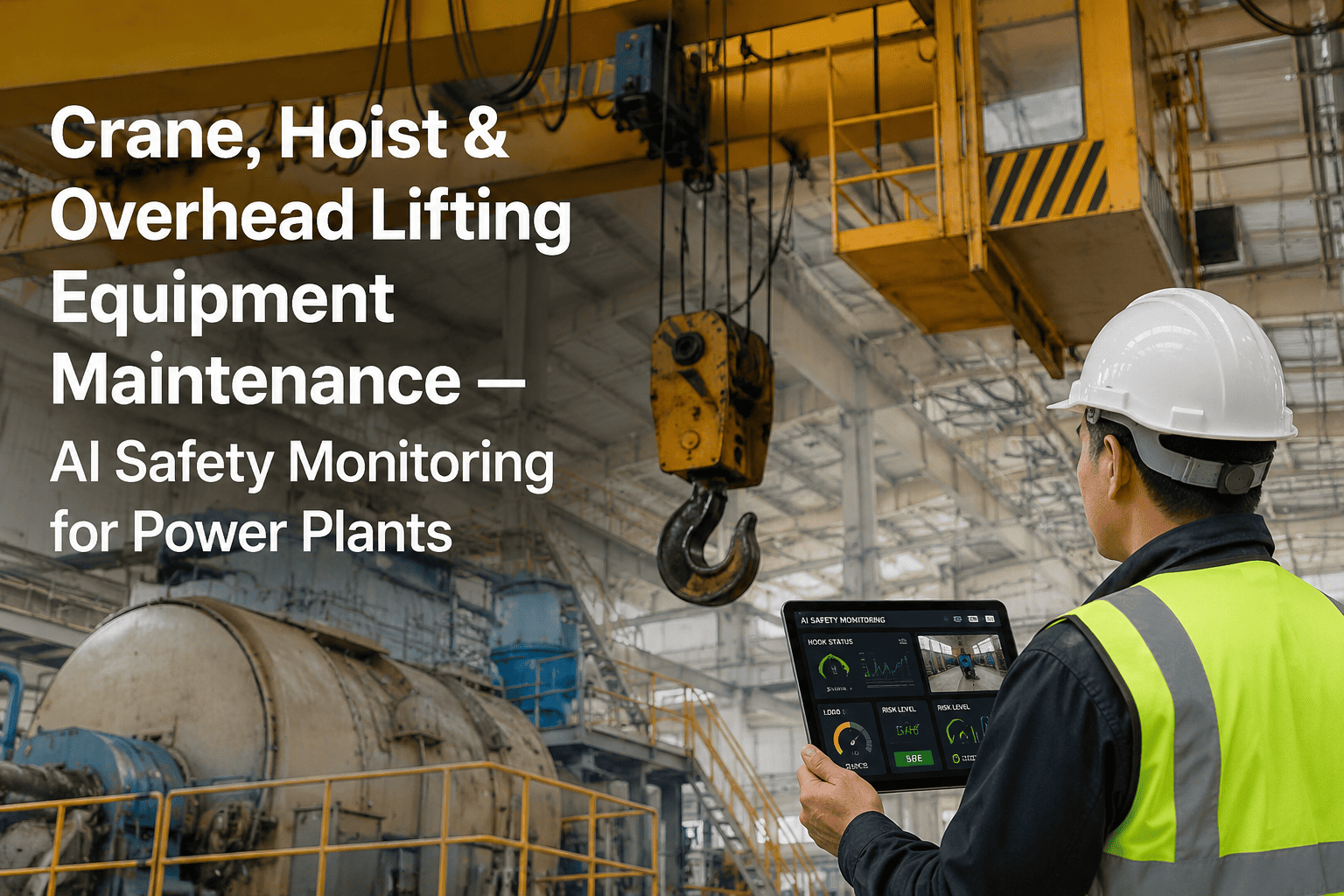
iFactory's AI monitoring platform watches load, brake performance, structural strain, and wire rope condition on every crane and hoist around the clock — turning the weeks of silent degradation between ASME B30.2 inspections into continuously tracked, alertable data.
40-44
Average Annual U.S. Crane-Related Fatalities
6+ Mo
Idle Time That Triggers Full Reinspection
24/7
Continuous Load, Brake & Strain Monitoring
THE COMPLIANCE GAP
Why a Passed Inspection Doesn't Mean a Safe Lift Tomorrow
Crane components rarely fail all at once. A wire rope can shed a fraction of a millimeter of diameter every month — invisible from one shift to the next but well past the rejection threshold within a year. A brake that holds comfortably at half load can begin slipping under full rated capacity long before anyone notices a change in sound or feel. ASME B30.2 and OSHA 29 CFR 1910.179 set the removal-from-service criteria for exactly this kind of gradual degradation, but a periodic inspection only measures the crane's condition on the day the inspector is standing under it. The numbers below are the thresholds your team is already working against — the question is whether you are catching them with a tape measure once a quarter or tracking them continuously.
6+
Broken Wires Per Lay Length
ASME B30.2 removal criteria for wire rope — or three or more broken wires within a single strand in one lay.
15%
Hook Throat Opening Growth
ASME B30.10 threshold for mandatory hook removal, alongside twist beyond 10 degrees from the original plane.
125%
Rated Load Brakes Must Hold
The minimum holding capacity every hoist brake must demonstrate under ASME B30.2 testing requirements.
5%
Wire Rope Diameter Loss Limit
Maximum allowable reduction from nominal rope diameter before the rope must be taken out of service.
THE INSPECTION FRAMEWORK
Four Layers of Crane Inspection — and Where AI Extends Coverage Between Them
OSHA and ASME B30.2 build crane safety on four distinct inspection layers, each performed by a different level of qualification and at a different interval. AI monitoring does not replace any of these layers — it fills the silent periods between them with continuous sensor data, so degradation shows up as a trend line instead of a surprise at the next scheduled check.
Pre-Shift Inspection — Every Shift
Performed by the trained crane operator before each use
Visual and functional checks of hooks, controls, limit switches, and obvious damage. AI coverage adds real-time drift and vibration alerts that surface abnormal behavior the moment it starts, not just at start-up.
Frequent Inspection — Daily to Monthly
Performed by a qualified person, interval set by CMAA duty class
Closer examination of wire rope, hoist chain, and hook condition. AI coverage tracks wire rope diameter and hook throat opening continuously, flagging the trend toward rejection thresholds before the scheduled check.
Periodic Inspection — Quarterly to Annual
Performed by a qualified, often third-party, crane inspector
Detailed structural, mechanical, and electrical review. AI coverage supplies a full history of load cycles, brake torque readings, and strain data that turns each periodic inspection into a trend review instead of a fresh assessment.
Load Test — Initial, Post-Repair, or After Idle Periods
Required before first use, after major repair, or after 6+ months idle
Confirms rated capacity performance under controlled conditions. AI coverage logs baseline load-cell and strain data at every test, giving future inspections a documented reference point to compare against.
Your Inspection Program Is Already OSHA and ASME Compliant — AI Monitoring Makes It Predictive
iFactory connects to your existing crane fleet without changing your inspection schedule, your qualified-person requirements, or your documentation process — it simply adds continuous data to every layer you already run.
SERVICE CLASSIFICATION
Matching Inspection Frequency to Your Crane's Actual Duty Cycle
Not every crane in your plant carries the same risk profile, and treating a standby crane and a continuously loaded crane on the same inspection calendar is one of the most common compliance gaps CMAA and ASME B30.2 auditors identify. Duty class is determined by lifts per hour, average load as a percentage of rated capacity, and total annual operating hours — the table below shows how that classification maps to inspection frequency.
| CMAA Class |
Service Level |
Typical Application |
Periodic Inspection Interval |
| Class A |
Standby / Infrequent |
Powerhouse standby cranes, rarely operated |
Semi-annual minimum |
| Class B |
Light Service |
Maintenance shop and utility area cranes |
Quarterly to annual |
| Class C |
Moderate Service |
General plant handling, single-shift operation |
Monthly documented inspection |
| Class D |
Heavy Service |
Multi-shift turbine hall and outage support cranes |
Bi-weekly documented inspection |
| Class E / F |
Severe / Continuous |
Fuel handling and continuous-duty lifting systems |
Weekly, every operating shift |
CONTINUOUS MONITORING
What AI Adds to a Crane Maintenance Program That Is Already Following the Standards
AI monitoring does not ask your team to change how cranes are inspected, documented, or signed off. It adds a layer of sensor-driven data underneath the existing program, so the qualified person performing the next scheduled inspection walks in with weeks of trend data instead of a blank checklist.
Load Cell & Weight Monitoring
Every lift is logged against rated capacity in real time, flagging overload attempts and unusual load patterns before they stress structural components or trip a limit switch under load.
Brake Drift & Torque Tracking
Continuous monitoring of brake holding torque and drift distance catches the gradual loss of holding capacity long before it falls below the 125% rated-load threshold at the next test.
Structural Strain & Fatigue Sensing
Strain gauges on bridge girders and end trucks track cumulative fatigue cycles, giving maintenance teams a data-backed answer to how much service life a heavily used crane has left.
Wire Rope & Hook Wear Prediction
Automated diameter and throat-opening tracking projects when a rope or hook will reach its ASME B30.2 or B30.10 rejection threshold, so replacement parts are ordered before the deadline, not after.
THE COST OF UNPLANNED DOWNTIME
An Unplanned Crane Outage Can Stall an Entire Outage Schedule
Crane and hoist equipment sits on the critical path of nearly every major plant activity, from routine component swaps to full turbine outages. When a crane goes down unexpectedly, the work it was supporting stops with it — and re-sequencing an outage schedule around a failed lifting asset is one of the most expensive disruptions a maintenance manager can face.
4-16 Wk
Typical Failure Lead Time Gained
Continuous monitoring across rotating and lifting equipment commonly surfaces developing faults this far ahead of unplanned failure.
30-50%
Reduction in Safety Incidents
Facilities running AI vision and condition monitoring on lifting and material handling equipment report incident reductions in this range.
3-5 Yr
Extended Component Service Life
Trend-based replacement of ropes, hooks, and brake components avoids both premature swaps and last-minute emergency replacement.
5+ Yr
Recommended Inspection Record Retention
Industry legal guidance recommends retaining full-service-life inspection and monitoring records well beyond OSHA's minimums.
FREQUENTLY ASKED QUESTIONS
Questions Maintenance Managers Ask About AI Crane and Hoist Monitoring
Does AI crane monitoring replace our existing OSHA and ASME B30.2 inspection program?
No. AI monitoring is designed to sit underneath your existing frequent, periodic, and pre-shift inspections, not replace any of them. Your qualified persons continue performing the same inspections on the same schedule with the same documentation requirements. What changes is that they walk into each inspection with weeks of continuous load, brake, and strain data already logged, which turns a periodic inspection into a trend review rather than a fresh assessment from scratch.
Book a demo to see how the monitoring layer maps onto your current inspection schedule without disrupting it.
What specific components does the AI platform actually track on a crane or hoist?
The platform tracks load against rated capacity on every lift, brake holding torque and drift distance, structural strain and fatigue cycles on bridge girders and end trucks, and wire rope diameter or hook throat opening trending toward ASME rejection thresholds. Each of these maps directly to a specific removal-from-service criterion already defined in ASME B30.2 or B30.10, so the data your team sees is measured against the same standards your inspectors already use.
Contact our support team to review which sensors apply to your specific crane and hoist models.
Can this platform monitor a mixed fleet of cranes from different manufacturers and different CMAA duty classes?
Yes. Power plants rarely run a single crane type — most facilities have a mix of standby Class A cranes, moderate-service Class C cranes in general plant areas, and heavy-service Class D or higher cranes in the turbine hall or fuel handling area. iFactory's platform deploys sensor packages calibrated to each crane's specific duty class and OEM specifications, and aggregates the resulting data into one fleet-wide view so maintenance managers can prioritize attention where duty cycle and wear actually warrant it.
Book a demo to see how mixed-fleet monitoring is configured for your plant.
Does adding AI monitoring change who is considered a qualified person for inspection sign-off?
No. Qualified-person requirements under OSHA 1910.179 and ASME B30.2 are unchanged by adding a monitoring layer — periodic inspections still require a qualified person with documented crane inspection training, and pre-shift checks still require a trained operator. The AI platform provides supporting data that qualified inspectors can reference during their sign-off, but it does not substitute for their judgment or their signature on the inspection record.
Contact our support team to discuss how monitoring data integrates into your existing sign-off and documentation workflow.
How long does it take to deploy AI monitoring across an existing crane fleet without stopping operations?
Most crane and hoist monitoring deployments are completed without taking equipment out of service for anything beyond a normal scheduled inspection window. Sensor installation on brakes, hooks, and structural members is typically scheduled to coincide with an already-planned frequent or periodic inspection, so no additional downtime is added specifically for the monitoring rollout. A typical single-crane deployment is completed in a matter of days, with fleet-wide rollouts phased around your existing outage and maintenance calendar.
Book a demo to get a deployment timeline specific to your crane fleet size.
Give Your Crane Fleet the Same Continuous Attention You Give Your Turbines
Every lift in your plant is already governed by OSHA and ASME B30.2 — AI monitoring simply makes sure nothing changes between the inspections that keep your team compliant. Book a session to map continuous monitoring onto your crane and hoist fleet.