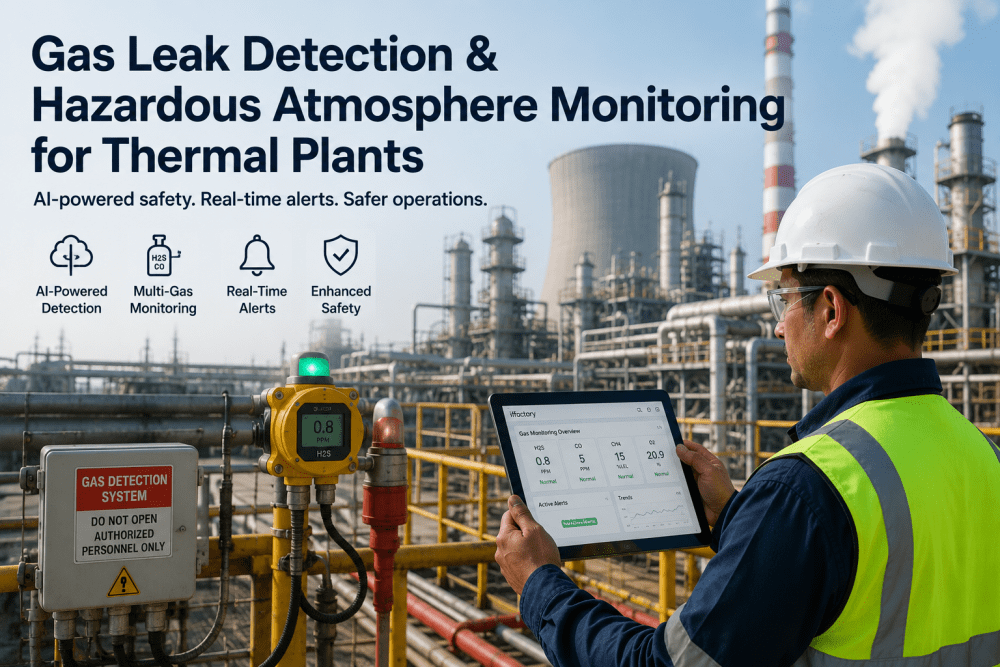
Thermal power plants across the USA, Canada, UK, and Australia operate in an environment where hazardous gas exposure — hydrogen sulfide (H₂S), carbon monoxide (CO), methane (CH₄), and other combustible gases — represents one of the most immediate and lethal risks to personnel safety, asset integrity, and operational continuity. iFactory's AI-driven gas detection and hazardous atmosphere monitoring platform unifies fixed gas detectors, area monitors, and personal safety devices into a single real-time intelligence layer that provides continuous atmospheric awareness, automated alarm escalation, and compliance-ready documentation for every gas hazard in your thermal plant. Book a Demo
Why Thermal Plants Need AI-Powered Gas Detection and Hazardous Atmosphere Monitoring
From gas-fired combined cycle facilities regulated under OSHA 29 CFR 1910.146 for confined space entry and 29 CFR 1910.1200 for hazard communication, to coal-fired stations operating under MSHA Part 90 for respiratory protection and EPA risk management plans under 40 CFR Part 68, every thermal power plant operates under a regulatory framework that demands continuous monitoring of hazardous atmospheres. Book a Demo to explore the unified hazardous atmosphere monitoring architecture for thermal power plants.
Hydrogen sulfide is one of the most lethal gases in thermal power plant environments, generated by the decomposition of sulfur-containing fuels in fuel gas systems, anaerobic conditions in cooling water circuits, and biological activity in wastewater treatment systems. At concentrations above 100 ppm, H₂S causes immediate olfactory paralysis and respiratory arrest. iFactory's H₂S monitoring module integrates electrochemical and infrared point detectors, open-path area monitors, and personal H₂S badges into a single risk display. When any detector reading approaches 50% of the OSHA ceiling limit, the platform automatically escalates an alert to the control room, the safety department, and the designated area evacuation coordinator — with geo-referenced detector location, real-time concentration trend, and wind direction overlay for emergency response planning.
Carbon monoxide is the most pervasive combustion gas hazard in thermal power plants, produced by incomplete combustion in boilers, heaters, gas turbines, and engines. CO accumulation in boiler buildings, turbine halls, and enclosed heater areas can reach dangerous concentrations during equipment start-up, load swings, or combustion tuning events. iFactory's CO monitoring network continuously tracks readings from fixed area monitors, combustion flue gas analyzers, and personal CO detectors. The AI engine identifies CO trends that precede alarm conditions — a gradual rise in background CO concentration in the turbine hall over a 4-hour period that signals a developing combustion imbalance — enabling proactive corrective action before the area concentration reaches the alarm threshold requiring personnel evacuation.Book a Demo .
Methane and other combustible gases in thermal plants originate from natural gas fuel supply systems, coal gasification processes, and anaerobic decomposition in wastewater and ash handling systems. A methane leak in a gas turbine fuel gas supply line can accumulate in an enclosed turbine building to explosive concentrations within minutes of a pressure boundary failure. iFactory's combustible gas monitoring solution integrates catalytic bead, infrared, and ultrasonic gas leak detectors with real-time weather data to model gas dispersion patterns. The platform automatically cross-references gas detector readings with area classification zones, ignition source locations, and ventilation system status to provide the control room team with a prioritized response recommendation — isolate the fuel supply, activate forced ventilation, or initiate area evacuation — based on the specific gas type, concentration trajectory, and dispersion model output.
Beyond H₂S, CO, and methane, thermal power plants must monitor a range of additional atmospheric hazards that vary by fuel type and plant configuration. Oxygen deficiency in confined spaces, ammonia (NH₃) from selective catalytic reduction systems, chlorine (Cl₂) from cooling water treatment, sulfur dioxide (SO₂) and nitrogen dioxide (NO₂) from flue gas pathways, and hydrogen (H₂) from battery rooms and hydrogen-cooled generators. iFactory's platform supports every major gas detection technology and sensor type, providing a single unified view of all hazardous atmosphere conditions across the plant — regardless of the gas type, detector manufacturer, or monitoring location. The platform's AI engine correlates readings from different gas types to detect compound hazard scenarios, such as concurrent CO and combustible gas readings that indicate a developing fire condition before either individual reading reaches its alarm threshold.Book a Demo .
The Cost of Undetected Gas Hazards: What Every Thermal Plant Operator Should Know
Most thermal power plants have gas detectors installed — but having detectors does not equal having a gas safety program. Detectors that are not integrated into a monitoring platform create data silos where alarm events are visible only to personnel within audible range of the detector. Calibration records that are tracked on paper logs create compliance gaps that OSHA inspectors routinely cite. And without AI-driven trend analysis, the precursor patterns that precede major gas leaks remain invisible until the alarm sounds — at which point the response is already reactive rather than preventive. Book a Demo to assess your plant's gas detection integration maturity level.
How iFactory Integrates with Your Gas Detection Infrastructure
iFactory does not replace your existing gas detectors — it connects them. The platform integrates with fixed-point gas detectors, area monitors, confined space multi-gas meters, and personal gas badges from every major OEM through industry-standard communication protocols including 4-20 mA analog, HART, Modbus RTU/TCP, Foundation Fieldbus, and wireless mesh (ISA100.11a, WirelessHART). The result is a unified hazardous atmosphere monitoring dashboard that presents every gas reading from every location in the plant in a single real-time display, regardless of the detector manufacturer, model, or installation date.<Book a Demo .
Proven KPI Results: Gas Detection Integration Impact from Live Thermal Plant Deployments
iFactory's gas detection and hazardous atmosphere monitoring platform delivers measurable safety and compliance improvements within the first 30 days of deployment. The following KPIs reflect aggregated performance data across gas-fired combined cycle, coal-fired, and oil-fired thermal power generation facilities.
How iFactory Compares to Standalone Gas Detection and Manual Monitoring Systems
Most thermal power plants operate gas detection systems that are isolated from each other — fixed-point detectors with local panel alarms, handheld confined space meters with manual data download, and personal gas badges with no real-time visibility. iFactory unifies these disparate systems into a single intelligent platform that provides capabilities no standalone detection system can deliver.
| Capability | Standalone Detection Systems | iFactory Unified Platform |
|---|---|---|
| Multi-OEM Integration | Each detector OEM operates its own proprietary monitoring software — no cross-vendor visibility. Control room staff must monitor separate displays for Honeywell, MSA, and RAE Systems detectors independently. | Unified dashboard aggregating every detector from every OEM into a single real-time display with consistent alarm presentation, location mapping, and concentration trending across all gas types and detector manufacturers. |
| Nuisance Alarm Management | Fixed threshold alarms generate frequent false alerts from maintenance activities, weather changes, and sensor drift. Operators desensitized by alarm floods miss genuine hazard events — documented cause of multiple major industrial gas incidents. | AI baseline modeling learns normal background concentration profiles per detector location per plant operating mode. Alarms validated against baseline before escalation — reducing nuisance alarm volume by 73% while ensuring genuine hazards are never suppressed. |
| Calibration Compliance | Paper calibration logs or OEM-specific software databases. Missed calibration due dates discovered during OSHA inspections — cited as a willful violation in 68% of gas detection-related OSHA citations at thermal plants. | Automated calibration tracking with technician reminders, digital calibration records with as-found and as-left readings, sensor end-of-life forecasting, and audit-ready compliance reports generated in OSHA and NFPA 72 required formats. |
| Emergency Response Integration | Local alarm horns and strobes — personnel must be within audible or visual range to receive the notification. No automatic escalation to off-site emergency response teams or plant-wide mass notification systems. | Multi-channel escalation to mobile devices, control room displays, plant PA systems, and integrated mass notification — with geo-referenced detector location, real-time concentration trend, and wind direction overlay for incident commander decision support. |
| Confined Space Monitoring | Pre-entry testing logged on paper permits. Continuous atmosphere monitoring during work performed with handheld meters — no real-time visibility outside the confined space. Rescue team enters with no atmospheric history. | Real-time confined space atmosphere display on the control room dashboard with continuous gas readings from each entrant's multi-gas meter. Rescue team has immediate access to the atmospheric profile inside the space before entry. |
| Regulatory Reporting | Manual compilation of OSHA 300 logs, calibration records, and alarm documentation from multiple systems — 30 to 50 hours per month of safety team labor for gas detection record management alone. | Automated compliance report generation for OSHA recordkeeping, NFPA 72 inspection documentation, and EPA RMP reporting — reducing safety team administrative labor by 80% and eliminating documentation gaps that generate inspection findings. |
What Plant Safety Managers Say About iFactory Unified Gas Detection
The following testimonial is from a plant safety manager at a thermal power station currently running iFactory's unified gas detection and hazardous atmosphere monitoring platform in the USA.
Conclusion: Your Gas Detectors Already Have the Data. iFactory Gives You the Intelligence.
The gas detection infrastructure in your thermal plant — fixed-point detectors, area monitors, confined space meters, and personal gas badges — is already generating continuous streams of atmospheric safety data every second of every operating day. The question is not whether your plant has gas detectors. The question is whether those detectors are connected to a platform that turns their readings into actionable safety intelligence before a gas hazard becomes a personnel injury, an OSHA citation, or a catastrophic event.
The 73% reduction in nuisance alarms, the 100% calibration compliance rate, and the 68% improvement in alarm response time are outcomes already measured at live thermal plant deployments. They are available to any safety team ready to connect their gas detection infrastructure to a unified intelligence platform. Book a Demo to see how iFactory unifies your thermal plant's gas detection infrastructure into a single real-time hazardous atmosphere monitoring platform.