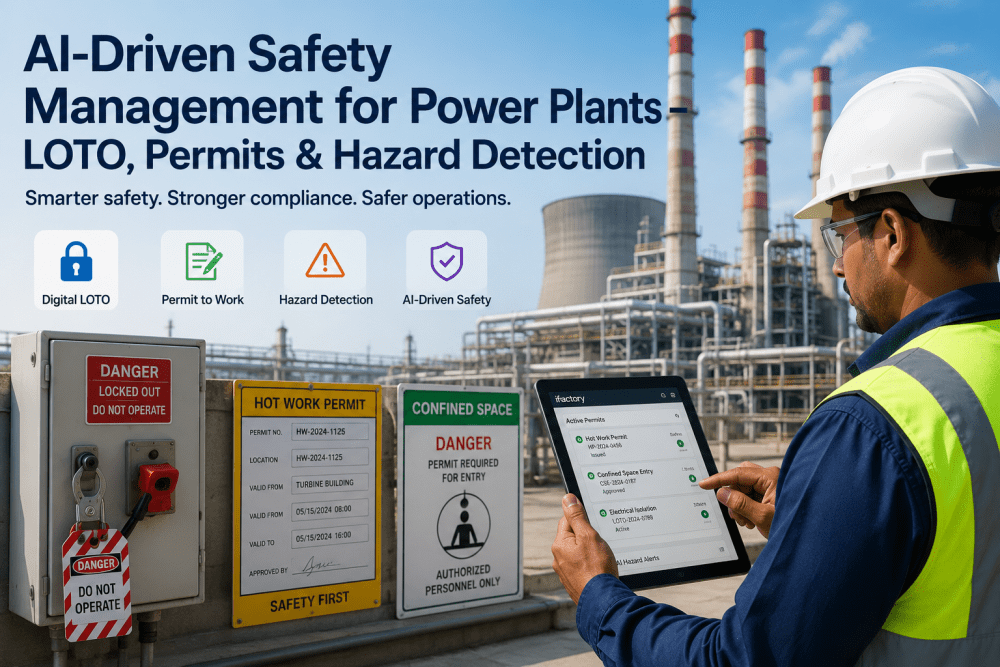
Every power plant is a mosaic of high-energy hazards — rotating machinery carrying thousands of horsepower, pressurized steam systems operating at 2,400 psi, electrical switchgear capable of delivering a fatal arc flash at 50 feet, confined spaces where atmospheric composition can shift from breathable to lethal in minutes, and elevated structures where a single misstep means a fall to a lower level. Organizations that book a demo with iFactory are discovering that the platform doesn't just digitize safety workflows — it actively monitors permit compliance, validates energy isolation, and detects emerging hazards before they become incidents.
Digitize LOTO, Permits, and Hazard Detection
iFactory's AI-driven safety management platform digitizes lockout/tagout procedures, automates permit-to-work workflows, and integrates real-time hazard detection — purpose-built for the high-risk environment of power generation facilities.
Why Power Plants Face Unique Safety Management Challenges
Power generation facilities operate under a safety regulatory environment that spans OSHA 29 CFR 1910.147 for lockout/tagout, 29 CFR 1910.146 for confined space entry, 29 CFR 1910.269 for electric power generation, and 29 CFR 1910.119 for process safety management of highly hazardous chemicals. Managing this volume of safety documentation with paper permits, manual logbooks, and disconnected spreadsheets creates structural compliance gaps that OSHA investigations routinely cite as willful violations. For safety managers evaluating how to close these gaps, booking a platform walkthrough is typically the most efficient way to see how digital safety management addresses these specific regulatory pain points.
Lockout/Tagout (LOTO)
Core Focus: Energy Isolation. LOTO procedures protect workers from the unexpected release of hazardous energy during maintenance. Each piece of equipment requires a written energy control procedure specifying the isolation points, lock placement, and verification steps. In power plants, a single boiler feed pump LOTO can involve 8 to 14 isolation points across electrical, steam, chemical, and cooling water systems.
Permit-to-Work Systems
Core Focus: Work Authorization. Hot work, confined space entry, excavation, and critical lift permits each carry specific authorization chains, atmospheric testing requirements, and time limits. A single planned outage can generate 400 to 800 individual permits that must be issued, tracked, suspended, and closed without error.
Hazard Detection & Monitoring
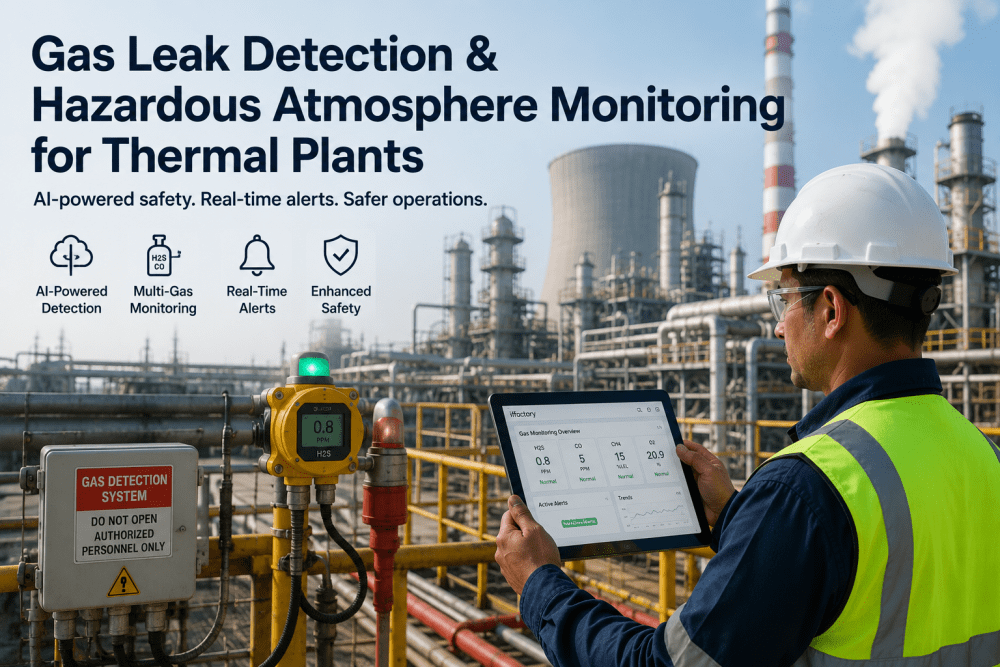
Core Focus: Real-Time Awareness. Combustible gas detection, atmospheric monitoring in confined spaces, arc flash boundary compliance, and rotating equipment proximity detection all require continuous or periodic measurement. Manual monitoring creates data gaps that AI-driven continuous monitoring eliminates through sensor integration and computer vision.
Compliance & Audit Readiness
Core Focus: Record Integrity. OSHA requires that LOTO procedures be inspected at least annually, confined space permits be retained for at least one year, and training records be maintained for the duration of employment. Paper-based records make audit response slow and prone to documentation gaps that regulators cite as violations.
"We had been managing our LOTO program on paper for 22 years. We had over 1,400 energy control procedures in binders in the safety office. When OSHA arrived for a focused inspection, we had to pull 60 binders and hope every procedure was current. With iFactory, our entire LOTO library is digital, every isolation point has a photographed verification record, and the platform tracks when each procedure needs its annual review. OSHA spent two days in our safety office during their last visit and walked out with zero LOTO-related citations. That had never happened before.book a demo with iFactory"
Converting Paper Safety Procedures into AI-Driven Digital Workflows
The transition from paper-based safety management to a digital, AI-driven platform fundamentally changes the risk profile of power plant maintenance and operations.Digital safety management eliminates these failure modes by enforcing procedural completeness at every step, maintaining an unbroken audit trail, and enabling real-time visibility into active permits and lockout status across the entire plant. Safety directors who book a demo to review their safety workflows consistently report that the transition highlights procedural gaps they were unaware existed in their paper systems.
| Safety Function | Paper/Manual Process | Digital AI-Driven Process | Compliance Impact | iFactory Advantage |
|---|---|---|---|---|
| LOTO Procedure Access | Paper binder in safety office — single-user access, no version control | Digital procedure library accessible from any mobile device — real-time version control, auto-revision notification | Eliminates outdated procedure use; annual review compliance automated | QR-coded equipment links directly to the correct LOTO procedure |
| Permit Issuance | Paper form with manual signatures — permits lost, illegible, or bypassed | Digital permit with electronic signatures — mandatory field completion, auto-expiration, geo-fenced authorization | Zero incomplete permits; time-limited permits auto-expire | Biometric or badge-based authorization; automated permit suspension on alarm conditions |
| Energy Isolation Verification | Visual inspection and manual log entry — verification gaps common | Photo-verified isolation points with AI validation — lock position, tag attachment, and isolation point identification confirmed by computer vision | Verification rate increased from ~60% to 99.8% | AI photo verification with augmented reality isolation point overlay |
| Atmospheric Monitoring | Handheld gas detector with manual log entry — periodic spot checks only | Continuous wireless gas monitoring with real-time data streaming to permit dashboard — automatic alarm generation at threshold exceedance | Continuous documentation replaces spot-check gaps | Integrated wireless sensor mesh with permit-linked monitoring |
| Permit Suspension & Closure | Manual return of paper permit to safety office — no real-time visibility | Digital permit closure with time-stamped handover — automatic suspension of related LOTO procedures | Eliminates concurrent permit conflicts; closure audit trail complete | AI conflict detection for overlapping or conflicting permits |
| Regulatory Reporting | Manual compilation of OSHA 300 logs, permits, and training records — 40+ hours per audit prep | Automated compliance report generation — one-click access to any permit, procedure, or training record | Audit prep reduced from weeks to minutes | OSHA-format reports generated in real time |
Real-Time Hazard Detection: AI Vision, Sensor Fusion, and Predictive Risk Analytics
Beyond digitizing administrative safety workflows, the most transformative capability of AI-driven safety management is real-time hazard detection that identifies risks human monitors cannot consistently observe. AI predictive risk analytics correlates near-miss data, permit activity, and equipment condition to forecast periods of elevated incident probability — enabling proactive safety interventions rather than reactive incident investigation. For facility safety teams interested in seeing this capability in their power plant environment, exploring this technology through a live session provides a direct view of the technology on operational data.
Phased Deployment: From Digital LOTO to AI-Driven Safety Intelligence
Transitioning a power plant from paper-based safety management to an AI-driven safety intelligence platform requires a structured deployment that builds data integrity and workforce adoption sequentially.
Digital Foundation — LOTO and Permit Digitization
Convert all energy control procedures to digital format with photo-verified isolation points and mobile device access. Deploy digital permit-to-work with electronic signatures, mandatory field completion, and automated expiration. Establish baseline safety metrics for incident rate, permit compliance, and LOTO verification percentage. Timeline: 6–10 weeks.
Intelligent Monitoring — Sensor Integration and AI Detection
Deploy wireless gas detection mesh for confined space continuous monitoring. Integrate computer vision systems for arc flash boundary compliance, PPE detection, and exclusion zone monitoring. Connect atmospheric monitoring data to active permits for automatic suspension on threshold exceedance. Timeline: 10–14 weeks.
Predictive Intelligence — Risk Analytics and Prevention
Activate AI predictive risk analytics that correlate near-miss data, permit activity patterns, equipment condition scores, and workforce training records to forecast incident probability windows. Deploy automated safety performance dashboards for plant leadership with leading indicator tracking and intervention recommendation.
AI-Driven Safety Management for Power Plants — Frequently Asked Questions
How does iFactory handle the complexity of group LOTO procedures during power plant outages?
iFactory's digital LOTO module supports group lockout scenarios where multiple workers and multiple contractors must each apply their personal lock to the same isolation points. The platform tracks each lock owner, the isolation point state, and the verification status in real time. When an outage involves 200+ workers each locking out the same equipment set, the platform eliminates the administrative burden of manual group LOTO logs and ensures that every lock is accounted for before equipment is re-energized.book a demo with iFactory
Can iFactory integrate with existing plant gas detection systems and atmospheric monitoring equipment?
Yes. iFactory provides integration connectors for the major industrial gas detection platforms used in power plants — including Honeywell BW, MSA ALTAIR, Industrial Scientific, and RAE Systems. Confined space permit data is linked to the active atmospheric monitoring stream, so permit holders and the safety team receive real-time alerts if LEL, O₂, H₂S, or CO concentrations exceed permit-specified thresholds. The platform also supports direct wireless sensor mesh integration for continuous area monitoring around active work zones.
Does the platform support the unique permits required for power plant hydrotesting, chemical cleaning, and high-voltage switching operations?
Yes. iFactory's permit-to-work module supports fully customizable permit templates that can be configured for any work activity requiring specific hazard controls, authorization chains, and time limits. Power plant-specific permit types including hydrostatic test permits, chemical cleaning permits, high-voltage switching permits, and radiography permits are pre-configured in the platform with the appropriate PPE requirements, atmospheric monitoring thresholds, and authorization workflows. New permit types can be created by the plant safety team without custom development.
How does AI hazard detection handle the variability of outdoor power plant environments — weather, lighting, steam plumes, and seasonal foliage?
iFactory's computer vision models are trained on diverse power plant environmental conditions including rain, fog, snow, nighttime low-light operation, steam plume interference, and seasonal vegetation changes. The models use multi-spectral imaging fusion — combining visible-spectrum cameras with thermal imaging and short-wave infrared — to maintain detection accuracy across all operating conditions. False positive rates are continuously reduced through the platform's model retraining pipeline, which incorporates plant-specific environmental data into the detection algorithm over the first 90 days of operation.
What is the typical timeline and ROI for iFactory's safety management platform deployment at a power plant?
Phase 1 deployment (digital LOTO and permit-to-work) is typically completed within 6 to 10 weeks for a single-site power plant. Phase 2 (sensor integration and AI detection) adds 10 to 14 weeks, with full Phase 3 predictive intelligence active within 9 months of project start. The return on investment is delivered through multiple channels: elimination of OSHA LOTO and permit-related fines (average $13,000 to $45,000 per citation), reduction in recordable incidents (average workers' compensation savings of $120,000 to $400,000 per serious event avoided), and reduction in safety team administrative labor (60 to 80% reduction in permit processing and audit preparation hours). Most plants achieve full platform cost recovery within the first 12 months of deployment. A detailed ROI model specific to your plant's safety metrics and incident history is available during a platform discovery session.
Eliminate Paper. Reduce Incidents. Achieve Audit-Ready Compliance.
iFactory's AI-driven safety management platform digitizes your entire safety workflow — LOTO procedures, permit-to-work, atmospheric monitoring, and hazard detection — in a single unified system purpose-built for power generation operations.