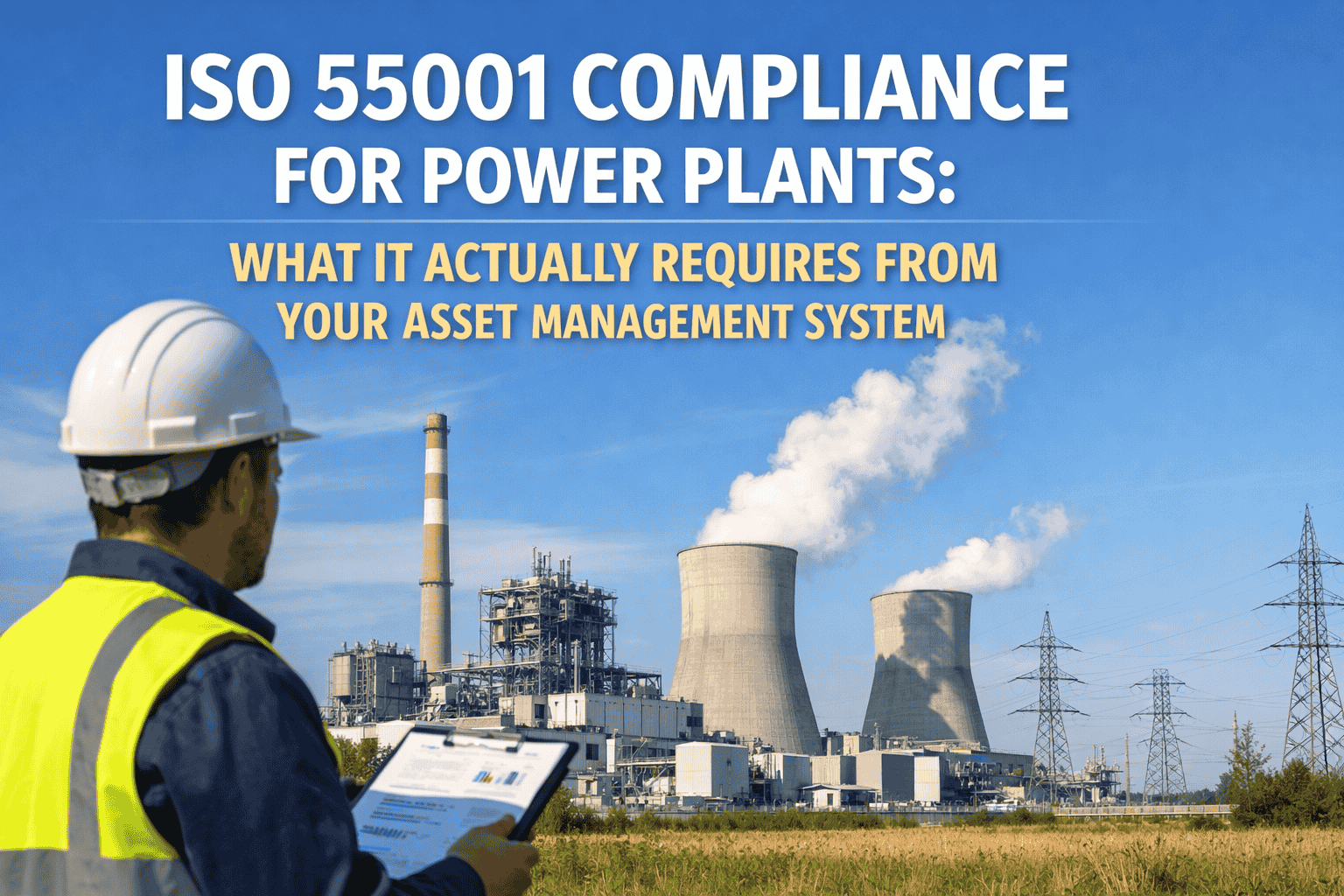
ISO 55001 asset management compliance for power plants: a practical guide
By Riley Quinn on March 20, 2026
Last month, a major utility failed their ISO 55001 audit. Not because their turbines were poorly maintained—they weren't. Their 98.7% availability proved that. They failed because when the auditor asked "Show me the documented decision that led to prioritizing Unit 3's overhaul over Unit 7," there was silence. The work was excellent. The proof was missing. This is the gap that catches 73% of power plants pursuing ISO 55001 certification—and it's entirely preventable.
ISO 55001:2024 Compliance Guide
What your asset management system actually needs to pass audit
ValueRealization
4Context
5Leadership
6Planning
7Support
8Operation
9Evaluation
10Improve
73%
fail first audit attempt
$1.7B
EPA penalties in 2024
20%
cost reduction with certification
95%
report positive ROI
Sources: ISO Survey 2024 · EPA Enforcement · IAM Research · Deloitte
The 4 Pillars Auditors Actually Check
ISO 55001 doesn't care what CMMS you use or how many certifications your technicians hold. It cares about one thing: can you prove your asset decisions are intentional, risk-based, and connected to business objectives?
01
Strategic Asset Management Plan
"How does maintaining this turbine connect to your plant's reliability targets?"
Required Evidence
Documented SAMP linking asset objectives to organizational goals with resourced budgets
Common Gap
Maintenance plans exist in isolation—no documented connection to plant KPIs
02
Risk-Based Decision Framework
"Show me the risk assessment that determined this work order's priority."
Required Evidence
Maintenance priorities derived from documented risk scores—not tribal knowledge
Common Gap
Risk matrices exist in safety systems but aren't applied to maintenance scheduling
03
Lifecycle Documentation
"Why did you choose repair over replacement for this generator?"
Required Evidence
Complete asset history with decision rationale—from acquisition through disposal
Common Gap
Work orders completed, but the "why" behind decisions isn't captured anywhere
04
Performance Measurement
"What actions did you take when availability dropped below target?"
Required Evidence
KPIs with regular review records and documented corrective actions
Common Gap
Data collected but not systematically reviewed or connected to improvement actions
The 2024 revision adds teeth to requirements that were previously vague. If you're certified to the 2014 standard, these sections now require attention:
NEW
Section 4.5
Decision-Making & Value
Organizations must now document HOW each asset decision creates value. No more implicit assumptions—auditors want to see the decision model.
REVISED
Section 6.2
SAMP Requirements
Objectives must now be RESOURCED, not just listed. This means budget allocation evidence tied to each asset management objective.
NEW
Section 7.6
Data & Information
New requirement to define data attributes, quality standards, and sources. Your data governance must now be documented.
NEW
Section 7.7
Knowledge Management
Tacit knowledge in experienced staff must be captured and transferable. When your senior tech retires, can you prove their knowledge lives on?
See How iFactory Automates Compliance Documentation
Our platform captures decision rationale automatically, connects maintenance to risk frameworks, and generates audit-ready reports—without adding paperwork for your team.
"This recertification confirms NYPA's asset management system is designed to deliver value, and highlights their commitment to New York's climate and energy goals."
— EA Technology, IAM Endorsed Assessor
What Certification Delivered
Improved stakeholder confidence
Integration with EHS systems
Documented sustainability alignment
Continuous improvement framework
How Digital Tools Close Every Gap
4.5
Decision-making linked to value
AI analytics automatically connect maintenance decisions to cost/risk outcomes
6.1
Risk and opportunity assessment
Predictive models calculate failure probability and prioritize by risk score
7.6
Data quality and governance
Single source of truth with defined attributes and validation rules
7.7
Knowledge retention and sharing
Institutional knowledge captured in asset records, not individual notebooks
8.2
Lifecycle management
Complete asset history from commissioning through disposal with decision logs
9.2
Internal audit evidence
Audit-ready reports generated on demand—no reconstruction under pressure
Is ISO 55001 certification mandatory for power plants?
No, certification is voluntary. However, regulatory bodies increasingly reference ISO 55001 principles, and certification demonstrates due diligence to investors, insurers, and oversight agencies. Many public utilities pursue certification as part of governance commitments—NYPA being a prime example.
How long does ISO 55001 certification take?
For organizations with existing asset management practices, 12-18 months is typical. This includes gap analysis, documentation development, implementation, internal audits, and the certification audit. Plants starting from scratch may need 18-24 months. Digital tools can significantly accelerate documentation phases.
What's the difference between ISO 55001 and ISO 50001?
ISO 55001 covers asset management—how you manage physical assets throughout their lifecycle. ISO 50001 covers energy management—how you optimize energy consumption. Power plants often pursue both, as they share the same high-level structure and complement each other well.
Do we need to replace our CMMS to comply?
Not necessarily. ISO 55001 doesn't mandate specific software. However, if your system can't capture decision rationale, connect maintenance to risk assessments, or generate audit-ready documentation, you may need to augment it. Many plants layer AI platforms on top of existing CMMS infrastructure.
We're certified to ISO 55001:2014—what now?
You'll need a transition audit covering new sections: decision-making model (4.5), data governance (7.6), and knowledge management (7.7). This can be combined with your regular surveillance audit. Most certification bodies allow 3 years for transition from the 2024 publication date.
Compliance Without the Paperwork Overload
iFactory documents what you're already doing—and fills the gaps where ISO 55001 requires more. See how automated compliance reporting can get you audit-ready faster.