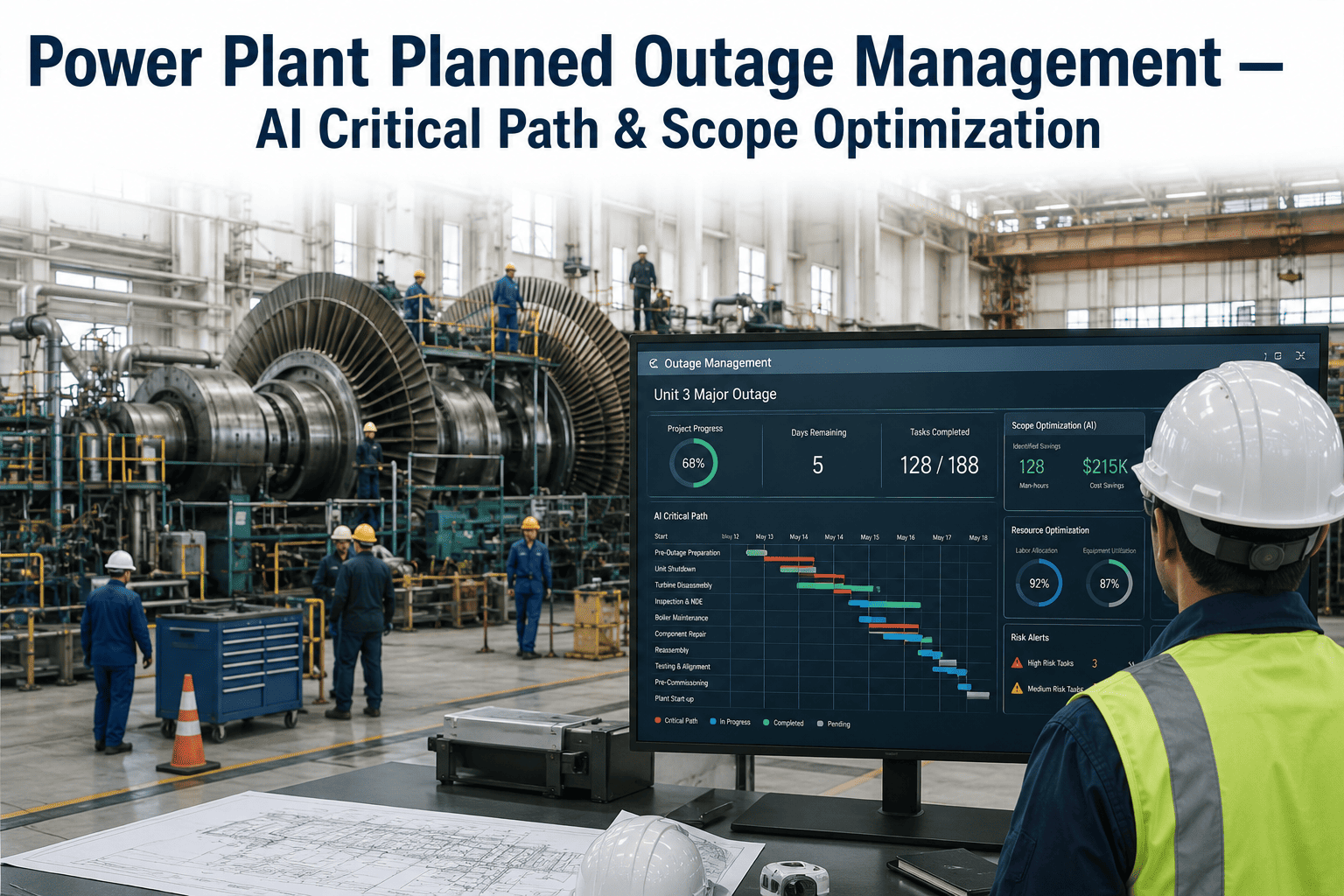
The gap between a 28-day planned overhaul and a 41-day overrun rarely comes down to crew size or crane availability. It comes down to whether the scope was locked from real condition data, whether the critical path was actually modeled before mobilization, and whether contractors were sequenced to run in parallel instead of stacking up one after another. Most plant managers have lived through an outage that started clean and slid sideways once emergent work showed up with no defined impact on the schedule. AI-driven critical path optimization changes that by modeling the full task dependency chain before the unit ever comes offline, surfacing which tasks can run simultaneously and which ones actually determine how many days the outage takes. Plants that have rebuilt their outage planning around this approach are consistently bringing overhauls in tighter, and comparing your last outage's actual duration against what a modeled critical path would have produced is worth a short planning conversation.
PLANNED OUTAGE & CRITICAL PATH AI
Turn Outage Planning Into a Modeled Schedule, Not a Guess
AI-driven critical path optimization sequences every outage task against real dependencies, labor, and contractor availability, identifying the parallel workstreams that shrink calendar days without cutting inspection depth.
25-35%
Typical reduction in total outage calendar days achievable through critical path sequencing
15-30%
How far outages commonly run over scheduled duration when planning is fragmented
$850K Per Day
Approximate lost revenue for every extra day a major unit stays offline
Sequential Planning vs Parallel Critical Path Modeling
The same scope of work can take very different amounts of calendar time depending on whether tasks are scheduled one after another or run side by side wherever dependencies allow.
Turbine Rotor Extraction
Heat Exchanger Cleaning
Electrical Testing
Gasket Replacement
Rotor extraction can run at the same time as heat exchanger cleaning, and electrical testing can begin while mechanical teams finish gasket work, cutting total calendar days without adding risk.
The Three Causes Behind Almost Every Outage Overrun
Late Scope Lock
Scope finalized too close to shutdown leaves no time to sequence contractors or verify parts before the unit goes offline.
Undefined Scope Additions
Discovered work gets added to the schedule without a formal critical path impact assessment, quietly extending the outage.
Parts Unavailability
A single missing spare discovered mid-task can stall a critical path activity for a day or more while it is sourced.
Model Your Next Outage Against Its Actual Critical Path
See how your current work list would sequence once dependencies, labor, and contractor windows are mapped out in full.
How Critical Path Optimization Gets Built
1
Condition-Based Scope Lock
NDT readings, vibration trends, and equipment hour counters build the outage scope from actual condition data months in advance.
2
Dependency Mapping
Every task is linked to its predecessors and successors, revealing which activities genuinely determine the outage duration.
3
Parallel Sequencing
Tasks without shared dependencies are scheduled to run simultaneously across different crews and disciplines.
4
Real-Time Progress Tracking
Daily work order status feeds a live dashboard, flagging slippage against the critical path the moment it happens.
5
Scope Change Control
Any discovered work is assessed for schedule and cost impact before approval, preventing invisible scope creep.
Frequently Asked Questions
The critical path is the specific sequence of dependent tasks that together determine the shortest possible duration for the entire outage, since any delay on one of these tasks delays the whole outage by the same amount. Tasks not on the critical path have float, meaning they can slip somewhat without affecting the overall finish date. Identifying which tasks are truly critical, rather than treating every task as equally urgent, is what allows planners to focus resources where a delay actually matters.
Plants that move from fragmented, spreadsheet-based planning to a structured critical path model commonly see total outage calendar days reduced by roughly a quarter to a third, achieved by identifying tasks that can run in parallel rather than by rushing individual task execution or reducing inspection depth. The exact improvement depends heavily on how much of the current schedule is already sequenced efficiently, so an initial review of a recent outage schedule is the most reliable way to estimate the specific opportunity.
When inspection reveals unplanned work, such as a corroded pipe or an unexpected bearing issue, the discovered work is logged as a formal scope addition and immediately assessed for its impact on the critical path before it is approved and assigned to a contractor. This keeps every schedule change visible and documented rather than absorbed silently into extra days, and it prevents small discoveries from compounding into the kind of overrun that catches an outage manager by surprise on the last day. More detail on this workflow is available through support.
Critical path modeling is built around task dependencies rather than who performs the work, so contractor crews, OEM specialists, and internal teams are all sequenced within the same schedule based on their assigned scope, access windows, and predecessor tasks. This is particularly valuable for major outages involving a dozen or more specialist contractor teams working in the same physical space, since it surfaces access conflicts and handover risks well before they become on-site disruptions.
Most successful outage programs lock scope well before mobilization, often 90 to 120 days ahead for major overhauls, since a frozen scope is what allows accurate critical path modeling, contractor estimating, and parts procurement to happen with enough lead time. Late scope changes do not disappear when the schedule is locked late, they simply compress into the active outage window and cost significantly more in both time and money than the same change would have cost if identified earlier. A planning session can help map out a realistic scope-lock timeline for your next outage.
EVERY DAY OFFLINE HAS A COST
Bring Your Next Outage In On a Modeled Schedule
See how condition-based scope, dependency mapping, and parallel sequencing can shorten your next planned outage.





.png)