Every power plant outage represents the single largest concentration of operational risk, maintenance spend, and schedule pressure in the asset management calendar. iFactory's outage planning and turnaround management platform applies AI-driven scheduling optimization, critical path analysis, resource leveling, and vendor coordination analytics to transform outage execution from a manually managed event into a data-driven operation. Book a Demo to see how iFactory optimizes end-to-end outage planning for power plant turnarounds.
14%
Average outage duration reduction using AI-optimized critical path scheduling versus manual planning
$2.8M
Average cost savings per major outage from reduced overtime, optimized contractor utilization, and faster return to service
92%
Work package completion accuracy when AI-scheduled execution sequencing replaces manual dependency mapping
6 wks
Platform deployment timeline — from data integration to live outage scheduling model for the next planned event
Why Outage Planning and Turnaround Management Needs AI-Driven Analytics
The operational complexity of a power plant outage is structurally different from routine maintenance. An outage compresses 12 to 18 months of accumulated maintenance scope into a 4- to 8-week execution window, with every work package competing for the same limited pool of personnel, crane capacity, scaffolding access, and laydown space. Manual planning approaches — spreadsheets, Gantt charts, whiteboard schedules — cannot keep up with the dynamic interactions between interdependent work packages, contractor availability shifts, parts delivery delays, and emergent scope discoveries that define every real outage execution environment. Analytics teams that have deployed iFactory consistently report that the most valuable capability of iFactory's platform is its ability to simulate outage scenarios — running what-if analyses on schedule compression, resource reallocation, and scope trade-offs — before committing to an execution plan that will cost millions and cannot be undone once the unit is offline.
AI-Optimized Critical Path Analysis and Resource Leveling
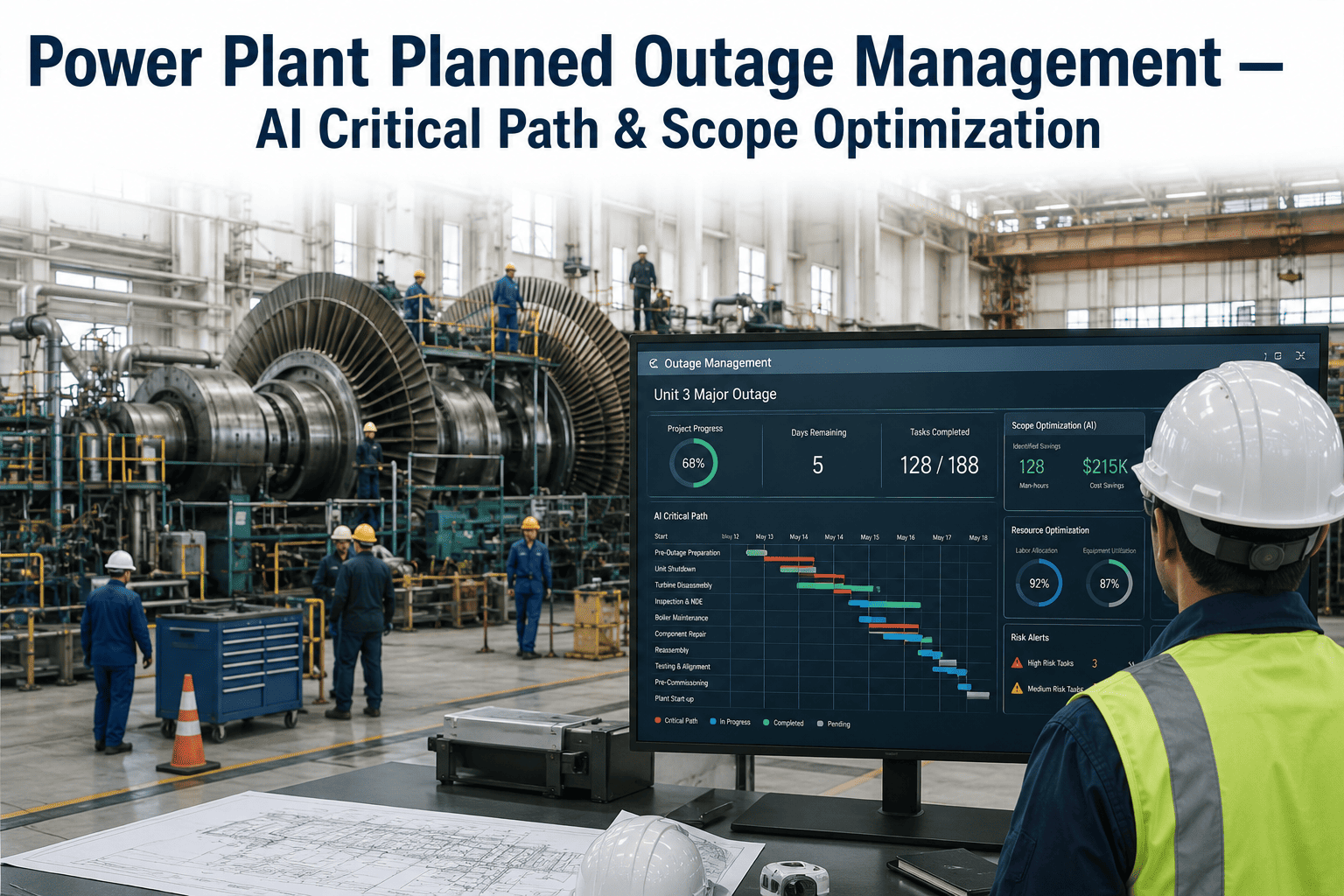
The critical path of a power plant outage — the sequence of dependent activities that determines the earliest possible return-to-service date — typically involves 15 to 25 work packages that cannot be rescheduled without extending the outage. These critical path activities include turbine rotor removal and replacement, generator stator maintenance, boiler tube repair, major valve overhauls, and control system upgrade cutovers. Book a Demo to discuss how iFactory's critical path optimization can reduce your next outage duration.
01
Work Package Data Ingestion and Dependency Mapping
iFactory ingests all planned work packages from the CMMS, including estimated durations, resource requirements, predecessor-successor dependencies, and risk classifications. The platform auto-generates the dependency network graph and validates it against historical outage execution data.
02
Constraint-Based Critical Path Calculation
The AI scheduling engine applies resource, parts availability, and spatial constraint data to identify the true critical path. Hidden critical paths — created by shared crane capacity, single-contractor crews across multiple work packages, or sequential lift study approvals — are surfaced and flagged for mitigation.
03
Resource Leveling and Bottleneck Resolution
The optimizer runs resource leveling across all work packages to minimize peak resource demand and eliminate crew idling caused by scheduling gaps. Recommendations include contractor crew adjustments, shift pattern modifications, and parts delivery schedule alignment with the optimized critical path.
Book a Demo
04
Scenario Simulation and Contingency Planning
Planners can run what-if scenarios — scope additions, resource reductions, schedule compression targets — and see the impact on outage duration, cost, and risk in real time.
05
Execution Tracking and Dynamic Rescheduling
During the outage, actual progress data is fed back into the scheduling engine. When a critical path activity runs over, the platform automatically recalculates the remaining schedule and recommends recovery actions — resource reallocation, scope deferrals, shift extensions — to minimize the overall schedule impact.
Your Next Outage Schedule Has Hidden Critical Paths That Manual Planning Cannot Find. iFactory Surfaces Them Before They Cost You Millions.
iFactory's AI-driven outage planning platform ingests your CMMS work package data, resource availability, parts inventory, and contractor schedules — then runs constraint-based optimization to deliver the shortest feasible outage schedule with full resource leveling and built-in contingency buffers. Deployed in 6 weeks. ROI measurable in the first outage.
Resource Allocation and Vendor Coordination Analytics
Resource management during a power plant outage is a logistics problem that rivals the complexity of the maintenance work itself. Multiple contractor crews with different skill certifications, union jurisdictions, shift preferences, and travel schedules must be coordinated across work packages that change daily as emergent scope is discovered.
Contractor Crew Scheduling Conflicts
Multiple contractors sharing the same work zone or requiring the same specialty equipment create scheduling conflicts that manual coordination cannot resolve optimally. iFactory's platform models all contractor constraints simultaneously and generates a conflict-free schedule with optimized crew utilization.
Parts and Material Availability Windows
Long-lead parts arriving after their scheduled installation window is one of the most common causes of outage extensions. iFactory tracks parts procurement status against the critical path and alerts planners before a parts delay becomes a schedule delay.
Spatial Constraint Conflicts
Limited laydown space, crane access corridors, and scaffolding zones create spatial conflicts that can halt multiple work packages simultaneously. iFactory's spatial constraint modeler ensures no two conflicting activities are scheduled in the same zone at the same time.
Emergent Scope Disruption
Unexpected findings during teardown inspection — rotor damage, tube wall thinning, insulation degradation — cascade through the schedule as new work packages are added. iFactory's dynamic rescheduling engine absorbs emergent scope with minimal overall schedule impact.
Book a Demo
What Outage Planning Professionals Say About AI-Driven Turnaround Management
iFactory's outage planning platform has been deployed across combined-cycle, coal, and hydroelectric facilities in North America and Europe. The following is from an outage planning manager at a major independent power producer.
Our previous outage planning process involved three full-time planners working for 14 weeks with Microsoft Project, spreadsheets, and wall charts to schedule a major combined-cycle outage. The schedule was always optimistic — we routinely extended outages by 5 to 10 days because resource conflicts and parts delays that we could not see during planning would emerge during execution. iFactory's platform ingested our work package data from Maximo, our contractor availability from our vendor management system, and our parts procurement status from our supply chain team — and generated an optimized outage schedule in 48 hours that our planning team had been working on for 10 weeks. The AI found seven resource conflicts in our manual schedule that we had missed, including two overlapping crane lifts in the same turbine bay that would have caused a four-day schedule delay.
Outage Planning Manager
Independent Power Producer — 1,200 MW Combined-Cycle Fleet, Southeast USA
Conclusion: The Difference Between an On-Time Outage and a Costly Extension Is the Planning Platform
iFactory's AI-driven outage planning and turnaround management platform delivers the analytical capability that the complexity of modern outages demands. Constraint-based critical path optimization, automated resource leveling, dynamic rescheduling during execution, and scenario simulation for contingency planning — all deployed on top of your existing CMMS, supply chain, and contractor management systems within a 6-week implementation. Book a Demo to discuss how iFactory can optimize your next planned outage.
Stop Planning Your Outages with Tools Designed for the Last Decade. Deploy AI-Optimized Turnaround Management in 6 Weeks.
iFactory gives outage planning teams AI-driven critical path optimization, automated resource leveling, dynamic rescheduling, and scenario simulation — fully integrated with your CMMS, contractor management, and supply chain systems. Deployed to production in 6 weeks. ROI measurable in the first outage execution.
14% Shorter Outages
CMMS Integration in 7 Days
Critical Path Optimization
Dynamic Rescheduling
$2.8M Avg. Savings per Outage
Outage Planning and Turnaround Management — Frequently Asked Questions



.png)