Boiler systems are among the most capital-intensive, safety-critical, and operationally demanding assets in any power plant. Yet most facilities still manage boiler health through paper-based inspection checklists, rigid calendar maintenance cycles, and pressure vessel records spread across disconnected spreadsheets and legacy CMMS systems. The result is a predictable pattern: inspection gaps, undetected degradation, costly pressure vessel failures andcompliance exposures compound annually into avoidable operational losses. iFactory AI-Driven Boiler Analytics Management Software transforms how power plants monitor, inspect, maintain, and optimise boiler systems — replacing fragmented manual processes with unified digital intelligence that improves safety, reduces maintenance spend, and ensures continuous regulatory compliance. Book a Demo to discover how iFactory streamlines boiler analytics management within 4 weeks.
43%
Average reduction in boiler-related maintenance costs through AI-driven inspection scheduling
92%
Predictive accuracy for pressure vessel degradation and early failure detection
$1.1M
Average annual boiler outage and compliance cost avoidance per facility
4 wks
Deployment from boiler asset audit to live AI-driven inspection management
The Hidden Cost of Manual Boiler Management in Power Plants
Boiler failures do not happen without warning — they happen when warning signals are missed. In most power plants, the tools used to track boiler health are simply not designed to catch early-stage degradation. The consequences range from expensive unplanned outages to catastrophic safety events and regulatory penalties.
Inspection Record Fragmentation
Boiler inspection histories spread across paper logs, spreadsheets, and disconnected CMMS entries create blind spots that make it impossible to track degradation trends across operating cycles or audit compliance with confidence.
Pressure Vessel Compliance Gaps
Regulatory requirements for pressure vessel inspection intervals, certification renewals, and documentation are managed manually in most facilities — creating audit risk and exposure to significant penalty costs when records are incomplete or deadlines are missed.
Calendar-Driven PM Waste
Preventive maintenance schedules based on fixed time intervals rather than actual boiler condition result in unnecessary inspections on healthy systems while degraded assets continue operating beyond their safe maintenance window.
Thermal Performance Drift
Scale buildup, tube fouling, and combustion inefficiency degrade boiler thermal performance gradually — below the threshold visible in weekly energy reports — accumulating into significant annual fuel overspend before detection.
Keep boilers safe, efficient, and compliant with digital inspection checklists, pressure vessel tracking, and automated PM schedules — all managed in iFactory’s AI-driven platform.
Book a Boiler Reliability Consultation
.
What Effective Boiler Analytics Management Software Must Deliver
Not all asset management platforms are built for the unique demands of boiler systems. Power plant boilers combine pressure vessel compliance, thermal performance management, safety inspection protocols, and predictive maintenance requirements that generic CMMS tools cannot address comprehensively. The following capabilities define what purpose-built boiler analytics software must provide.
01
Digital Inspection Checklists
Structured, standardised digital inspection forms replace paper-based protocols — capturing inspection findings, images, and measurements in a centralised record with timestamps, technician attribution, and automatic escalation triggers for out-of-tolerance readings.
02
Pressure Vessel Lifecycle Tracking
Complete lifecycle records for every pressure vessel — including manufacturing certificates, previous inspection findings, thickness measurements, weld repair history, and remaining life calculations — accessible in a single platform and automatically flagged when certification renewal windows approach.
03
AI-Driven Predictive Maintenance
Machine learning models trained on boiler sensor data, historical inspection findings, and operating parameters identify degradation patterns weeks before they manifest as failures — enabling condition-based maintenance scheduling that eliminates both over-maintenance and reactive emergency repairs.
04
Automated PM Scheduling
Maintenance work orders are generated automatically based on real asset condition, operating hours, and regulatory inspection intervals — removing manual scheduling overhead and ensuring no maintenance window or compliance deadline is missed due to calendar management failures.
05
Steam & Thermal Performance Analytics
Continuous monitoring of steam output, combustion efficiency, heat transfer rates, flue gas temperatures, and blow-down losses identifies thermal performance degradation at the 1–2% level — far below the threshold visible on periodic efficiency reports — enabling corrections before losses accumulate into significant fuel overspend.
06
Compliance & Audit Reporting
Regulatory inspection records, certification documentation, and maintenance histories are automatically compiled into audit-ready reports — eliminating the manual effort of compliance reporting and dramatically reducing the risk of penalty exposure during regulatory inspections.
Boiler Asset Health: Understanding the Degradation Timeline
Boiler degradation follows a well-understood progression — but most plants only intervene at the emergency stage, when repair costs are highest and safety risks are greatest. The following timeline maps how degradation develops, where traditional analytics tools lose visibility, and where AI-driven detection creates the intervention window that prevents costly failures.
Stage 1
Micro-degradation Onset (Weeks 1–8)
Corrosion, scale formation, tube thinning, or combustion parameter drift begins at levels below sensor alarm thresholds. No visible operational impact. Traditional analytics: invisible. AI analytics: detectable through multi-parameter trend analysis.
AI detects here — intervention cost: low
Stage 2
Measurable Performance Drift (Weeks 4–16)
Thermal efficiency begins declining, steam quality may fluctuate slightly, and fuel consumption rises incrementally. Visible on detailed analytics dashboards but below alarm thresholds on standard SCADA monitoring. Traditional analytics: rarely caught. AI analytics: clearly flagged with ranked intervention recommendations.
Planned maintenance window — intervention cost: moderate
Stage 3
Active Degradation (Weeks 8–24)
Efficiency losses compound, minor leaks or tube failures may appear, and maintenance teams begin reactive inspections. Alarms fire. Traditional analytics: identified at alarm stage only. Emergency repair, unplanned downtime, and compliance exposure all increase.
Reactive intervention — intervention cost: high
Stage 4
Critical Failure or Forced Outage (If unaddressed)
Major tube failures, pressure vessel breaches, or combustion system breakdowns force emergency shutdown. Contractor overtime, expedited parts procurement, generation losses, safety investigations, and potential regulatory penalties combine into peak cost events.
Emergency event — intervention cost: critical
Keep boilers safe, efficient, and compliant with digital inspection checklists, pressure vessel tracking, and automated PM schedules — all managed in iFactory’s AI-driven platform.
Book a Boiler Reliability Consultation
.
Financial Impact of AI-Driven Boiler Analytics Management
The financial case for purpose-built boiler analytics software is grounded in three measurable cost categories that compound annually when left unaddressed. Plants that deploy AI-driven boiler management consistently report impact across all three categories within the first operating quarter.
Maintenance Cost Reduction
$540K
Average annual reduction in unnecessary boiler inspections, emergency repair spend, and reactive maintenance labour per facility.
Fuel & Thermal Efficiency Gains
$320K
Annual savings from early detection of combustion inefficiency, scale buildup, heat transfer loss, and blow-down waste through continuous AI monitoring.
Outage & Compliance Avoidance
$1.1M
Avoided costs from unplanned boiler outages, generation losses, safety incidents, and regulatory penalty exposure through predictive and compliance management.
Financial Note
These figures represent per-facility averages across multi-boiler power plant deployments. Plants operating four or more boiler units typically see proportionally higher returns as AI models identify cross-unit interaction patterns and portfolio-level maintenance optimisation opportunities that single-unit monitoring cannot surface.
Discover Exactly What Boiler Inefficiencies Are Costing Your Plant — Free Analytics Audit.
iFactory's team analyses your current boiler inspection records, maintenance spend patterns, and pressure vessel data to identify the specific efficiency losses, compliance gaps, and maintenance waste AI analytics can eliminate — at no cost and no commitment.
Key Performance Results from AI-Driven Boiler Management Deployment
43%
Maintenance Cost Reduction
Condition-based scheduling eliminates over-maintenance on healthy boiler systems and prevents reactive emergency spend.
89%
Fewer Emergency Boiler Failures
AI detection at Stage 1–2 degradation prevents the majority of unplanned forced outages and safety-critical failure events.
22%
Fuel Efficiency Improvement
Early identification of combustion degradation, scale accumulation, and heat transfer losses delivers measurable fuel savings.
100%
Compliance Audit Readiness
Digital inspection records and automated compliance reporting ensure full documentation is available on demand for any regulatory inspection.
37%
Inspection Labour Optimisation
Digital checklists and AI-prioritised inspection queues reduce technician time spent on non-critical inspections and paperwork.
4 Weeks
Deployment Timeline
From boiler asset audit to live AI inspection management, predictive alerts, and compliance tracking — fully operational in 4 weeks.
Keep boilers safe, efficient, and compliant with digital inspection checklists, pressure vessel tracking, and automated PM schedules — all managed in iFactory’s AI-driven platform.
Book a Boiler Reliability Consultation
.
Boiler Analytics vs. Standard CMMS: A Direct Comparison
Many power plants already operate a CMMS platform and question whether purpose-built boiler analytics software adds incremental value. The comparison below clarifies where standard CMMS capability ends and where AI-driven boiler analytics begins.
| Capability |
Standard CMMS |
iFactory Boiler Analytics |
| Inspection Record Management |
Manual data entry, paper scan uploads |
Digital checklists with auto-escalation, image capture, and timestamping |
| Pressure Vessel Lifecycle Tracking |
Static document storage |
Full lifecycle records with automated certification renewal alerts and remaining life calculations |
| Maintenance Scheduling Basis |
Calendar intervals and manual triggers |
AI condition-based scheduling using real-time sensor data and degradation models |
| Thermal Performance Monitoring |
Not available or manual trend analysis |
Continuous AI monitoring of combustion efficiency, heat rate, steam quality, and blow-down losses |
| Failure Detection Lead Time |
Alarm-triggered (Stage 3–4) |
AI-driven detection at Stage 1–2 — weeks before alarm thresholds are reached |
| Regulatory Compliance Reporting |
Manual compilation, error-prone |
Automated audit-ready reports generated on demand with full traceability |
| Cross-System Data Integration |
Isolated — no DCS/SCADA integration |
Unified with DCS, SCADA, ERP, OEM telemetry, and historian data |
4-Week Deployment: From Boiler Asset Audit to Live AI Management
Week 1 — Asset Audit
Boiler Asset & Data Infrastructure Review
Inventory all boiler units, pressure vessels, and associated auxiliary systems requiring analytics coverage
Assess existing inspection records, CMMS data quality, and DCS/SCADA integration architecture
Identify highest-cost maintenance inefficiencies and compliance gaps for priority deployment focus
Weeks 2–3 — Deployment
Platform Integration & AI Model Activation
Connect boiler sensor streams, historian data, and CMMS records into unified iFactory analytics environment
Activate digital inspection checklists, automated PM scheduling, and pressure vessel compliance tracking
Deploy predictive degradation models and thermal performance monitoring across priority boiler units
Week 4 — Optimise
Validation, Scale & ROI Baseline
Validate AI predictions against boiler inspection findings and calibrate model thresholds to plant-specific conditions
Expand analytics coverage to secondary boiler systems and balance-of-plant assets
Deliver initial ROI baseline report and 12-month boiler optimisation roadmap
Keep boilers safe, efficient, and compliant with digital inspection checklists, pressure vessel tracking, and automated PM schedules — all managed in iFactory’s AI-driven platform.
Book a Boiler Reliability Consultation
.
Frequently Asked Questions
Does iFactory Boiler Analytics Software support all major boiler types used in power generation?
Yes. iFactory supports analytics management for all primary power generation boiler types — including natural circulation and forced circulation drum boilers, once-through supercritical and ultra-supercritical boilers, heat recovery steam generators (HRSGs) in combined cycle configurations, fluidised bed combustion (FBC) boilers, and waste heat boilers. The platform is configured to the specific sensor architecture, operating parameters, and inspection requirements of each boiler type during the Week 1 asset audit phase, ensuring AI models and digital checklists are accurately calibrated to your equipment.
How does the platform handle pressure vessel regulatory compliance tracking across multiple jurisdictions?
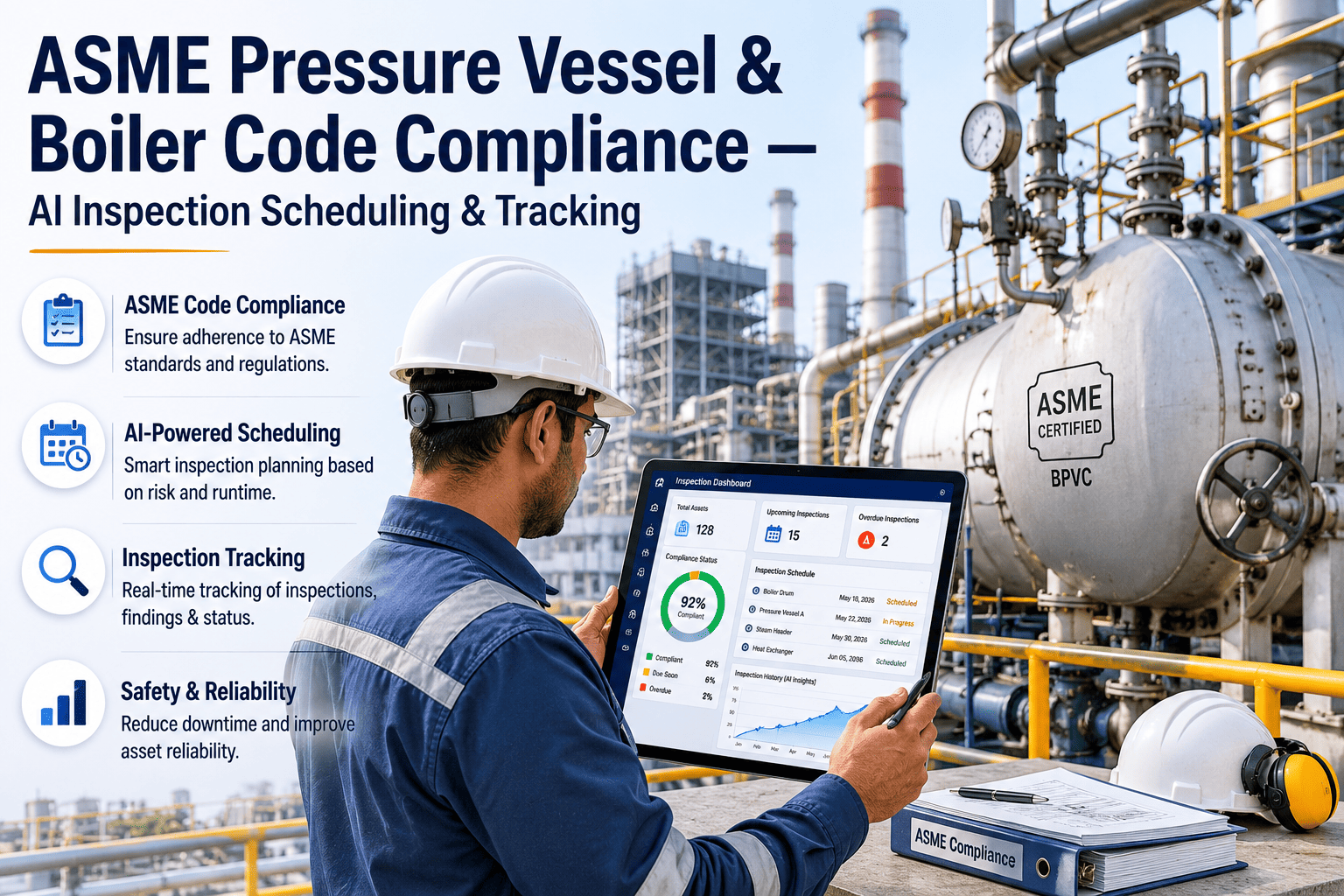
iFactory's pressure vessel compliance module is configurable to the inspection interval requirements, certification standards, and documentation formats mandated by different regulatory bodies — including ASME, EN 13445, PED, and national regulatory frameworks. The platform automatically tracks inspection due dates, certification expiry windows, and documentation completeness for every registered pressure vessel, generating automated alerts when renewal windows approach and producing audit-ready compliance packages on demand. For plants operating across multiple regulatory jurisdictions, compliance rule sets can be maintained separately for each applicable standard.
Can digital inspection checklists replace existing paper-based inspection protocols without disrupting current technician workflows?
Digital inspection checklists in iFactory are built to mirror existing paper-based inspection protocols in structure — so technicians work through familiar sequences rather than learning entirely new procedures. The transition to digital is typically completed within the first two weeks of deployment, with technician training sessions integrated into the deployment timeline. Mobile-optimised checklist forms allow inspections to be completed on tablets or smartphones in the field, with offline capability for areas with limited connectivity. Completed digital inspections automatically populate the asset maintenance record, eliminating the manual data entry step that creates delays and transcription errors in paper-based processes.
How does the AI thermal performance monitoring differ from the efficiency monitoring already built into our DCS?
DCS-based efficiency monitoring is designed to report current operating parameters and fire alarms when values exceed defined thresholds. It operates in isolation — assessing each parameter independently against a static set point. iFactory AI thermal monitoring does three things DCS cannot: it correlates multiple performance parameters simultaneously to identify compound degradation patterns; it models trajectory rather than point-in-time status, detecting a parameter trending toward an alarm threshold days or weeks before it arrives; and it cross-references thermal performance data against maintenance history, inspection findings, and operational context to identify the probable root cause of performance drift, not just its existence. These capabilities are additive to DCS monitoring, not replacements for it.
What is the typical payback period for iFactory Boiler Analytics Software deployment?
Most facilities achieve full deployment cost recovery within 3 to 5 months of going live — driven primarily by avoided emergency repair spend and fuel efficiency gains identified in the first operating quarter. The initial ROI baseline report delivered at Week 4 documents the specific cost reduction categories and values attributed to the platform in the first month of operation, providing a clear financial foundation for ongoing investment justification. Plants with high-frequency boiler issues or recent emergency repair history typically see faster payback, as the predictive intelligence addresses active cost drivers from day one of deployment.
Eliminate Boiler Inspection Gaps, Reduce Maintenance Waste & Ensure Compliance — Starting in 4 Weeks.
iFactory Boiler Analytics Management Software gives power plants digital inspection checklists, AI-driven predictive maintenance, automated pressure vessel compliance tracking, and real-time thermal performance monitoring — fully deployed and delivering measurable cost reductions within a single month.