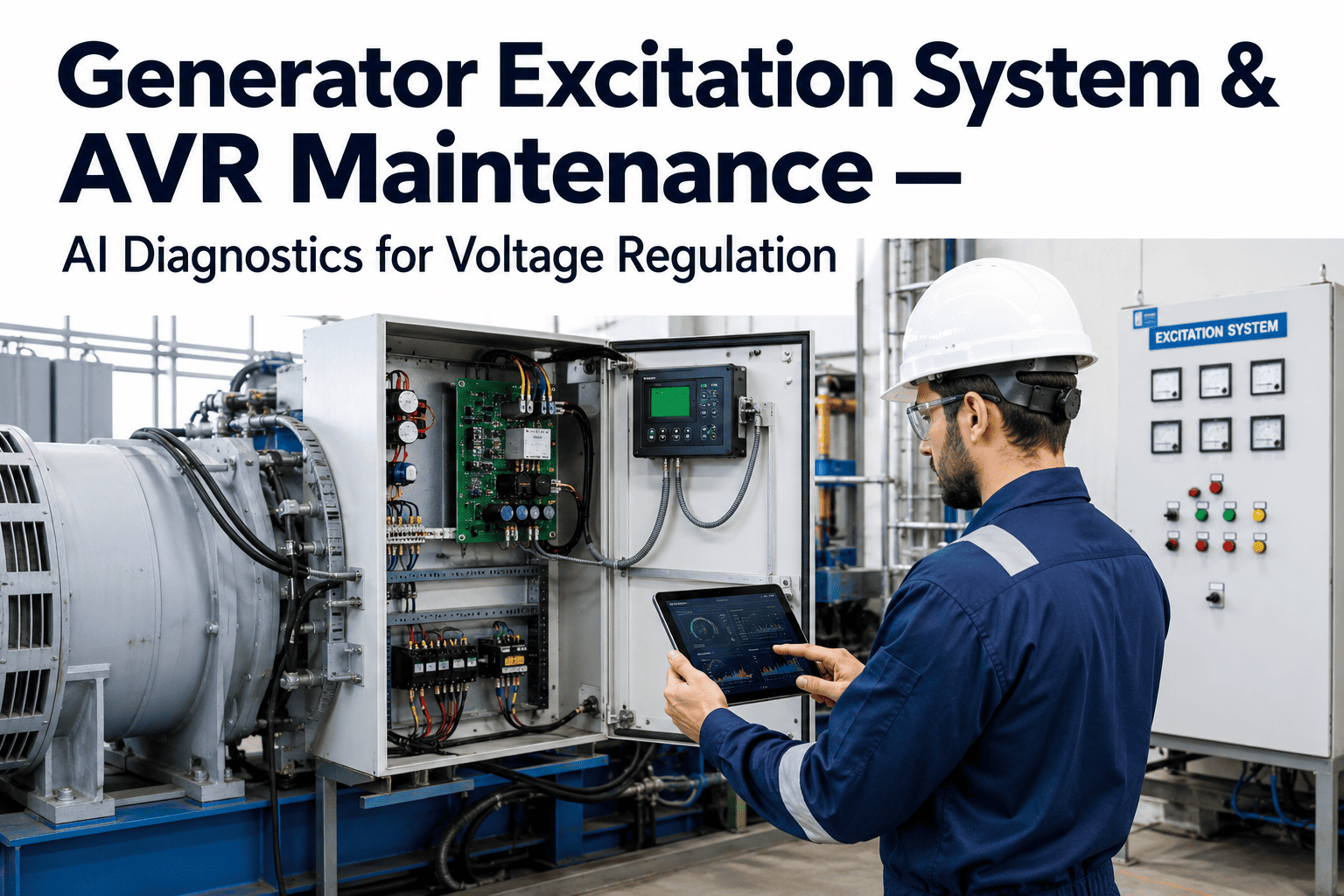
In the high-stakes environment of power generation, the excitation system and automatic voltage regulator (AVR) form the critical link between mechanical energy and stable electrical output. These components dictate voltage regulation, reactive power sharing, and overall grid synchronization. A failure in the excitation system can lead to voltage collapse, generator tripping, or even catastrophic damage to the rotor and stator windings. Traditional maintenance approaches, relying on time-based inspections and manual data logging, often miss early signs of degradation such as thyristor junction fatigue, field winding insulation breakdown, or control loop instability. This comprehensive guide delves into the advanced diagnostics and AI-driven strategies that empower plant engineers to transition from reactive repairs to predictive excellence. By leveraging real-time monitoring of excitation parameters, including field current ripple, firing angle consistency, and voltage regulator response, maintenance teams can detect anomalies weeks before they escalate. Book a Demo to see how iFactory's AI platform transforms your excitation system reliability.
Precision Voltage Regulation Starts Here
Deploy AI-driven diagnostics to eliminate unplanned outages and optimize reactive power control. Gain real-time visibility into thyristor health and field winding integrity.
Thyristor Health Index
Continuous assessment of thyristor junction temperature, switching losses, and gate pulse integrity. AI models predict remaining useful life with 95% accuracy.
Fleet Average: 85% HealthField Winding Insulation
Real-time polarization index and dielectric loss monitoring. Early detection of moisture ingress or carbon tracking reduces flashover risk by 70%.
Insulation Resistance: 72%AVR Control Stability
Analysis of step response, overshoot, and settling time. Adaptive tuning recommendations ensure optimal voltage regulation under dynamic load conditions.
Stability Index: 91%Understanding Excitation System Architecture
The excitation system supplies direct current to the generator field winding, producing the magnetic field necessary for voltage generation. Modern systems fall into three main categories: brushless exciters, static exciters, and rotating diode assemblies. Each configuration presents unique failure modes. Brushless exciters, for instance, rely on rotating diodes that are prone to fatigue under thermal cycling. Static exciters use thyristor bridges that can suffer from commutation failures. AI-driven diagnostics analyze waveforms from voltage and current sensors to pinpoint which component is degrading. By modeling the excitation system's transfer function, machine learning algorithms can detect deviations from normal behavior, such as increased firing angle jitter or abnormal field current harmonics. This granular visibility enables condition-based maintenance instead of fixed schedules, reducing unnecessary downtime and extending component life.
- Real-time monitoring of field voltage and current
- Thyristor firing angle consistency analysis
- Rotating diode health assessment
- AVR setpoint tracking and drift detection
AI-Driven Excitation Diagnostics Workflow
Data Acquisition
High-frequency sensors capture field current, field voltage, exciter armature current, and AVR output at 10 kHz. Data is streamed to the cloud for real-time analysis.
Feature Engineering
Domain-specific features are extracted: firing angle variance, thyristor junction temperature rise, field winding insulation resistance, and AVR step response metrics.
Anomaly Detection
Autoencoder neural networks identify deviations from normal operating patterns. Alerts are generated for subtle changes like increased field current ripple or AVR oscillation.
Prescriptive Recommendations
AI provides actionable insights: adjust AVR gains, schedule thyristor replacement, or perform insulation drying. Each recommendation includes risk assessment and cost-benefit analysis.
Key Excitation System Parameters Monitored
| Parameter | Normal Range | AI Alert Threshold | Failure Mode |
|---|---|---|---|
| Field Current Ripple | < 2% of DC value | > 5% | Thyristor misfiring |
| Firing Angle Variance | < 1 degree | > 3 degrees | Gate drive degradation |
| Insulation Resistance (PI) | > 2.0 | < 1.5 | Moisture or carbon tracking |
| AVR Settling Time | < 1 second | > 2 seconds | Control loop instability |
| Exciter Armature Current | Within 10% of nominal | > 20% deviation | Diode failure or winding short |
Advanced AVR Control Loop Analysis
The automatic voltage regulator is a closed-loop control system that maintains generator terminal voltage at the setpoint. Its performance is characterized by response time, overshoot, and steady-state error. AI algorithms continuously analyze the control loop's transfer function by injecting small-signal perturbations and measuring the system's reaction. This allows for adaptive tuning of PID parameters to compensate for aging components or changing grid conditions. For example, if the exciter's time constant increases due to winding heating, the AI can adjust the AVR's integral gain to maintain stability. Additionally, the system detects limit cycles or oscillations that indicate impending instability. By providing real-time tuning recommendations, the AI ensures that the generator remains synchronized even during severe grid disturbances, such as load rejection or fault clearing. This level of dynamic optimization is impossible with traditional fixed-gain controllers.
Optimize Your Voltage Regulation Today
Leverage AI to automatically tune AVR parameters and detect early signs of control loop degradation. Protect your generator from voltage instability and extend component life.
Field Winding Insulation Diagnostics
Field winding insulation is subjected to extreme thermal, electrical, and mechanical stresses. Over time, insulation degrades due to partial discharge, moisture absorption, and thermal aging. AI-driven diagnostics use polarization index (PI), dielectric loss factor (tan delta), and capacitance measurements to assess insulation health. Machine learning models trained on historical failure data can predict the remaining life of the insulation system with high accuracy. For instance, a sudden increase in tan delta at low frequencies indicates moisture ingress, while a steady rise in capacitance suggests delamination. The system provides early warnings, allowing maintenance teams to schedule drying or re-insulation during planned outages. This proactive approach prevents catastrophic ground faults that can destroy the rotor and require weeks of repair. With iFactory's platform, engineers receive daily health scores and trend analyses, enabling data-driven decisions about field winding maintenance.
Thyristor Bridge Health Monitoring
Thyristors in static excitation systems are prone to failure due to junction fatigue, cosmic ray-induced breakdown, and thermal runaway. AI monitoring tracks junction temperature, switching losses, and gate pulse characteristics to assess thyristor health. By analyzing the I-V curve during each switching cycle, the system can detect early signs of degradation, such as increased forward voltage drop or reduced dV/dt capability. Predictive models estimate the remaining useful life of each thyristor, enabling just-in-time replacement. This reduces the risk of a commutation failure, which can cause severe overvoltage and damage to the generator. The AI also optimizes the firing sequence to balance thermal stress across the bridge, extending the overall life of the assembly. Real-time alerts notify engineers when a thyristor's health falls below a critical threshold, allowing for replacement during a scheduled outage rather than an emergency shutdown.
Reactive Power Control and Grid Synchronization
Excitation systems play a pivotal role in reactive power management and grid stability. The AVR adjusts field current to control the generator's reactive power output, influencing voltage levels at the point of interconnection. AI-driven analytics optimize reactive power setpoints based on grid conditions, load forecasts, and generator capability curves. This ensures that the generator operates within its safe operating region while contributing to voltage support. The system also detects anomalies in reactive power response, such as delayed or oscillatory behavior, which can indicate excitation system degradation. By providing real-time recommendations for setpoint adjustments, the AI helps maintain power factor within contractual limits and avoids penalties. Furthermore, during grid disturbances, the AI can trigger fast-acting excitation boosting to support voltage recovery, enhancing overall system reliability. This level of intelligent control is essential for modern power plants operating in deregulated markets.
Case Study: AI-Driven Excitation Overhaul at a 500MW Plant
A 500MW coal-fired power plant experienced frequent AVR trips due to thyristor failures. Traditional troubleshooting involved replacing components after failure, leading to extended downtime. iFactory deployed its AI platform to monitor excitation parameters in real time. Within three months, the system identified a pattern of increased firing angle variance in one thyristor leg, indicating gate driver degradation. The plant replaced the driver during a scheduled outage, preventing an imminent failure. Over the next year, the AI system detected insulation degradation in the field winding due to moisture ingress, prompting a drying procedure that restored insulation resistance. As a result, unplanned outages related to the excitation system were reduced by 80%, saving the plant $1.2 million annually in lost generation and repair costs. The AI also optimized AVR tuning, improving voltage regulation accuracy by 15% and reducing reactive power penalties.
Integration with Existing Plant Systems
iFactory's AI platform seamlessly integrates with existing DCS, SCADA, and protection relays through standard communication protocols such as Modbus, OPC-UA, and IEC 61850. Data from excitation system sensors, including field current transducers, voltage transformers, and temperature probes, is aggregated in a unified data lake. The AI engine processes this data in real time, generating alerts and recommendations that are displayed on existing operator workstations. No hardware modifications are required, as the platform can be deployed on edge devices or in the cloud. The integration ensures that maintenance teams have a single source of truth for excitation system health, eliminating data silos and improving decision-making. The platform also supports historical data analysis, enabling root cause analysis of past failures and continuous improvement of predictive models.
Cost-Benefit Analysis of AI-Driven Excitation Maintenance
Implementing AI-driven diagnostics for excitation systems yields significant financial benefits. The initial investment includes sensor installation, platform licensing, and integration services, typically ranging from $50,000 to $150,000 per unit. However, the return on investment is realized through reduced unplanned downtime, extended component life, and optimized maintenance schedules. For example, a typical thyristor bridge replacement costs $30,000 per event, while a field winding failure can exceed $500,000 in repair and lost generation. By predicting failures weeks in advance, AI reduces emergency repairs by 70%, saving an average of $200,000 per year per generator. Additionally, improved voltage regulation reduces reactive power penalties by 20%, adding another $50,000 in annual savings. The total payback period is typically less than 12 months, making AI-driven excitation maintenance a high-ROI investment for any power plant.
Frequently Asked Questions
What is the difference between brushless and static excitation systems?
Brushless excitation systems use a rotating armature and diode bridge mounted on the generator shaft, eliminating the need for slip rings and brushes. This reduces mechanical wear but introduces failure modes in rotating diodes and rectifier assemblies. Static excitation systems use stationary thyristor bridges fed from the generator terminals or a separate source, offering faster response times but requiring more maintenance of power electronics. AI diagnostics are essential for both types to monitor component health and predict failures. For detailed guidance, contact our support team.
How does AI detect thyristor degradation before failure?
AI algorithms analyze high-frequency data from current and voltage sensors to extract features such as junction temperature rise, switching losses, and gate pulse characteristics. By comparing these features to historical failure patterns, the AI can identify early signs of degradation, such as increased forward voltage drop or reduced dV/dt capability. Predictive models estimate remaining useful life with high accuracy, allowing for proactive replacement. To learn more, book a demo of our platform.
Can AI improve AVR tuning for better voltage regulation?
Yes, AI continuously analyzes the control loop's transfer function by injecting small-signal perturbations and measuring the system's response. It then adjusts PID parameters to optimize response time, overshoot, and steady-state error. This adaptive tuning compensates for aging components and changing grid conditions, ensuring optimal voltage regulation. The result is improved power quality and reduced reactive power penalties. For more information, visit our support page.
What sensors are required for AI-driven excitation diagnostics?
Typical sensors include field current transducers, field voltage transducers, exciter armature current transformers, and temperature probes on thyristor heatsinks. For brushless exciters, additional sensors for rotating diode health (e.g., infrared temperature sensors) are recommended. The iFactory platform supports a wide range of sensor inputs and can integrate with existing plant instrumentation. For a detailed list, contact our support team.
How long does it take to implement AI-driven excitation monitoring?
Implementation typically takes 4 to 8 weeks, depending on the complexity of the existing instrumentation and data infrastructure. The process includes sensor installation (if needed), data integration, model training, and operator training. iFactory provides full project management and support to ensure a smooth rollout. To discuss your specific plant requirements, book a demo today.
Transform Your Excitation Maintenance Strategy
Stop reacting to failures and start predicting them. iFactory's AI platform gives you complete visibility into thyristor health, field winding insulation, and AVR control stability. Schedule your demo now.