Field inspections across industrial sites routinely find grounding resistance above recommended targets at more than one in five facilities, and seasonal soil moisture swings can push a grid that passed its last test well outside spec by the next storm season. A single lightning event can carry tens of kiloamps into bonded steel, cable trays, and grounded neutrals, and where that energy goes depends entirely on system impedance at the moment it strikes — not on how the protection system was designed on paper years ago. For a reliability engineer, that gap between design assumption and present-day ground condition is the real exposure. Talk to start tracking your plant's grounding and surge protection health.
Assess and continuously monitor ground grid integrity, surge arrester health, and shielding effectiveness across every critical equipment protection zone in your plant.
Three Systems That Only Work as a Set
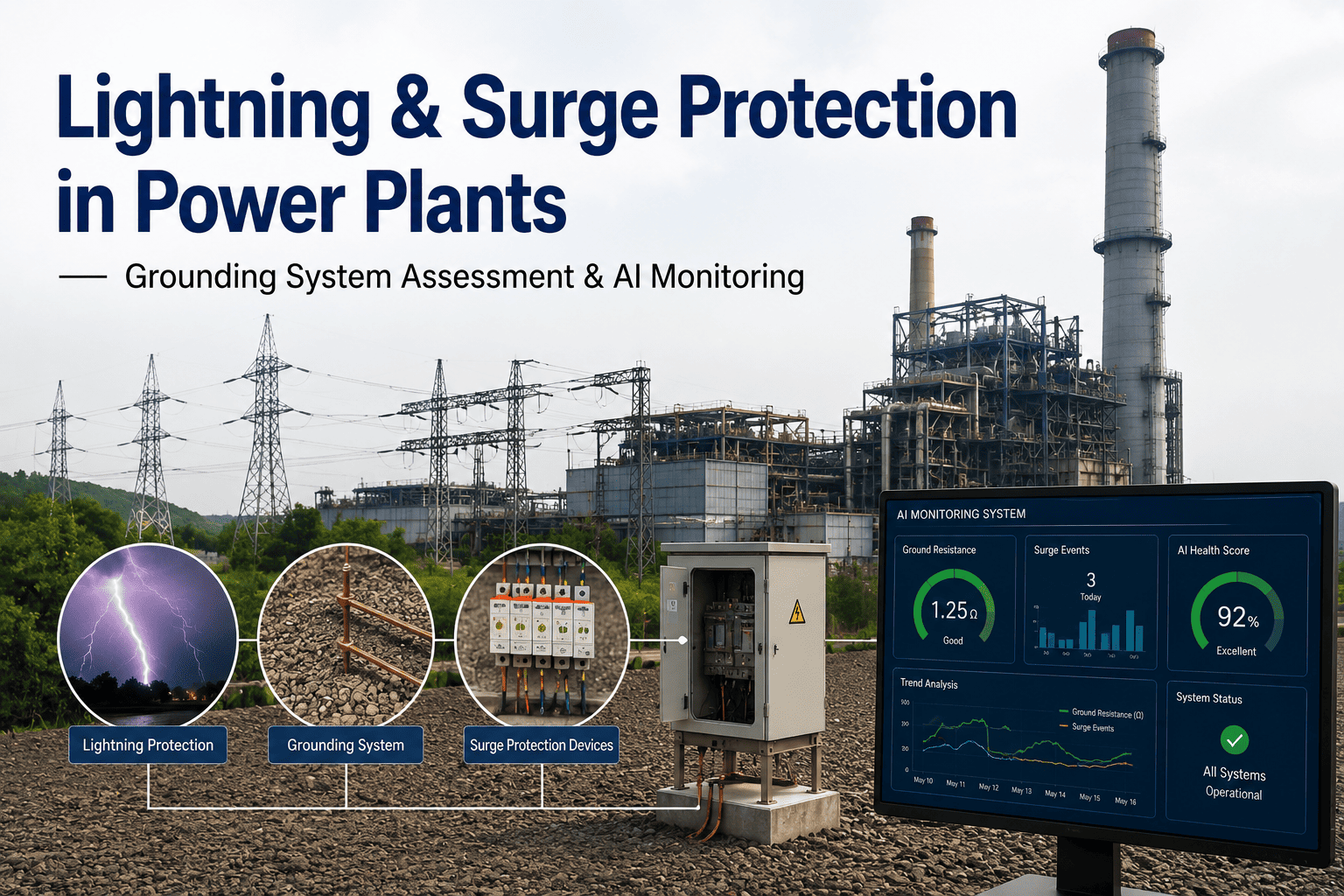
Lightning protection is not one device — it is three complementary layers, and a weakness in any single layer undermines the other two, no matter how well they were designed individually.
Air terminals and down conductors are meant to capture a direct strike at a controlled point, channeling bulk current away from sensitive equipment before it can enter the plant's electrical systems.
Surge arresters switch from a high-resistance to a low-resistance state the instant an overvoltage appears, diverting the transient safely to ground and returning to normal once the surge passes.
The ground grid gives the diverted energy somewhere to go. Bonding continuity between structural steel, cable trays, and grounded neutrals determines whether that energy dissipates safely or finds its way back through operational equipment.
Failure Scenarios Reliability Engineers Are Called In For
Soil moisture shifts, corrosion at ground rod connections, and undocumented structural changes gradually raise ground grid impedance, quietly reducing the protection margin your system was designed around.
An arrester that absorbs more energy than it is rated for can fail into a permanent short circuit, and that failure is often invisible until the next surge event finds no protection where one should be.
Cable trays, motor frames, and structural steel can act as parallel metallic paths that redirect impulse energy into equipment never designed to carry it, especially after plant modifications add new bonded steel.
A single loose or corroded bond connection can change how current divides across the entire grid during a strike, sending disproportionate energy through equipment on the weaker path.
What AI Monitoring Verifies Across Your Protection System
Online monitoring methods are preferred across the industry because they verify protection health without taking a substation or unit out of service — a meaningful advantage over periodic manual testing alone.
Watch iFactory Flag a Rising Ground Resistance Trend Before Storm Season
In a 30-minute session, we walk through real grounding and surge arrester data — how the platform tracks seasonal resistance drift, arrester conduction history, and bonding continuity in one dashboard built for reliability engineers.
What a Thorough Lightning Protection Review Should Cover
Ground resistance measured at multiple points across the grid, not a single reference test point, since resistance can vary significantly by location.
Every surge arrester's conduction history reviewed to identify units approaching their energy absorption limits.
Bonding continuity re-verified after any structural or equipment modification, since added metallic pathways change current distribution.
Seasonal soil resistivity variation accounted for, rather than relying on a single dry-season measurement.
Air terminal and down conductor placement reviewed against any new structures or equipment added since the original design.
Frequently Asked Questions
Most reliability programs test annually at minimum, but a single annual reading misses seasonal soil moisture swings that can shift resistance well outside spec for months at a time. Continuous or quarterly trending gives a far more accurate picture of your actual protection margin throughout the year. Talk to start trending your ground grid continuously.
An arrester nearing its limit typically shows rising leakage current and an increasing conduction count well before it fails into a permanent short circuit. Online monitoring tracks both trends continuously, which is the only practical way to catch degradation without taking equipment out of service for testing. Book a demo to see arrester condition trending on real plant data.
Any new bonded metallic pathway — cable trays, structural steel, motor frames — can become an unintended return conductor, changing how impulse current divides across the plant during a strike. A protection system designed around the original plant layout can develop gaps as the plant physically changes over time, which is why bonding continuity needs re-verification after modifications.
Increasingly, yes. Because lightning strikes account for the majority of transmission and distribution disturbances in many regions, protection system integrity is being tracked alongside other reliability infrastructure metrics at the executive level, tied directly to outage accountability. Talk to bring your protection data into that same reliability view.
Yes. iFactory is designed to layer analytics on top of existing ground grid test equipment, surge arrester monitors, and SCADA feeds rather than requiring new protection hardware, so your current system gains continuous visibility without a redesign.
iFactory AI Monitoring for Grounding, Surge Arresters, and Lightning Protection
iFactory connects to your existing ground grid test equipment, surge arrester monitors, and SCADA infrastructure to give reliability engineers continuous visibility into grounding integrity, arrester health, and bonding continuity across the plant.