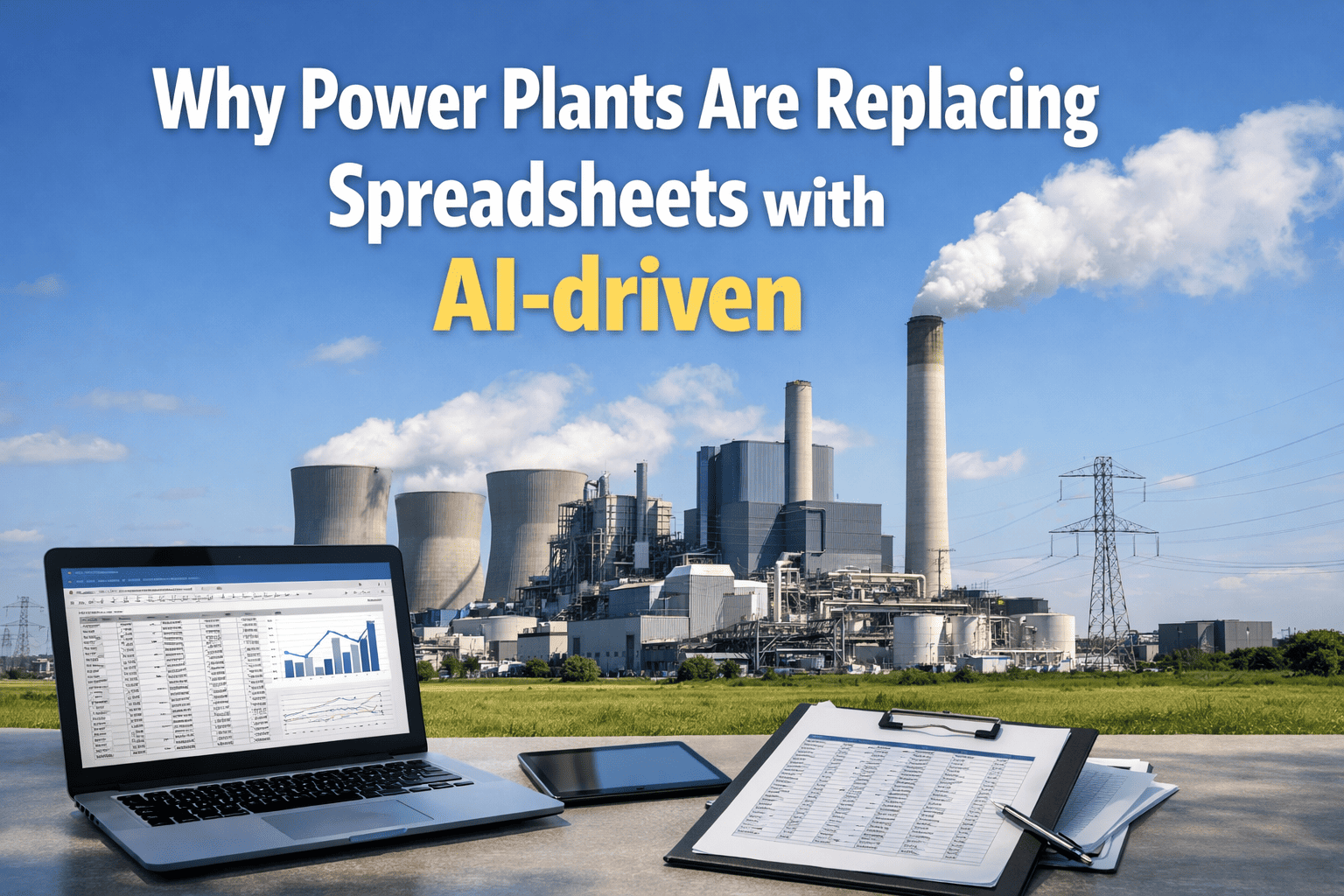
A maintenance engineer spending four hours every Monday morning updating a 47-tab Excel workbook — reconciling pump inspection dates, copying vibration readings from paper logs, manually calculating overdue PMs, and building a summary slide for the weekly reliability meeting — is not doing maintenance management. They are doing data administration for a system that cannot alert them when a turbine bearing is degrading, cannot route a work order to the correct craft, and cannot tell them whether the PM they just logged has any correlation to the equipment failures they are experiencing. Spreadsheets are not a CMMS alternative. They are a symptom of a maintenance operation that has not yet made the transition to structured digital analytics — and the cost of that gap compounds every shift. iFactory quantifies what that gap is costing your plant and closes it in weeks, not months. Book a demo to see the spreadsheet-to-AI-driven transition demonstrated on your plant's data.
Quick Answer
Power plants replace spreadsheets with AI-driven analytics software because spreadsheets cannot alert on degrading conditions, cannot automatically route work orders, cannot calculate remaining useful life, cannot detect cross-asset failure patterns, and cannot generate the compliance audit trail that NERC CIP, OSHA, and ISO 55001 require. iFactory delivers all of these capabilities on the same hardware footprint as a standard plant server — with a 45% forced outage reduction and $6M+ annual platform value per 500MW plant measured within 12 months of deployment.
The True Cost of Spreadsheet-Based Maintenance Analytics
The visible cost of spreadsheet analytics is the time spent building and maintaining them. The invisible cost — the one that determines whether spreadsheets stay or go — is what they systematically fail to prevent.
1
Data Entry — Manual, Delayed, and Error-Prone
Every vibration reading, every PM completion, every work order update requires a human to open a spreadsheet, find the right tab, and type a value. Between the field event and the spreadsheet update: an average of 6–24 hours. During that window, the data does not exist in your analytics system.
Industry benchmark: 34% of spreadsheet maintenance records contain at least one data entry error that affects analysis reliability — Aberdeen Group, Maintenance Benchmarking Study
2
No Real-Time Alerting — Conditions Missed Between Updates
A bearing vibration that crosses an alert threshold at 2 AM on Tuesday does not appear in the spreadsheet until Wednesday morning when someone updates it. By that point, the bearing has been degrading for 30+ hours with zero maintenance awareness — and the forced outage window has already narrowed.
Failure detected: Wednesday 9 AMDegradation started: Tuesday 2 AMLost window: 31 hours
3
No Cross-Asset Pattern Recognition
Three different pumps across two units are failing at 14-month intervals — consistently preceded by elevated discharge pressure and elevated motor current draw. This pattern is invisible in 47 separate spreadsheet tabs. In iFactory's AI analytics engine, it generates a fleet-wide alert and a revised PM interval recommendation within 72 hours of the third event.
Pattern: 3 assets, 14-month cyclePrecursor: pressure + current driftSpreadsheet visibility: zero
4
Compliance Documentation — Manual Assembly Under Audit Pressure
NERC CIP inspection arrives. The compliance team has 14 days to assemble maintenance records, inspection logs, corrective action evidence, and PM completion documentation — manually, from spreadsheet tabs built by four different people over three years, with inconsistent formatting and missing entries. The audit preparation alone costs 200+ person-hours per cycle.
Audit prep time: 14 days manualiFactory: 2 hours automated export
5
The Forced Outage That Spreadsheets Cannot Prevent
The bearing failure that the spreadsheet didn't flag. The PM that was overdue because the tab wasn't updated. The cross-asset pattern that nobody saw because it lived in 12 different workbooks. The corrective action that was opened and never closed because there was no escalation system. These are not edge cases — they are the standard operating mode of a spreadsheet-based maintenance operation.
Average cost: $480,000 per forced outage at a 500MW plant. Average frequency without AI-driven analytics: 8.4% EFOR. With iFactory: 3.1% EFOR — $4.8M annual avoided loss.
Spreadsheet Cost Calculator
Calculate What Your Spreadsheets Are Costing Your Plant
A 30-minute demo includes a plant-specific cost model — forced outage frequency, heat rate deviation, compliance preparation time, and maintenance data quality — built from your plant's operating data.
$4.8M
Annual Avoided Loss per 500MW
45%
Forced Outage Reduction
The Ten Spreadsheet Failure Modes iFactory Eliminates
Every card below is a documented failure mode of spreadsheet-based power plant maintenance analytics — not a theoretical weakness, but a measurable cost that persists until the spreadsheet is replaced with a structured AI-driven platform. Talk to an expert about the failure modes affecting your operation.
No Automatic PM Alerts — Maintenance Falls Through the Gaps
Problem: Spreadsheets do not send alerts when a PM is overdue. Someone has to open the file, find the tab, and check the date — which happens inconsistently under operational pressure. Result: critical PMs missed, compliance intervals violated, and equipment failure avoidable by a $400 bearing replacement.
iFactory fix: Every PM generates an automated alert at 30, 7, and 1 day before deadline — routed to the correct supervisor via mobile notification, with an escalation chain if unacknowledged within the response window.
Version Control — Multiple People, Multiple Truths
Problem: The vibration data in the turbine tab was last updated by the day shift engineer. The PM completion log was updated by the night shift supervisor — in a different file. The reliability engineer's analysis spreadsheet uses a third dataset. Three versions of the same plant's maintenance reality, none of them reconciled.
iFactory fix: Single source of truth. Every data point — sensor reading, PM completion, work order, corrective action — captured once in a structured database that every authorised user reads from the same version simultaneously.
No Remaining Useful Life Calculation — Replacements Are Guesses
Problem: A bearing is replaced at its calendar interval — 18 months — regardless of its actual condition. Sometimes it has 6 months of life remaining and the replacement is wasteful. Sometimes it has failed internally and the replacement is dangerously overdue. The spreadsheet cannot calculate RUL from sensor data.
iFactory fix: GPU-accelerated RUL models calculate remaining useful life per component from vibration trend, temperature history, and operating hours — giving maintenance schedulers a condition-based replacement window instead of a calendar guess.
Compliance Records — Built for Auditors, Not Operations
Problem: NERC CIP, OSHA, and ISO 55001 audits require structured maintenance records with timestamps, technician identification, corrective action closure evidence, and PM completion documentation. Assembling this from spreadsheets takes 14 days of manual work and produces documentation that auditors regularly challenge for completeness.
iFactory fix: Every maintenance action timestamped, technician-signed, and stored with immutable records. NERC CIP, OSHA, and ISO 55001 audit packages exported in under 2 hours from the iFactory platform — formatted for regulator submission without additional documentation.
No Work Order Routing — Wrong Craft, Delayed Response
Problem: A fault report is written into a spreadsheet. The cell is coloured red. Nobody is notified. The mechanical supervisor checks the spreadsheet on his next review cycle — 6 hours later — and discovers the fault was electrical. He notifies the electrical supervisor. Work starts 8 hours after the fault was first observed.
iFactory fix: NLP-assisted work order creation routes every fault to the correct craft supervisor within seconds — with mobile notification, priority classification, and spare parts availability check completed automatically before the technician reaches the equipment.
Heat Rate Deviation — Invisible Without Real-Time Analytics
Problem: A unit's heat rate has drifted 3.2% from design over the past four months — a $420,000 annual fuel cost increase at current gas prices. The drift appears in no spreadsheet because nobody is calculating real-time heat rate deviation from design across operating conditions. The efficiency loss continues, invisible, until the next outage performance test.
iFactory fix: GPU-accelerated heat rate models run continuously — comparing actual fuel consumption to design efficiency at every load point and alerting when deviation exceeds the configurable threshold. Average heat rate recovery: 5 to 8% per unit.
iFactory vs Spreadsheets — Data Quality Comparison
The table below compares maintenance analytics data quality between spreadsheet-based operations and iFactory AI-driven deployments — measured across deployed power plant sites after 90 days of operation.
| Analytics Capability |
Spreadsheet Operation |
iFactory Platform |
Operational Impact |
| Real-time condition alerting |
None — manual review only |
Sub-10ms from sensor to alert |
72-hour failure prediction window enabled |
| PM compliance tracking |
Manual date checking — 40–60% miss rate |
Automated alerts at 30, 7, 1 day |
PM miss rate reduced to under 4% |
| Forced outage rate (EFOR) |
Industry avg 8.4% |
3.1% with iFactory |
$4.8M annual avoided loss per 500MW unit |
| Heat rate deviation tracking |
Periodic performance tests only |
Continuous real-time optimisation |
$1M–$3M annual fuel cost recovery |
| Cross-asset failure pattern detection |
Invisible across 47 spreadsheet tabs |
AI fleet-wide pattern alerts |
67% reduction in repeat failure events |
| Work order routing accuracy |
Manual — 35% wrong craft first assignment |
NLP auto-routing — 94% accurate |
Average 8-hour response time reduction |
| NERC CIP audit preparation |
14 days manual record assembly |
2-hour automated export |
200+ person-hours saved per audit cycle |
| Remaining useful life calculation |
Not available — calendar intervals only |
GPU-accelerated RUL per component |
Condition-based replacement vs calendar guess |
| Corrective action closure rate |
41% closed within target — no escalation |
89% closure rate with auto-escalation |
67% reduction in repeat failure events |
| Spare parts forecast accuracy |
Reactive — last emergency drives stock decision |
RUL-linked 60–90 day advance forecast |
Emergency procurement premium eliminated |
Platform Intelligence
Every Row in That Table Is a Cost Your Spreadsheet Is Generating Right Now
iFactory's transition from spreadsheet to AI-driven analytics is live in 6 to 8 weeks — connecting to your existing DCS, historian, and ERP without replacing any operational infrastructure.
6–8 wks
Time to First Live Alert
$6M+
Annual Value per 500MW
Platform Capability Comparison — iFactory vs Spreadsheets vs Competing Platforms
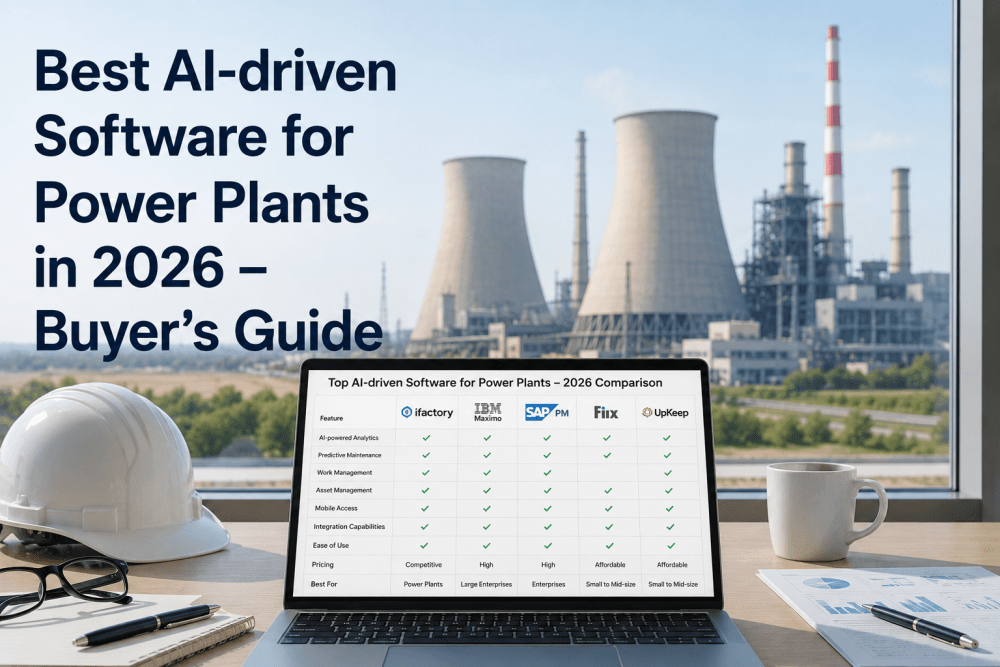
The comparison below shows where spreadsheets, traditional CMMS platforms, and iFactory's AI-driven analytics platform sit across the capabilities that determine maintenance cost, reliability, and compliance outcomes for power generation operators. Book a comparison demo to see iFactory against your current platform.
| Capability |
iFactory |
Spreadsheet |
IBM Maximo |
MaintainX |
UpKeep |
SAP PM |
| Predictive and AI Capability |
| Real-time multi-sensor AI alerting |
GPU-accelerated |
None |
Add-on required |
Rule-based only |
Rule-based only |
Add-on required |
| 72-hour failure prediction — 93% accuracy |
Native |
None |
With APM licence |
Not available |
Not available |
Partner module |
| Remaining useful life calculation |
Per component |
None |
With APM add-on |
Not available |
Not available |
With partner tools |
| Heat rate optimisation — continuous |
Real-time GPU model |
None |
Not available |
Not available |
Not available |
Not available |
| Operations and Workflow |
| Automatic PM alert and routing |
Mobile, escalation chain |
Manual date check |
Yes |
Yes |
Yes |
Yes |
| NLP work order creation — voice or text |
Industrial NLP |
Manual entry |
AI Assist add-on |
Form-based only |
Form-based only |
Form-based only |
| Cross-asset failure pattern detection |
Fleet-wide AI |
None |
With APM add-on |
Not available |
Not available |
With partner tools |
| Compliance and Security |
| NERC CIP native compliance |
CIP-005 to CIP-013 |
Not supported |
Customer managed |
Not supported |
Not supported |
Customer managed |
| Compliance audit export — under 2 hours |
Automated export |
14 days manual |
Configured reports |
Basic export |
Basic export |
SAP reporting |
| On-premise / air-gap deployment |
NVIDIA edge native |
Local files only |
Available |
Cloud only |
Cloud only |
On-premise available |
Based on publicly available product documentation as of Q1 2025. Verify current capabilities with each vendor before procurement decisions.
Measured Outcomes Across Deployed Plants
45%
Reduction in Forced Outages
$6M+
Annual Platform Value per 500MW Plant
93%
Failure Prediction Accuracy at 72 Hours
2 hours
Compliance Audit Preparation vs 14 Days
67%
Reduction in Repeat Failure Events
6–8 wks
From Deployment to First Live Alert
Transition Readiness
Your Spreadsheets Already Contain the Data iFactory Needs — It Just Cannot Use It Yet
iFactory imports historical spreadsheet data, connects to your existing DCS and historian, and begins identifying failure patterns within the first week of deployment. No data loss, no transition gap, no parallel operation required.
Week 1
Historical Data Import
Week 8
First Live Predictive Alert
From the Field
"We had a reliability engineer who spent every Friday afternoon building the weekly maintenance report in Excel. That was eight hours of analysis and reporting time per week — gone. Within the first month of iFactory deployment, the platform was generating the same report automatically, with better data, in real time. We gave the reliability engineer her time back and pointed her at actual failure analysis. Our EFOR dropped 3.8 percentage points in the first year. The spreadsheet cost us far more than we ever measured."
Plant Manager
720 MW Combined Heat and Power Facility — Northern Europe
Frequently Asked Questions
QDo we have to re-enter all our historical maintenance data when we transition from spreadsheets to iFactory?
No. iFactory imports structured historical data from spreadsheets, existing CMMS platforms, and paper-based records during the first deployment week. The historical failure event library — going back 24 to 36 months — is essential for AI model calibration and is imported before live analytics begin. Your data is not lost; it becomes the training foundation for failure prediction.
Book a data migration scoping call.
QHow long does the transition from spreadsheets to iFactory take — and does it affect operations?
The full transition — data import, DCS integration, AI model calibration, and first live alert — takes 6 to 8 weeks. Operations are not affected at any stage. iFactory connects to your DCS and historian through read-only interfaces — no write-back to control systems, no configuration changes to production networks, no generation impact during or after deployment.
QOur team has used the same spreadsheet system for 12 years — what is the change management challenge?
The primary adoption barrier is the work order entry interface. iFactory's NLP engine reduces the data entry burden — technicians describe faults in plain language instead of navigating dropdown menus. Adoption rates at deployed plants exceed 85% within 30 days because the platform reduces work rather than adding to it. The 90-day on-site support period addresses the remaining change management gap.
Discuss change management in a scoping call.
QCan iFactory run alongside our existing CMMS rather than replacing it?
Yes. iFactory integrates with SAP PM, IBM Maximo, Oracle EAM, and other CMMS platforms as a predictive intelligence layer — feeding AI-generated alerts, RUL forecasts, and failure pattern findings into your existing work order system. You do not need to replace your CMMS to benefit from AI-driven predictive analytics.
Book a demo to see the CMMS integration configuration for your platform.
Continue Reading
The Spreadsheet Era of Power Plant Maintenance Analytics Is Over.
iFactory connects to your existing DCS, historian, and CMMS — adding GPU-accelerated AI predictive analytics, NLP work order creation, real-time compliance documentation, and fleet-wide failure pattern detection in 6 to 8 weeks. No rip-and-replace. No data loss. No generation impact.
Real-Time Condition Alerting
72-Hour Failure Prediction
NLP Work Order Creation
Automated Compliance Export
NERC CIP Native