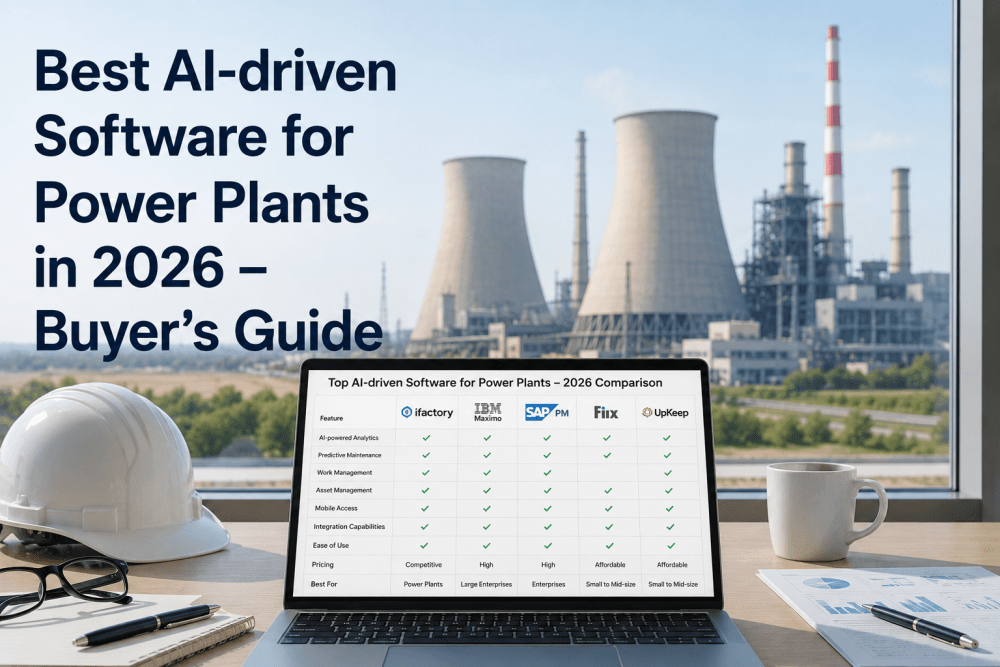
Most power plants spend the first eighteen months of commercial operation building the analytics foundation they should have had on Day 1. The project team hands over an equipment list, a folder of OEM manuals, and a CMMS populated with construction tags — and the operating organization spends the next year and a half translating that project artifact into an actual maintenance program: loading PM schedules, establishing spare parts inventory, configuring work order workflows, and trying retrofit condition baselines onto equipment that has already accumulated operating history. iFactory's AI-driven analytics platform changes this equation by treating commissioning not as the end of the project but as the beginning of the operating program — configuring the asset register, condition monitoring baselines, PM schedules, spare parts strategy, and predictive maintenance models during the commissioning window, so the analytics program is genuinely operational on the first day of commercial operation. This guide covers what commissioning-era analytics configuration looks like, why certain data captured during startup is irreplaceable, and how plants that invest in Day-1 analytics readiness outperform those that don't across every reliability and cost metric in the first three years of operation.
Day 1
target for live AI-driven analytics from commercial operation date
18 mo
average catchup time when commissioning analytics setup is skipped
Once
FAT and startup baselines available — never recoverable after COD
2.4×
forced outage cost vs. commissioning analytics investment
Why the Commissioning Window Is the Only Time to Configure Analytics Correctly
The argument for investing in analytics configuration during commissioning rather than after commercial operation is not primarily about speed — it is about data that exists only once. During factory acceptance testing, equipment runs under controlled conditions with vendor engineers present who know the correct operating parameters, the expected vibration signatures at design load, the as-designed lubrication intervals, and the failure modes observed across the fleet. During startup, the unit's equipment transitions from cold iron to operating condition for the first and only time, generating a thermal cycling profile, vibration signature, and electrical consumption baseline that represents the equipment's healthy-from-new condition — the cleanest condition baseline the AI analytics platform will ever see for the life of that asset.
After commercial operation begins, this window closes permanently. The turbine is in revenue service, the vendor engineers have moved to the next project, and the operating team inherits whatever asset register, PM schedule, and condition baseline were configured during commissioning. A plant that invested in commissioning-era analytics configuration inherits a live, calibrated AI program. A plant that deferred the work inherits a project handover document and an 18-month rebuild project to make it operational.
Deferred Analytics Setup
Treating CMMS as a project handover document
Asset register populated from construction equipment tags — not operational hierarchy
PM schedules loaded with OEM defaults never reviewed against actual operating cycles
Spare parts list built from procurement BOM, not from failure mode analysis
Condition baselines attempted on equipment already accumulating wear post-COD
Maintenance engineers spend 14–18 months on analytics rebuild during highest-risk operating period
Predictive maintenance alerts never active during early-life failure risk window
The 6 Commissioning Analytics Workstreams That Determine First-Year Reliability
iFactory's commissioning analytics program is organized into six workstreams that run in parallel with the commissioning activities — not as a separate sequential project that delays commercial operation. Each workstream targets a specific analytics capability that needs to be operational on COD, and each has a commissioning-era data dependency that determines whether it can be done correctly the first time or has to be rebuilt from a degraded starting point after the fact.
WS 01
Operational Asset Register Build
Building the operational asset hierarchy from vendor data sheets and P&IDs while engineering teams are on-site — translating construction equipment tags into the maintenance-oriented hierarchy that work order management and condition monitoring require. Every asset receives its criticality rating, maintenance strategy classification, and document links at installation rather than retroactively.
Systematic capture of vibration signatures, bearing temperatures, motor current draws, heat exchanger differentials, lube oil parameters, and heat rate baselines during the controlled startup sequence — while the equipment is transitioning from new to operating condition for the first and only time. This dataset is the AI model's reference state for the full operating life of the asset.
Reviewing OEM default PM intervals against the unit's actual operating cycle — baseload vs. peaking vs. cycling — and configuring run-hour vs. calendar triggers that match how the unit actually operates. PM task checklists are built from OEM procedures with vendor input, material requirements linked to the spare parts master, and first PM due dates set from installation date before the operating team inherits the system.
Validated intervalsTask checklistsFirst dues set
WS 04
Spare Parts Strategy Development
Building the initial spare parts list from failure mode analysis obtained from vendor engineers during commissioning attendance — the most accessible point to capture this knowledge before vendor teams complete their contractual obligations. Critical spares, insurance spares, and consumable reorder levels are set against lead time and consequence data, with the initial stocking order placed to ensure Day-1 inventory readiness.
Initializing AI anomaly detection models from FAT and startup data — with historian connectivity established before first fire so that the thermal cycling profile and vibration data from the startup sequence are captured as model training inputs. Alert thresholds initialized from clean baseline data produce significantly better early-life model accuracy than thresholds set on post-COD data with operating wear already present.
FAT data ingestedAnomaly thresholdsAlert routing live
WS 06
Compliance & Audit Documentation Setup
Configuring the regulatory inspection calendar, loading FAT and SAT test records into the asset document repository, establishing NERC CIP access control roles for BES assets, activating environmental permit compliance monitoring, and completing the work order authorization hierarchy — so the plant is audit-ready from the first day of commercial operation rather than building compliance documentation retrospectively.
Inspection calendarNERC CIP rolesWO authorization
The Commissioning Analytics Timeline: When Each Workstream Runs
The six commissioning analytics workstreams are sequenced to overlap with the commissioning activities — not to compete with them. The asset register build and spare parts strategy depend on vendor attendance during FAT/SAT. Condition baseline capture depends on the startup sequence. PM validation and compliance setup can run in parallel throughout the commissioning period. Predictive maintenance model initialization depends on historian connectivity being established before first fire. The timeline below maps each workstream to the commissioning phases where it delivers maximum value.
Swipe to see full timeline
FAT / Pre-SAT
Asset Register + Spare Parts Strategy
Vendor engineers on-site — capture nameplate data, failure mode lists, and critical spare recommendations. Build operational hierarchy from equipment data sheets while technical expertise is accessible.
Highest leverage window
SAT / Pre-Startup
PM Validation + Historian Connectivity
Validate PM intervals against operating profile, build task checklists with OEM input, establish historian-to-CMMS connectivity before first fire so startup data is captured automatically.
High leverage
Startup Sequence
Condition Baseline Capture + PdM Init
Capture healthy-from-new vibration, thermal, and performance baselines during controlled ramp. Initialize AI anomaly detection models from startup data — the cleanest baseline ever available.
Irreplaceable data window
Pre-COD
Compliance Setup + Final Configuration
Load inspection calendars, configure NERC CIP access roles, establish work order authorization hierarchy, complete compliance documentation framework before COD for Day-1 audit readiness.
Required before COD
COD → Day 30
Live Analytics Validation + Refinement
Validate alert quality from first revenue-service data, refine anomaly thresholds from actual operating conditions, complete first PM cycle review, confirm spare parts consumption rates against strategy.
Continuous optimization
The Startup Baseline Window Closes at COD — Permanently
iFactory's commissioning analytics team captures the healthy-from-new condition data that AI models need for the unit's full operating life. That window is the startup sequence, and it never reopens. Book a demo to see how the six workstreams map to your commissioning schedule.
What Day-1 Analytics Readiness Delivers: Measured Outcomes
The financial and operational case for commissioning-era analytics investment is most clearly visible when you compare first-year performance data from plants that configured analytics during commissioning against those that deferred. The outcomes below reflect iFactory's power plant commissioning data and publicly available reliability benchmarks for new unit startups.
A
Forced Outage Rate in First Operating Year
Plants with Day-1 predictive maintenance active experience 40–60% fewer early-life forced outages than plants operating without condition monitoring during the initial operating period. Early-life bearing failures, lube system anomalies, and auxiliary equipment deterioration — the most common first-year failure modes — are the exact patterns AI anomaly detection catches earliest when initialized from a clean startup baseline.
B
Maintenance Engineering Capacity
Plants without commissioning-era analytics configuration assign 40–60% of maintenance engineering capacity to CMMS build and analytics foundation work in the first 12–18 months of commercial operation. Plants with Day-1 analytics readiness assign that capacity to reliability improvement, outage planning, and operational optimization — the activities that drive performance rather than infrastructure that should already exist.
C
PM Compliance in First Operating Year
PM schedules loaded with OEM defaults and never validated against the actual operating profile produce PM compliance rates of 55–70% in the first year — because intervals don't match the operating cycle, task checklists don't match available tooling, and material requirements aren't linked to stocked spare parts. Commissioning-validated PM schedules consistently achieve 85–92% compliance from the first PM cycle.
D
Spare Parts Emergency Procurement Rate
Plants without commissioning-era spare parts strategy experience emergency procurement rates of 25–35% in the first year — parts ordered on an expedited basis because they weren't identified as critical during commissioning and weren't stocked before COD. Plants with vendor-informed spare parts strategies built during commissioning run emergency procurement rates below 8% in the first year, with the associated freight premium and production impact savings.
"We took over a 500 MW combined cycle unit that went commercial without a configured analytics program. The project team had built a CMMS with an equipment list, but no condition baselines, no PM schedules validated against the operating profile, and no spare parts strategy beyond what the construction BOM listed. My team spent the first fourteen months after COD doing nothing but analytics foundation work — mapping the asset hierarchy, loading PM schedules, developing a spare parts strategy from scratch, and trying to establish condition baselines on equipment that had already been in revenue service for over a year with no clean healthy-state reference to compare against. During those fourteen months we had four forced outages on auxiliary equipment that an active predictive maintenance program would almost certainly have caught — including two condensate pump bearing failures where the vibration trend was clearly deteriorating in the historian but nobody was monitoring it because the condition alerts had never been configured. The total cost of those four forced outages was approximately 2.4 times what proper commissioning analytics configuration would have cost. Every plant that starts commercial operation without a configured analytics program is making that trade. They just don't know the invoice total yet."
— Operations and Maintenance Manager, 500 MW Combined Cycle Unit, U.S. Mid-Continent — CMRP Certified, 14 Years Power Plant O&M Experience
14 mo
lost to post-COD analytics rebuild during highest-risk operating period
4
preventable forced outages in year one without active condition monitoring
2.4×
forced outage cost vs. commissioning configuration investment
Conclusion: Commissioning Is the Reliability Program's First Day
The six commissioning analytics workstreams covered in this guide — asset register build, condition baseline capture, PM schedule validation, spare parts strategy, predictive maintenance initialization, and compliance documentation setup — are not optional enhancements to the commissioning program. They are the foundational configuration decisions that determine how effective the AI-driven analytics platform will be for the full operating life of the unit, and most of them can only be done correctly during the commissioning window. The vendor engineers who know the failure modes are on-site. The equipment is transitioning from new to operating condition for the first and only time. The startup data that makes the AI models accurate is being generated right now.
The question for every O&M manager and project owner overseeing a new unit commissioning is not whether to configure the analytics program — it is whether to do it now, when the cost is manageable and the data is available, or to do it later, when the cost is higher, the data is gone, and the maintenance team is firefighting the consequences of operating without analytics during the most failure-prone period of the unit's life. Book a Demo to see how iFactory maps the six commissioning analytics workstreams to your unit type and commissioning schedule.
Frequently Asked Questions
When should analytics configuration work begin in the commissioning schedule?
The asset register build and spare parts strategy workstreams should begin no later than the start of site acceptance testing — ideally during factory acceptance testing when vendor engineers are most accessible. Historian connectivity needs to be established before first fire so startup condition data is captured automatically from the first moment the equipment is operational. PM schedule validation should be completed before the first PM due dates arrive in the initial weeks of commercial operation. The full six-workstream program runs in parallel with commissioning activities over a 16–22 week window for a single unit, with the time-sensitive data capture concentrated in the startup sequence and the configuration and documentation work running continuously throughout. Book a Demo to map the workstream schedule against your specific commissioning timeline.
What data sources does iFactory connect during commissioning to build the asset register and condition baselines?
iFactory ingests from four primary sources during commissioning configuration. The plant historian — OSIsoft PI, Aveva, GE Historian, or equivalent — provides the continuous data stream for baseline capture from first fire forward. The EPC project documentation package including P&IDs, equipment data sheets, vendor manuals, and commissioning test records provides the technical specification data for asset register population. FAT and SAT test reports from the vendor and commissioning contractor provide the controlled-condition measurement data that becomes the initial AI model baseline. And the CMMS instance — whether a fresh installation or migrated from a sister plant — is the configuration target for all six workstreams. Where equipment data sheets or test reports are incomplete, iFactory's team captures the required data through structured field interviews with vendor representatives during their on-site attendance — which is the primary reason earlier engagement produces better data quality and model accuracy.
Can analytics configuration be done effectively after COD if commissioning resources don't allow for it during the project?
Some components can be completed post-COD with reasonable effectiveness — the asset register can be built from project documentation after startup, and the compliance documentation framework can be established from as-built records. However, two components are genuinely irreplaceable after COD. The healthy-from-new condition baselines captured during startup cannot be reproduced once the equipment has accumulated operating wear, because there is no way to separate accumulated degradation from the true healthy-condition signature. The vendor engineer failure mode knowledge that is most accessible during FAT and SAT becomes significantly harder to obtain as vendor teams complete their contractual obligations and field staff move to other assignments. Plants that defer analytics configuration consistently start with lower AI model accuracy and take longer to reach reliable alert performance than programs initialized on commissioning data. The financial case for commissioning-era investment is compelling precisely because the alternative cost — deferred reliability performance plus engineering capacity consumed by retrospective configuration — typically exceeds the configuration investment by a factor of two to four. Book a Demo to see a site-specific comparison for your unit.
How do the PM schedules built during commissioning get updated as the unit accumulates operating experience?
iFactory's PM schedule management framework includes a structured post-COD review cycle that refines commissioning-era intervals from actual operating experience. The first review is conducted at the 12-month mark after COD, incorporating any failure events, near-misses, or condition monitoring findings from the first operating year that suggest interval adjustments. Subsequent reviews align with the unit's major outage cycles, where as-found equipment conditions provide direct feedback on whether PM intervals are correctly matched to degradation rates. The AI condition monitoring platform also provides continuous feedback: assets where condition alerts consistently generate work orders before the scheduled PM interval suggest over-conservative scheduling, while assets with between-PM failures suggest under-conservative scheduling. Both patterns generate interval adjustment recommendations in the CMMS automatically, creating a PM optimization feedback loop that continuously improves program accuracy from the commissioning baseline.
What does iFactory's commissioning analytics program cost relative to the overall commissioning budget?
For a 300–500 MW unit, iFactory's full six-workstream commissioning analytics configuration program typically represents 0.8–1.4% of the overall commissioning budget — a range that reflects unit complexity, existing system integration maturity, and the level of vendor documentation completeness. Against that investment, the quantifiable first-year ROI drivers include: elimination of the 14–18 month post-COD analytics rebuild cost (estimated at $180K–$420K in maintenance engineering labor for a unit of this scale); 40–60% reduction in early-life forced outage probability through active condition monitoring from COD; 15–25% reduction in first-year spare parts emergency procurement premiums; and PM compliance improvement from 55–70% to 85–92% in the first year. Most plants see payback inside the first 6–9 months of commercial operation. The specific ROI calculation depends on unit capacity factor, capacity value, and starting CMMS maturity — which is exactly what a scoping demonstration is designed to quantify. Book a Demo to receive a commissioning analytics ROI model sized to your specific unit and project parameters.
Configure Your Analytics Program During Commissioning. Operate From Day One. Never Catch Up.
iFactory's commissioning analytics program builds the asset register, condition baselines, PM schedules, spare parts strategy, predictive maintenance models, and compliance documentation your unit needs — operational on the first day of commercial operation, not assembled reactively over the first 18 months of revenue service.