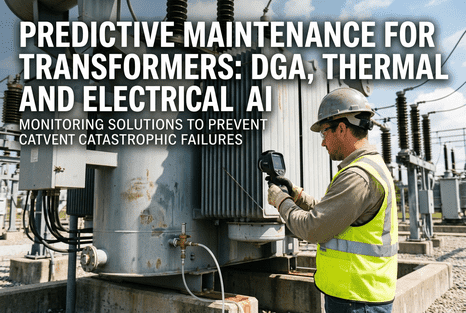
Predictive Maintenance for Transformers: DGA, Thermal and Electrical AI
By Christopher Hayes on June 7, 2026
Power and distribution transformers form the backbone of electrical transmission and distribution networks, with a single large power transformer failure costing between $2 million and $10 million in replacement costs, lost revenue, and environmental remediation. Lead times for replacement transformers extend 6–18 months, making every preventable failure a critical business continuity risk. Traditional time-based maintenance — periodic oil sampling, thermography scans, and manual inspection rounds — cannot capture the continuous degradation processes that precede catastrophic transformer failure: dissolved gas accumulation from incipient faults, progressive insulation paper depolymerization, partial discharge activity, and hotspot development from cooling system degradation. iFactory's predictive maintenance platform fuses dissolved gas analysis sensors, online partial discharge monitors, winding temperature probes, load history, and ambient temperature data into machine learning models that forecast transformer faults 6–12 months in advance, enabling utilities and industrial operators to plan interventions before failure occurs. Book a Demo to see how iFactory applies predictive intelligence to your transformer fleet.
Transformers · Electrical Grid · 2026
Predictive Maintenance for Transformers: DGA, Thermal and Electrical AI
Dissolved gas analysis prediction · thermal hotspot detection · partial discharge classification · insulation aging prognostics — preventing catastrophic transformer failures with AI-powered condition-based intelligence across your entire fleet.
Why Traditional Transformer Maintenance Is Hitting Its Ceiling
The traditional approach — annual dissolved gas analysis sampling, periodic thermography scans, and time-based bushing inspections — treats every transformer as if it operates under identical conditions. A generator step-up transformer at a cycling gas plant experiences thermal and electrical stress cycles that differ dramatically from a transmission autotransformer operating at steady load. A distribution transformer serving an industrial load with high harmonic content degrades faster than one in a residential feeder. Fixed-interval maintenance either over-serves healthy transformers (wasting sampling budget and planned outages) or under-serves transformers approaching failure (risking catastrophic tank rupture, oil fires, and extended outages). Four specific ceilings are visible across transformer maintenance programs.
01
Fixed DGA Sampling Intervals
Annual or semi-annual oil samples capture a snapshot of dissolved gas concentrations, but transient fault evolution accelerates between samples. A partial discharge escalating into winding failure can develop in weeks — invisible to annual DGA. AI models use continuous online DGA sensors to track gas generation rates in real time.
Gap: Discrete samples vs Continuous monitoring
02
Complex Gas Interpretation Methods
Duval Triangle, Rogers Ratio, IEC 60599, and IEEE C57.104 each provide partial fault diagnosis, but no single method catches all fault types. Disagreement between ratio methods causes diagnostic uncertainty. AI models trained on thousands of fault events learn patterns that no single ratio method captures.
Gap: Manual interpretation vs AI pattern recognition
03
No Cross-Fleet Learning
Each transformer operates independently with siloed DGA records, thermal scans, and maintenance history. Patterns — a specific bushing model failing at 15 years, or winding hot spots correlating with load profile — remain invisible across the fleet. AI models learn degradation patterns across all transformers in the portfolio.
Gap: Siloed vs Fleet-wide intelligence
04
Manual Inspection Limitations
Thermography and partial discharge surveys capture only the moment of inspection. Intermittent PD activity, transient hotspot formation during peak load, and slow developing faults between inspection rounds go undetected. Continuous online monitoring with AI analysis closes the gap between inspection intervals.
Gap: Periodic vs Continuous assessment
What Predictive Maintenance Actually Adds to Transformer Operations
The misconception some utility and industrial operators carry: predictive maintenance replaces existing CMMS, DGA databases, or SCADA systems. It doesn't. Your CMMS continues handling work orders, parts inventory, and maintenance schedules. Your existing DGA lab reports continue providing oil sample analysis. What changes is the intelligence layer feeding those systems. Time-based sampling schedules migrate to AI-driven continuous monitoring and prediction. DGA alarm thresholds gain predictive context — not just "hydrogen exceeds 100 ppm" but "hydrogen generation rate indicates incipient fault — elevated acetylene confirms arcing — estimated remaining life 45 days — recommended action: schedule internal inspection within two weeks." The existing CMMS receives higher-quality input. iFactory AI's Shift Logbook provides operators and maintenance teams with a unified interface for shift handovers, transformer status, and AI-generated maintenance recommendations integrated with existing workflows.
Capability
Traditional Maintenance
AI Predictive Maintenance
Oil analysis
Annual / semi-annual DGA sampling
Continuous online DGA with AI trend analysis
Fault detection
After gas limits exceeded
6–12 month predictive lead time from gas generation rates
Thermal monitoring
Periodic thermography scans
Continuous winding temperature + hotspot prediction
PD monitoring
Offline PD testing at intervals
Online PD classification with AI pattern recognition
Bushing health
Capacitance / PF measured annually
Continuous bushing monitoring with predictive alerts
Fleet coverage
Critical transformers only
All instrumented transformers fleet-wide
Operator interface
Paper logs + DGA spreadsheets
Mobile dashboards + shift logbook + AI copilot
Critical Transformer Failure Modes — What AI Catches That Periodic Inspections Miss
Transformer failures develop through identifiable physical and chemical processes that leave signatures in sensor data months before they become visible to operators or detectable through periodic sampling. AI models trained on these signatures detect degradation 6–12 months before failure — the window that separates a planned intervention from a catastrophic tank rupture, oil fire, and extended outage.
D
Dissolved Gas Analysis
Hydrogen from partial discharge, acetylene from arcing, ethylene from thermal oil breakdown, carbon oxides from cellulose paper degradation. AI correlates gas generation rates, ratios, and loading data to classify fault type and severity — catching evolving faults between sampling intervals.
Predictive lead time: 6–12 months
T
Thermal Degradation
Winding hot spots from cooling system blockage, overloading, or compromised oil circulation. Insulation paper accelerates aging above 98°C — each 8°C rise halves insulation life. AI models fuse winding temperature, load profile, and ambient data to predict remaining insulation life.
Predictive lead time: 3–6 months
P
Partial Discharge
Incipient PD from voids in solid insulation, floating metal particles, or moisture ingress. Sustained PD erodes paper insulation and can escalate to winding failure in weeks. AI classifies discharge patterns by source — corona, surface, void, or particle — enabling targeted intervention.
Predictive lead time: 4–8 weeks
I
Insulation Breakdown
Cellulose paper depolymerization reduces mechanical strength — a transformer that passes electrical tests may fail on the next through-fault. AI models fuse furan analysis, CO/CO2 ratios, degree of polymerization estimates, and cumulative fault current history to predict remaining mechanical life.
Predictive lead time: 3–6 months
The Keep / Retire / Transform / Replace Decision Matrix
Migration discipline starts here. Every transformer asset management artifact in your current operation falls into one of four categories. Getting the categorization right in week one saves quarters of debate later.
Keep
Core operations foundations
CMMS work order engine
SCADA / DCS substation control
DGA lab analysis protocols
ERP financial integration
Asset registry & nameplate data
Established capabilities. No business case to replace. AI predictive maintenance writes recommendations and work orders to these systems.
Retire
Legacy inspection layers
Fixed annual DGA sampling schedules
Paper thermography checklists
Standalone PD test spreadsheets
Manual furan analysis tracking
Email-based alert notification
Replaced by AI-driven continuous monitoring and prediction. 70–90% reduction in manual data collection effort.
Transform
Analysis workflows
DGA interpretation & fault classification
Gas generation rate trending
Thermal loading analysis
Risk-based inspection prioritization
Shift handover reporting
Become AI model invocations grounded in real-time transformer data. Intelligence upgraded via iFactory Shift Logbook.
Replace
Alert & notification layer
Legacy DGA alarm gateways
Manual escalation workflows
Standalone PD alert systems
Paper-based transformer log sheets
Siloed inspection reports
Event-driven AI alert engine replaces manual notification. Fault predictions with automated work order creation and traceability.
Want this matrix applied to your specific transformer fleet in a working session? Book a Demo to walk through every transformer class and prioritize your predictive maintenance rollout.
Three Deployment Paths for Transformer Predictive Maintenance
Same starting point, three valid destinations. The right path depends on transformer criticality, regulatory requirements, substation location, and current sensor instrumentation. Operators that pick the wrong path spend 12 months in pilot purgatory. Operators that pick the right path deploy in 8–12 weeks.
Path A
Augment in Place
6–8 weeks
AI predictive monitoring runs alongside existing DGA sampling and maintenance programs. Shadow mode for 4 weeks. Alerts flow to CMMS for review. No legacy systems retired.
Best fit
Safety-critical substations · regulated utilities · first AI deployment in transformer management
Wk 1–2 Sensor data federation
Wk 3–5 Shadow mode AI
Wk 6–8 CMMS integration live
Path B
Hybrid Migration
8–12 weeks
AI predictive layer replaces fixed sampling intervals. Legacy dashboards retire for unified mobile UX. SCADA, CMMS, and ERP preserved. DGA and PD data federated continuously.
Best fit
Mature operations · moderate budget authority · sponsorship for digital transformation
Wk 1–3 Discovery · matrix
Wk 4–8 Deploy AI prediction layer
Wk 9–12 Mobile UX migration · cutover
Path C
Full Modernization
10–14 weeks
Legacy fixed-interval programs retired. iFactory platform provides full predictive capability. CMMS retained. All transformer classes covered against matrix.
Best fit
Large multi-substation operations · siloed legacy systems · strategic platform consolidation
Wk 1–4 Full asset inventory + matrix
Wk 5–10 Parallel build + test
Wk 11–14 Cutover + legacy sunset
Pick the Right Path for Your Transformer Fleet in a 90-Minute Workshop
iFactory AI's transformer practice runs a focused workshop against your specific transformer classes, DGA and PD sensor coverage, existing CMMS configuration, and regulatory requirements. You leave with a defended path recommendation, a 12-week deployment plan, and a cost reduction projection grounded in your maintenance history.
Generic predictive maintenance vendors handle the AI math. Transformer-aware vendors handle the integration reality — DGA interpretation standards, online PD monitoring integration, bushing health diagnostics, load tap changer prognostics, and zero-disruption deployment in energized substations. Eight criteria separate vendors who have done transformer modernizations from vendors selling a demo.
01
DGA integration and interpretation
Ask:
"Does your platform integrate with online DGA monitors and lab DGA data, and does it apply IEEE C57.104, IEC 60599, Duval Triangle, and Rogers Ratio simultaneously?"
Platforms that only support one interpretation method miss faults that other methods would catch. Production-grade platforms run all major DGA interpretation methods in parallel and flag diagnostic disagreements for expert review.
02
Partial discharge monitoring
Ask:
"Does your platform integrate with UHF, HFCT, and TEV partial discharge sensors for online PD classification?"
PD is the fastest-developing transformer fault mode. Platforms must classify discharge patterns by source — corona, surface discharge, void discharge, or particle discharge — and track PD trend evolution in real time.
03
Thermal and loading analysis
Ask:
"Does your platform model winding hot spot temperature and remaining insulation life using load profile, ambient temperature, and cooling system status?"
Insulation aging follows the Arrhenius law — each 8°C temperature rise halves remaining life. Platforms that do not model thermal degradation cannot predict the most common transformer failure mode.
04
Bushing and tap changer monitoring
Ask:
"Does your platform integrate with online bushing monitors and load tap changer condition assessment systems?"
Bushing failures and tap changer defects account for 35% of transformer unplanned outages. Platforms covering only main tank monitoring miss a third of failure risk.
05
Substation connectivity
Ask:
"How does your platform connect to transformer sensors in energized substations with cybersecurity requirements?"
Read-only data acquisition through substation firewalls, IEC 61850 integration, and DNP3 support are required. Platforms requiring direct cloud access or unsecured connections cannot deploy in utility substations.
06
Fleet-wide benchmarking
Ask:
"Does your platform benchmark each transformer against similar units in the fleet using DGA trends, loading patterns, and age?"
Fleet-wide benchmarking identifies underperforming transformers before they reach critical condition. Single-asset platforms cannot provide comparative insight across the portfolio.
07
Regulatory compliance reporting
Ask:
"Does your platform generate transformer condition reports aligned with NERC, OSHA, and internal utility reliability standards?"
Regulated utilities need predictive maintenance records that satisfy reliability authority reporting requirements. Platforms with pre-built regulatory report templates save months of deployment time.
08
Deployment timeline commitment
Ask:
"When does the first validated predictive alert for a transformer reach our CMMS in production?"
8–12 weeks is the production-grade benchmark. Path A is 6–8 weeks. Vendors quoting 6+ months are building custom development for transformer-specific integration.
The ROI Math — What Predictive Maintenance Delivers for Transformers
The business case for AI-native predictive maintenance in transformer management is not about software cost — it is about cost avoidance on unplanned transformer failures, extended outages, and environmental incidents. Operators moving from DGA-based threshold alarms to AI-native predictive maintenance see measurable improvements across four metrics in the first quarter post-deployment.
−35–55%
Unplanned outage reduction
AI identifies transformer faults 6–12 months before failure. Emergency outages shift to planned interventions during scheduled substation maintenance windows.
−20–40%
Maintenance cost reduction
Condition-based oil sampling and PD testing eliminate unnecessary inspections while catching faults before they escalate to catastrophic failure.
−50–70%
Catastrophic failure reduction
Continuous DGA and PD monitoring with AI trend analysis detects evolving faults weeks to months before conventional alarm thresholds are breached.
6–12 mo
Typical ROI payback
Full investment recovery through avoided transformer failure costs, reduced outage duration, and extended asset service life.
Expert Perspective
"The single biggest mistake utilities make in transformer predictive maintenance modernization is treating it as a CMMS replacement project. It is not. Your work order engine, DGA lab protocols, and substation SCADA systems work as designed — there is no business case to replace them. What needs to change is the intelligence layer feeding those systems. Fixed annual DGA sampling schedules and calendar-based oil change programs need to migrate to AI model invocations running continuous gas trend analysis across the entire transformer fleet. Online partial discharge data that currently sits in quarterly PDF reports needs to stream continuously into fusion models that predict winding failure before it happens. The architectural decision is not CMMS-or-AI — it is CMMS-plus-AI-plus-DGA-plus-PD-plus-thermal. Utilities that frame it correctly deploy in 8–12 weeks. Utilities that frame it as rip-and-replace spend 12 months in pilot purgatory."
— Transformer Asset Management Practice, 2026 industry insight
8–12 wk
hybrid deployment with pre-configured transformer templates
70–90%
reduction in custom deployment scope with templates
Zero rip
of existing CMMS, DGA lab, or SCADA required
Conclusion: The Modernization Decision Has Three Right Answers
Annual DGA sampling programs are not failing in transformer management — they are hitting an architectural ceiling that fixed-interval analysis cannot cross. AI-native predictive maintenance adds the continuous monitoring and intelligence layer that traditional systems were never designed to deliver: real-time DGA trend analysis across all major fault gas ratios, online partial discharge classification with pattern recognition, winding hot spot temperature modeling with remaining insulation life prediction, bushing and tap changer health surveillance, self-updating models from operator confirmations, and mobile-native operator interfaces grounded in real-time transformer data. The modernization conversation has three valid answers depending on transformer criticality and regulatory exposure — augment in place (6–8 weeks), hybrid migration (8–12 weeks), or full modernization (10–14 weeks). All three keep existing CMMS intact and reuse current sensor infrastructure. All three deliver 35–55% reduction in unplanned outages and 50–70% reduction in catastrophic failures within the first year. The decision worth making in 2026 is not whether to adopt AI predictive maintenance for transformers — it is which of the three paths fits your specific transformer portfolio. Book a Demo to walk through your specific transformer classes and predictive maintenance requirements.
Run the Predictive Maintenance Workshop Built for Your Transformer Fleet
iFactory AI's transformer practice runs a 90-minute workshop against your real transformer classes, DGA and PD sensor coverage, and CMMS configuration. You leave with a defended path recommendation, the keep/retire/transform/replace matrix applied to your transformers, and a cost reduction projection grounded in your maintenance history.
Does predictive maintenance replace our existing DGA lab and oil sampling program?
No. Your DGA lab continues providing oil sample analysis exactly as today — these are established, accredited processes with no business case to replace. What changes is that continuous online DGA sensor data now feeds AI models that predict fault evolution 6–12 months in advance, while your lab results provide calibration validation and furan/DBDS analysis that online sensors cannot yet measure. The predictive layer sits on top of existing DGA data through standard lab data import and online sensor integration. Deployment does not require any changes to sampling protocols or lab accreditation.
What transformer failure modes can AI actually predict?
Production-grade AI predictive maintenance covers dissolved gas analysis faults (partial discharge, low- and high-energy arcing, thermal oil and paper decomposition), thermal degradation (winding hot spots, cooling system blockage, overloading), partial discharge activity (corona, surface discharge, void discharge, floating particles), insulation system degradation (paper depolymerization, moisture ingress, furan generation), bushing health (capacitance change, power factor drift, dielectric loss), load tap changer defects (contact wear, mechanism degradation, oil contamination), and through-fault cumulative damage (winding deformation, axial force accumulation, clamp loosening). Each failure mode has a characteristic sensor signature detectable weeks to months before catastrophic failure.
Does deployment require new sensors on existing transformers?
No. Production-grade predictive maintenance platforms integrate with existing sensor instrumentation already installed on most power transformers — online DGA monitors, winding temperature RTDs, top oil thermometers, load tap changer position indicators, and bushing monitoring systems. iFactory's federation layer reuses current instrument data through existing substation RTU and SCADA infrastructure. For transformers without online DGA monitors, retrofit units can be installed during energized substation operations, but the platform is designed to extract maximum value from existing instrumentation first.
How does predictive maintenance improve transformer fleet reliability?
Reliability improvements come through three mechanisms. First, continuous DGA trend analysis detects gas generation rate changes that conventional threshold alarms miss — a transformer with hydrogen increasing at 5 ppm per week has a different risk profile than one with stable hydrogen at the same absolute concentration. Second, fleet-wide benchmarking identifies transformers performing poorly relative to peers of similar age, design, and loading — enabling proactive intervention before the worst performers reach critical condition. Third, integrated PD monitoring catches the fastest-developing fault modes that DGA alone cannot detect early. Utilities deploying transformer predictive maintenance typically see 35–55% reduction in unplanned outages within the first year.
Which deployment path fits a regulated utility substation best?
Path A (Augment in Place) is the right starting point for regulated utility environments with NERC or equivalent oversight. The platform runs alongside existing DGA sampling and maintenance programs for 4 weeks in shadow mode, generating predictions logged for review but not triggering automatic work orders. Operations teams compare AI predictions against laboratory DGA results and actual events, document performance, and approve cutover with full traceability. No legacy systems retire in Path A — existing sampling programs and maintenance schedules continue running as a control comparison. Read-only data acquisition through substation firewalls satisfies cybersecurity requirements. After 6–12 months, most utilities progress to Path B or C to capture additional efficiency gains.