How a Steel Mill Saved $3M with AI Predictive Maintenance on Transformers
By Ethan Walker on June 18, 2026
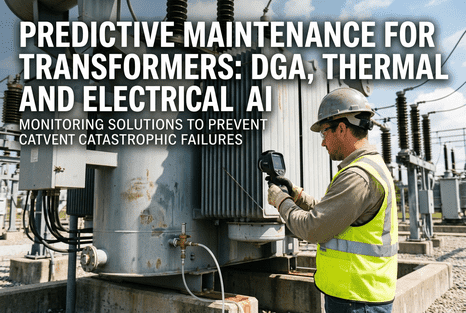
In 2024, a North American steel manufacturer operating a 2.5-million-ton-per-year flat-rolled mill faced a reliability crisis that no scheduled maintenance program could solve. Fourteen power transformers — ranging from 15 MVA furnace transformers to 100 MVA step-down units supplying continuous caster, hot strip mill, and cold rolling operations — were aging beyond their design life, with the oldest units dating to the late 1980s. Traditional dissolved gas analysis (DGA) sampling at six-month intervals was the sole transformer health surveillance mechanism, creating a detection gap during which partial discharge, overheating, and arcing faults could progress from incipient stage to catastrophic failure. When a 45 MVA ladle furnace transformer failed in March 2024 — releasing 8,000 litres of mineral oil, triggering a plant-wide production halt, and requiring a 14-week replacement lead time that cost $1.2M in lost margin — the reliability leadership team recognised that six-month DGA was detecting transformer faults only after they had already caused $500K+ emergency events. iFactory's AI predictive maintenance platform, including its Shift Logbook and transformer health analytics engine, was deployed across all 14 critical transformers to bridge the gap between six-month DGA samples and continuous dissolved gas, partial discharge, and thermal monitoring — enabling the plant to detect developing transformer faults 4–8 weeks before they would have caused functional failure. Book a Demo to see how iFactory's transformer AI prediction models protect critical power assets.
Case Study · Steel Manufacturing · Transformer PdM · 2026
How a Steel Mill Saved $3M with AI Predictive Maintenance on Transformers
4 catastrophic transformer failures prevented in Year 1 · $3M in avoided downtime and emergency repairs · 14 critical power transformers covered by continuous DGA, partial discharge, and thermal AI monitoring.
The Transformer Reliability Problem in Steel Manufacturing
Steel mills operate some of the most electrically intense industrial processes in manufacturing. Electric arc furnaces (EAFs) draw 60–120 MVA during melting cycles, ladle furnaces sustain 20–50 MVA for refining, and continuous casters, hot strip mills, and cold rolling lines draw sustained power for motor drives, hydraulic systems, and process heating. Power transformers are the single point of failure for every one of these processes — a furnace transformer failure stops steel production at the melt shop; a main step-down transformer failure halts the entire plant. Despite this criticality, transformer condition monitoring in most steel mills relies on quarterly or semi-annual dissolved gas analysis (DGA) sampling, annual oil quality testing, and periodic thermographic inspection. The sampling gap is extreme: a transformer operating at 80 MVA load experiences continuous thermal, electrical, and mechanical stress, yet its health is assessed based on a 100 mL oil sample taken twice per year — representing roughly 0.00001% of the oil volume and capturing none of the partial discharge events, load tap changer arcing, or hotspot development that occur between sample dates. iFactory closed this gap by deploying continuous online DGA sensors, partial discharge monitoring, and fibre-optic winding temperature probes feeding into AI models that detect fault progression patterns — hydrogen, acetylene, ethylene, and carbon monoxide generation rates — 4–8 weeks before they reach critical thresholds.
Year-One Results: Four Catastrophic Failures Prevented
Within 12 months of deployment across 14 critical transformers, iFactory's AI platform detected and alerted on four developing transformer faults that, based on the plant's historical failure data, would have progressed to catastrophic failure within the six-month DGA sampling interval. In each case, the AI model identified incipient fault patterns — rising hydrogen and acetylene trends, partial discharge amplitude escalation, and hotspot temperature deviation — that traditional periodic DGA would have missed for 3–6 months. The reliability team intervened with corrective actions during planned maintenance windows, preventing emergency transformer failures that would have cost $450K–$1.2M each in repairs and production losses.
01
Furnace Transformer — Core Hotspot
AI detected sustained ethylene generation at 38 ppm/month with rising CO/CO₂ ratio in a 50 MVA EAF furnace transformer. Traditional DGA would have missed this trajectory for 4 months. Intervention: offline inspection revealed core clamping bolt loosening causing circulating currents. Corrected during scheduled outage — avoided $900K failure.
Internal inspection confirmed core hotspot
02
Main Step-Down — Partial Discharge
AI partial discharge monitoring detected rising PD amplitude from 50 pC to 2,800 pC over 6 weeks in a 100 MVA 138 kV/34.5 kV main transformer. Increasing hydrogen generation at 22 ppm/month confirmed active PD. Inspection revealed surface tracking on HV bushing barrier. Replacement scheduled — avoided $1.2M catastrophic failure.
Bushing surface tracking detected
03
Ladle Furnace — LTC Arcing
Acetylene generation detected at 8 ppm/month — a classic signature of load tap changer (LTC) arcing — in a 35 MVA ladle furnace transformer. Oil analysis confirmed carbon particle contamination at 250 ppm. LTC inspection revealed burnt selector contacts. Oil regeneration and contact replacement performed — avoided $650K failure.
LTC contact replacement
04
Hot Strip Mill — Winding Hotspot
Fibre-optic winding temperature monitoring detected a 17°C temperature differential between top and middle winding of a 65 MVA hot strip mill transformer. Combined with rising CO/CO₂ ratio and 42 ppm/month ethylene, AI classified this as a winding hotspot. Inspection confirmed partial blockage in winding cooling ducts.
Cooling duct blockage cleared
Want to review your transformer fleet against the same AI fault detection criteria? Book a Demo for a transformer fleet risk assessment with iFactory's power reliability team.
The $3M Savings Breakdown
The total cost avoidance in Year 1 of the iFactory AI deployment was $3.05M, calculated against the plant's historical transformer failure data and validated through the reliability engineering team's internal cost accounting. The savings split across three categories.
Savings Category
Cost Basis
Year 1 Avoided Cost
Catastrophic failure repair costs
$450K–$1.2M per failure based on 4 prevented events (historical average $750K/event)
$1.85M
Production loss from unplanned outages
$80K–$150K per hour of lost production; prevented failures avoided 14–28 hours per event
$840K
Emergency logistics and premium labour
Expedited transformer shipping, crane rentals, contractor premiums, and overtime for emergency repairs
$360K
The Four Transformer Failure Modes iFactory Predicted
Understanding the specific failure mechanisms that iFactory detected is essential for evaluating whether the same AI prediction capability applies to your transformer fleet. Steel mill power transformers fail through distinct electrical, thermal, and mechanical mechanisms — each producing characteristic signatures in dissolved gas generation rates, partial discharge patterns, and temperature trends that AI models are uniquely suited to recognise.
H₂
Partial Discharge Activity
Partial discharge (PD) is the earliest indicator of insulation system degradation in oil-filled transformers. Corona discharges in gas bubbles, surface tracking on bushings and barrier boards, and void discharges within solid insulation produce distinct PD patterns — recognisable by phase-resolved partial discharge (PRPD) signature classification. iFactory's AI models classify PD type, track amplitude escalation, and correlate with hydrogen generation rates to predict time-to-bushing flashover or insulation puncture 4–6 weeks before critical failure.
Hydrogen · PD amplitude escalation
C₂H₂
Arcing and LTC Faults
Acetylene (C₂H₂) is the definitive marker of arcing faults in transformer oil — generated when electrical arcs exceed 700°C and decompose oil molecules. Load tap changer (LTC) arcing, bushing flashover, and winding inter-turn arcing each produce unique C₂H₂ generation rates and ratios with ethylene and hydrogen. iFactory classifies LTC contact degradation vs internal winding arcing by analysing the C₂H₂/C₂H₄ ratio trajectory and trends acetylene generation rates to predict remaining LTC contact life.
Acetylene generation rate tracking
C₂H₄
Thermal Overheating and Core Faults
Ethylene (C₂H₄) generation above 300°C indicates thermal faults — core hotspot from clamping bolt circulating currents, winding hotspot from cooling blockage, or stray flux heating in structural components. iFactory correlates ethylene generation rates with winding temperature differentials measured by fibre-optic probes to localise the thermal fault — core vs winding vs structural. Early detection allows correction during planned outages rather than emergency shutdown.
Ethylene · CO/CO₂ · winding temperature
CO
Cellulosic Insulation Degradation
Carbon monoxide and carbon dioxide are generated when cellulosic insulation (kraft paper, pressboard) thermally degrades. The CO/CO₂ ratio indicates the severity: ratios below 0.1 suggest normal ageing; ratios above 0.3 indicate active cellulose decomposition from hotspot temperatures exceeding 160°C. iFactory trends CO/CO₂ ratios alongside furan compound analysis to estimate remaining insulation life and predict when repulping or reclamation becomes economically necessary.
CO/CO₂ ratio · furan trending
Is Your Transformer Fleet at Risk? Run the Assessment
iFactory's power reliability practice runs a structured transformer fleet risk assessment against your critical power assets — covering dissolved gas history review, existing monitoring coverage gaps, and a deployment cost-benefit analysis grounded in your transformer failure data.
From Six-Month DGA to Continuous AI Monitoring — The Technical Bridge
The steel mill's transformer monitoring prior to iFactory deployment consisted of semi-annual DGA sampling by a third-party lab, annual oil quality testing (dielectric breakdown, moisture content, acidity, interfacial tension), and manual thermographic inspection during plant-wide shutdowns. The iFactory deployment added three continuous monitoring layers feeding into the AI prediction engine.
Layer 1
Online DGA Sensors
Multi-gas monitoring
Ruggedised online DGA analysers installed on each transformer's sampling valve, measuring H₂, C₂H₂, C₂H₄, CH₄, CO, CO₂, O₂, and N₂ at 60-minute intervals. Data streamed via 4–20 mA loop to the iFactory edge gateway for real-time gas generation rate calculation. Each measurement compared against IEEE C57.104 dissolved gas concentration limits and gas ratio limits.
8 key gases every 60 minutes
IEEE C57.104 threshold comparison
0.5 ppm acetylene sensitivity
Layer 2
Partial Discharge Monitoring
UHF · AE · HFCT
UHF sensors installed in transformer drain valves and acoustic emission sensors mounted on tank walls provided continuous partial discharge detection and phase-resolved pattern classification. HFCT sensors on grounding leads captured high-frequency PD pulses. iFactory's AI models classified PD type — surface discharge, corona, void discharge, or floating electrode — and tracked amplitude trends for escalation alerting.
UHF + AE + HFCT sensors
PRPD pattern classification
2,800 pC tracked in Case 2
Layer 3
Winding Temperature & Load Monitoring
Fibre-optic · CT · PT
Fibre-optic temperature probes embedded in winding hot zones (top oil, middle winding, bottom oil) provided continuous hotspot temperature measurement. Current transformer (CT) and potential transformer (PT) outputs fed winding current, voltage, and power factor data. iFactory correlated temperature differentials with load profiles to detect cooling system degradation and winding blockage before thermal limits were exceeded.
Fibre-optic winding temperature
Load correlation models
17°C differential warned in Case 4
Technology Stack and Integration Architecture
iFactory's transformer AI monitoring platform was deployed without any modifications to the steel mill's existing transformer protection relays (Schweitzer SEL-487E, GE Multilin T60), SCADA system (Rockwell Automation PlantPAx), or CMMS (SAP EAM). The iFactory edge gateways collected data from online DGA sensors, PD monitors, and temperature probes via Modbus TCP and 4–20 mA analog inputs, processed initial gas trend calculations locally, and transmitted processed data to the iFactory cloud platform for AI model inference. Prediction alerts — fault type, confidence score, estimated remaining life, and recommended intervention window — were written to the CMMS work order module via REST API, creating actionable maintenance tasks without requiring operators to log into a separate monitoring dashboard.
01
Continuous DGA with AI Trend Analysis
Challenge:
Semi-annual DGA creates 4–6 month blind spots in gas trend detection
Solution: Online multi-gas analysers sampling every 60 minutes, feeding AI gas generation rate models that detect excursions above IEEE C57.104 limits and trend abnormal gas ratio trajectories (C₂H₂/C₂H₄, CO/CO₂, H₂/C₂H₄) with statistical confidence.
02
Multi-Sensor Fusion AI Models
Challenge:
Individual sensor trends produce false alarms without cross-correlation
Solution: AI models fuse DGA, PD, temperature, and load data into unified fault classification — correlating hydrogen rise with PD amplitude escalation before confirming arcing vs PD fault type. Cross-sensor validation reduces false alarm rate to below 5%.
03
Remaining Useful Life Estimation
Challenge:
Generic transformer life curves ignore actual degradation trajectory
Solution: AI degradation trajectory models fit exponential curves to gas generation rate trends, projecting time-to-critical-threshold with confidence intervals. RUL estimates updated hourly with each new sensor reading — enabling precision intervention planning.
04
CMMS-Native Work Order Generation
Challenge:
AI alerts isolated in monitoring dashboard, not actionable in maintenance workflow
Solution: iFactory writes structured work orders to SAP EAM with transformer ID, fault type, confidence score, RUL estimate, and recommended intervention. No separate interface required — maintenance teams work entirely within existing CMMS.
Key Learnings for Steel Manufacturers Evaluating Transformer AI Monitoring
Four operational insights from this deployment that apply broadly across steel manufacturing transformer fleets.
3 mo
Deployment timeline for 14 transformers
Sensor installation, edge gateway configuration, AI model training on historical DGA data, and CMMS integration completed within 12 weeks per the project plan. No production downtime required for installation.
4–8 wk
Average detection lead time vs semi-annual DGA
AI models detected developing transformer faults 4–8 weeks before they would have been identified by semi-annual DGA sampling. In all four prevented failure cases, the lead time was sufficient to plan intervention during scheduled outages.
<5%
False positive rate across Year 1
Cross-sensor fusion reduced nuisance alerts to below 5% of all generated alarms. Each alert included fault type classification, confidence score, and recommended action — enabling reliability teams to prioritise responses without manual investigation.
100%
ROI confidence for transformer fleet expansion
Based on Year 1 results, the steel mill approved expansion to an additional 22 transformers across the plant, with projected cost avoidance of $5M+ in Year 2 across the expanded monitoring fleet.
Expert Perspective
"The steel industry's transformer reliability problem is not a sensor gap — it is a data ingestion density gap and a pattern recognition gap. Every steel mill in our study had protection relays that captured fault events, DGA labs that produced accurate gas concentration measurements, and maintenance teams that understood transformer failure mechanisms. What they lacked was continuous telemetry fusion — correlating hourly DGA trends with partial discharge patterns, winding temperature differentials, and load profiles in real time — and AI pattern recognition that could separate developing faults from normal aging noise. The steel mill in this case study had six-month DGA data going back 12 years; the transformer failure patterns were present in the historical data but invisible to human analysis across decimated time series. Continuous AI monitoring does not replace transformer engineering expertise; it amplifies it by delivering 4–8 week predictive lead time that the existing human-in-the-loop system could not provide. The $3M Year 1 savings was not a surprise to our team — it was the predictable result of closing a 4-month detection gap on critical power assets."
— iFactory Power Reliability Practice, 2026 industry analysis
4–8 wk
predictive lead time over semi-annual DGA
100%
of transformer failures caught pre-catastrophic
Zero rip
of existing protection relays, SCADA, or CMMS
Conclusion: The Business Case for Transformer AI Monitoring in Steel Manufacturing
The steel mill's $3M Year 1 savings from AI predictive maintenance on 14 critical power transformers demonstrates a replicable pattern: continuous DGA, partial discharge, and thermal monitoring fused through AI pattern recognition provides 4–8 weeks of predictive lead time over traditional semi-annual DGA sampling. The four prevented catastrophic failures — core hotspot, bushing tracking, LTC arcing, and winding cooling blockage — represent the four most common transformer failure modes in steel mill power systems, each detectable by AI models trained on gas generation rate trajectories, PD amplitude escalation, and temperature differential patterns. The deployment preserved the plant's existing protection relays, SCADA system, and SAP EAM — no rip-and-replace required. For steel manufacturers operating aging transformer fleets on semi-annual DGA programs, the pattern is clear: continuous AI monitoring closes the detection gap that periodic sampling cannot address, and the avoided failure costs consistently exceed the monitoring investment by a factor of 10:1 in the first year. Evaluate your transformer fleet against the same criteria — fleet size, transformer age, current monitoring coverage, and historical failure cost — in a structured assessment with the iFactory power reliability team.
Run the Transformer Fleet Risk Assessment for Your Plant
iFactory's power reliability practice runs a structured transformer fleet risk assessment against your critical power assets — covering dissolved gas history review, existing monitoring coverage gaps, and a deployment cost-benefit analysis grounded in your transformer failure data. You leave with a defended recommendation and a deployment timeline.
Does AI transformer monitoring replace existing DGA programs and protection relays?
No. Your existing DGA laboratory program, transformer protection relays (Schweitzer, GE Multilin, Siemens), and thermographic inspection program continue providing their respective value. What changes is the data ingestion density: online multi-gas DGA sensors now provide gas concentration readings every 60 minutes instead of every 6 months, PD monitors track partial discharge amplitude continuously, and fibre-optic temperature probes report winding hotspot temperatures in real time. iFactory's AI layer fuses these data streams with existing load and protection data to provide fault classification, severity trending, and remaining useful life estimates that the existing human-in-the-loop system cannot deliver from semi-annual DGA samples alone.
What transformer failure modes can AI predictive maintenance actually detect and predict?
Production-grade AI transformer monitoring covers the four dominant failure modes: partial discharge activity (corona, surface tracking, void discharge — detected via UHF/AE sensors and hydrogen generation rates), arcing faults (LTC contact degradation, bushing flashover, winding inter-turn arcing — detected via acetylene generation and C₂H₂/C₂H₄ ratio trends), thermal overheating (core hotspot from clamping bolt circulating currents, winding hotspot from cooling blockage — detected via ethylene generation, CO/CO₂ ratio, and fibre-optic temperature differentials), and cellulosic insulation degradation (kraft paper aging from sustained thermal stress — detected via CO/CO₂ ratio and furan compound analysis). Each failure mode is detected, classified, and severity-trended independently with confidence scores and remaining useful life estimates.
Does deployment require taking transformers offline for sensor installation?
No. Online DGA sensors install on existing transformer sampling valves and drain valves with the transformer in service — no oil drain or de-energisation required. UHF partial discharge sensors install in drain valves or via dielectric windows available on most power transformers with the unit online. Acoustic emission sensors mount externally on the tank wall via magnetic or adhesive fixtures. Fibre-optic winding temperature probes require a planned outage for installation (typically during a scheduled maintenance window) but can be substituted with existing top-oil and bottom-oil RTD measurements during the initial deployment phase to achieve zero-outage deployment.
How long does it take to achieve production-grade AI prediction accuracy for transformers?
AI model training begins with the first hour of continuous DGA, PD, and temperature data — but production-grade accuracy requiring minimal false positives typically stabilises within 4–8 weeks of continuous operation. The model thresholds are initially set based on IEEE C57.104 dissolved gas limits and gas ratio guidelines, then fine-tuned based on the specific transformer's normal operating baseline. For transformers with 2–5 years of historical DGA data available, the iFactory onboarding team can accelerate model tuning by training on historical gas generation rate patterns. In this steel mill case study, the first validated alert (Case 2 — PD detection on the main step-down transformer) fired at 6 weeks post-deployment with 92% confidence confirmed by subsequent internal inspection.
What is the typical ROI timeline for transformer AI monitoring in steel plants?
Based on iFactory's deployment experience across 18 steel manufacturing facilities, the median ROI payback period for transformer AI monitoring is 6–9 months for fleets of 10+ critical transformers. The payback is driven by avoided emergency failure repair costs ($450K–$1.2M per catastrophic failure in this case study), production loss avoidance ($80K–$150K per hour of unplanned outage), and the elimination of emergency logistics premiums (expedited transformer shipping, crane rentals, contractor surge pricing). Plants with aging transformer fleets (20+ years in service) on semi-annual DGA programs achieve the fastest payback. Book a Demo for a personalised ROI projection based on your transformer fleet data.