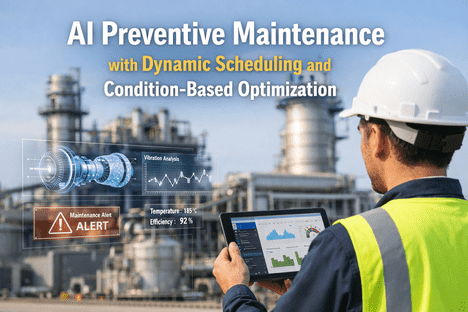
Every Monday morning, in thousands of plants around the world, the same ritual plays out. A maintenance planner opens a spreadsheet, looks at a list of 400 PM tasks scheduled for the week, and starts playing calendar Tetris. Pump 7 is due for greasing — but it has only run 40 hours in the last month. Motor 12 is not due for another three weeks — but vibration data says its bearing is screaming. The planner does the best they can with what they can see, which is not enough. By Friday, healthy assets have been torn apart unnecessarily while one machine that nobody was watching has already failed. This is the exact reason the world is moving past calendar-based preventive maintenance. AI-driven dynamic scheduling reads live condition data from every asset, recalculates priorities every 15 minutes, and schedules each intervention at the precise moment it delivers maximum value — not a day early, not a day late. Teams that make this shift report 22% fewer total PM hours, 35% fewer emergency repairs, and a 28% jump in first-time-fix rates. The calendar has had its century. It is time for schedules that think.
Dynamic AI Scheduling & CBM
AI Preventive Maintenance That Schedules Itself Around Real Equipment Condition
Replace rigid calendars with live condition intelligence — AI adjusts every PM task in real time based on vibration, temperature, runtime, and failure risk, so every intervention lands at the optimal moment.
22%
Reduction in total PM hours with dynamic frequency tuning
35%
Fewer emergency repairs through condition-triggered tasks
28%
Improvement in first-time-fix rates with skill-based matching
18–25 hrs
Weekly planner hours saved on manual scheduling work
Sources: Oxmaint 2026 · Ntwist Dynamic Scheduling · Nature Scientific Reports · Cybernews 2026
Static Calendar vs. Dynamic Condition-Based Scheduling
The fundamental flaw in traditional PM is that a calendar cannot see inside a machine. A fixed 90-day interval treats every pump identically — whether it ran 10 hours or 10,000 hours, whether its bearings are pristine or screaming. Dynamic scheduling flips this logic completely: the machine tells the schedule when it needs attention, not the other way around.
The Old Way
Static Calendar Scheduling
Schedules set weekly or monthly in a spreadsheet
Every asset serviced at the same frequency regardless of use
Healthy assets torn apart unnecessarily
Failing assets missed between intervals
Planner spends 18–25 hours per week rebuilding the plan
The iFactory Way
Dynamic AI Scheduling
AI recalculates priorities every 15 minutes
Each asset serviced at its own optimal frequency
Healthy assets left alone, resources redirected
Failing assets caught 2–8 weeks in advance
Planner shifts from firefighting to strategy
The Six Signals That Drive Condition-Based Decisions
Dynamic scheduling is only as smart as the signals it reads. iFactory ingests six distinct condition data streams from every asset and fuses them into a single continuously-updated health score — the number that drives every scheduling decision downstream.
Asset Health Score
Fused & updated in real time
Vibration
Detects bearing wear, imbalance, misalignment weeks before failure
Temperature
Identifies thermal signatures of motor winding, lubrication issues
Pressure
Flags hydraulic leaks, seal degradation, flow restrictions
Runtime Hours
Actual usage vs. rated life replaces calendar assumptions
Current Draw
Electrical anomalies signal load changes and winding faults
Acoustic & Ultrasonic
Picks up compressed air leaks, cavitation, early friction
Curious how iFactory reads your existing sensors? Book a quick integration walkthrough.
How AI Decides What Gets Scheduled When
Every asset falls somewhere on a two-dimensional map: how hard is it working, and how healthy does it look? The AI engine uses this map to classify each asset every 15 minutes and apply one of four scheduling actions automatically — no planner intervention required.
CONDITION RISK ↑
Low Use / High Risk
Inspect Soon
Asset is barely running but showing anomalies. AI schedules early diagnostic inspection — symptom may indicate installation issue or environmental stress.
High Use / High Risk
Immediate PM
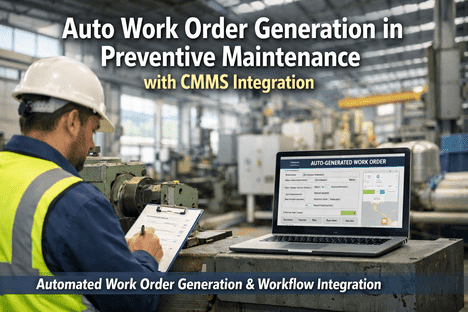
Heavy duty cycle combined with degrading signals — highest priority. AI auto-generates work order, reserves parts, alerts shift supervisor.
Low Use / Low Risk
Extend Interval
Healthy asset running below capacity. AI pushes next PM out — saves parts, labor, and downtime with zero reliability risk.
High Use / Low Risk
Follow Baseline
Heavy use but still within normal signatures. AI keeps standard PM rhythm with tighter sensor monitoring between intervals.
UTILIZATION →
A Real Week, Re-Optimized in Real Time
Here is what dynamic scheduling actually looks like on the floor. The top bar shows a traditional Monday morning plan built on calendar assumptions. The bottom bar shows the same week after AI has re-sequenced tasks based on live condition data, parts availability, and a mid-week breakdown event.
Static Plan
Built Monday 7 AM
Pump 7 PM
Motor 12 check
Conveyor greasing
HVAC filter
Compressor PM
AI Dynamic Plan
Live, every 15 min
Motor 12 URGENT
HVAC filter
Compressor PM
Pump 7 deferred
Conveyor greasing
Calendar-driven
Condition-triggered
AI-rescheduled
Healthy — deferred
Condition Thresholds That Trigger Action Automatically
Every asset class has its own failure signatures. iFactory ships with pre-configured threshold logic for the most common industrial assets — and continuously tunes these thresholds based on your plant's actual history.
The "Right Moment" Every Maintenance Team Chases
Every asset has a Remaining Useful Life (RUL) curve — the window between "working fine" and "catastrophic failure." The cost of maintenance changes dramatically depending on where in the curve you intervene. Dynamic scheduling's entire job is to land you in the green zone every single time.
Too Early
Calendar-driven PM often lands here. Healthy parts thrown away with 40% of useful life remaining. Waste without reliability gain.
Optimal Zone
AI dynamic scheduling targets this window. Maximum useful life extracted, failure prevented, lowest total cost per maintenance event.
Too Late
Reactive territory. Emergency repair, collateral damage, overtime, expedited parts, lost production — 3 to 5x the planned cost.
Want to see where your assets are sitting on this curve right now? Schedule a free condition audit.
What Dynamic Scheduling Actually Delivers
The business case for moving from static to dynamic is not theoretical. These are real, repeatable outcomes reported across manufacturing, facility, and heavy industry deployments in 2025–2026.
50%
Less unplanned downtime through condition-triggered intervention
40–60%
Reduction in administrative scheduling time per planner
2–8 wks
Early warning window before detected failures occur
91%
PM compliance achievable with AI-automated scheduling
Frequently Asked Questions
What is dynamic AI scheduling in preventive maintenance?
Dynamic AI scheduling uses machine learning to continuously recalculate the optimal time to service each asset based on live condition data — vibration, temperature, pressure, runtime, and failure probability — rather than fixed calendar intervals. Priorities are re-evaluated every 15 minutes, and work orders are generated automatically when condition thresholds are crossed.
Book a demo to see it live.
How is condition-based maintenance different from traditional preventive maintenance?
Traditional preventive maintenance uses fixed time or usage intervals — replace bearing every 6 months, grease every 2,000 hours — regardless of actual equipment condition. Condition-based maintenance (CBM) triggers intervention only when real sensor data indicates degradation. CBM eliminates both "over-maintenance" of healthy assets and "under-maintenance" of failing ones between intervals.
What sensors or data do we need to get started with iFactory?
Most plants already have what they need. iFactory ingests data from existing SCADA, PI, Wonderware, or Ignition systems via OPC-UA, MQTT, or REST API — no hardware replacement required. For assets without instrumentation, we recommend starting with wireless vibration and temperature sensors, which typically deliver ROI within 60 days.
Let us review your current setup.
Can dynamic scheduling coexist with our existing PM program?
Absolutely. Most successful deployments run dynamic scheduling alongside the existing calendar-based program for the first 60–90 days, letting the AI learn each asset's baseline. Once models are tuned, tasks gradually migrate from fixed intervals to condition triggers — giving your team full visibility and control throughout the transition.
How quickly can we see results from AI dynamic scheduling?
Most iFactory customers see measurable planner time savings within the first 2 weeks and meaningful downtime reduction within 60 days. Full ROI — typically 22% fewer PM hours, 35% fewer emergencies, 28% better first-time-fix rates — is usually validated within 90 days of go-live.
Does AI replace our maintenance planners?
No — it multiplies them. Dynamic scheduling eliminates 18–25 hours per week of manual calendar juggling so your planners can focus on strategic work: reliability engineering, root cause analysis, CapEx planning, and continuous improvement. AI handles the repetitive optimization; humans handle the judgment calls that actually move the needle.
Retire the Maintenance Calendar
Your Assets Know When They Need Help. Your Schedule Should Listen.
iFactory turns live condition data into a self-optimizing maintenance plan that catches failures earlier, eliminates unnecessary work, and frees your planners from the Monday morning spreadsheet grind.
6 Signals
Fused into one live asset health score
15 min
Re-optimization cycle across every asset
4 Quadrants
Automated decision matrix per asset
60 Days
Typical time to first measurable ROI