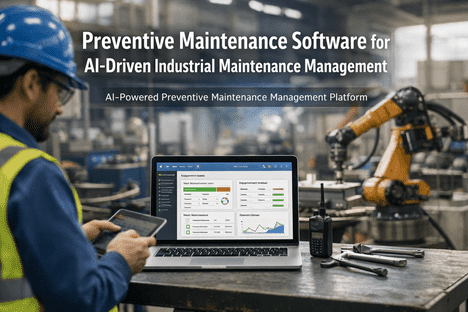
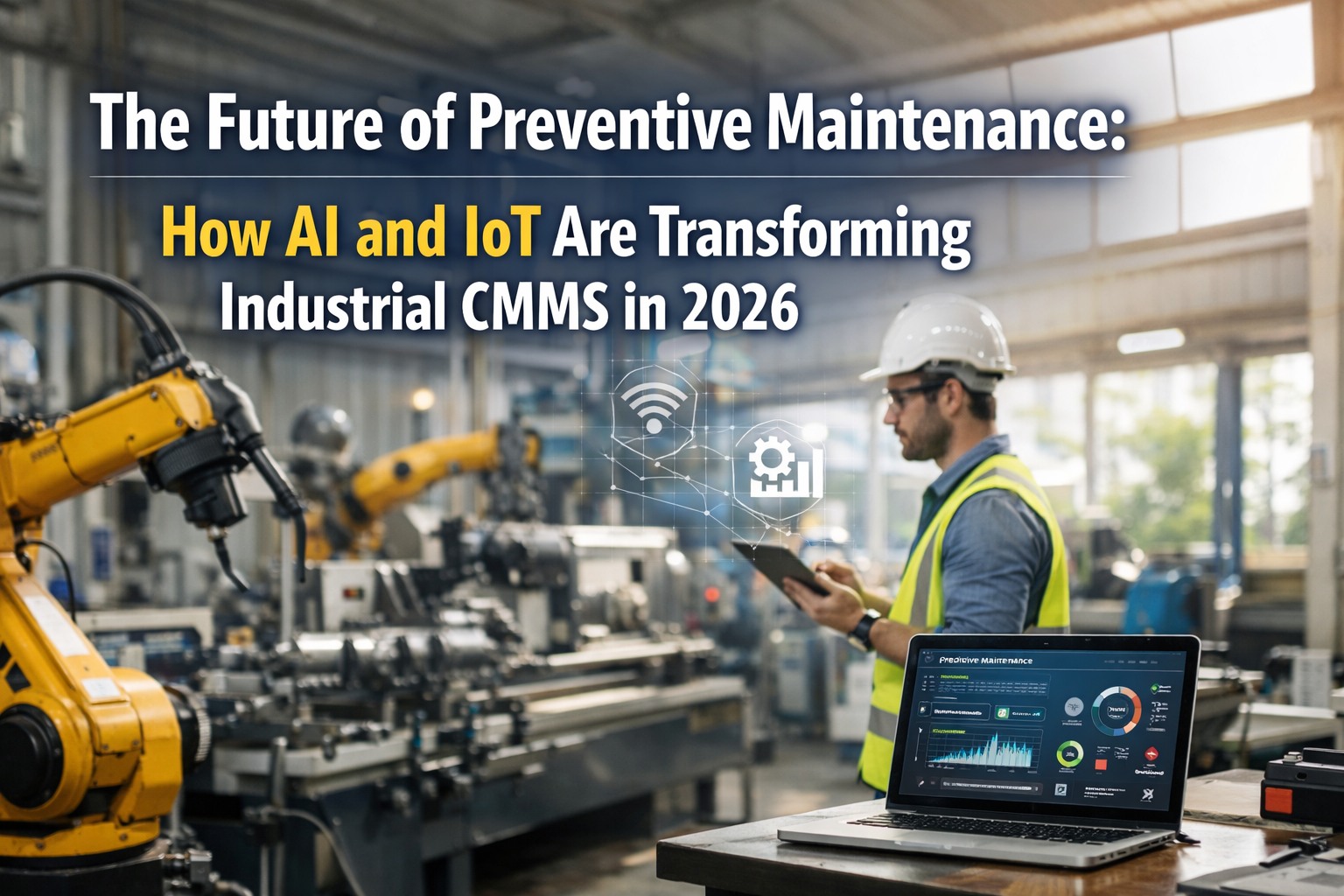
Picture this: It is 2:47 AM and the floor supervisor's phone lights up. A critical motor on Line 3 has just seized. The next shift is already walking in. Parts are in a warehouse 400 miles away. Production will be down for at least 18 hours, and every hour costs the plant $148,000. By sunrise, someone will be asked why the motor's vibration anomalies — which had been growing steadily for three weeks — were never acted on. The answer is simple and expensive: nobody was watching. This is the exact scenario AI-powered preventive maintenance software was built to eliminate. Instead of paper checklists, tribal knowledge, and calendar-based guesswork, modern platforms like iFactory turn every asset into a self-monitoring, self-scheduling, self-reporting entity — catching failures weeks before they happen, generating work orders automatically, and giving every technician the right task at the right time on the right device. The global preventive maintenance software market is racing toward $3.56 billion by 2035, and the companies moving first are already seeing 30–50% less downtime and 25–30% lower maintenance costs. The rest are still paying the 2:47 AM tax.
AI-Driven Maintenance Management
Preventive Maintenance Software That Thinks Before Your Machines Fail
Automate scheduling, auto-generate work orders, track assets in real time, and let AI predict breakdowns weeks before they happen — all on one unified platform.
50%
Reduction in unplanned downtime with AI-driven maintenance
40%
Longer asset lifespan with predictive monitoring
$260K
Per-hour cost of downtime in high-precision manufacturing
25%
Reduction in total maintenance costs across industries
Sources: McKinsey · Deloitte · Siemens 2024 · FTI Consulting 2026 · Global Growth Insights
The Silent Cost of Reactive Maintenance
Most plants do not track what reactive maintenance actually costs them. They track the repair invoice — and miss the 80% of cost that lives outside it. A single unplanned stop cascades through six layers of loss, and each layer compounds the next. Here is what one hour of downtime really looks like.
Reputation & Customer Trust
Missed deliveries, SLA penalties, contract risk
Safety & Compliance Risk
Emergency repairs triple injury risk per Siemens
Expedited Parts & Overtime
3.2x more labor hours than planned repairs
Lost Production Output
$36K to $2.3M per hour by industry sector
$2.8B
Average annual downtime loss for a Fortune 500 firm — about 11% of revenue
See how much reactive maintenance is costing your plant right now. Book a free assessment.
The Maintenance Maturity Ladder: Where Does Your Plant Stand?
Every maintenance organization falls somewhere on a four-rung maturity ladder. Moving up even one rung typically produces double-digit gains in uptime, cost, and technician productivity. The goal is not to sprint to the top — it is to know where you are and make the next jump intentional.
Level 4
AI-Driven Prescriptive
AI not only predicts failures but prescribes the exact action, part, technician, and window. Self-generating work orders. Continuous learning from every outcome. The new frontier for 2026.
Target: 85%+ planned work · 40% longer asset life
Level 3
Predictive & Condition-Based
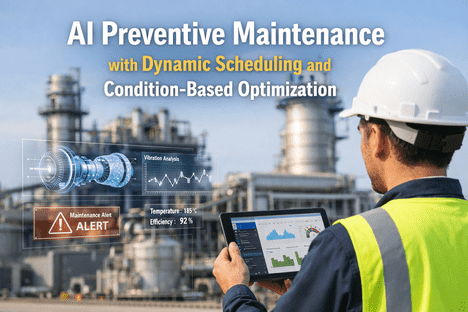
IoT sensors feed vibration, temperature, and pressure data to AI models that detect anomalies weeks before failure. Maintenance triggered by asset condition, not the calendar.
Typical: 30–50% downtime reduction · 70%+ failure prediction accuracy
Level 2
Preventive & Scheduled
CMMS-driven calendar schedules, PM checklists, and work order tracking. Better than reactive, but still "over-maintains" healthy assets and "under-maintains" degrading ones.
Reality: Only 35% of facilities actually spend most time on PM tasks
Level 1
Reactive & Run-to-Failure
Fix it when it breaks. Paper work orders, tribal knowledge, spreadsheets, and firefighting. The most expensive strategy by far — yet still the default at most mid-sized plants.
Cost: 3–5x the maintenance spend of a Level 3 operation
The Old Way vs. The iFactory Way
The difference between a traditional CMMS and an AI-powered maintenance platform is not a feature list — it is a completely different way of thinking about what maintenance software should do. Here is how the two approaches handle the same six real-world problems every maintenance team faces every week.
Knowing when an asset will fail
Calendar schedules based on averages — miss failures between intervals
AI analyzes live sensor data and predicts failure windows weeks in advance
Creating work orders
Manually created, often from paper forms, delayed by data entry
Auto-generated the moment an anomaly, threshold breach, or schedule trigger occurs
Assigning the right technician
Supervisor guesses based on availability and memory
AI matches skill, certification, shift, and current workload automatically
Finding the right spare part
Technician walks to the crib, hopes it is in stock, logs it later
Parts auto-reserved from inventory, reorder triggered below threshold
Capturing what the technician did
Handwritten notes, lost forms, "ask Bob before he retires"
Mobile capture with photos, voice notes, and AI-indexed searchable history
Proving compliance during audits
Weeks of digging through binders and spreadsheets
One-click audit report with full history, signatures, and parts traceability
Six Capabilities That Separate Modern PM Software
Not every platform labeled "preventive maintenance software" can deliver modern results. These are the six capabilities that define the difference between a digital logbook and an intelligent maintenance engine — the features worth paying for and the features worth demanding in a demo.
01
AI-Driven Scheduling
Machine learning models study runtime hours, usage patterns, condition data, and failure history to schedule each PM task at the optimal moment — not a day early, not a day late.
02
Automated Work Orders
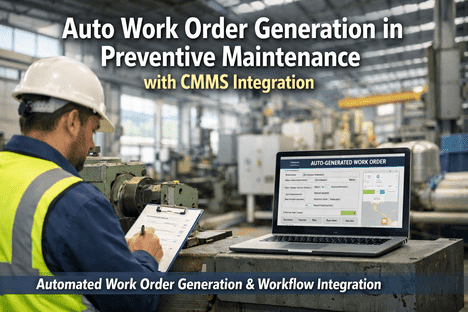
Anomaly detected? Schedule hit? Inspection failed? The platform generates the work order, attaches SOPs and parts lists, and routes it to the right technician — with zero human steps.
03
Asset Health Dashboards
Every machine gets a live health score blending vibration, temperature, runtime, and PM compliance. Drill from plant view to component view in two clicks.
04
Mobile Technician Interface
Technicians scan QR codes on assets, see full history, complete checklists, attach photos, and close work orders from the field — no return trip to the office.
05
Smart Parts Inventory
Auto-reservation, min-max reordering, critical spares flagging, and usage forecasting tied to upcoming PM schedules — so a part is never the reason a job waits.
06
Compliance & Audit Trail
Every action timestamped and signed. One-click reports for OSHA, ISO, FDA, and internal audits. Institutional knowledge preserved even as senior technicians retire.
The AI Automation Loop That Runs 24/7
Here is what actually happens inside an AI-driven preventive maintenance platform — the closed feedback loop that runs continuously in the background while your team focuses on execution. Every cycle makes the next prediction sharper.
1
Sense
IoT sensors stream vibration, temperature, pressure, runtime data every second
2
Analyze
AI models compare live patterns against failure signatures and asset baselines
3
Predict
Remaining useful life estimates and failure windows generated per asset
4
Act
Work order auto-generated, technician assigned, parts reserved, schedule updated
5
Learn
Outcome fed back into the model — every completed job sharpens future predictions
Want to see this loop running on your actual assets? Schedule a live iFactory demo.
ROI by Industry: What the Numbers Actually Say
Different industries see different returns from AI-powered preventive maintenance — because asset intensity, downtime cost, and regulatory stakes vary wildly. These are real-world benchmarks reported across McKinsey, Deloitte, FTI Consulting, and Siemens research for 2025–2026.
From Signup to Savings: Your 8-Week Rollout
Modern PM software should not take a year to deploy. iFactory uses a structured 8-week sprint model that delivers measurable impact inside the first month — and full ROI validation before the quarter ends.
Week 1–2
Asset Onboarding & Data Mapping
Import asset hierarchy from spreadsheets or legacy CMMS. Connect IoT sensors, SCADA, and ERP feeds via OPC-UA, MQTT, or REST API. Map criticality levels and failure modes.
Week 3–4
PM Schedule & AI Baseline
Migrate existing PM schedules. AI learns normal operating patterns per asset. Configure mobile app, technician roles, parts catalog, and auto-assignment rules.
Week 5–6
Go-Live & Team Enablement
Roll out to technicians on mobile devices. Activate automated work orders and anomaly alerts. Train supervisors on dashboards, reporting, and AI-driven recommendations.
Week 7–8
Optimize & Prove ROI
Tune thresholds, expand to additional lines or plants, and measure baseline vs. current performance. Most clients see 15–20% downtime reduction in the first 60 days.
10x
ROI potential from AI-driven maintenance per Deloitte research
75%
Fewer workplace safety incidents from equipment failure
92%
Accuracy demonstrated by AI defect detection in MIT case studies
60 days
Typical time to measurable downtime reduction with iFactory
Frequently Asked Questions
What is AI-powered preventive maintenance software?
AI-powered preventive maintenance software goes beyond calendar-based scheduling by using machine learning on sensor data, runtime history, and failure patterns to predict when each specific asset needs service. It auto-generates work orders, assigns technicians, reserves parts, and learns continuously from every completed job — shifting maintenance from reactive firefighting to prescriptive intelligence.
Book a demo to see iFactory in action.
How does AI improve preventive maintenance compared to traditional CMMS?
Traditional CMMS follows fixed schedules — replace a bearing every 6 months regardless of actual wear. AI-driven platforms analyze real-time condition data to service assets only when needed. McKinsey research shows this approach reduces unplanned downtime by up to 50%, cuts maintenance costs 10–40%, and extends asset life by approximately 40% — all while eliminating over-maintenance waste.
What is the ROI of implementing AI preventive maintenance software?
Deloitte reports that AI-driven predictive maintenance can deliver up to 10x ROI by preventing costly equipment failures. Typical benefits include 25–30% reduction in maintenance costs, 30–50% reduction in unplanned downtime, 40% longer asset lifespan, and 75% fewer workplace safety incidents related to equipment failure. Most iFactory customers see measurable gains within the first 60 days.
Can iFactory integrate with our existing ERP, SCADA, and IoT systems?
Yes. iFactory integrates with SAP, Oracle, Microsoft Dynamics, major SCADA platforms, and any IoT sensor system using OPC-UA, MQTT, REST API, or database connectors. There is no rip-and-replace — the platform layers on top of your existing infrastructure and unifies siloed maintenance, production, and asset data into a single intelligent view.
Schedule an integration walkthrough.
How long does it take to deploy iFactory preventive maintenance software?
iFactory deploys in 6 to 8 weeks using a structured sprint model. Weeks 1–2 handle asset onboarding and data integration, weeks 3–4 configure PM schedules and train AI baselines, weeks 5–6 activate go-live with mobile technicians, and weeks 7–8 optimize thresholds and validate ROI. Most plants see 15–20% downtime reduction before week 8 ends.
Is iFactory suitable for small and mid-sized manufacturers, or only enterprises?
iFactory scales from single-plant mid-sized manufacturers to multi-site enterprise deployments. SMEs are the fastest-growing CMMS adoption segment globally because AI-driven maintenance no longer requires massive data science teams — the platform handles model training, anomaly detection, and scheduling logic out of the box, with pricing designed for plants of every size.
Stop Paying the 2 AM Tax
Every Unplanned Stop Is a Problem You Already Had the Data to Predict
iFactory turns your existing asset, sensor, and work order data into an AI engine that prevents failures, schedules itself, and keeps your plant running while your team sleeps.
6 Modules
End-to-end maintenance intelligence on one platform
4 Levels
Maturity ladder from reactive to AI-prescriptive
8 Weeks
From signup to measurable ROI on your floor
$3.56B
PM software market by 2035 — the shift is happening now