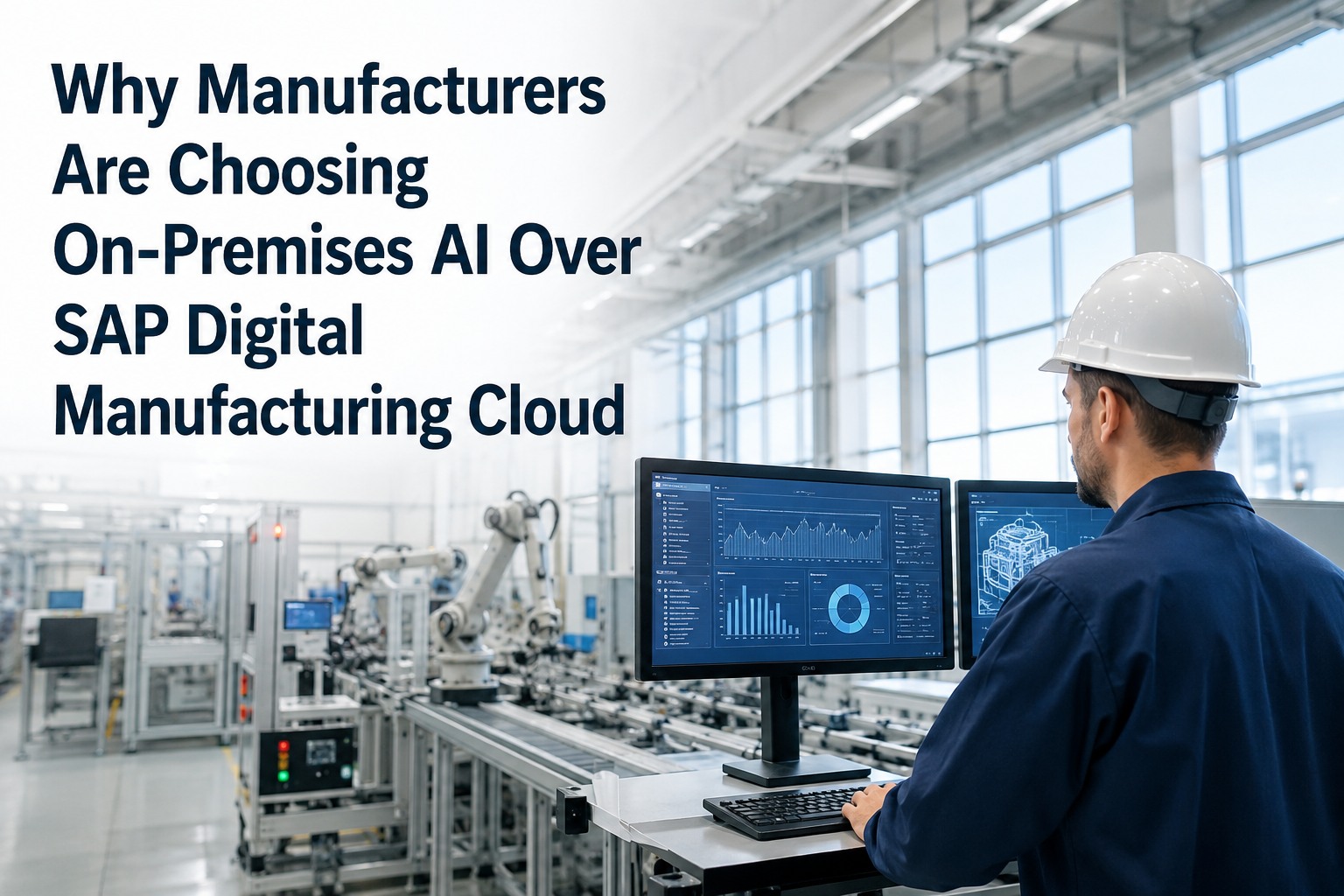
For most of the past decade, "cloud-first" was the unchallenged default for manufacturing modernization. SAP went all-in with Digital Manufacturing on Business Technology Platform. Analyst slides assumed the cloud question was settled. Then something changed. In 2025 and 2026, manufacturers in regulated industries — aerospace under ITAR, pharma under FDA 21 CFR Part 11, defense suppliers, automotive Tier-1s with OEM data-residency mandates, and operators of 24/7 critical infrastructure — started saying no. Not no to AI. Not no to modernization. No to sending their most sensitive operational data to a cloud they don't control. This page lays out exactly why on-premises AI-native platforms are winning these conversations against SAP Digital Manufacturing Cloud — and why, for a specific but large class of manufacturers, on-prem is now the right answer. Book a 30-minute conversation to map your specific deployment constraints against on-prem AI-native options.
5ms
Local inference latency on-prem vs. 100–500ms typical for cloud AI APIs
0
Bytes of operational data leave your perimeter on a properly designed on-prem deployment
100%
Of decisions remain auditable inside your facility, with no third-party data processor
24/7
Production continuity even when the internet link to your cloud provider drops
The Quiet Shift: Why Cloud-First Stopped Being the Default
The case for cloud-first manufacturing AI was built on assumptions that mostly held in 2018. Most of those assumptions have weakened — and in regulated industries, several have inverted entirely. Below are the five shifts that are driving manufacturers back toward on-prem deployment in 2026.
01
Regulatory walls got higher, fast
The EU Data Act took effect for industrial IoT data in September 2025. National data localization laws expanded across the EU, India, China, and several US states. ITAR, FDA 21 CFR Part 11, and OEM-specific data mandates have all tightened. Cloud deployments that satisfied auditors in 2022 are now generating findings.
02
AI commoditized — on-prem GPU got cheap
The economics that pushed AI into the cloud — "we can't afford the GPU server" — have inverted. On-prem AI infrastructure is now within reach of any serious manufacturer, while continuous cloud API spend on industrial-scale telemetry has gone the other way.
03
Latency is no longer a soft constraint
When AI is the operator's co-pilot, 100–500ms of round-trip latency to a cloud API breaks the user experience. When AI is part of a control loop — vision QC, anomaly response, predictive shutdown — it breaks the engineering. On-prem and edge inference is the only architecture that supports real-time decisions.
04
Vendor lock-in fears intensified
After several high-profile cloud outages, ransomware events, and pricing shifts, manufacturing CIOs are asking what happens to production if the cloud vendor becomes unavailable — for technical, commercial, or geopolitical reasons. On-prem answers that question definitively.
05
IP protection became a board issue
Your process recipes, control parameters, batch genealogy, and tooling data are the most valuable IP your plant produces. Sending all of it to a cloud platform — even an SAP-operated one — raises uncomfortable questions in board reviews, OEM customer audits, and insurance underwriting.
Cloud Is Still the Right Answer for Many Manufacturers. It Is Not the Right Answer for All.
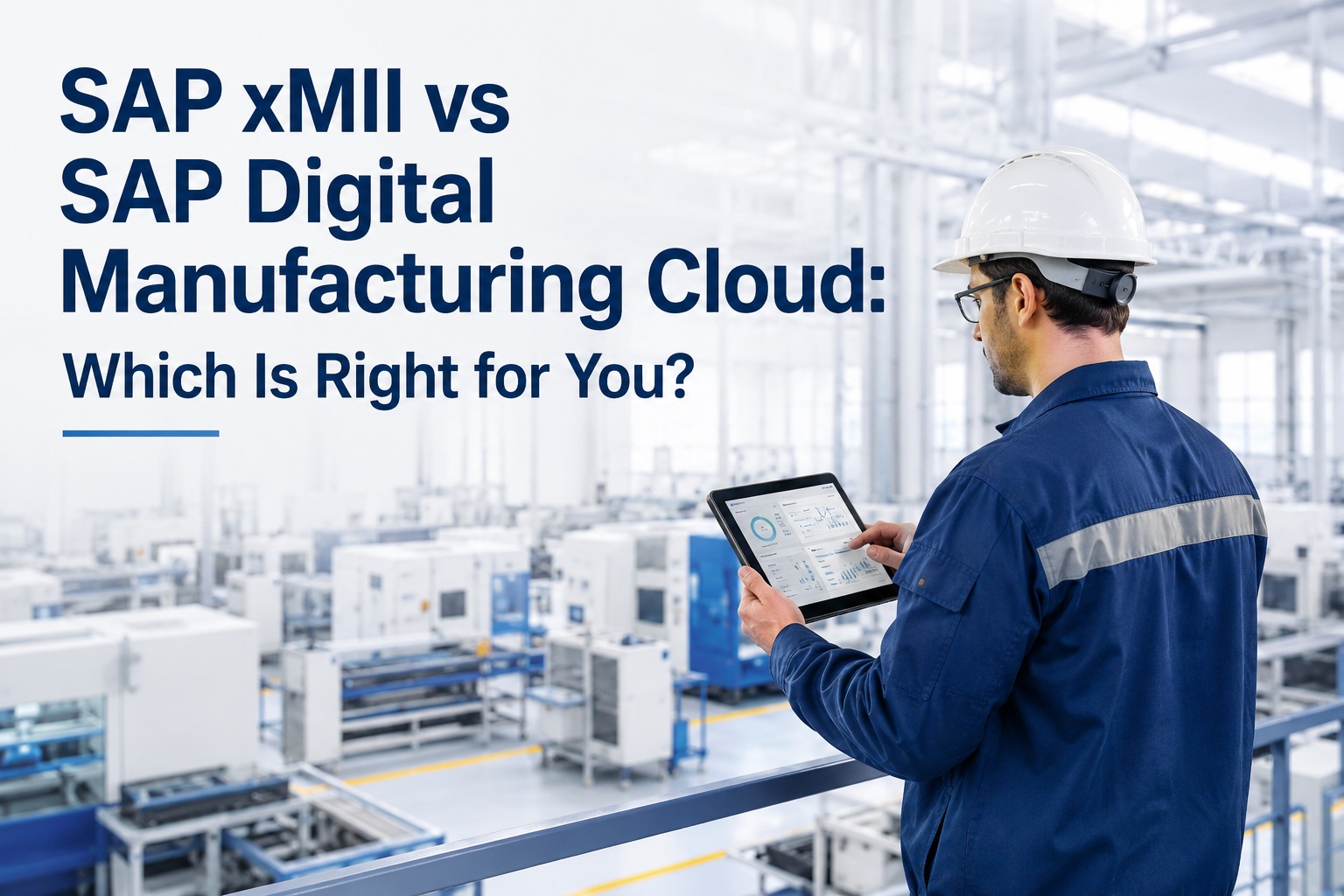
SAP Digital Manufacturing Cloud is a strong product. For plants with light regulatory exposure, stable internet, and standard execution needs, it is often the natural choice. For regulated industries, 24/7 critical operations, or environments where data sovereignty is non-negotiable, an on-prem AI-native platform is a better architectural fit.
Who Is Choosing On-Prem AI — and Why
The manufacturers moving toward on-prem AI-native platforms are not a uniform group. Different industries have different drivers. The pattern below shows which industry profiles are most likely to land on on-prem, and what specifically is pulling them there.
AEROSPACE & DEFENSE
ITAR controls non-negotiable
Technical data covered by ITAR cannot leave US persons' control or US infrastructure. Customer-specific data residency mandates from defense primes layer on top. Cloud architectures are non-compliant by default; on-prem is the baseline.
PHARMA & BIOTECH
GxP validation and 21 CFR Part 11
FDA 21 CFR Part 11 requires demonstrable control over electronic records and signatures. GxP validation demands that AI behaviour be reproducible on demand. Both work cleanly with on-prem; cloud architectures introduce third-party processors and lengthen validation cycles.
AUTOMOTIVE TIER-1
OEM customer mandates
Major OEMs — German, Japanese, US — increasingly impose data-residency, data-sovereignty, and supplier-IT-control requirements on Tier-1 manufacturers. Supplier scorecards now reflect IT posture. On-prem deployments protect contract awards.
FOOD & BEVERAGE
24/7 production reliability
Continuous-process plants cannot accept internet-link dependencies for production-critical decisions. When the cloud goes dark — for any reason — the line keeps running. On-prem AI keeps the analytics, alerts, and control loops running with it.
UTILITIES & ENERGY
Critical infrastructure regulation
NERC CIP, EU NIS2, and national critical-infrastructure rules require demonstrable resilience independent of external vendors. On-prem AI-native deployments give regulators the answer they want: production continues even if the vendor disappears.
CHEMICALS & PROCESS
IP-critical recipes and parameters
Process recipes and control parameters are the company's most valuable IP. Sending them to a cloud — even one operated by a major SAP partner — raises legitimate concerns in board reviews. On-prem ensures the IP never leaves the perimeter.
SAP DM Cloud vs. On-Prem AI-Native: The Honest Comparison
This is not "cloud bad, on-prem good." Both architectures have legitimate strengths. The honest question is which one fits your specific operating profile. Use the comparison below to find where each architecture genuinely wins.
What "On-Prem AI-Native" Actually Looks Like Inside Your Facility
The phrase "on-premises AI" sometimes triggers visions of dusty server rooms and 20-year-old appliances. The reality of modern on-prem AI-native infrastructure is closer to a fridge-sized GPU server, a few edge gateways near the production line, and a single management console. Below is the typical architecture.
Layer 1 — Edge Gateways
At the production line
Small ruggedized devices (industrial PC class) installed near machines, PLCs, and cameras. Collect data via OPC UA, MQTT, Modbus, native protocols. Run lightweight AI models for time-critical inference (millisecond response). Buffer locally if upstream is unavailable.
Layer 2 — Plant Server
In the plant IT room
GPU-enabled server (or small cluster) handling heavier AI workloads — vision QC, predictive maintenance models, knowledge-graph reasoning, dashboarding, and operator-facing applications. Connects to edge gateways via plant network only.
Layer 3 — Management Console
On corporate network or private cloud
Centralized governance: deploy AI models, manage configurations, view aggregate KPIs across multiple sites, push updates. Receives metadata and aggregated metrics — not raw operational data, unless explicitly configured to.
Layer 4 — Optional Cloud Burst
Public cloud (optional)
For workloads that justify it — large-model training, cross-site analytics, supplier collaboration — selected data can be sent to a public cloud component. This is opt-in per workload, not a default architecture choice.
A Fridge-Sized Server. A Few Edge Gateways. Production That Keeps Running No Matter What.
Modern on-prem AI-native infrastructure is not the rack-and-stack nightmare of 2010. It is purpose-built hardware, pre-loaded software, and a deployment process measured in weeks. iFactory ships the hardware, the AI stack, and the integration tooling as a single bundle — pre-validated, pre-hardened, ready to integrate with your SAP S/4HANA or ECC landscape.
The Five Strongest Arguments Manufacturers Make for On-Prem
When we sit in customer meetings, the same five arguments come up again and again. Below are the actual words manufacturers use — and what each one means for your evaluation.
01
"Our IP cannot live on someone else's infrastructure."
Process recipes, control parameters, and tooling data are the most valuable IP the plant produces. Putting all of it on a vendor's cloud — however reputable — is a board-level risk that gets harder to defend every year.
02
"Production cannot depend on the internet."
Continuous-process and 24/7 plants need to keep running when the link goes down. Edge-cached cloud architectures lose features during outages. On-prem keeps full functionality regardless of upstream status.
03
"Our auditors want to see data inside the facility."
ITAR, FDA 21 CFR Part 11, and OEM customer audits all prefer — or require — that data and audit trails stay inside the regulated facility. On-prem makes audit prep faster and findings rarer.
04
"AI in a control loop has to be local."
When AI is making real-time decisions — vision QC at line speed, anomaly response, predictive shutdown — 100ms of round-trip latency to a cloud is the difference between "works" and "doesn't." On-prem inference is the only architecture that fits.
05
"We need to plan for vendor exit."
Sophisticated CIOs assume every vendor relationship eventually ends — by acquisition, pricing shift, or strategic pivot. On-prem deployments retain residual value through any transition; cloud lock-in does not.
06
"Our cloud egress costs are getting absurd."
Industrial telemetry at scale — thousands of tags, hundreds of cameras, continuous streams — generates surprising data volumes. Cloud egress and API costs grow with usage. On-prem inference holds those costs flat.
When SAP DM Cloud Is Still the Right Answer
This page makes the case for on-prem, but it would be dishonest not to identify where SAP DM Cloud is genuinely the better fit. Here are the operating profiles where DM Cloud is the correct choice — not as a default, but as a deliberate decision.
Light regulatory exposure
If your products and processes are not subject to ITAR, FDA Part 11, GxP, or OEM-specific data mandates, the cloud architecture works fine. The cost of avoiding cloud may exceed the benefit.
Stable, high-bandwidth internet
Plants in mature markets with redundant fibre links and well-funded IT support can tolerate cloud architectures. The edge cache covers brief outages; longer outages are rare.
Existing SAP ME paired with MII
If MII is paired with SAP ME for execution and your customizations are moderate, SAP DM Cloud is the natural successor. Continuity of SAP semantics and native S/4HANA integration matter.
Multi-site collaboration is the priority
If your strategic priority is cross-site analytics, supplier collaboration, or aggregated portfolio dashboards, a cloud architecture removes friction. On-prem with a central management console can do this, but cloud-first is simpler.
Frequently Asked Questions
Is on-prem AI really more secure than cloud?
"More secure" is the wrong framing. Both can be highly secure with the right architecture. The right question is: who controls the data, who has audit access, and what happens during outages, breaches, or vendor changes? For ITAR, FDA Part 11, and OEM-mandated environments, on-prem answers those questions more cleanly.
Book a Demo for a security architecture review.
Is on-prem really cheaper than SAP DM Cloud?
It depends on workload profile. Upfront infrastructure is higher; ongoing costs (subscription, data egress, API spend) are lower. For high-telemetry-volume environments — hundreds of cameras, thousands of tags, continuous AI inference — on-prem typically wins on five-year TCO. For lighter workloads, cloud can be more economical.
Talk to Support for a TCO model.
Can we run hybrid — on-prem for sensitive workloads, cloud for the rest?
Yes. Many manufacturers do exactly this. Process recipes, control parameters, and ITAR-controlled data stay on-prem. Cross-site analytics, aggregated dashboards, and supplier collaboration run in the cloud. The architecture supports both, with explicit data-flow controls between layers.
Book a Demo for hybrid patterns.
What about updates, patches, and AI model improvements? How do they reach on-prem?
Updates are pushed through a managed channel, validated locally before deployment, and rolled out under your change-control process. Air-gapped sites support fully offline update workflows. AI model improvements ship as containerized updates with the same control plane that handles infrastructure patches.
Talk to Support about update mechanics.
Can on-prem AI integrate with SAP S/4HANA or do we need cloud for that?
On-prem AI-native platforms integrate with SAP S/4HANA and ECC via standard OData, RFC, IDoc, and BAPI interfaces — exactly the same as any other SAP integration. Cloud is not a prerequisite for SAP connectivity.
Book a Demo to see integration patterns.
How long does on-prem deployment take vs. SAP DM Cloud?
First production use cases live in 4–12 weeks on on-prem AI-native, comparable to or faster than SAP DM Cloud's typical 12–24 month full rollout. The hardware ships pre-configured; integration is the variable.
Talk to Support for a timeline against your landscape.
Cloud Is Not the Default Anymore. Pick the Architecture That Actually Fits.
If your operating profile includes ITAR, GxP, OEM data mandates, 24/7 continuity, IP-critical recipes, or real-time AI control loops, on-prem AI-native is not a fallback — it is the better architectural choice. iFactory ships hardware, AI stack, and integration tooling as a single bundle, pre-validated and ready for SAP S/4HANA integration without ABAP.
Compliant by design with ITAR, FDA 21 CFR Part 11, GxP, OEM mandates
Single-digit millisecond local inference
Production continues during cloud or internet outages
First use cases live in 4–12 weeks
Native S/4HANA & ECC integration with no ABAP