A modern semiconductor fab generates 5 to 20 terabytes of process, metrology, and inspection data every single day across hundreds of tool types from Applied Materials, ASML, Lam Research, TEL, KLA, and dozens of other OEMs. An advanced-node wafer costs $16,000 to $22,000 with yields hovering near 50%. A single percentage point of yield improvement on a 300mm fab is worth millions of dollars per month. And yet, in many fabs, the SAP ERP system and the manufacturing systems still talk to each other through legacy SAP MII integration patterns designed in the 2010s — Q-time data reaching ERP hours late, work-in-process visibility lagging the actual fab, and yield root-cause data living in different systems than the cost data. AI-based optimization changes this entirely. Real-time FDC fused with metrology, APC fused with SPC, yield prediction from FDC streams alone with R² near 0.5 in just six process steps — all flowing into an SAP ERP integration layer modern enough to keep up. This page explains how semiconductor manufacturers are migrating from legacy SAP MII to AI-native manufacturing apps, specifically focused on the ERP integration modernization that makes it work. Book a 30-minute working session to map your specific fab MII estate and SAP integration patterns against AI-native equivalents.
5–20 TB
Process, metrology, and inspection data generated by a single fab every day
$16–22K
Cost of a single advanced-node wafer; yield improvements measured in millions/month
95%
AI defect detection accuracy reported in published fab deployments
40%
Defect rate reduction reported across AI-driven yield management programs
Why Semiconductor Fabs Are a Special Case for SAP MII Modernization
Every industry running SAP MII has a migration story. Semiconductor fabs have a uniquely difficult one. The combination of data volume, process complexity, equipment diversity, cycle time, and cost-per-wafer creates a set of constraints that pull harder against legacy architectures than any other vertical.
01
Data volume beyond legacy capacity
A single fab generates 5–20 TB per day across FDC sensor streams, metrology measurements, and inspection images. Legacy MII architectures were designed for an era of kilobytes per minute, not terabytes per day. Most fab MII installations have already worked around this with bolt-on tools.
02
Hundreds of process steps per wafer
A wafer passes through 400–1,500 process steps across dozens of tools, taking 30+ days to complete. The dependency graph between tool, recipe, lot, wafer, and step is the single most complex execution context in manufacturing. ERP integration must keep up with all of it.
03
OEM-specific automation standards
Fabs run on SECS/GEM and GEM300 standards for tool communication. Integration with Applied Materials, ASML, Lam, TEL, KLA, and dozens of others requires deep protocol fluency. MII handled the integration layer; AI-native platforms handle it natively while adding modern data fabric on top.
04
Q-time and recipe management complexity
Q-time violations between consecutive steps can scrap wafers worth tens of thousands of dollars each. Recipe management across tool generations adds another layer. SAP ERP needs accurate, fast visibility into both — which is exactly where legacy MII integration patterns fall short.
05
Yield economics dwarf migration cost
A 1% yield improvement on a high-volume advanced-node fab is worth tens of millions annually. The economics of getting yield management right are so strong that any migration paying for itself in yield alone is a no-brainer — even before predictive maintenance or scheduling savings.
06
SAP MII EOL hits a $200B+ industry mid-cycle
SAP MII mainstream maintenance ends Dec 31, 2027. With fabs operating on 5–7 year capital cycles and many running custom MII integrations a decade deep, the migration window is finite. Plants without a plan in motion by 2027 face compressed timelines and consultant scarcity.
The SAP ERP Integration Layer in a Modern Fab
In semiconductor manufacturing, "ERP integration" is not one connection — it is a continuous bi-directional flow of information between the fab floor and the SAP ERP system covering inventory, work orders, finance, materials, lot disposition, and reporting. Below is what that integration layer actually carries, and where the modernization opportunity lives.
FAB TO ERP
Real-Time WIP & Production Reporting
Lot moves, step completions, hold/release transactions, yield results, and disposition decisions flow from MES to SAP ERP. Legacy MII pushed this in batches every hour or shift; AI-native platforms stream it event-by-event with full lineage.
FAB TO ERP
Consumption & Material Movement
Photoresist consumption, target material usage, gas consumption, chemical bath replenishment, mask set utilization — all flow back to ERP for inventory accuracy. Real-time visibility prevents stockouts on critical materials with long lead times.
FAB TO ERP
Yield, Scrap & Lot Disposition
Final yield results, scrap quantities by failure mode, and lot-level disposition decisions feed into ERP cost accounting. AI attribution lets finance trace yield variance to specific tools, recipes, or process steps — not just plant-level rollups.
ERP TO FAB
Work Order Release & Priority
Production plans, lot priorities, and customer commitments flow from SAP ERP to the fab. Dynamic re-prioritization during reality changes (tool down, hot lot insertion, customer urgent request) needs sub-minute integration, not overnight batch.
ERP TO FAB
Recipe & BOM Master Data
Engineering changes, recipe revisions, BOM updates, and tool qualification status flow from SAP ERP and PLM systems into the fab execution layer. Tool-by-tool recipe synchronization is a recurring integration headache that AI-native platforms solve at the data layer.
BI-DIRECTIONAL
Maintenance & Asset Management
Predictive maintenance alerts flow from fab AI to SAP PM as work orders. Maintenance completion flows back to fab systems for tool qualification gates. Bi-directional integration with SAP PM, IBM Maximo, and Infor EAM is standard.
The ERP Integration Modernization Is Where Most Fab MII Migration Value Actually Lives.
FDC alarms and yield dashboards get the marketing attention. The real day-to-day value comes from ERP integration that streams events in real time, carries full lineage, and supports the bi-directional flows finance, planning, and engineering all depend on. iFactory's semiconductor migration playbook treats ERP integration as a first-class workstream, not an afterthought.
The Six AI-Based Optimization Use Cases Driving Fab Migrations
Across semiconductor manufacturers moving from SAP MII to AI-native platforms, six specific optimization use cases account for most of the early ROI. Each one connects to the ERP integration layer because yield, throughput, and cost are all measured there.
USE CASE 01
AI-Enhanced Fault Detection & Classification (FDC)
Continuous monitoring of sensor signatures across hundreds of tools with AI models trained on labeled fault libraries. Goes beyond user-defined limits with unsupervised machine learning that catches novel process shifts. Industry-leading platforms now offer "SmartFDC" capabilities for this exact use case.
Data sources: Tool sensor streams via SECS/GEM, trace data, equipment health logs
Model approach: Supervised classification on known faults; unsupervised anomaly detection on novel patterns; auto-correlation with downstream defects
Outcome: Process excursions caught earlier; tool downtime reduced; yield protected through faster intervention
USE CASE 02
Yield Prediction from FDC Streams
Two-step machine learning approach: classify lots into "good" vs "defective" first, then predict yield on the good cohort. Published research shows R² near 0.5 achievable using data from just six process steps — meaning useful yield predictions hours into production instead of weeks at electrical test.
Data sources: FDC sensor streams, metrology, inline inspection, equipment context
Model approach: Two-stage classification + regression; outlier-aware predictions; per-step contribution analysis
Outcome: Yield issues caught early enough to hold lots; root cause traced to specific process steps
USE CASE 03
Inline Defect Classification & Wafer Map Pattern Recognition
Computer vision models classify wafer-map defect patterns automatically. Known patterns (edge defects, ring defects, scratches, particles, stepper signatures) routed to standard dispositions. Novel patterns flagged for engineer review. Continuous retraining as new patterns emerge.
Data sources: Inline inspection images, wafer-map datasets, historical labeled defect library
Model approach: CNN classification, wafer-map clustering, anomaly-based detection on novel signatures
Outcome: 95% classification accuracy in benchmark deployments; faster engineer disposition; defect rate reduced 40% in published cases
USE CASE 04
Q-Time Violation Prevention & Lot Routing
AI-driven Q-time tracking with predictive risk flagging. Lots approaching Q-time violation get prioritized in tool queues automatically. Engineers see Q-time risk dashboards before violations occur, not after the wafer is scrapped. Direct cost savings on advanced-node wafers running $20K+ each.
Data sources: Lot tracking events, tool queue states, recipe constraints, MES Q-time definitions
Model approach: Predictive risk scoring on lots in flight; constraint-aware queue optimization; alerting on emerging violations
Outcome: Q-time violations dropped; scrap reduced; advanced-node lot loss prevented
USE CASE 05
Predictive Maintenance on Fab Equipment
Vibration, thermal, electrical, and process-side signatures fed into AI models for tool-by-tool failure prediction. Pumps, robots, RF generators, cryopumps, gas flow controllers, and chamber components monitored continuously. Predictions feed SAP PM work orders bi-directionally.
Data sources: Tool sensors via SECS/GEM, vibration/thermal probes, motor current, process trace data
Model approach: LSTM on time series, signature classification, RUL regression with confidence intervals
Outcome: Tool failures shifted from emergency to scheduled; tool availability improved; PM compliance up
USE CASE 06
Engineer Copilot for Yield Investigation
A retrieval-grounded language model fine-tuned on your fab's defect library, FDC history, engineering notebooks, OEM tool manuals, and past root-cause analyses. Engineers query: "Find lots affected by this defect signature in the past 30 days" — and get answers in seconds instead of running queries against multiple disconnected systems.
Data sources: FDC database, EDA (engineering data analysis) tools, defect libraries, engineering notebooks, OEM manuals
Model approach: Fine-tuned LLM with retrieval-augmented generation; grounded in fab-specific data
Outcome: Root-cause investigations compressed from days to hours; tribal knowledge preserved; engineer productivity lifted
Why Legacy SAP MII Integration Cannot Carry This Workload
SAP MII shipped a strong integration layer for the manufacturing data volumes of 2010. Fabs in 2026 generate orders of magnitude more data, demand sub-minute decision cycles, and run AI workloads MII was never architected to handle. Below are the four specific limits that force migration in semiconductor environments.
01
Data volume saturation at fab scale
5–20 TB per day per fab exceeds what NetWeaver-era MII was designed to ingest, store, or query at interactive speeds. Most fab MII installations have already added third-party historians, time-series databases, and analytics tools to compensate — multiplying integration complexity.
02
Batch-mode ERP integration in a streaming world
Legacy MII typically batches WIP, consumption, and yield data to SAP ERP on hourly or shift cadences. Modern semiconductor operations need event-driven integration: lot moves stream as they happen, hold decisions reach ERP within seconds, finance sees consumption in near-real-time. Batch architecture cannot deliver this.
03
No native ML runtime for FDC or yield prediction
MII has no built-in capability to run LSTM, CNN, or anomaly detection models. Fabs have worked around this with bolt-on AI vendors — Synopsys Fab.da, INFICON FabGuard, Applied SmartFactory, others — but the bolt-on pattern creates data silos and validation overhead. AI-native platforms run these models natively with full lineage.
04
Customization burden compounds with every fab generation
Every recipe change, every new tool generation, every new metrology type requires BLS transactions, query templates, and dashboard updates in MII. A decade of accumulated customization is now a maintenance liability. AI-native platforms handle the same evolution through configuration, not custom code.
What Changes for Each Role in the Fab
The migration changes how different fab roles get their work done. Below is the practical view from each role when MII operational reporting and integration is replaced with AI-native equivalents.
PROCESS ENGINEER
Roots causes in hours, not days.
FDC signatures correlated automatically with downstream yield. Engineer queries the copilot for similar past events. Root-cause investigations that used to span days compress into a single shift.
YIELD ENGINEER
Predicts yield from FDC, not from electrical test.
Two-step ML models forecast yield within six process steps. Lots flagged for intervention while still recoverable. Yield engineering moves from autopsy to prevention.
EQUIPMENT ENGINEER
Schedules tool repairs days ahead, not minutes.
AI flags pump degradation, RF generator drift, robot positional error, and chamber issues with days of forewarning. PM compliance and tool availability both rise. Emergency tool calls drop.
FAB OPERATIONS LEAD
Sees Q-time risk before lots get scrapped.
Live Q-time dashboards roll up at-risk lots by step. Queue prioritization adjusts automatically. The wafer worth $20K+ never times out — because the system caught it 4 hours ago.
SAP / ERP TEAM
Real-time data flow into ERP, no more batch lag.
Lot moves stream to ERP event-by-event. Consumption visible in near-real-time. Finance sees yield variance attributed by tool and recipe. The integration layer keeps pace with the fab, not the other way around.
FAB MANAGER
One source of truth, every tool, every lot, real-time.
Live OEE, live yield, live Q-time, live tool availability — across the entire fab. Decisions about hot lots, tool capacity, and customer commitments made on current operating reality, not yesterday's batch report.
95% Defect Detection. 40% Defect Rate Reduction. Yield Prediction Hours Into Production.
Semiconductor manufacturers running AI-native optimization report results that make legacy MII analytics look like an earlier era of engineering. The migration is challenging — but the yield economics make it the highest-ROI manufacturing migration in any industry.
SAP MII vs. AI-Native: The Semiconductor View
The honest comparison for fab operations specifically. Both architectures still have legitimate strengths in integration roles. The gap on AI workloads, data volume, and real-time ERP integration is wide.
The Migration Pattern Aligned With Fab Reality
Fab migrations cannot afford a wafer scrap event during cutover. Production must continue. ERP integration must keep working. Below is the rhythm that works — phased, validated, and aligned to natural fab events (tool requalification, recipe releases, scheduled maintenance windows).
MONTHS 1–2
Integration Estate Audit
Catalog every MII integration with SAP ERP, every BLS transaction, every custom query, every dashboard. Map data flows from tool to MES to MII to ERP and back. Tag each artifact for preserve, transform, or retire. Identify ERP integration touchpoints requiring streaming upgrade.
MONTHS 2–4
Data Fabric & Tool Connectivity
Stand up the AI-native data fabric. Connect to fab equipment via SECS/GEM and GEM300. Onboard FDC streams from high-priority tool groups. Validate against existing MII data for behavioural equivalence. Modernize SAP ERP integration to event-driven streaming for pilot scope.
MONTHS 4–8
AI Model Training & Pilot Deployment
Train FDC models on fab-specific historical data. Calibrate yield prediction models against known outcomes. Pilot a single tool family or process module. Run parallel with existing MII analytics through a full lot cycle.
MONTHS 8–14
Expansion Across Process Modules
Expand from pilot tool family to full process modules — lithography, etch, deposition, CMP, metrology. Each module gets parallel run, validation, and engineer sign-off before MII components retire. ERP integration migrates module-by-module to event-driven streaming.
MONTHS 14–24
Full Fab Coverage & MII Decommissioning
All process modules running on AI-native platform. ERP integration fully event-driven. Legacy MII components retired. Audit, validation, and cyber insurance posture updated. Cross-fab analytics activate as additional sites come online.
Frequently Asked Questions
Will AI-native platforms integrate with our existing tools from Applied Materials, ASML, Lam, TEL, and KLA?
Yes. The platform supports SECS/GEM and GEM300 standards used across all major fab equipment OEMs — Applied Materials, ASML, Lam Research, TEL, KLA, ASM, Hitachi High-Tech, Screen, and others. Tool integrations carry over from existing MII configurations where possible; modern protocols layer on top for higher-frequency data capture.
Book a Demo for a tool-by-tool integration review.
How does this work with our existing FDC vendors — Synopsys, INFICON, Applied SmartFactory?
AI-native platforms can run in coexistence with existing FDC vendors or replace them, depending on your strategic preference. Many fabs initially preserve existing FDC tools while modernizing the broader integration and analytics layer; others consolidate onto a single platform over time. The migration playbook supports both approaches.
Talk to Support about coexistence vs replacement patterns.
Can the platform handle our data volumes — 5–20 TB per day?
Yes. The architecture is built for fab-scale data with edge processing for high-frequency tool streams, time-series storage for historians, and event streaming for ERP integration. Most fabs distribute the ingestion load across edge nodes near tool clusters and centralize only the aggregations that need plant-level processing.
Book a Demo for architecture sizing.
Will our SAP integration patterns carry over? We have years of custom BLS for ERP flows.
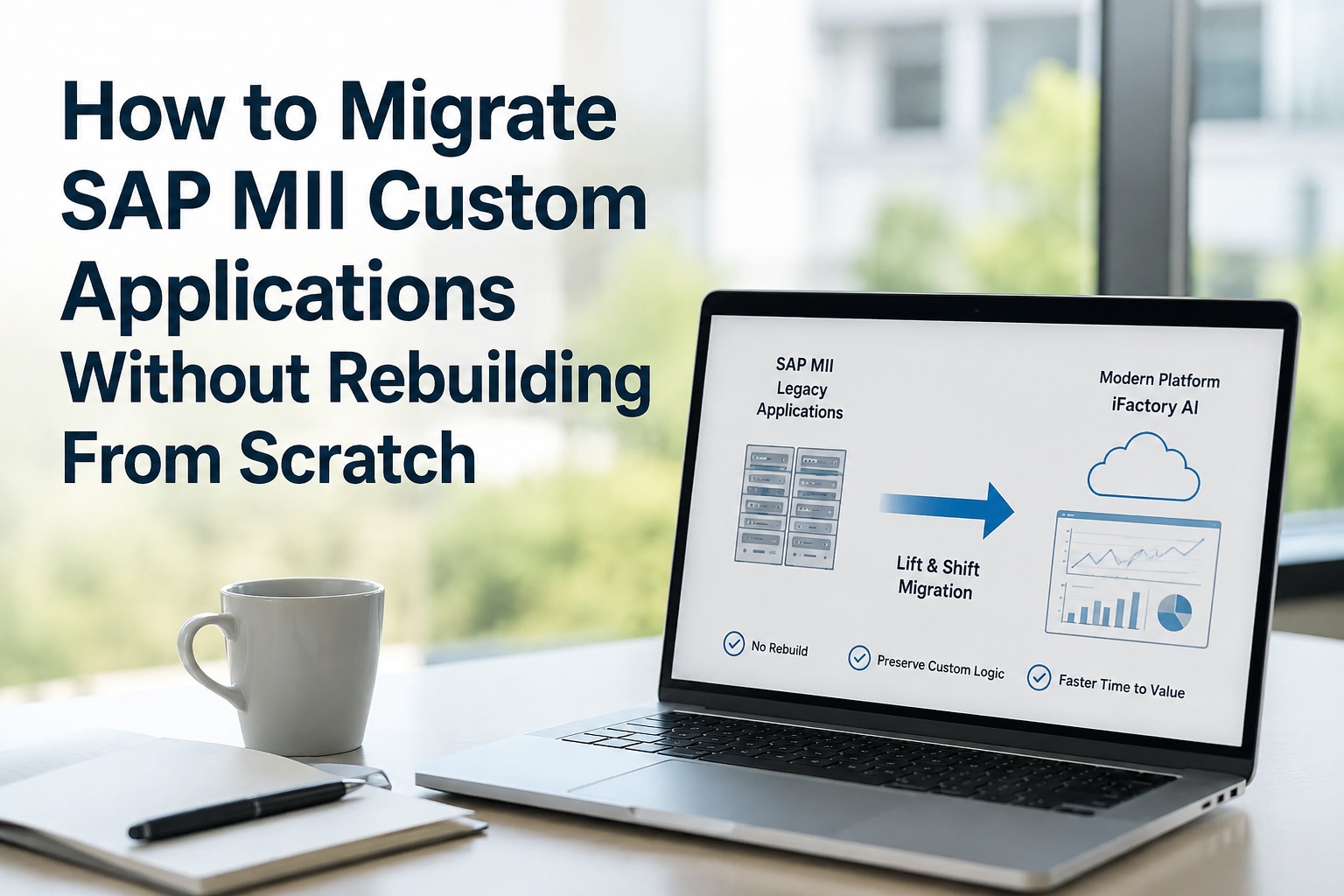
Yes. Custom BLS transactions handling SAP ERP integration are translated onto the new platform using deterministic pattern mappings. The logic, decision rules, and data flows are preserved; the runtime modernizes to event-driven streaming. Behavioural equivalence is validated before cutover.
Talk to Support for SAP integration translation details.
How does on-prem deployment work for IP-critical fab data?
The platform runs on-prem, hybrid, or cloud — your choice. For fabs with recipe IP, process parameters, and customer-confidential roadmap information, on-prem deployment keeps everything inside the facility perimeter. Edge processing handles real-time decisions; aggregate metrics can optionally synchronize to a private management console.
Book a Demo for on-prem architecture details.
What is a realistic first step we can take this quarter?
An 8–12 week pilot on one process module — typically lithography or etch — covering FDC, yield correlation, and ERP integration modernization for that module's lot flows. Output: working pilot, validated against existing MII analytics, with measurable yield or Q-time impact and a defensible business case for full fab rollout.
Talk to Support to scope it.
Fab-Scale Data. Real-Time ERP Integration. AI Optimization From FDC to Yield to Finance.
Semiconductor manufacturing in 2026 demands the data fabric, the AI workloads, and the SAP integration cadence that legacy MII was never designed to deliver. iFactory provides the platform, the SECS/GEM tool integration, the SAP ERP modernization, and the AI optimization stack as a single integrated capability — purpose-built for advanced-node fab economics.
5–20 TB/day fab-scale data ingestion native
95% defect detection accuracy; 40% defect rate reduction
Event-driven ERP integration replacing batch lag
Native FDC, yield prediction, Q-time, and predictive maintenance
SECS/GEM & GEM300 standards across all major fab OEMs