Migrating from SAP MII is not a basis upgrade. It is a transformation program that touches every plant floor system, every operator workflow, every ERP integration, and every audit binder. With SAP MII mainstream maintenance ending December 31, 2027 and extended support closing on December 31, 2030, the question stopped being "should we migrate?" — it is now "how do we migrate without taking production down?" This complete step-by-step guide walks you through every phase of an SAP MII migration, from the first inventory call to the last decommissioning ticket. It is built for the people who actually have to do the work: SAP basis leads, plant IT, operations heads, and CIOs who need to brief their boards. Book a 30-minute migration scoping call to align this framework to your specific MII landscape.
5
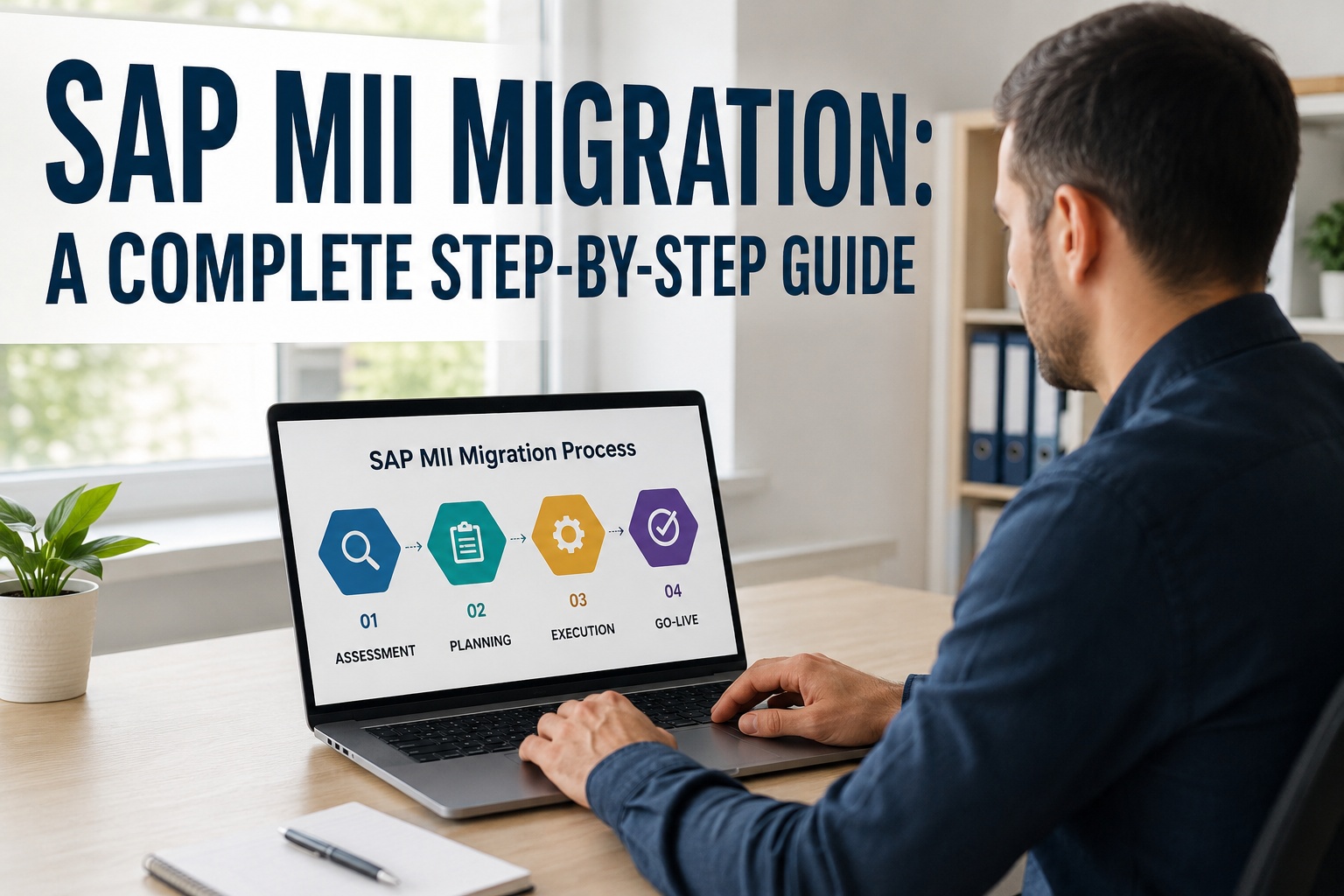
Phases from assessment to go-live, each with defined deliverables and exit criteria
18–36
Months for a typical multi-site migration done well, not under panic conditions
4–12
Weeks to prove the first quick-win use case on the new platform alongside MII
0
Big-bang cutovers — every successful migration runs site-by-site in waves
Before You Start: Three Questions That Decide Everything
Most migration projects fail not in execution but in scoping. Three questions, asked honestly at the start, decide 80% of the cost, timeline, and risk profile of the program. Skip them and you will rediscover them later — usually during testing, when changes hurt the most.
QUESTION 01
What is SAP MII actually doing for you today?
Is MII running heavy MES-style execution paired with SAP ME, or is it acting mostly as an integration and dashboard layer? The honest answer determines whether your target should be SAP DM, a best-of-breed analytics platform, or a hybrid of both.
Output: Workload classification — MES-heavy, integration-heavy, or analytics-heavy.
QUESTION 02
How much of MII is custom code vs. standard?
Count BLS transactions, xMII queries, SSCE pages, custom action blocks, and any Java enhancements. Heavy customization means SAP DM's clean-core model will require redesign, not lift-and-shift. Light customization means a faster, cheaper path.
Output: Custom code inventory tagged keep, retire, transform, replace.
QUESTION 03
What are the non-negotiable constraints?
Data residency requirements? On-prem-only sites? Edge latency rules for time-critical control? OEM customer audit obligations? These constraints rule out some target architectures before you ever evaluate platforms — and finding them late wastes months.
Output: Constraint register that gates platform and deployment-model selection.
The Complete 5-Phase Migration Roadmap
Every successful SAP MII migration follows the same five phases. The names may differ between consultancies, but the work does not. Each phase has defined inputs, defined outputs, and exit criteria you should not cross until they are met. Below is the full roadmap.
PHASE 1
Months 1–2
Pre-Migration Assessment
Catalogue what you have, decide what you need, and quantify the gap. This phase is the one most teams under-invest in — and the one that determines whether the next 18 months go smoothly or painfully.
Key Activities
Full inventory of MII transactions, xMII queries, SSCE pages, action blocks, data servers, scheduled jobs
Map every PLC, SCADA, historian, and ERP integration touchpoint MII currently handles
Interview operators, supervisors, plant IT, and engineering to surface undocumented workflows
Define future-state vision, success criteria, and measurable business outcomes
Tag every artifact: keep, retire, transform, replace
Deliverables
MII artifact inventory with disposition tags
Integration topology map showing every external system
Future-state vision document signed off by IT and operations
High-level effort estimate and phasing strategy
Business case for board approval
Exit Criteria — every BLS transaction is accounted for, every integration is mapped, the future-state target is one document, and the business case has a sponsor.
PHASE 2
Months 2–4
Preparation & Architecture Design
Allocate resources, stand up target environments, and lock the architecture. This is the phase where decisions get expensive to reverse, so the design has to be defended end-to-end before any code is written.
Key Activities
Provision target environments — SAP DM tenant, BTP subaccount, or best-of-breed platform like iFactory
Design the integration architecture for ERP, plant systems, identity, and edge devices
Run proof-of-concept workshops on the 2–3 highest-value use cases
Define data migration strategy: master data, historical data, and ongoing sync
Stand up project governance, change-control, and security review processes
Deliverables
Target architecture document with integration patterns
PoC validation report on top 2–3 use cases
Data migration plan and master-data ownership matrix
Project plan with workstreams, dependencies, and milestones
Risk register and mitigation playbook
Exit Criteria — target environment is live, PoC results validate the design, and the architecture has cleared security and compliance review.
PHASE 3
Months 4–14
Development & Configuration
The longest phase by far. Custom logic gets rebuilt, integrations get wired, dashboards get configured. The trick here is shipping in iterations — proving each piece works before stacking the next on top.
Key Activities
Rebuild keep-and-transform BLS logic as APIs, services, or configurable workflows on the new platform
Configure ERP integration via RFC, BAPI, IDoc, OData — replacing custom MII transactions
Wire up plant connectivity: PLCs, SCADA, historians via OPC UA, MQTT, native protocols
Rebuild operator dashboards, KPIs, and alerts in the new platform's UX framework
Implement security model: SSO, role-based access, audit logging
Deliverables
Working target system with feature parity on Wave 1 use cases
Integration test results across ERP and plant systems
Configured dashboards and operator workflows
Security and audit-trail validation
Updated runbooks and operational documentation
Exit Criteria — Wave 1 functionality demonstrates feature parity, integration tests pass, and operational documentation is current.
PHASE 4
Months 14–18
Testing, Validation & Operator Enablement
Run new and old in parallel. Train the people who will actually use the system. This is the phase where late projects skip steps and pay for it during go-live. Do not skip steps.
Key Activities
Parallel-run MII and target platform for at least one full production cycle per site
Validate KPI numbers match between systems within agreed tolerance
User acceptance testing with real operators on real data
Hands-on operator training with live exercises, not slide decks
Performance, load, and failover testing under peak production scenarios
Deliverables
Parallel-run sign-off report per site
UAT completion certificate from operations leadership
Training completion records for every shift, every role
Performance benchmarks under peak load
Cutover playbook with rollback plan
Exit Criteria — KPIs match, operators are signed off, performance is proven, and the cutover playbook is rehearsed.
PHASE 5
Months 18–24+
Cutover, Hypercare & Decommissioning
Cut over by site, in waves. Run hypercare. Only then start decommissioning MII. The temptation to switch off the legacy system early always shows up — resist it until the new platform has at least one stable quarter.
Key Activities
Execute go-live one site at a time, never all sites at once
Run hypercare for 30–60 days per site with elevated support coverage
Track and resolve every incident during stabilization
Keep MII read-only for at least one quarter for compliance lookups
Formally retire MII components, archive data, update audit documentation
Deliverables
Per-site go-live confirmation
Hypercare incident log with resolutions
Steady-state operations report
MII decommissioning certificate
Updated cyber insurance and audit documentation reflecting new posture
Exit Criteria — every site is stable, MII is decommissioned or read-only, audit and insurance documentation is refreshed.
Five Phases. One Goal: Production Never Stops Because of the Migration.
iFactory has helped manufacturers run this exact roadmap across automotive, pharma, food, and process industries. We can plug in at any phase — assessment, architecture, development, parallel-run, or post-go-live optimization — and bring proven playbooks and modern tooling that compress timelines.
Decision Tree: Which Target Platform Fits Your MII Workload?
SAP DM is one path. A best-of-breed platform is another. A hybrid of both is the right answer for many manufacturers. Use this decision tree to find your starting point — then validate it through PoC in Phase 2.
If your MII workload is mostly...
Then your starting point is...
If MII is paired with SAP ME for execution + moderate customization
SAP Digital Manufacturing (DM) is the natural fit. You get continuity of SAP semantics, native S/4HANA integration, and an SAP-supported roadmap. Plan for clean-core API redesign of custom MII logic — there is no automatic conversion path.
Path: SAP DM-led migration
If MII is mostly analytics, dashboards, and ERP integration with limited ME use
A modern best-of-breed platform like iFactory is often a faster, lower-cost match. Direct integration with S/4HANA or ECC via OData, RFC, IDoc — no ABAP needed. Live use cases in 4–12 weeks vs. 12–24 months for full DM rollouts.
Path: Best-of-breed-led migration
If MII is a heavy custom MES with industry-specific workflows DM does not cover
Hybrid model. SAP DM owns standard execution and ERP-aligned transactions. iFactory or another modern layer handles real-time analytics, AI, edge processing, and operator UX where speed and flexibility matter most.
Path: Hybrid SAP DM + best-of-breed
If on-premise is non-negotiable due to data sovereignty or low-bandwidth sites
SAP DM cloud-only model creates a constraint problem. Best-of-breed platforms supporting on-prem, edge, or hybrid deployment become the practical answer. Validate this in Phase 1 before locking the target architecture.
Path: On-prem-capable best-of-breed
The Migration Risk Register: Top 6 Risks and How to Mitigate Them
Every SAP MII migration faces the same six risks. The plants that succeed know them in advance and design mitigations into the program plan, not into the post-mortem.
The Hybrid Coexistence Pattern: Why MII and Your Target Platform Run Together
SAP themselves recommend a hybrid coexistence model during transition. The new platform takes over standard transactions first while MII continues to handle shop floor integration and custom processes. As the new platform's footprint grows, MII gets phased out one capability at a time. Below is the typical handover sequence.
Standard Order Management & Execution
SAP MII
Target Platform (Wave 1)
PM, QM, & Compliance Transactions
SAP MII
Target Platform (Wave 1)
Real-Time Analytics & Operator Dashboards
SAP MII
Target Platform (Wave 2)
Shop Floor Integration (PLCs, SCADA)
SAP MII
Target Platform (Wave 3)
Custom Reports & Industry-Specific Processes
SAP MII
Target Platform (Wave 4)
By the end of Wave 4, MII has handed off every capability and can be moved to read-only or fully decommissioned. The whole point of the hybrid pattern is to never have a moment where production depends on a system you have already turned off.
Pre-Migration Readiness Checklist
Use this checklist before you sign your first migration contract. Every "no" is a risk you have not yet planned for. Better to surface them now than during Phase 3.
01
Have we inventoried every BLS transaction, xMII query, SSCE page, and custom action block, with business owner and current usage data?
02
Do we have a current topology diagram of every system MII integrates with — ERP, PLCs, SCADA, historians, identity, monitoring tools?
03
Have operations leaders signed off on a future-state vision and measurable success criteria for the migration?
04
Do we know our hard constraints — data residency, on-prem requirements, edge latency, OEM customer audit obligations?
05
Do we have an executive sponsor with budget authority and the political weight to defend timeline and scope?
06
Have we secured retention plans for our key SAP MII engineers through the migration window?
07
Are change-control freezes coordinated with S/4HANA, security, OT, and infrastructure teams during the migration window?
08
Have we shortlisted target platforms — SAP DM, best-of-breed, hybrid — and the deployment models we will validate via PoC?
Want This Roadmap Tailored to Your Specific Landscape?
iFactory's migration team will run a 4-week assessment against your actual MII estate, deliver a phased plan with effort estimates, and identify the first 2–3 use cases where the new platform pays back inside one quarter. No big-bang. No forced cloud. Coexists with SAP DM during transition.
Frequently Asked Questions About SAP MII Migration
How long does an SAP MII migration actually take?
For a multi-site, moderately customized landscape, 18–24 months end-to-end is typical. Heavily customized estates can stretch to 30–36 months. Best-of-breed analytics-layer replacements can deliver first production value in 4–12 weeks while the broader program continues.
Book a Workshop for a tailored timeline.
Is there an automatic migration tool from SAP MII to SAP DM?
No. SAP DM follows a clean-core architecture — direct database access is gone, all interactions go through APIs. BLS transactions, xMII queries, and SSCE pages must be redesigned, not lifted. Some vendors offer frameworks that convert MII logic into modern Node.js or API-based applications.
Talk to Support for migration-pattern details.
Do we have to migrate to SAP DM or are there other options?
Three real paths exist: full SAP DM migration, hybrid SAP DM + best-of-breed analytics layer like iFactory, or full best-of-breed replacement. The right answer depends on your MII workload profile, customization volume, deployment constraints, and IT strategy.
Book a Demo for a fit analysis.
Can we keep some processes on MII during transition?
Yes — and you should. SAP themselves recommend a hybrid coexistence model where the target platform takes over standard transactions first, and MII continues handling shop floor integration and custom processes until those are migrated in later waves. Big-bang cutover is not the goal.
Talk to Support about phasing.
What happens to our master data and historical MII data?
Master data flows from S/4HANA or ECC into the target platform via standard integration. Historical MII data typically gets archived for compliance lookups, with critical history loaded into the new platform's time-series store for trending. The data migration plan is a formal Phase 2 deliverable.
Book a Demo for migration patterns.
What is the smallest first step we can take this quarter?
A 4-week pre-migration assessment. Inventory MII artifacts, map integrations, classify customizations, define future-state vision, and produce a phased plan with effort estimates. Output: a board-ready paper plus a shortlist of quick-win use cases for the new platform.
Talk to Support to scope it.
Migrate With a Plan, Not a Panic. Start the Roadmap While You Still Have Runway.
SAP MII migration is a transformation, not an upgrade. Done in phases with the right partner, it protects production, modernizes operations, and pays back during the program itself. Done late under pressure, it costs more, takes longer, and leaves quality and morale debt for years. iFactory has the playbooks, the platform, and the people to do it right.
5-phase roadmap with clear deliverables and exit criteria
First quick-win use cases live in 4–12 weeks
Direct S/4HANA & ECC integration without ABAP
On-prem, edge, hybrid, or cloud — your terms
Coexists with SAP MII, ME, and DM throughout transition




-and-the-role-of-collaborative-ai..png)