A midwestern automotive parts manufacturer employed 1,200 people across three shifts and five production buildings. Their shift handover process — paper logs passed between 37 workstations every eight hours — had been unchanged for 16 years. The new CEO, brought in to reverse three consecutive quarters of declining OEE, discovered that 23% of all quality deviations were traced to information lost between shifts: a tooling change ordered on first shift that never reached the third shift setup team; a coolant temperature alert logged at 2:00 AM that was not read until the 8:00 AM production meeting; a safety lockout on a transfer press that was documented on paper but not communicated before the maintenance crew ended their shift. The cumulative cost of these handover failures was estimated at $4.7 million annually — 2.3% of total plant revenue, invisible on any single P&L line item because it was spread across rework, scrap, overtime, and expedited shipping. Manufacturing executives evaluating digital shift handover transformation for their organization who Book a Demo with iFactory receive an executive-level transformation roadmap with quantified ROI projections specific to their operations footprint before any implementation begins.
Why Shift Handover Digital Transformation Demands Executive-Led Strategy
Shift Handover Failures Represent a Hidden Multi-Million-Dollar Revenue Leak
Most manufacturing executives track OEE, yield, and downtime at the plant level — but few quantify the cost of information lost between shifts. Industry research shows that 76% of serious manufacturing incidents involve miscommunication during shift handover, and facilities with unstructured or paper-based handover processes experience 2.4x higher recurring incident rates than those with structured digital handover workflows. For a $200M manufacturing operation, eliminating handover-driven quality deviations and rework can recover $3-6M annually that never appears on any single cost line but compounds across every shift, every day, every year. See iFactory's executive-level ROI model that quantifies your facility's specific handover failure cost.
Digital Transformation Without Executive Sponsorship Consistently Fails to Scale
Organisations that launch digital shift handover initiatives without visible, sustained executive sponsorship see operator adoption plateau at 30-50% within six months — and 47% of all digital shift logbook initiatives fail to sustain adoption past year one. The common thread across failed initiatives is not technology capability; it is the absence of executive reinforcement that signals to every level of the organization that the new process is not optional. Facilities where the plant manager references digital handover logs in daily stand-ups for the first 90 days achieve 2.3x higher adoption rates than those where digital transformation is delegated to IT or operations engineering without executive visibility.
Executive Perspective: What Separates Successful Digital Shift Handover Transformations from Stalled Initiatives
The most consistent pattern I see across manufacturing companies that succeed with shift handover digital transformation is that they treat it as an operational improvement initiative with executive ownership, not an IT project with operational input. The CEO or plant director who shows up for weekly stand-ups during the first 90 days, who references the digital handover data in daily production meetings, who asks operators directly how the new system is working — that visible commitment changes the adoption trajectory more than any technology feature or integration capability. The organizations that stall are the ones where executive sponsorship is limited to signing the purchase order and reviewing a quarterly dashboard. This transformation touches every operator, every shift, every day. If the executive team is not visibly engaged every week, the organization reads that as optional — and 47% of the time, the initiative fails within the first year.
Conclusion: Lead Your Shift Handover Digital Transformation With Executive Confidence
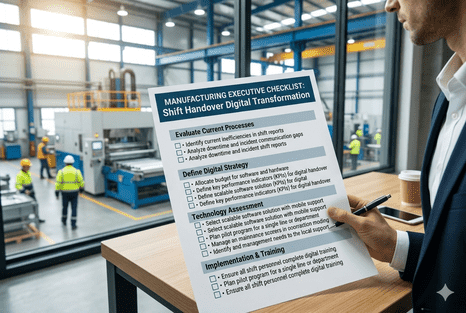
A structured executive checklist for shift handover digital transformation is not an administrative formality — it is the strategic framework that ensures your organization captures the full operational and financial value that digital shift handover technology enables. The eight checklist phases outlined here reflect the sequence that consistently delivers successful transformation programs across discrete and process manufacturing environments. Strategic assessment and stakeholder alignment create the organizational foundation. Technology evaluation and implementation planning select the right platform and deployment approach. Change management and enterprise integration drive operator adoption and system connectivity. Metrics definition and scale planning ensure that early wins translate into sustained, multi-site ROI. Manufacturing executives ready to evaluate their shift handover digital transformation strategy against this framework are encouraged to schedule an executive strategy session with iFactory and receive an executive-level transformation roadmap with quantified ROI projections specific to their operations footprint before any platform commitment is made.