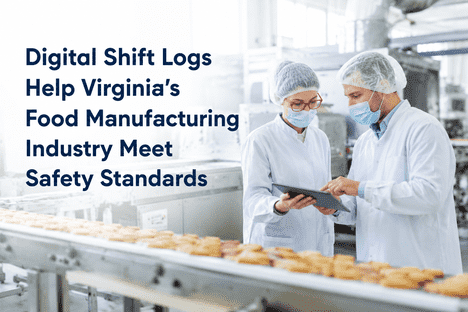
Virginia's food and beverage manufacturing sector — the Commonwealth's second-largest manufacturing industry, employing more than 45,000 workers across 290+ value-added food establishments, anchored by Mars Incorporated in McLean, Wayne-Sanderson Farms poultry operations, and a 15% five-year employment growth rate (second-highest in the Southeast) — operates under some of the strictest food safety regulations in U.S. industry. FDA's Food Safety Modernization Act (FSMA), HACCP Critical Control Point monitoring, and GFSI-recognized standards like SQF, BRCGS, and FSSC 22000 all share one operational reality: continuous monitoring evidence must exist for every production batch, every shift, every changeover. Paper logbooks fail that test predictably — and FDA inspectors treat gaps in shift records as monitoring failures, not paperwork errors. Book a Demo to see how iFactory's digital shift logbook keeps Virginia food manufacturers continuously audit-ready.
Is Your Food Plant's Shift Documentation Audit-Ready or Audit-Exposed?
Capture every CCP check, sanitation sign-off, allergen changeover, and shift handover in a single digital platform built for Virginia food manufacturing compliance.
Why Digital Shift Logs Are the Compliance Backbone for Virginia Food Manufacturers
Virginia's food and beverage manufacturing industry runs continuous, multi-shift operations across poultry processing, dairy, baking, beverage bottling, snack foods, pet food, and value-added meat — each governed by FDA's 21 CFR Part 117 Preventive Controls rule, USDA-FSIS inspection requirements where applicable, and customer-mandated GFSI certifications. Every shift change is a critical control point in itself: time-temperature logs, sanitation verifications, allergen control records, and metal detector challenge tests must hand off cleanly between crews with zero documentation gaps. Paper logbooks and whiteboards break down under this load — illegible handwriting on CCP forms, missed sanitation sign-offs during allergen changeovers, and lost corrective action records that surface only during an FDA Form 483 observation. Plants that Book a Demo with iFactory consistently report that digitizing shift records is their fastest path to closing documentation gaps and accelerating GFSI surveillance readiness.
Structured CCP & Pre-Requisite Templates
Pre-built shift templates capture time-temperature checks at every CCP, metal detector challenge tests, sanitation verifications, and allergen changeover sign-offs — in the structured format FDA and GFSI auditors expect.
AI-Generated Handover Briefs
Incoming shift supervisors get a 90-second summary of open deviations, in-progress corrective actions, pending sanitation tasks, and watch-list equipment — replacing 30–45 minute verbal handovers that lose context.
Deviation & Corrective Action Tracking
Every CCP deviation is flagged in real time, routed to the responsible PCQI or QA lead, tracked through corrective and preventive action closure, and locked into an immutable audit trail.
Immutable Audit-Ready Records
Timestamped, electronically signed shift entries with full operator attribution — exportable instantly for FDA Form 483 responses, GFSI audits, customer quality reviews, and the 2-year FSMA record retention requirement.
Paper Shift Logs vs iFactory Digital Shift Logbook: A Food Safety Performance Benchmark
Understanding where digital shift logbooks deliver measurable safety and compliance ROI is critical before committing to a rollout plan. The table below compares paper-based shift documentation against iFactory's digital platform across the dimensions that matter most to Virginia food safety directors and plant managers.
| Performance Dimension | Paper Shift Logs | iFactory Digital Shift Logbook | Compliance Impact | Priority Level |
|---|---|---|---|---|
| CCP Monitoring Continuity | Gaps during shift change | Continuous, timestamped capture | FDA monitoring failure eliminated | Critical |
| Deviation Detection Speed | End-of-shift discovery | Real-time alert at deviation | Corrective action begins immediately | Critical |
| Allergen Changeover Sign-Off | Verbal confirmation or missing entry | Mandatory e-signature + photo | Class I recall risk reduced | Critical |
| Shift Handover Duration | 30–45 minute verbal walk-throughs | 90-second AI-generated brief | Shifts start on time, no context loss | High |
| Audit Documentation Retrieval | Days of binder search | Seconds via filter and export | FDA & GFSI audits without scramble | High |
| Documentation Time per Shift | Baseline | 85% reduction | Supervisors back on the floor | Standard |
How iFactory Deploys Digital Shift Logbooks in 5 Structured Phases at Virginia Food Plants
A successful digital shift logbook rollout in a food manufacturing plant is never plug-and-play. It requires systematic configuration of templates, integration with existing QMS and CMMS systems, and operator-level adoption from line supervisors to QA leads. iFactory's five-phase deployment model is purpose-built for food and beverage facilities — from single-site bakeries to multi-line poultry processors. Most Virginia food plants achieve live shift logging within 1–2 weeks. Book a Demo to map your facility to the right deployment phase.
Food Safety Plan Audit & Template Digitization
Map all existing CCP monitoring forms, sanitation SSOP records, allergen control records, pre-operational inspection checklists, and shift handover templates into a centralized digital registry aligned to your Food Safety Plan.
Mobile Rollout & QMS / CMMS Integration
Deploy iFactory's offline-capable mobile app on iOS, Android, or rugged industrial tablets at every line station. Integrate with existing QMS, CMMS, and ERP platforms so deviations auto-route to PCQI review and equipment issues trigger maintenance work orders.
Real-Time CCP & Pre-Requisite Monitoring Activation
Activate continuous CCP monitoring with mandatory entry windows, instant deviation alerts to QA leadership, and structured sanitation pre-operational verification workflows aligned with FDA 21 CFR Part 117 and USDA-FSIS requirements where applicable.
AI Handover Briefs & Mandatory Acknowledgment
Switch on AI-generated shift handover summaries with mandatory electronic acknowledgment of open deviations, in-progress corrective actions, and watch-list equipment — replacing verbal walk-throughs and eliminating shift-change information loss.
Audit Trail Lockdown & Continuous Compliance Reporting
Lock in immutable audit trails with timestamped electronic signatures meeting FDA 21 CFR Part 11 expectations. Auto-generate compliance packages for FSMA, HACCP, SQF, BRCGS, and FSSC 22000 audits — ensuring continuous audit readiness without manual binder compilation.
Critical Documentation Gaps in Paper-Based Shift Programs at Food Plants
FDA inspectors flag missing time-temperature entries during shift transitions as monitoring failures — not paperwork errors. Paper logs make these gaps almost inevitable during high-tempo production.
A single undocumented sanitation sign-off between an allergen-containing and allergen-free run can trigger a Class I recall affecting millions of units. Verbal confirmations leave no defensible record.
FSMA and GFSI auditors demand tight linkage from every deviation to its corrective action and preventive action closure. Paper records frequently break that chain — leaving deviations open in the official record.
When paper logs show identical readings across multiple shifts, FDA inspectors raise immediate credibility concerns — even when the readings are legitimate. Digital timestamping eliminates the appearance of falsification.
SSOP pre-operational inspection records that go missing or unsigned create audit findings during SQF, BRCGS, and FSSC 22000 surveillance visits — and weaken the entire prerequisite program defense.
Virginia food manufacturing faces ongoing workforce turnover. Verbal handovers and undocumented operator observations walk out the door with every retiring supervisor — leaving new hires to rediscover the same line quirks.
What iFactory Delivers for Digital Shift Logging in Virginia Food Manufacturing
iFactory is built as a next-generation industrial software platform that connects structured shift entry, AI handover intelligence, and audit-grade documentation into a unified operational layer. For Virginia food manufacturers, this means every CCP check, sanitation sign-off, allergen changeover, and equipment observation is captured, verified, time-stamped, and archived — within a single platform that integrates with existing QMS, CMMS, and ERP systems. Below are the core capabilities that drive measurable compliance and operational outcomes. Book a Demo to see these capabilities demonstrated in a food plant scenario.
Pre-built templates for CCP monitoring, SSOP pre-operational inspections, allergen changeovers, metal detector challenge tests, and shift handovers — configured for FDA 21 CFR Part 117, USDA-FSIS, SQF, BRCGS, and FSSC 22000 requirements.
AI-generated 90-second handover briefs surface open deviations, in-progress CAPAs, watch-list equipment, and pending sanitation tasks. Mandatory electronic acknowledgment by the incoming supervisor closes the verbal handover gap permanently.
100% offline operation on iOS, Android, and rugged tablets. Line operators capture CCP readings, photos of equipment issues, and sanitation sign-offs anywhere on the floor — even in cold storage zones with no WiFi. Auto-sync on reconnect.
Filter by line, shift, product, or date range and export FSMA, HACCP, SQF, BRCGS, and FSSC 22000 audit packages in seconds. Replaces days of manual binder compilation during FDA inspections and GFSI surveillance visits.
The Future of Food Safety in Virginia Is Continuous, Documented, and Audit-Ready in Real Time
Digital shift logbooks in Virginia food manufacturing are no longer a future investment — they are an operational necessity for plants that must meet FSMA Preventive Controls, HACCP CCP monitoring, and GFSI certification expectations without proportionally growing their QA and supervisory workforce. The case for deploying a structured digital shift logbook rests on three pillars: continuous CCP evidence, defensible allergen and sanitation records, and audit-ready documentation on demand. Virginia food manufacturers who consolidate shift documentation, deviation tracking, and compliance reporting into a single intelligent platform like iFactory don't just close audit findings — they transform shift management from a recordkeeping burden into a real-time food safety control system. From poultry processing in Region 8 to beverage bottling in Northern Virginia and snack production statewide, the operations adopting this model today carry significantly lower recall and regulatory risk into the next inspection cycle.
Modernize Your Virginia Food Plant's Shift Documentation in 1–2 Weeks
Deploy a unified digital shift logbook that captures every CCP, sanitation sign-off, and allergen changeover — engineered for Virginia food and beverage manufacturing compliance.
Digital Shift Logbooks for Virginia Food Manufacturing — Frequently Asked Questions
How does iFactory's digital shift logbook support FSMA Preventive Controls compliance?
iFactory captures CCP monitoring data continuously, timestamps every entry, locks records against modification, and routes deviations to the responsible PCQI for review and corrective action — meeting FDA 21 CFR Part 117 monitoring, verification, and record retention requirements.
Does the platform support HACCP, SQF, BRCGS, and FSSC 22000 audit documentation?
Yes. Every entry exports in formats accepted by FDA inspectors, USDA-FSIS, SQF auditors, BRCGS surveyors, and FSSC 22000 certification bodies — filterable by line, shift, product, CCP, or date range with full electronic signature traceability.
Will the mobile app work in cold storage zones and wet processing areas without WiFi?
Yes. iFactory's shift logbook supports 100% offline operation on iOS, Android, and rugged industrial tablets. Operators capture CCP readings, photos, and sign-offs anywhere on the plant floor without network connectivity, with automatic data sync when devices return to coverage.
Can iFactory integrate with our existing QMS, CMMS, and ERP systems?
Yes. iFactory connects to major QMS, CMMS, and ERP platforms via API. Deviations route automatically to QMS workflows, equipment issues trigger CMMS work orders, and production data flows into ERP — eliminating duplicate data entry between systems.
What is the typical deployment timeline for a Virginia food manufacturing plant?
Most food plants go live within 1–2 weeks: template configuration takes 2–3 days, QMS/CMMS integration takes 3–5 days, and supervisor and line lead training plus pilot shift testing takes 1–2 days. Multi-site rollouts across Virginia food operations typically complete in 4–8 weeks.