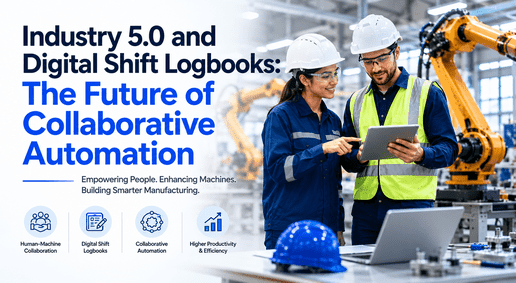
Industry 5.0 is reframing manufacturing around a single defining principle: humans and intelligent machines working in synchronized partnership, not in sequence. The European Commission, McKinsey, and the Industry 5.0 academic consensus all converge on the same three pillars — human-centricity, resilience, and sustainability — built on top of the connectivity and automation foundation that Industry 4.0 already established. With the global Industry 5.0 market projected to grow from $65.8 billion in 2024 to $255.7 billion by 2029 (31.2% CAGR) the question for manufacturing leaders is no longer whether to adopt collaborative automation, but how to make the human side of that collaboration measurably effective. That is exactly where digital shift logbooks become a foundational technology — they are the operational layer where human operator knowledge, AI insights, cobot status, and cross-shift continuity actually meet. This guide maps how Industry 5.0 principles depend on structured digital shift logging, and how iFactory's platform delivers that capability for collaborative-automation manufacturing environments. Book a Demo to see how iFactory operationalizes Industry 5.0 collaboration on your plant floor.
Industry 5.0 and Digital Shift Logbooks:
The Future of Collaborative Automation
Human-centricity, resilience, and sustainability — mapped to the structured shift documentation layer that makes collaborative automation actually work on the factory floor.
Why Industry 5.0 Cannot Succeed Without Structured Shift Documentation
Industry 5.0 is often described in terms of its enabling technologies — cobots, AI, digital twins, AR/VR — but its operational reality lives on the shift handover. Where Industry 4.0 focused on machines talking to machines, Industry 5.0 explicitly requires machines and humans to share context: cobot status, AI-generated recommendations, operator overrides, quality observations, and the tacit knowledge that experienced workers carry between shifts. Paper logbooks and whiteboards cannot carry that load. When an AI model flags an anomaly that the day-shift operator investigates and resolves with a workaround, that workaround must reach night shift in a structured, retrievable form — or the same anomaly recurs, the cobot trips the same fault, and the AI re-flags the same alert. Industry 5.0 collapses without the documentation layer that records human-machine collaboration outcomes.
The structural reality for manufacturers moving into Industry 5.0 is that three forces make the shift logbook decision more consequential than ever: collaborative robots that change state continuously and must be handed off cleanly between human supervisors; AI alerts that lose value if the human response is not captured back into the model's training context; and a manufacturing workforce facing high attrition where tribal knowledge walks out the door faster than it can be transferred. Digital shift logbooks address all three by making human-machine collaboration outcomes a first-class, structured, searchable record.
Head-to-Head: Industry 4.0 vs Industry 5.0 — Where the Shift Logbook Becomes Essential
The table below is a definitive comparison across every operational dimension where Industry 5.0 introduces new requirements on top of the Industry 4.0 foundation — and where structured digital shift logbooks become the connective layer between humans, machines, and AI.
| Operational Dimension | Industry 4.0 Baseline | Industry 5.0 Requirement | Shift Logbook Role |
|---|---|---|---|
| Human-Machine Relationship | Automation-first. Machines optimize. Humans monitor and intervene only on exception. | Collaboration-first. Humans and cobots share workspace and synchronized tasks. Both contribute decisions. | Captures operator overrides, cobot status changes, and joint task outcomes as structured records. |
| AI Decision Loop | AI generates predictions and alerts. Human response is informal or untracked. | Closed-loop AI requires structured capture of human response, validation, and rationale to retrain models. | Logs the human decision, override reason, and outcome — feeding back into AI training and tuning. |
| Cobot Status Handover | Cobots largely operate in isolation from human-handover documentation. | Cobot teach-points, exception history, and active programs must be visible to incoming human supervisor. | Auto-captures cobot state alongside human shift entries — both visible in the same handover brief. |
| Operator Knowledge Capture | Tacit knowledge stays with individual operators. Lost on retirement or turnover. | Worker creativity and judgement are core inputs — must be retained, shared, and discoverable across shifts. | Voice-dictated and photo-attached entries make operator observations searchable across the full plant history. |
| Sustainability Tracking | Energy and waste data captured at machine or system level. | Per-shift sustainability metrics — energy, water, scrap, rework — visible to operators in real time. | Per-shift sustainability KPIs auto-summarized in handover, surfacing waste and energy trends to incoming crew. |
| Resilience & Continuity | Plant resilience depends on automation uptime and PLC redundancy. | Resilience requires that human knowledge transfers cleanly between shifts even when systems are degraded. | Offline-capable mobile capture works through network or system outages. Auto-sync on reconnect. |
| Mass Customization | Production runs are batch-defined; changeovers are scheduled events. | Personalized product runs require continuous changeover instructions handed shift-to-shift without error. | Structured changeover templates carry SKU-specific instructions, sign-offs, and parameter changes between crews. |
| Compliance & Audit Trail | Compliance records compiled manually at audit time from paper sources. | ISO 9001, ISO 45001, and customer audits expect timestamped, immutable, electronically signed records. | Every entry is timestamped, e-signed, and exportable instantly by line, shift, product, or date range. |
| Cross-Site Visibility | Plant data lives in plant-level historians. Limited cross-site comparison. | Distributed manufacturing requires fleet-level visibility into shift performance, AI events, and human outcomes. | Fleet analytics roll up shift entries across plants — enabling cross-site benchmarking and best-practice sharing. |
| Workforce Upskilling | Training is event-based — periodic classroom or LMS sessions. | Continuous, in-context upskilling — operators learn from prior-shift entries and AI-generated guidance. | Historical entries become a searchable knowledge base — new hires onboard by reading what experienced operators did. |
The Five Pillars of Industry 5.0 — And How Digital Shift Logbooks Enable Each One
Industry 5.0 is built on three core European Commission principles (human-centricity, resilience, sustainability) plus two operational pillars that emerge from manufacturing practice (collaborative automation and continuous workforce upskilling). The decision framework below identifies how digital shift logbooks become the operational backbone for each pillar.
Sustainability, Workforce Upskilling, and Continuous Improvement
Two additional Industry 5.0 pillars — sustainability and continuous workforce upskilling — depend on the same structured shift documentation layer. The following breakdown maps what each pillar actually requires from your shift recordkeeping infrastructure to deliver the outcomes Industry 5.0 promises.
Sustainability KPIs Per Shift
Industry 5.0's sustainability pillar requires real-time, per-shift visibility into energy use, water consumption, scrap rate, and rework. Digital shift logbooks capture these KPIs alongside operator observations, surfacing waste trends in the handover brief — so each crew owns the sustainability improvement loop rather than discovering deviations weeks later in a monthly report.
Workforce Upskilling in Context
Continuous upskilling — a defining Industry 5.0 expectation — requires that operators learn from prior-shift records, AI guidance, and peer observations in the flow of work. Searchable historical entries become a living knowledge base. New hires onboard faster by reviewing what experienced operators did when a specific fault, SKU changeover, or quality hold occurred previously.
Continuous Improvement Loops
Industry 5.0 amplifies the continuous improvement discipline by making every shift a data point. Structured shift entries feed lean, Six Sigma, and Kaizen programs with reliable observations rather than memory-based debriefs. Recurring defect patterns, downtime causes, and changeover friction surface in days rather than quarters.
Audit & Customer Compliance Readiness
Industry 5.0 plants operate under ISO 9001, ISO 45001, and customer-specific quality programs — all of which expect timestamped, immutable, electronically signed records. Digital shift logbooks replace days of manual binder compilation with instant filter-and-export by line, shift, product, or date range, making continuous audit readiness a default operational state.
What iFactory's Digital Shift Logbook Delivers for Industry 5.0 Manufacturing
iFactory's shift logbook is purpose-built for the collaborative-automation environments Industry 5.0 demands. Below is the capability breakdown across the three operational modes most relevant to Industry 5.0 deployments — structured human-machine handover, AI feedback capture, and cross-shift knowledge retention. The reference case below reflects a mid-size discrete manufacturing plant running cobots, AI vision systems, and three-shift continuous operations.
Expert Perspective: What Operations Leaders Say About Industry 5.0 and Shift Documentation
The Industry 5.0 conversation in most plants focuses on the visible technology — the cobots arriving on the floor, the AI vision system flagging defects, the digital twin running in the cloud. What gets missed is the connective tissue: the place where human observations, machine state, and AI outputs actually meet in a form the next shift can use. That place is the shift logbook. Plants that skip the documentation layer end up with collaborative-automation deployments that work brilliantly for one shift and degrade across every handover after that.
Conclusion: Industry 5.0 Lives or Dies at the Shift Handover
Industry 5.0 promises a manufacturing future where humans and intelligent machines work in synchronized partnership — where operator judgement amplifies AI outputs, cobots adapt to human creativity, and the plant continuously improves through closed-loop feedback. That promise rests on a single operational assumption: that human-machine collaboration outcomes are captured, shared, and acted on between shifts. Plants that solve the documentation problem turn Industry 5.0 from a marketing concept into a measurable operational discipline. Plants that leave it on paper end up with expensive cobots, sophisticated AI, and a 20th-century shift book that defeats both.
iFactory's digital shift logbook is purpose-built for this collaborative-automation reality. Structured templates for human-machine handover, closed-loop AI feedback capture, offline-capable mobile entry, and long-horizon knowledge retention — all integrated with the MES, SCADA, cobot, and AI systems already on the floor. The deployment timeline is measured in weeks, not quarters, which means measurable Industry 5.0 outcomes begin within the first month rather than the first fiscal year.