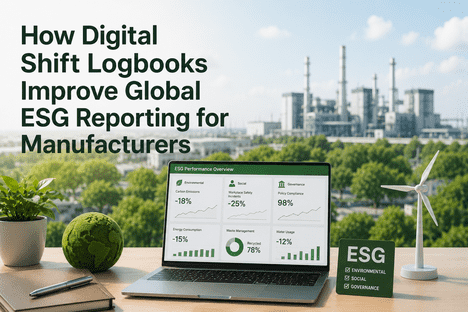
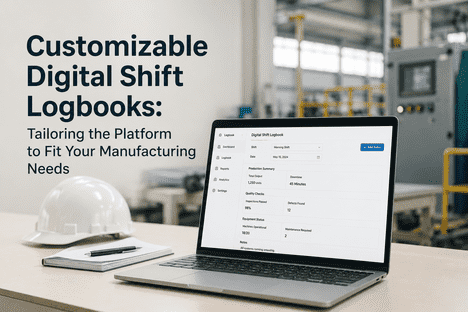
At 4:18 AM, a furnace in Plant 2 burned 11% more natural gas than usual due to an undocumented temperature setting change. Nobody logged it. By the time the quarterly ESG report was being assembled six weeks later, the Scope 1 emissions estimate for the period was a confident-looking number that bore no relationship to what had actually happened on the shop floor. Under CSRD audit, that gap is now a material misstatement — and assurance providers are flagging it. The era of estimated ESG numbers is over. CSRD compliance, Scope 1/2/3 emissions disclosure, ISSB alignment, and supply chain transparency all require auditable, machine-level data captured at the source. Digital shift logbooks are how manufacturers actually deliver it. Book a Demo to see iFactory's audit-grade ESG data capture in action.
ESG · CSRD · ISSB · GHG PROTOCOL
Your ESG Report Is Only
As Good As Your
Shop Floor Data.
Digital shift logbooks capture the energy, emissions, waste, water, and safety data your sustainability team needs — at the moment it happens, attributed, timestamped, and audit-ready for CSRD, ISSB, GRI, and SEC climate disclosures.
CSRD / ESRS Aligned
GHG Protocol Scope 1/2/3
ISSB & GRI Compatible
Audit-Ready Trail
LIVE ESG DATA FEED — PLANT 2
04:18:42
04:18
Furnace F-2 Gas Usage +11%
Scope 1 deviation flagged · Auto-logged · Setpoint change recorded
03:50
Scrap Bin Weighed: 142 kg
ESRS E5 waste metric · K. Patel · photo attached
03:22
Water Discharge pH Excursion
ESRS E3 event · EHS notified · Permit doc updated
02:45
Near-Miss Reported — Loading Dock
ESRS S1 social metric · Resolution assigned
01:30
Shift Handover Acknowledged
ESG KPI summary attached · 18 entries reviewed
Why ESG Reporting Lives or Dies on Shop Floor Data
CSRD reporting is not a finance task that lives in the accounting department. It is a production data challenge that begins at the machine. Under ESRS E1, manufacturers must disclose Scope 1, 2, and 3 greenhouse gas emissions traceable to specific assets and processes. ESRS E2 requires emissions to air, water, and soil. ESRS E5 covers waste volumes, scrap rates, and recycling — data that exists only on the shop floor. ESRS S1 covers workforce safety, training, and conditions. The era of plausible-looking estimates pulled from utility bills is closing fast: external auditors are now testing the data lineage from disclosure number back to the machine that produced it. If that chain doesn't exist, the disclosure doesn't either.
Utility Bill Estimates
~30% auditable
Spreadsheet ESG Logs
~50% auditable
Standalone Sustainability Platform
~70% auditable
Shop-Floor Digital Shift Logbook
100% auditable
Wondering whether your current ESG data would survive a CSRD audit? Book a 20-minute ESG data audit — we'll walk through your current collection workflow and show you where the lineage gaps are.
What ESG-Grade Shift Logbook Data Actually Looks Like
An ESG-ready shift logbook is not a paper form digitized. It is a continuous capture system that turns every shop-floor event into a structured, timestamped, attributed data point — flowing into the same operational record as production, quality, and safety data. Here is the radial map of ESG event sources that feed a single unified sustainability record.
01
Energy & Fuel Consumption
Per-machine kWh, gas, steam — Scope 1 & 2
02
Waste & Scrap Records
Volume, type, recycling — ESRS E5
03
Emissions & Excursion Events
Air, water, soil — ESRS E2 / E3
Six ESG streams. One auditable record. CSRD-ready.
04
Water Usage & Discharge
Intake, treatment, pH — ESRS E3
05
Safety & Workforce
Incidents, near-misses, training — ESRS S1
06
Production Metrics
Volume per SKU — intensity calculations
The ESG Data Maturity Ladder
Most manufacturers think they are further along on ESG data than they actually are. The gap between Level 3 and Level 4 is where CSRD assurance findings concentrate — and where the next wave of disclosure penalties will land. To map your current maturity level, Book a Demo with our ESG data team.
1
Estimated From Bills
Scope 1/2 emissions calculated from utility bills divided by production volume. No machine-level traceability. Will not survive CSRD assurance.
Audit confidence: ~15%
2
Spreadsheet Aggregation
Quarterly Excel rollups of energy, waste, and safety data. Manual reconciliation. Limited lineage, no real-time signal.
Audit confidence: ~40%
3
Standalone Sustainability Platform
Dedicated ESG software, but disconnected from shop-floor logbooks. Operational ESG events still flow through paper or memory before reaching the platform.
Audit confidence: ~70%
4
Connected Shift Logbook ESG Data
ESG events captured at the source — energy meters, scrap weights, water excursions, safety observations — auto-logged with operator attribution, timestamped, immutable. Full CSRD audit lineage.
Audit confidence: 100%
Operating across multiple sites with different ESG data maturity? Request a multi-site assessment — our team benchmarks every plant against CSRD and ISSB standards in a single report.
The ESG Dashboard That Replaces Quarterly Panic
Capturing ESG data at the source is only half the battle. The other half is making that data continuously visible to sustainability, EHS, and operations teams — so deviations are caught the day they happen, not the month before the disclosure deadline.
ESG Operations Dashboard — Plant 2
Live · Updated 18 sec ago
Scope 1 Emissions (Shift)
4.2 tCO₂e
+11% vs baseline · F-2 flagged
Energy Intensity
0.48
kWh per unit · target: 0.45
Scrap Rate
2.3%
142 kg this shift · ESRS E5
Safety Events
1
Near-miss · ESRS S1 logged
Energy Intensity by Hour — Last 24h
What ESG Reporting Looks Like When Data Is Captured at the Source
Real-time ESG data only matters if it changes how disclosures are produced and audited. These are the four workflows that transform a manufacturer's ESG posture the moment shift logbooks become the data backbone for sustainability reporting.
CAPTURE
100% machine-level lineage
Every ESG event recorded at the source
Energy meter readings, scrap weights, water discharges, safety events, and emission excursions all hit the same timeline. Estimated numbers replaced by measured numbers, attributed to a named operator and a specific asset.
CALCULATE
Scope 1/2/3 in real time
GHG Protocol calculation, automated
Per-machine energy and fuel data feeds Scope 1 and 2 calculation continuously. Per-unit production data enables product carbon intensity. Supplier and logistics records support Scope 3 modeling without manual quarterly reconciliation.
DISCLOSE
CSRD / ISSB / GRI ready
Disclosure data, audit-quality from day one
Outputs align directly with ESRS E1/E2/E3/E5/S1, ISSB IFRS S1/S2, GRI Standards, and SEC climate disclosure rules. No retroactive reconstruction, no estimation gaps, no assurance-blocking data quality findings.
PROVE
Limited & reasonable assurance ready
Pass CSRD assurance without panic
Every ESG data point is timestamped, attributed, e-signed, and immutable. Auditors trace the disclosure number back through aggregation, back to the shift entry, back to the asset and operator that produced it. ALCOA+ compliant by default.
SEE IT LIVE
Watch iFactory's ESG-Ready Shift Logbook in Action
A 15-minute walkthrough on your own ESG data scenarios — energy, scrap, water, safety. See the live capture, the disclosure rollups, and the audit trail before you commit to anything.
What Gets Measured at the Source, Gets Disclosed With Confidence
The single biggest argument for capturing ESG data through digital shift logbooks isn't cost reduction — it's that you finally have disclosure-grade data. Here is what manufacturers report after switching, that they couldn't substantiate before.
Scroll horizontally to view all metrics
Built for the Regulatory Reality of 2026 and Beyond
An ESG-grade shift logbook only works if it fits the regulatory and operational reality of multi-site, multi-jurisdiction manufacturing. Here is how iFactory handles the edge cases that break standalone sustainability platforms. Book a Demo to see how the platform configures for your specific disclosure framework mix.
01
Framework Agnostic
Outputs map to CSRD/ESRS, ISSB IFRS S1/S2, GRI Standards, SEC climate, TCFD, and CDP without separate reporting workflows.
02
Multi-Site Native
Different jurisdictions, different reporting templates, one unified ESG data record. Site-level disclosure with corporate roll-up in one platform.
03
Mobile-First Capture
Operators log scrap weights, water excursions, energy events, and safety observations from tablet, phone, or rugged device — offline-capable with auto-sync.
04
Integrates Deeply
Bi-directional connection with SAP, Oracle, SCADA, MES, CMMS, energy meters, and dedicated sustainability platforms — your shift logbook becomes the ESG source of truth.
First CSRD report due and your data lineage isn't ready? Book a Demo and see how fast you can go from estimated numbers to audit-grade ESG capture — most facilities go live in 2 to 4 weeks.
CSRD FY2025 REPORTING IS HERE
Get Audit-Grade ESG Data Before Your Next Disclosure Deadline
Replace estimated emissions with measured, machine-attributed ESG data. Most facilities move from utility-bill estimates to fully auditable Scope 1/2 capture within 4 weeks.
Book a Demo to see your specific ESG framework mapping.
Frequently Asked Questions
How does a digital shift logbook produce CSRD-grade ESG data?
iFactory captures ESG events at the moment they happen — energy meter readings, scrap weights, water excursions, safety observations — attributed to a specific asset and operator, with timestamp and e-signature. That data flows directly into Scope 1/2/3 calculations and ESRS E1/E2/E3/E5/S1 disclosures with complete lineage from the disclosure number back to the original event. Auditors get the traceability CSRD assurance requires.
Can the platform support both CSRD and ISSB reporting at the same time?
Yes. The underlying data captured is framework-agnostic. The same per-machine energy, emissions, waste, water, and safety records feed CSRD/ESRS disclosures, ISSB IFRS S1/S2 reporting, GRI Standards, SEC climate disclosure rules, TCFD, and CDP responses — without separate data collection workflows for each framework.
Does the platform support Scope 3 supply chain emissions data?
Yes. iFactory captures the production volume, material consumption, and logistics data your sustainability team needs to model Scope 3 categories and respond to upstream customer requests for product-level carbon data. Where Tier 1 supplier data is exchanged, the platform integrates via API with leading carbon accounting platforms to incorporate it into Scope 3 calculations.
How does it handle multi-site operations across different ESG regulatory regimes?
iFactory supports site-specific configuration so a European plant operating under CSRD, a US plant subject to SEC climate rules, and an APAC plant reporting under ISSB-aligned regimes all run on the same platform. Corporate sustainability teams see a unified record across all sites while each site maintains its specific disclosure templates and timing.
Is the audit trail strong enough for CSRD limited or reasonable assurance?
Yes. Every ESG entry is timestamped, attributed to a named user, immutable, and e-signed. The system meets ALCOA+ data integrity principles and is compatible with FDA 21 CFR Part 11, GMP, and ISO management system requirements. CSRD assurance providers can trace any disclosed figure back to the originating shift entry, asset, and operator without intermediate reconstruction.