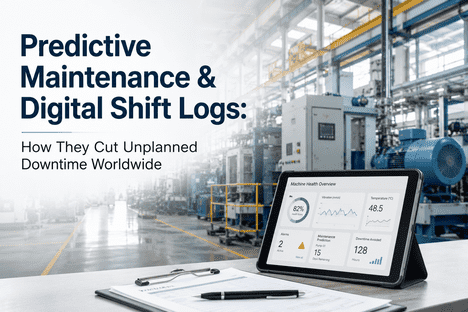
Predictive Maintenance & Digital Shift Logs: How They Cut Unplanned Downtime Worldwide
By Rebecca on May 26, 2026
Every unplanned breakdown that takes a production line down for hours started somewhere — a vibration that climbed past baseline, a temperature that drifted, a pump that "sounded different" to the operator on second shift. The signals were almost always there. The problem is that in most plants those early-warning observations live on paper logbooks nobody reads, while sensor data lives in a predictive analytics platform nobody connects to the operator's note. Unplanned downtime costs industrial manufacturers an estimated $50 billion globally each year and a single hour can cost $40,000–$260,000 depending on the facility — yet the technical solution is already mature. When digital shift logs feed directly into a predictive maintenance platform, operator observations corroborate sensor alerts, work orders auto-generate before failures escalate, and developing faults get caught days before they stop production. Book a Demo to see iFactory's combined shift logbook and predictive maintenance workflow in action.
Predictive Maintenance · Digital Shift Logs
Cut Unplanned Downtime by Closing the Loop Between Operator Observations and Predictive Alerts
Predictive maintenance alone catches sensor anomalies. Shift logbooks alone capture human observations. Together they detect developing faults days earlier, generate work orders automatically, and turn every shift into a continuous data source for your reliability program.
Annual cost of unplanned downtime to industrial manufacturers globally
30–50%
Reduction in unplanned downtime reported with AI-driven predictive maintenance
86%
Reduction in missed handover information when shift logs are digital and structured
15–30%
Lower maintenance cost per operating hour with condition-based intervention
The Real Problem
Why Predictive Maintenance Programs Underperform Without Shift Log Integration
Predictive maintenance platforms generate alerts from vibration spikes, temperature deviations, current anomalies, and other sensor signals. But sensors miss what humans notice — unusual sounds, smells, intermittent leaks, subtle product quality drift, vibration that only happens during specific operating modes. When those operator observations live on paper logbooks that nobody links to the predictive platform, two failures compound: developing faults that operators saw get lost between shifts, and predictive alerts that operators could have corroborated never get the human context that would have escalated them in time.
Lost Operator Observations
"Pump 2B sounds different" gets scribbled in a paper logbook on evening shift. Night shift doesn't read it. Morning shift never sees it. The seal fails catastrophically 30 hours later — $18,000 emergency repair, 22 hours of downtime that was preventable.
Uncorroborated Predictive Alerts
The predictive platform flags rising vibration on a bearing three days ago. No operator note ever connected to that alert, so reliability engineering deprioritized it. The bearing fails on shift change, taking the line down for six hours.
Manual Work Order Latency
An operator notices a developing fault, tells the supervisor verbally, supervisor calls maintenance, maintenance opens a work order in the CMMS. By the time the technician arrives, 60–120 minutes are gone — and the fault has escalated.
Reactive Repair Loops
Without shift log data feeding the predictive model, the AI never learns from operator-recorded failures, near-misses, and overrides. The result: a predictive platform that never improves, and a maintenance team that keeps fighting the same breakdowns.
42%of all unplanned manufacturing downtime is caused by equipment failure
800 hrsof equipment downtime per year at the average manufacturer (Forbes Tech Council)
$840Kannual savings reported by one auto plant from eliminating shift-change information loss alone
The Maturity Path
Three Stages: From Paper Logs to Predictive-Linked Shift Intelligence
Most plants are stuck somewhere between stage one and stage two — running paper or whiteboard handovers alongside a predictive platform that operates in isolation. Here's what the journey actually looks like, and what becomes possible at each level. Book a Demo to map your current stage and what stage three looks like for your plant.
Stage 1
Paper Logs + Reactive Maintenance
Operators write observations on paper. Maintenance fires when something breaks. No sensor data. No correlation between shifts. Maximum unplanned downtime, maximum emergency callout cost.
Typical: 800+ hrs annual downtime · 65% of maintenance budget on reactive repairs
→
Stage 2
Predictive Platform + Paper Logs (Disconnected)
Sensors and predictive analytics installed — but operator observations still on paper. Predictive alerts fire without human corroboration. Operator-spotted faults never reach the model. Two systems, both partially blind.
Typical: 20–30% downtime reduction · plateau without operator input loop
→
Stage 3
Digital Shift Logs + Predictive Maintenance (Closed Loop)
Operator observations logged digitally, auto-linked to asset tags, cross-checked against active predictive alerts, and turned into work orders when corroborated. Human + machine intelligence operating as one system.
Result: 30–50% less unplanned downtime · 86% less handover information lost · sub-90s alert-to-action
How the Closed Loop Works
What iFactory's Predictive-Linked Shift Logbook Actually Does
iFactory's digital shift logbook is built to be the human-side input layer of a predictive maintenance program — not a separate documentation tool. Here's the four-step workflow that turns every operator observation into either a corroboration of a predictive alert or a new fault signal the AI learns from.
01
Structured Observation Capture at the Point of Action
Operators log observations on a mobile app with dropdown categories — Equipment Observation, Process Deviation, Maintenance Action, Safety Event. Asset tag auto-completes from QR scan or location. Voice dictation supports gloved-hand use. Photos and short videos attach to the entry. Every observation gets a timestamp, operator ID, and asset link — no exceptions, no skipped fields.
Entry time: under 2 minutes · full offline capability for in-hull or low-coverage zones
02
Auto-Correlation With Active Predictive Alerts
When an entry is saved, the platform checks for active predictive alerts on that asset within a configurable lookback window. A match — "operator hears bearing noise" + "active vibration anomaly detected 36 hours ago" — flags the entry as a corroborating observation, escalating both the alert priority and the certainty of the developing fault.
Match logic: asset tag + alert type + time window · zero manual cross-referencing required
03
Automatic Work Order Generation
A corroborated alert auto-creates a maintenance work order in the CMMS — pre-populated with the asset record, the operator's observation, the predictive alert history, and a priority score reflecting the joint human-machine signal. The work order reaches the assigned technician in under 60 seconds, with full context. No phone calls, no verbal re-explanation, no lost detail.
Work order to technician: under 60 seconds · CMMS integration with Maximo, SAP PM, Fiix, and others
04
AI-Generated Handover Brief & Feedback to the Model
At shift end, the AI generates a 90-second handover brief for the incoming supervisor — surfacing open work orders, watch-list assets, predictive alerts requiring observation, and any developing trends. The incoming shift acknowledges with e-signature. Every operator decision (alert accepted, overridden, deferred) feeds back into the predictive model's training loop, continuously improving accuracy.
Handover brief: 90 seconds vs 30–45 min verbal · closes the human-feedback loop to AI
Wondering how predictive-linked shift logs integrate with your existing CMMS, SCADA, and predictive maintenance platform? Book a Demo and our team will walk through your specific stack in a 30-minute working session — no slideware, just a live integration map for your plant.
Documented Outcomes
What Plants Gain When Shift Logs Feed Predictive Maintenance
The outcomes below reflect industry-documented results from plants that have connected operator observations to their predictive maintenance platform — turning shift logs from a passive record into an active reliability input. Book a Demo to see how these numbers map to your specific asset mix and current maintenance baseline.
30–50%
Reduction in Unplanned Downtime
When operator observations corroborate predictive alerts and trigger work orders automatically, plants report 30–50% reductions in unplanned downtime. Some implementations report up to 70% reduction on specific high-criticality assets.
86%
Less Handover Info Lost
Structured digital handovers with AI-generated briefs and mandatory acknowledgment cut missed handover information by up to 86% — directly preventing the "nobody read the prior shift log" failure mode.
15–30%
Lower Maintenance Cost
Eliminating emergency callouts, expedited parts orders, and unnecessary calendar-based PM tasks reduces maintenance cost per operating hour by 15–30% across documented deployments.
$840K
Annual Savings (Auto Plant)
One automotive plant calculated $840,000 in annual savings just from eliminating duplicated troubleshooting caused by information loss at shift change — before any predictive maintenance gains were counted.
94%
Faster Historical Access
Searchable digital shift records give reliability engineers 94% faster access to historical operational decisions — replacing days of binder search with seconds of filter-and-export.
Reliability Metric
Predictive Platform Alone
Predictive + iFactory Shift Logs
Fault Detection
Sensor signal only — misses sub-sensor signs
Sensor + operator observation correlated
Alert Corroboration
Manual cross-referencing by reliability eng
Automatic match against active alerts
Work Order Latency
30–120 min manual creation
Auto-generated in under 60 seconds
Shift Handover
Paper logs, 30–45 min verbal walk-through
90-second AI brief + mandatory ack
AI Model Improvement
Stagnates — no human-feedback loop
Operator decisions feed retraining pipeline
Audit Trail
Fragmented across paper + CMMS
Single immutable record per asset
Stop Losing Operator-Spotted Faults Between Shifts
iFactory gives reliability and maintenance teams a single platform where operator observations, predictive alerts, and CMMS work orders close the loop automatically — deployed in 1–2 weeks, integrated with your existing predictive maintenance and CMMS stack.
A predictive maintenance platform sees sensor data — vibration, temperature, current, pressure. It does not see what operators see and hear: unusual noises, intermittent leaks, vibration during specific operating modes, subtle product quality drift. iFactory's shift logbook captures those human observations and auto-correlates them with active predictive alerts on the same asset. The corroboration both raises the certainty of developing faults and gives reliability engineering the context to act before failure. Operator-only signals also feed back into the predictive model's training data, continuously improving its detection accuracy.
Yes. iFactory connects to major CMMS platforms (Maximo, SAP PM, Fiix, eMaint), predictive maintenance and condition monitoring systems (SKF, Augury, Petasense, ABB Ability), SCADA historians, and ERP environments via standard APIs. Corroborated shift log entries auto-generate work orders in your existing CMMS — pre-populated with asset record, operator observation, and predictive alert history. Operator decisions on AI alerts (accepted, overridden, deferred) export back to your MLOps pipeline for model retraining.
Most facilities go live within 1–2 weeks. Template configuration for your trade-specific entries takes 2–3 days, integration with your CMMS and predictive platform takes 3–5 days, and operator and supervisor training plus pilot shift testing takes 1–2 days. Multi-site rollouts across larger manufacturing footprints typically complete in 4–8 weeks. The platform supports incremental deployment — start with one line or critical asset cluster, validate the predictive-linked workflow, then scale across the plant and across sites without re-architecting.
Adoption is driven by usability. iFactory's mobile-first design with tap-to-select fields, voice capture for gloved-hand use, and photo attachment reduces entry time below what paper logs took — most entries complete in under two minutes. The platform supports 100% offline operation on iOS, Android, and rugged industrial tablets, so coverage gaps inside equipment housings or in low-WiFi zones never block entry. Plants typically report 90%+ operator adoption within the first month, with supervisors actively preferring the AI-generated handover brief over reconstructing prior-shift events verbally.
iFactory's mobile app maintains full offline capability — operators continue logging entries, capturing photos, completing checklists, and acknowledging handovers without any network connection. When connectivity is restored, queued entries sync automatically with conflict resolution for overlapping items. Local copies of the most recent AI handover brief remain accessible offline so the incoming shift never starts blind, even during extended outages. This is critical for plants in remote locations or with intermittent network reliability across the production floor.