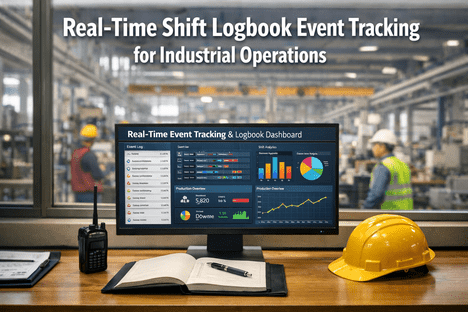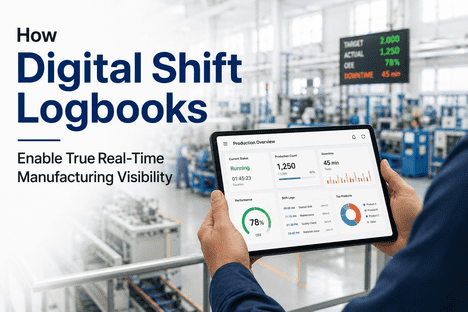
Real-time visibility on the factory floor is no longer a competitive luxury — it is the operating standard that separates plants making decisions on what is happening now from those still reacting to yesterday's numbers. McKinsey research suggests manufacturer productivity can climb up to 20% when performance is tracked in real time while better operational communication is associated with revenue growth roughly 4× higher than peers running on fragmented handovers. The hard truth is that most manufacturers don't have a data problem — they have a visibility problem. Sensor data lives in one system, OEE in another, shift notes on a clipboard, and decisions get made on whichever number reaches the supervisor first. Digital shift logbooks close that gap. They turn every shift observation into structured, live data that flows into the same operational view your dashboards, CMMS, and leadership team are already watching. For plant managers ready to make real-time visibility actually real, Book a Demo to see iFactory's digital shift logbook in a live factory walkthrough.
What Real-Time Manufacturing Visibility Actually Means
Real-time manufacturing visibility is the operational discipline of making every shift event, equipment state, safety observation, and production data point visible to the people who need it — at the moment it happens, not at the end of the shift, the week, or the month. In traditional plants, visibility is fragmented: machine data lives in SCADA, OEE in a dashboard, shift observations on paper, work orders in the CMMS, and quality data in the QMS. By the time anyone assembles a complete picture, hours or days have already passed. True real-time visibility eliminates that assembly delay — and the digital shift logbook is the connective tissue that makes it possible by capturing the human observations that sensors miss and routing them into the same operational view as machine data.
Why Paper Logbooks Make Real-Time Visibility Impossible
A digital manufacturing dashboard can pull live machine data from sensors and PLCs — but if the operator who noticed an unusual vibration on third shift wrote that observation in a paper logbook, that observation is invisible to the dashboard, invisible to the day-shift engineer, invisible to leadership, and invisible to the predictive analytics model. The visibility gap is structural: anything captured on paper is, by definition, not real-time data.
Machine telemetry, vibration, temperature, current draw, throughput, and quality measurements streamed continuously from production equipment. Necessary but not sufficient — sensors do not capture context, intent, or human-spotted anomalies.
Operator-spotted anomalies, near-miss reports, equipment quirks, quality observations, and shift handover notes — captured in structured digital format and routed to the same view as machine data. The element most plants are still missing.
Real-time delivery of combined sensor and human data to the right person — operator alert, engineer dashboard, leadership roll-up, automatic work order in CMMS — within seconds of the event, not hours after.
Real-Time Visibility Maturity: Where Does Your Plant Sit?
Understanding where your facility sits on the real-time visibility maturity curve is essential for prioritizing the right investments. The model below reflects published benchmarks from food, beverage, pharmaceutical, and discrete manufacturing environments deploying digital shift logbook platforms. If your facility sits in the lower half, Book a Demo to receive a custom visibility maturity assessment.
The Six Visibility Gaps Digital Shift Logbooks Close
Real-time visibility is rarely lost in one big failure — it leaks out through small, predictable gaps in the shift handover process. The framework below identifies the six most common visibility gaps in manufacturing operations, and how a structured digital shift logbook closes each one. These are the gaps that determine whether your dashboards reflect reality or yesterday's snapshot.
"Pump sounded different" gets scribbled on paper, never reaches engineering, never feeds the predictive model. Digital capture with asset auto-link and routing closes the gap permanently — every observation becomes searchable, live data.
Verbal handovers miss 40–60% of actionable context, and 40% of plant incidents occur during or immediately after shift transitions. AI-generated handover briefs and mandatory acknowledgment eliminate the "I never heard about that" failure mode.
Shift notes in one system, machine data in another, work orders in a third — no single live view. Digital shift logbooks integrated via API to CMMS, SCADA, ERP, and QMS create one unified operational reality.
Manual end-of-shift reports deliver insights hours after the events. Live logbook entries update dashboards within seconds, so supervisors and engineers respond to deviations as they happen rather than after the next morning's review.
Operations leadership managing multiple sites cannot wait for monthly roll-ups. Multi-site dashboards aggregating live shift data deliver real-time portfolio visibility across every plant, region, and time zone.
Paper logs, email threads, and spreadsheets cannot produce an inspection-ready operational history on demand. Immutable, timestamped, e-signed digital records meet FDA 21 CFR Part 11, ISO 9001, OSHA PSM, and ALCOA+ requirements.
How iFactory's Digital Shift Logbook Delivers True Real-Time Visibility
iFactory's digital shift logbook is built for the connected manufacturing reality — structured templates on the plant floor, AI-generated handover summaries for shift change, live dashboards for engineers and leadership, and full integration with the CMMS, SCADA, ERP, and QMS systems your operation already depends on. The platform is designed so that every observation captured on the floor becomes live data within seconds, visible to every stakeholder who needs it. To see the platform configured for your facility's asset profile, Book a Demo for a personalized walkthrough.
Core Capabilities That Make Real-Time Visibility Work
Real-time visibility is not about adding another dashboard — it is about closing the data loop between human observations and machine data. These are the iFactory shift logbook capabilities that make that closed loop operational across every shift, every line, every site.
AI Handover Briefs and Predictive Alert Corroboration: The Visibility Multiplier
The most consequential real-time visibility capability available to manufacturers in 2026 is the integration between digital shift logbooks and predictive analytics platforms. When an operator observation auto-correlates with an active predictive alert — "operator hears bearing noise" + "active vibration anomaly detected 36 hours ago" — both signals escalate together, and a maintenance work order auto-generates with full context in under 60 seconds. AI-generated handover briefs compress 30–45 minute verbal walk-throughs to 90 seconds, with mandatory acknowledgment of every open item, so the incoming shift starts with complete operational context every time. The combined effect: shift change stops being the highest-risk moment in 24/7 operations and becomes the most data-rich. Ready to see how these capabilities map onto your operation? Book a Demo for a real-time visibility roadmap specific to your plant.
Real-Time Visibility Results: What Connected Plants Are Achieving
The performance outcomes below reflect published industry benchmarks from manufacturers that have deployed digital shift logbooks integrated with their real-time operational dashboards. These numbers define the competitive separation between connected, real-time operations and those still running on end-of-shift reports.
Deploying Real-Time Visibility: A Structured Path for Manufacturing Plants
Manufacturers that achieve genuine real-time visibility share a structured deployment approach — starting with a single line or critical asset cluster, validating the integration loop, and scaling across the portfolio. The sequence below reflects the proven deployment path across food, beverage, pharmaceutical, and discrete manufacturing facilities. For a step-by-step plan tailored to your operation, Book a Demo with our operations engineering team.
Map current visibility gaps — where shift data lives, who needs it, what delays exist between observation and action. Configure shift templates aligned to operations type, asset tags loaded, role-based access defined for operators, engineers, and leadership.
FoundationDeploy iFactory mobile app to shift supervisors and key operators. Integrate with CMMS, SCADA, ERP, and QMS via API. Browser access enabled for engineers and leadership. Pilot shifts run parallel with existing process to validate complete capture.
Mobile LiveLive operational dashboards activated. AI-generated handover briefs begin replacing verbal walk-throughs. Mandatory electronic acknowledgment of open items. First measurable handover quality improvements recorded — typically within the first two weeks.
Visibility LiveExtend deployment across remaining sites in the portfolio. Activate predictive-alert corroboration where predictive maintenance platforms are in place. Multi-site benchmarking dashboards live for operations leadership. Continuous optimization drives toward connected real-time maturity across the network.
Multi-Site Live