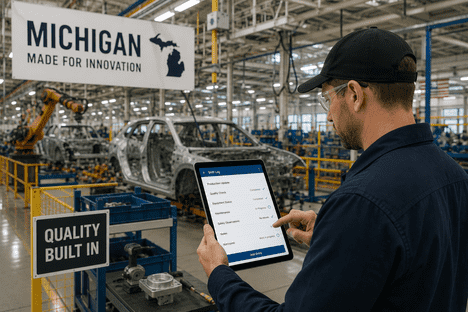
Every minute of unplanned downtime, every missed quality signal, every shift handover where critical context gets lost — these aren't just operational inconveniences. They are lean manufacturing failures in real time. And in most plants today, a paper logbook or a shared Excel sheet is the only system standing between a manageable incident and a $180,000 production loss.
LEAN MANUFACTURING INTELLIGENCE
Stop the 8 Wastes Before
They Stop Your Line
Digital shift logbooks connect your lean principles to real-time operational data — eliminating the information waste that traditional logbooks silently create every shift, every day.
Kaizen-Ready
5S Digital
OEE Tracking
SCADA Linked
WASTE ELIMINATION TRACKER
LIVE
✓
Overproduction Flagged
SKU-4420 · 340 excess units · Shift B · auto-logged
MUDA
!
Waiting: Conveyor C-2 Idle
18 min unplanned stop · WO #5102 created
MUDA
~
Motion: Rework Loop Detected
Line 3 · 4.2% defect rate · QC notified
MUDA
↓
Shift Handover Complete
31 entries reviewed · J. Patel e-signed · 0 missed items
OK
Lean Manufacturing's Invisible Enemy: Information Waste
The Toyota Production System identified seven classic wastes — overproduction, waiting, transportation, over-processing, inventory, motion, and defects. Modern lean frameworks add an eighth: unused talent, or the waste of human knowledge never captured. What lean literature rarely names explicitly is a ninth form of waste hiding in plain sight across every plant floor: information waste.
When an operator notices a subtle vibration anomaly, logs it in a paper notebook, and that note becomes unreadable by handover — that is information waste. When a shift supervisor emails a summary that misses three quality deviations from the overnight run — that is information waste. When root cause analysis takes four days because event history is scattered across three systems and two notebooks — the waste compounds into lost throughput, missed improvement cycles, and a lean program that runs on incomplete data.
A digital shift logbook doesn't just digitize paper. It eliminates the information waste that makes every other lean improvement harder to sustain.
40%
Events captured by paper logbooks
60% of your plant's story is never recorded
$50B
Annual loss from shift communication failures
Industry-wide, every year
25%
Downtime reduction with real-time logging
Measured across iFactory deployments
4 days → 1hr
Root cause analysis timeline
With full searchable event history
Lean teams running on paper or Excel are flying blind. Book a free visibility audit — see exactly what your current logbook is missing before your next shift change.
How the 8 Wastes Map to Your Logbook Gap
Every one of lean manufacturing's eight wastes has a digital logbook counterpart — a specific moment where better event capture either prevents the waste or accelerates its elimination. Here is how iFactory's real-time shift logbook addresses each one directly.
01
Overproduction
Production targets logged by shift, SKU, and line in real time. Supervisors see when output is outpacing demand before the inventory problem compounds — not at month-end review.
iFactory fix: Real-time OEE and production counters per shift
02
Waiting
Every idle event — conveyor stop, material delay, machine queue — is auto-captured with timestamp, asset ID, and duration. Waiting waste becomes measurable and pattern-able, not anecdotal.
iFactory fix: SCADA-linked idle event auto-logging with WO creation
03
Transportation
Operator movement logs, material transfer entries, and changeover records reveal unnecessary motion patterns that kaizen events can target — once you have the data to see them.
iFactory fix: Changeover and material movement event tagging
04
Over-Processing
Duplicate checklists, redundant inspections, and multi-system data entry all appear in logbook workflow analytics. If operators are re-entering data three times, that's visible and fixable.
iFactory fix: Workflow analytics and duplicate-entry detection
05
Inventory
Inventory anomalies, material shortages, and buffer stock events logged in context with production data give procurement and planning teams the signal they need before stockouts or overage.
iFactory fix: Inventory event tagging linked to production timeline
06
Motion
Rework loops, quality re-inspection paths, and repeated fault acknowledgments logged per operator and asset reveal where unnecessary physical motion is embedded in your standard work.
iFactory fix: Per-operator and per-asset motion event analytics
07
Defects
Quality deviations are logged the moment SPC alerts fire, with photo attachments, defect codes, and linked root cause fields. Defect rate per SKU, per shift, per operator — all in one searchable timeline.
iFactory fix: SPC-linked quality deviation logging with photos
08
Unused Knowledge
Every observation, every near-miss, every workaround your experienced operators know — captured, searchable, and preserved. Tribal knowledge becomes institutional intelligence that survives shift changes and retirements.
iFactory fix: Searchable event history, AI-summarized shift handovers
The Lean Logbook Maturity Model
Lean thinking demands that you measure where you are before you can improve. Most plants believe their event capture is far more complete than it actually is. This maturity model shows the real picture — and where the lean ROI unlocks.
L1
Paper / Verbal Handover
Whiteboard notes, verbal briefings, shift notebooks. Lean kaizen events run on memory and estimates. Data loss is invisible — nobody knows what they don't know.
Lean data completeness: ~15%
L2
Excel / Shared Drive Logs
Structured but fragmented. Events are logged after the fact, context is lost, and kaizen teams spend more time gathering data than analyzing it.
Lean data completeness: ~40%
L3
Standalone Digital Logbook
Better than paper. Operators enter structured records. But without SCADA or CMMS integration, a major portion of machine-level events are still missed or entered late.
Lean data completeness: ~65%
L4
Real-Time Connected Logbook — iFactory
Auto-logged from SCADA and CMMS, augmented by operators, AI-summarized at handover. Every waste event is captured, categorized, and traceable. Lean kaizen runs on complete, real data — not the 40% someone remembered to write down.
Lean data completeness: 100%
Unsure which maturity level your plant is at? Book a 20-minute logbook maturity assessment with our team — we benchmark your current event capture against lean best practice in under an hour.
Lean Workflows That Digital Shift Logging Enables
Real-time shift logbooks don't just record what happened. They change what happens next. These are the four lean workflows that transform the moment your plant moves to connected event tracking.
JIDOKA
Anomaly to alert: seconds, not hours
Detect Defects the Moment They Occur
Jidoka — building quality into the process — requires catching deviations at the source. SPC alerts, SCADA threshold crossings, and operator observations all hit the same live timeline instantly. The defect at 03:42 is logged and escalated at 03:42, not discovered at 07:00 shift change.
KAIZEN
RCA: days to under one hour
Run Kaizen on Real Data, Not Estimates
Kaizen events are only as good as the data they run on. With a searchable 48-hour event replay — alarms, changeovers, quality signals, operator notes — your improvement teams stop arguing about what happened and start agreeing on what to fix.
HEIJUNKA
Production leveling in real time
Level Production Loads Across Shifts
Heijunka — production leveling — requires knowing exactly what each shift produced, when, and why volumes deviated. Real-time OEE by shift, changeover duration logging, and downtime categorization give planners the granularity to balance load before the next cycle.
STANDARD WORK
96%+ checklist compliance
Enforce Standard Work Without Policing
Standard work only works when compliance is measurable. Digital checklists with mandatory fields, e-signatures, and completion timestamps turn standard work from a poster on the wall into a verifiable, auditable daily practice — without supervisors chasing operators for sign-offs.
SEE LEAN IN ACTION
Watch iFactory Eliminate Waste in a Live Plant Walkthrough
A 15-minute walkthrough on your own sample data. See real-time event capture, the lean dashboard, and the kaizen data trail — decide if it fits your operation before committing to anything.
What Lean Metrics Look Like Before and After
The difference between lean programs that plateau and lean programs that compound is measurement quality. Here is what plants actually measure after moving to real-time connected logbooks — metrics that simply didn't exist in paper or spreadsheet environments.
Scroll horizontally to view all metrics
Built for the Realities of a Lean Shop Floor
A digital logbook that operators don't use is worse than paper — it creates a false sense of coverage. iFactory is built for how 24/7 lean operations actually run, including the edge cases that cause most digital tools to fail.
?
Works Offline
Operators log events, complete checklists, and capture photos without Wi-Fi. Everything syncs automatically when connectivity returns — no lost entries, no gaps in the lean data trail.
?
Deep System Integration
Bi-directional sync with SAP, Oracle, SCADA, DCS, MES, and CMMS. Your lean data flows from machine to logbook to ERP without manual re-entry — eliminating over-processing waste in the logging workflow itself.
?
Mobile-First for Shop Floor
Log entries, attach photos, and e-sign handovers from a tablet, phone, or control room display. The interface matches where lean operators actually work — not where IT assumes they sit.
?
Multi-Site Lean Dashboard
Different shift patterns, different lean templates, one unified view. Regional lean managers compare waste events across plants without logging into each site separately — closing the gap between corporate lean KPIs and floor-level reality.
?
AI-Summarized Shift Handovers
At every shift change, iFactory generates an AI summary of critical events, open work orders, and unresolved quality issues. Incoming supervisors review complete context in two minutes — not two hours of catching up.
?
Audit-Ready by Default
Every entry is timestamped, attributed, e-signed, and immutable. FDA 21 CFR Part 11, GMP, OSHA PSM, and ALCOA+ compliant from day one — so your lean program never trades quality compliance for speed.
Ready to give your lean program the data it deserves? Book a demo with iFactory — most lean-focused plants go live in 2 to 4 weeks, with measurable waste reduction in the first shift cycle.
Frequently Asked Questions
How does a digital shift logbook specifically support lean manufacturing versus general operations software?
Lean manufacturing depends on identifying, measuring, and eliminating the eight wastes — but only if your data is complete. A digital shift logbook connected to SCADA, CMMS, and quality systems captures 100% of shop floor events in real time, giving kaizen teams and lean managers the accurate, timestamped data they need to run meaningful improvement cycles. General operations software tracks transactions; iFactory's logbook tracks the operational reality between transactions.
Can iFactory's logbook integrate with existing lean tools like MES or ERP systems?
Yes. iFactory supports bi-directional integration with SAP, Oracle, OSIsoft PI, standard SCADA and DCS systems, and all major CMMS platforms. Most integrations are completed within one to three weeks. The logbook goes live with manual entries immediately while system integrations are finalized, so lean data capture begins from day one.
How does real-time event logging accelerate kaizen and root cause analysis?
With iFactory, every event — SCADA alarms, quality deviations, operator observations, work order activity — is logged to a unified, searchable timeline. When a kaizen team investigates a failure, they can replay the full 48-hour event history for the affected asset and shift in one view. Root cause analysis that previously took four days of data gathering completes in under an hour — with evidence, not estimates.
What happens to the lean data if operators don't have Wi-Fi on the floor?
iFactory works fully offline. Operators log events, complete checklists, and capture photos without connectivity. All entries sync automatically when Wi-Fi or cellular returns, with built-in conflict resolution for simultaneous entries. No lean data is lost due to connectivity gaps — even in remote areas of the plant floor or in cold-storage environments.
How quickly can a plant see lean improvements after deploying iFactory?
Most facilities go live within two to four weeks. Lean teams typically see measurable improvements in the first full shift cycle — not because the software magically fixes processes, but because complete event data immediately surfaces the waste patterns that were previously invisible. Downtime categorization alone often reveals the top three recurring waste sources within the first week of deployment.
START YOUR LEAN DATA JOURNEY
Give Your Lean Program the Real-Time Data It's Been Missing
iFactory's connected shift logbook turns every operator observation, every sensor alarm, and every quality deviation into fuel for your lean improvement engine — automatically, in real time, across every shift.