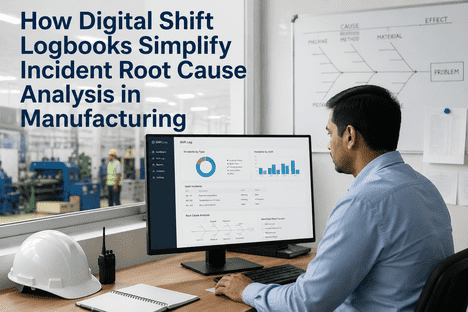
How Digital Shift Logbooks Simplify Incident Root Cause Analysis in Manufacturing

By Ethan Walker on June 3, 2026

how-digital-shift-logbooks-simplify-incident-root-cause-analysis-in-manufacturing

When an equipment failure, quality escape, or safety incident occurs on a manufacturing line, the first question is always the same: what happened in the shifts leading up to the event? Root cause analysis depends entirely on the quality of shift documentation — operator observations, equipment status at handover, alarm history, and corrective actions taken. Paper shift logbooks routinely fail this test with illegible handwriting, incomplete entries, missing pages, and no structured data to correlate across shifts or assets. iFactory's Digital Shift Logbook replaces paper binders with structured, timestamped, searchable shift records that capture every operator observation, equipment status change, handover note, and corrective action with immutable timestamps and operator ID — creating the data foundation for rapid, accurate root cause analysis. Book a Demo to see how iFactory's Digital Shift Logbook turns shift documentation from an RCA bottleneck into an RCA accelerator.

Root Cause Analysis · Manufacturing 2026
How Digital Shift Logbooks Simplify Incident Root Cause Analysis

Structured shift data for RCA · Timestamped operator observations · Cross-shift, cross-asset correlation · CAPA workflow integration · All flowing into iFactory Shift Logbook & CMMS.

Paper Logs
Illegible · incomplete · untraceable · hours to search
Shift Logbook
Structured · timestamped · searchable in seconds
RCA Impact
60% faster · accurate · actionable findings
Integration
CMMS · CAPA · ERP · audit trail

Why Paper Shift Logbooks Undermine Root Cause Analysis

Root cause analysis is fundamentally a data reconstruction exercise — the investigator must piece together the sequence of events, operator actions, equipment conditions, and process parameters that preceded an incident. Paper shift logbooks create four systemic barriers to this reconstruction. First, data completeness depends entirely on individual operator diligence: one operator writes detailed notes while another writes nothing, leaving critical gaps in the timeline. Second, illegible handwriting makes even recorded observations unusable, forcing investigators to track down the operator who wrote the entry — if that operator is still on-site and remembers the shift weeks later. Third, paper records lack any structured search: finding all entries related to a specific machine over a 30-day period requires flipping through every page of every binder. Fourth, paper logbooks can be altered after the fact with no forensic trace, creating compliance risk in regulated industries. These four barriers routinely extend RCA timelines from days to weeks and leave root causes unidentified — allowing the same failure pattern to recur.

PAPER LOGBOOK FAILURES IN RCA INVESTIGATIONS
1
Incomplete data — entries depend on operator diligence; critical observations are routinely missing from the timeline
2
Illegible records — handwriting cannot be read, observations are lost, and follow-up with absent operators is impossible
3
No searchability — finding all entries for a machine over 30 days requires hours of manual binder review
4
Alterable records — no forensic audit trail means paper logs can be changed without detection

Three Ways iFactory's Digital Shift Logbook Accelerates RCA

01
Structured Shift Data With Immutable Audit Trail
Every shift entry in iFactory's Digital Shift Logbook captures structured data fields — equipment ID, status category (running, idle, down, maintenance), observation type (vibration, noise, leak, temperature, safety), severity level, corrective action taken, and operator ID — all with an immutable timestamp. This structure transforms shift data from free-text noise into queryable, filterable, analyzable information. When an incident occurs, the RCA investigator filters by asset, date range, and observation type to retrieve every relevant shift entry in seconds — not hours. Every entry carries a complete audit trail showing who created it, when, from which device, and whether any edits were made. Edits are tracked as version history, preserving the original entry alongside the correction with rationale. This single capability eliminates the most common RCA frustration: discovering that the most critical shift entries are incomplete, illegible, or untraceable.
Structured fieldsImmutable audit trailSeconds retrieval
02
Cross-Shift & Cross-Asset Correlation
Manufacturing incidents rarely stem from a single shift's actions. A vibration noted on the night shift, a temperature spike on the day shift, and a skipped PM on the previous weekend — the pattern emerges only when data from multiple shifts and multiple assets is correlated. Paper logbooks make this correlation practically impossible because each shift's binder is physically separate and each operator's notes follow a different format. iFactory's Digital Shift Logbook stores all shift data in a unified database indexed by asset, shift, operator, observation type, and timestamp. The RCA investigator runs a single query — "show all entries for conveyor line 3 across all shifts for the 14 days before the bearing failure" — and the platform returns a correlated timeline with every relevant operator observation, equipment status change, work order, and corrective action. This cross-shift, cross-asset view reveals failure patterns that paper logbooks conceal.
Unified databaseCross-shift queriesPattern visibility
03
Direct CAPA & Work Order Integration
Root cause analysis is only valuable when its findings lead to corrective action. With paper logbooks, the RCA report is written, filed, and often forgotten — because there is no systematic link between the finding and the execution of corrective actions. iFactory's Shift Logbook integrates directly with the platform's CAPA module and connected CMMS. When an RCA identifies a root cause, the investigator creates a corrective action directly in the platform: modify the preventive maintenance schedule, update the operator training checklist, replace the bearing type, or adjust the lubrication interval. The CAPA is assigned, tracked, and verified for effectiveness. If the same failure mode recurs, the Shift Logbook entries that document the recurrence are linked to the original CAPA, creating a continuous improvement loop rather than a one-time RCA report. Book a Demo to see how iFactory connects shift log entries to CAPA workflows.
CAPA linked to shift dataAuto work ordersContinuous improvement loop

Paper vs Digital Shift Logbook for Root Cause Analysis

RCA Requirement
Paper Logbook
iFactory Digital Shift Logbook
RCA Impact
Data completeness
Inconsistent — operator-dependent
Mandatory fields per structured form
Every shift contributes analyzable data
Record legibility
Illegible handwriting common
Digital text, photo, voice capture
All observations readable and usable
Search speed
Hours — manual binder review
Seconds — keyword, asset, date filter
RCA investigation time reduced by 60%+
Cross-shift correlation
Physically separate binders
Unified database, single query
Failure patterns visible across shifts
Data integrity
Alterable, no audit trail
Immutable, versioned, timestamped
Defensible records for RCA findings
CAPA linkage
Manual, easily lost
Direct link from shift entry to CAPA
Findings converted to verified actions
Photo & evidence capture
Not available
Photo, video, document attached to entry
Visual evidence preserved with shift record

Root Cause Analysis Use Cases With Digital Shift Logbooks

Equipment
Bearing Failure Root Cause Investigation With Shift Data Timeline
As needed

A critical conveyor bearing seized on a food processing line, causing 4 hours of unplanned downtime and $80,000 in lost production. The maintenance supervisor needed to determine whether the failure was caused by missed lubrication, abnormal loading, or a defective bearing — each requiring a different corrective action. With paper logbooks, the investigation took three days of binder searches, operator interviews, and guesswork. With iFactory's Digital Shift Logbook, the supervisor filtered by asset ID over the preceding 30 days and retrieved every shift entry in under 30 seconds. The timeline revealed that operators on the night shift had noted increasing vibration for five consecutive shifts before the failure, but the entries were buried in illegible paper notes in a binder on the other side of the plant. The digital logbook's structured fields captured vibration severity levels, and the trend was clearly visible. The root cause was identified as lubrication interval drift and the CAPA assigned to adjust the PM schedule — all within a single shift.

RCA Time3 days → 1 shift
Evidence5-shift vibration trend visible
Talk to an Expert
Quality
Quality Escape Investigation With Cross-Shift Operator Correlations
As needed

A batch of packaged product was returned by a customer for contamination. The quality manager needed to trace the contamination source across three shifts over a 48-hour production window. With paper logbooks, each shift's binder contained different levels of detail — the day shift operator had documented a CIP cycle, the night shift had no entries for the relevant equipment, and the swing shift binder was missing entirely. The investigation took six days and could not definitively identify the root cause. With iFactory's Digital Shift Logbook, every shift's entries for the production line were structured with mandatory fields for CIP execution, line status changes, and operator observations. The quality manager ran a 48-hour query and immediately saw that the CIP cycle on shift A had not reached the correct temperature — the operator had noted it in the observation field but the system had automatically flagged it as incomplete because the temperature did not meet the configured threshold. The CAPA was assigned to recalibrate the CIP temperature sensor and add operator training — all within two hours of starting the investigation.

Investigation6 days → 2 hours
CAPA CreatedSensor recalibration + training
Talk to an Expert
Safety
Safety Incident Reconstruction With Immutable Shift Records
As needed

An operator reported a near-miss involving a conveyor guard that had been removed and not replaced. The safety manager needed to determine when the guard was removed, by whom, and whether any previous shifts had noted the missing guard. Paper logbooks showed no entries about the guard for the preceding week — either no one had noticed, or the entries were made but illegible. iFactory's Digital Shift Logbook revealed that three previous shifts had noted the missing guard in their observation fields, but the entries were buried in unstructured paper notes that the safety manager could not retrieve during the initial investigation. The digital logbook's mandatory guard-status field requires each shift to confirm guard position at handover. The shift that first noted the missing guard was identified, the corrective action (replace guard and investigate removal cause) was assigned via the CAPA module, and a mandatory guard-check field was added to future handover forms — all within 90 minutes. The immutable audit trail provided defensible documentation for the safety investigation file.

Evidence Found3 prior shift entries on missing guard
Resolution90-minute investigation + CAPA
Talk to an Expert

What iFactory Delivers for Root Cause Analysis

60%+
Faster RCA investigation time with searchable digital records
Seconds retrieval vs hours of binder searches
100%
Searchable, immutable shift records for every investigation
Structured fields, photo, voice, video evidence
More usable data per shift vs unstructured paper notes
Mandatory fields, severity levels, observation categories
100%
CAPA linkage from shift observations to verified corrective actions
Direct integration with CAPA module and CMMS

FAQ: Digital Shift Logbooks for Root Cause Analysis

iFactory replaces free-text paper entries with structured digital forms that guide operators through mandatory fields — equipment ID, status category, observation type, severity level, and corrective action taken. This structure ensures every shift entry captures the data points that RCA investigators need, without relying on individual operator writing habits. Optional photo, voice, and video capture let operators document visual evidence that paper logbooks cannot accommodate. The result is consistently structured, analyzable shift data across every shift and every operator — eliminating the information gaps that paper logbooks create.
Yes. iFactory's Shift Logbook integrates directly with the platform's built-in CAPA module and with external QMS, CMMS, and ERP systems via REST API, flat file, or database connector. When an RCA investigation identifies a root cause, the investigator creates a CAPA record directly in the platform or sends it to the corporate QMS. The CAPA is tracked through investigation, action assignment, implementation, and effectiveness verification. Shift log entries that document the same failure mode are linked to the CAPA, creating a traceable chain from operator observation through root cause to verified corrective action.
iFactory's Digital Shift Logbook captures every entry with an immutable audit trail — who created the entry, when, from which device, and whether any edits were made after submission. Edits are tracked as version history, preserving the original entry alongside the correction with a required rationale field for why the edit was made. No entry can be permanently deleted; deletion actions are logged as administrative actions in the audit trail. This meets FDA 21 CFR Part 11 requirements for closed systems and provides defensible documentation for regulatory investigations, insurance claims, and legal proceedings.
iFactory's Digital Shift Logbook deploys in 1–2 weeks with pre-configured shift log templates for manufacturing, food & beverage, mining, and other industrial sectors. Operator training takes under 30 minutes per shift team, and most plants achieve full adoption within 30 days. The platform can be piloted on a single shift or production line while the rest of the plant continues with paper logs. The deployment team configures your specific shift structure, equipment hierarchy, mandatory observation fields, and handover form templates during the implementation phase. Historical paper logbooks can be scanned and attached as PDF documents to the digital archive.
Deploy iFactory for Root Cause Analysis

Digital Shift Logbook with structured shift data, immutable audit trail, cross-shift and cross-asset correlation, and direct CAPA integration — transforming shift documentation from an RCA bottleneck into an RCA accelerator. 1–2 week deployment, under 30-minute operator training.
Structured Shift Data Immutable Audit Trail Cross-Shift Correlation CAPA Integration 60% Faster RCA

Share This Story, Choose Your Platform!