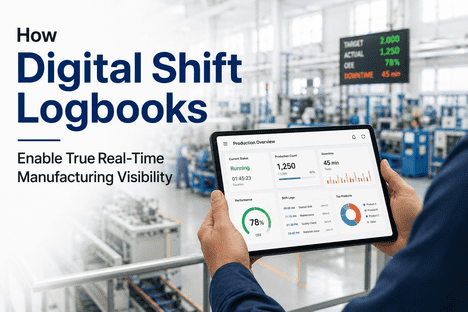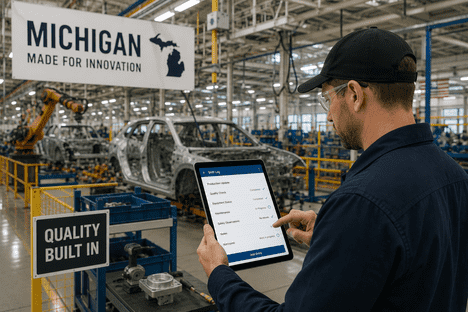
Michigan is the undisputed center of the U.S. automotive industry — home to the Big Three OEM headquarters, the largest concentration of vehicle assembly plants, more than 75% of the nation's automotive R&D investment, an annual industry payroll exceeding $83 billion, and roughly 20% of all U.S. vehicle production. Michigan auto plants run on extraordinary scale: assembly lines moving 60 to 80 vehicles per hour, 24/7 operations across three shifts, thousands of suppliers feeding just-in-time deliveries, and IATF 16949 quality systems where a single missed defect can cascade into a multi-million-dollar field recall. In that environment, paper logbooks and verbal shift briefings are not just outdated — they are an operational liability. Plants that Book a Demo with iFactory consistently uncover two to three multi-million-dollar improvement opportunities in shift handover, quality holds, and changeover discipline that paper-based logs had been hiding for years.
Modernize Shift Handovers Across Every Michigan Auto Plant — In 4 Weeks
iFactory's digital shift logbook captures every event, quality hold, and equipment fault automatically — feeding AI-generated handover summaries, CMMS work orders, and IATF 16949 audit trails across stamping, body, paint, and final assembly.
Why Shift Handover Is the Highest-Leverage Process in a Michigan Auto Plant
Shift handover consumes less than 5 percent of a Michigan auto plant's operating time — and is implicated in roughly 40 percent of plant incidents. On an assembly line running 60 vehicles per hour, every minute of shift handover delay represents a vehicle that doesn't ship, a quality hold that didn't transfer, or an equipment fault that becomes a breakdown the next shift discovers the hard way. Verbal briefings lose 40 to 60 percent of actionable detail. Paper logbooks remain illegible and unsearchable. In a Big Three or Tier 1 environment where IATF 16949 demands traceable, attributed quality records, those gaps translate into PPAP exposure, customer chargebacks, and the kind of FMEA failures that auditors flag for months. iFactory's digital shift logbook typically reveals that measured downtime rises 30 to 50 percent in the first week of deployment — not because performance got worse, but because the true picture is finally being captured.
Verbal Handover Loss
40 to 60 percent of actionable detail lost between outgoing and incoming crews. Quality holds, equipment quirks, and pending containment actions get rediscovered every shift rather than carried forward.
IATF 16949 Exposure
Paper logs fail traceability and attribution standards. Quality incidents trigger customer corrective action requests, supplier scorecards drop, and PPAP renewals become a documentation scramble.
JIT Supply Chain Cascades
A two-hour line stop in stamping cascades to body, paint, and final assembly — and to every Tier 1 and Tier 2 supplier feeding the plant. Slow shift information transfer compounds that cascade exponentially.
Aging Workforce Knowledge Loss
More than 55 percent of Michigan automotive workers are over 45. As experienced operators retire, tribal knowledge walks out with them — unless it's been captured in a searchable digital record.
How a Digital Shift Logbook Changes the Math Across Michigan Plants
A digital shift logbook is not a paperless form. It is a structured, integrated, AI-augmented platform that converts every shift transition into traceable, auditable, searchable intelligence. For Michigan auto plants, the impact lands in four specific areas where Big Three, Tier 1, and Tier 2 operations measure success: throughput per shift, quality escapes, audit readiness, and operator ramp time. The flow below mirrors how iFactory's logbook moves operational data from raw event to closed-loop action.
Capture
Every event, quality hold, fault, and changeover step logged on tablets via IATF-aligned templates — offline-capable across the plant floor.
Classify
NLP parses each entry — extracts asset IDs, classifies severity, links to active CMMS alerts and MES production data.
Summarize
Incoming crew receives an AI-generated handover brief in under 3 minutes — top priorities, open quality holds, and pending containment actions ranked.
Act
Auto-generated CMMS work orders, mandatory e-signed handover acknowledgment, and IATF 16949 audit trail ready for OEM customer reviews.
Six Capabilities Michigan Auto Plants Get Out of the Box
iFactory's digital shift logbook is configured for the realities of Michigan automotive operations — high-speed assembly, complex multi-trim mix, IATF 16949 quality discipline, and the constant Tier 1 and Tier 2 supplier coordination that defines the state's automotive ecosystem. The six capabilities below are activated during onboarding and ready to use from day one.
Automotive-Specific Shift Templates
Pre-built templates for stamping, body-in-white, paint, trim, and final assembly. Mandatory fields capture station status, line speed, quality holds, andon events, downtime codes, and scrap reasons. No-code template editing lets your IE and operations teams tune templates without IT involvement.
AI-Generated Handover Summaries
NLP analyzes every entry as it is written — extracting asset IDs, classifying severity, and validating completeness. Incoming crew receives a prioritized brief surfacing the top 3 to 5 critical items in under 3 minutes. Briefings that used to take 30 to 45 minutes verbally now complete with no detail loss.
IATF 16949 Audit-Ready Records
Every entry timestamped, attributed to a named user, e-signed, and immutable. Evidence packages generate on demand for customer audits, PPAP submissions, FMEA reviews, and IATF surveillance audits — replacing days of paper retrieval with seconds of filtered output.
CMMS, MES & Andon Integration
Bi-directional sync with Maximo, SAP PM, Plex, GM Global MES, FCA WCM systems, OSIsoft PI, and standard andon platforms. Logbook entries flagged as equipment faults auto-generate CMMS work orders. Andon events and OEE flow into shift context for real-time visibility.
Quality Hold & Containment Tracking
Every quality hold logged with VIN range, defect type, containment scope, and disposition status. Open holds carry across shifts with mandatory acknowledgment. Containment timelines align with customer notification requirements and supplier corrective action workflows.
Multi-Site Dashboard Across Michigan
Operators running plants across Detroit, Warren, Sterling Heights, Dearborn, Flint, Lansing, and Macomb County get one corporate dashboard with cross-plant shift KPIs. Each site keeps its own templates while feeding consistent metrics to plant managers and corporate operations leaders.
Michigan Automotive Sectors iFactory Already Supports
Michigan automotive operations are not monolithic. From Big Three final assembly in Detroit, Warren, and Sterling Heights to powertrain and EV battery plants in Lansing and Marshall, Tier 1 supplier facilities clustered through Macomb and Oakland counties, and the mechanical and industrial engineering R&D concentration that gives Michigan four times the national average of mechanical engineers — each segment has distinct shift handover priorities. iFactory's pre-built templates cover every major automotive operation type.
| Automotive Segment | Where It Operates in Michigan | Shift Logbook Priorities | Compliance Layer |
|---|---|---|---|
| OEM Final Assembly | Detroit, Warren, Sterling Heights, Flat Rock | Line balance, andon, JPH attainment, quality holds, andon events | IATF 16949 · OEM CSR · OSHA |
| Stamping & Body | Sterling Heights, Warren, Pontiac, Dearborn | Die changes, scrap reasons, press downtime codes, dimensional QC | IATF 16949 · ISO 9001 |
| Paint & Coatings | Detroit, Flint, Lansing, Wayne | Color changes, booth permits, VOC monitoring, defect logs | IATF 16949 · EPA · EGLE |
| Powertrain & Engine | Romulus, Dundee, Trenton, Saline | Machining tolerances, tool changes, leak tests, dyno results | IATF 16949 · ISO 14001 |
| EV Battery & Cell | Marshall, Lansing, Hazel Park, Holland | Cell formation, electrolyte handling, dry-room logs, safety permits | IATF 16949 · OSHA · NFPA |
| Tier 1 & Tier 2 Suppliers | Macomb County, Oakland County, Auburn Hills | PPAP runs, deviation tracking, customer corrective actions, scrap | IATF 16949 · Customer CSRs |
From Stamping to Final Assembly. Across Every Michigan Plant. One Platform.
iFactory replaces paper handovers with structured digital logging, AI-generated summaries, CMMS-linked work orders, and IATF 16949-aligned audit trails — deployed in 2 to 4 weeks across single sites or multi-plant networks.
Paper Handover vs Digital Logbook: What Actually Changes on the Floor
The difference between paper logbooks and iFactory's digital shift logbook is not an upgrade — it is a structural change in how operational information flows through your Michigan plant. Each row below reflects measurable performance differences automotive operators report after deployment, validated across stamping, body, paint, trim, and final assembly environments.
| Operational Area | Paper / Verbal Handover | iFactory Digital Logbook | Typical Impact |
|---|---|---|---|
| Handover Briefing | 30 to 45 minutes verbal walk-through | Under 3 minutes via AI-generated summary | 76% time reduction |
| Information Accuracy | 40 to 60% of detail lost between shifts | Structured entry plus AI extraction | 99.2% accuracy |
| IATF Audit Prep | Days of paper retrieval, scanning, indexing | Evidence package generated on demand | 95% prep reduction |
| Equipment Fault Response | Verbal mention, often missed by maintenance | Auto-creates CMMS work order with attribution | 40% MTTR reduction |
| Quality Hold Tracking | Whiteboard or shift log; lost between crews | Persistent hold with VIN range and disposition | Zero hold escapes |
| Operator Onboarding | Shadow shifts + tribal knowledge transfer | Searchable logbook history plus templates | 50% ramp reduction |
A 12-Month Roadmap for Michigan Auto Plant Shift Modernization
A credible automotive shift modernization program follows a clear, sequenced roadmap. Plants that attempt advanced analytics before establishing reliable digital handover data invariably stall; plants that build the data foundation first compound gains across every subsequent improvement initiative. The framework below mirrors the path Michigan auto plants follow when they Book a Demo with iFactory and move into rollout.
Truthful Baseline
Deploy digital logbook across one pilot area — typically final assembly or paint. Establish true handover time, quality hold visibility, and shift-to-shift information accuracy baseline.
AI Activation
Activate AI handover summaries, severity classification, and CMMS integration. First measurable handover time reduction and duplicate troubleshooting elimination observed.
Plant-Wide Rollout
Expand from pilot to stamping, body, paint, trim, and final assembly. IATF 16949 audit dashboards activated. Cross-shift pattern detection surfaces recurring quality and equipment issues.
Multi-Site Scale
Roll proven approaches across Michigan plant network — Detroit, Warren, Sterling Heights, Flint, Lansing, Macomb. Corporate dashboard provides cross-plant KPI visibility for operations leadership.
Michigan Automotive Shift Logbooks: Frequently Asked Questions
How quickly can iFactory deploy across a Michigan auto plant?
Most Michigan automotive plants go live in 2 to 4 weeks for a pilot area, with full plant rollout typically completed in 3 months. Cloud-based deployment requires no infrastructure changes — just tablets per shift station and integration to existing CMMS, MES, andon, and SCADA systems. Multi-plant rollouts across the Michigan network typically complete in 6 to 12 months.
Is the platform IATF 16949 and OEM customer-specific requirement ready?
Yes. Every entry is timestamped, attributed to a named user, immutable, and e-signed. The platform supports IATF 16949 audit evidence requirements, PPAP documentation, FMEA traceability, customer corrective action workflows, and OEM-specific CSRs from GM, Ford, and Stellantis. Evidence packages for any customer audit generate on demand.
Does it integrate with OEM MES, andon, and CMMS systems?
Yes. iFactory provides bi-directional integration with Maximo, SAP PM, Plex, OSIsoft PI, GM Global MES environments, FCA WCM systems, standard andon platforms, and major SCADA stacks. Logbook entries flagged as equipment faults auto-generate CMMS work orders. Andon events and OEE data flow into shift context for real-time visibility.
Can one platform handle Tier 1 plants serving multiple OEMs with different requirements?
Yes. Multi-customer Tier 1 suppliers can configure customer-specific templates, audit views, and reporting hierarchies on a single platform. A facility serving GM, Ford, and Stellantis can run distinct customer workflows side-by-side while feeding unified metrics to operations leadership.
How does the platform support the aging workforce knowledge transfer problem?
With more than 55 percent of Michigan automotive workers over 45, knowledge retention is a structural risk. iFactory's searchable logbook becomes the institutional memory new operators train against — every event, fault, and resolution from prior shifts becomes available via search. Plants report new operators reaching full productivity 40 to 50 percent faster after deployment.
Ready to Modernize Shift Handovers Across Every Michigan Auto Plant?
iFactory's digital shift logbook turns every shift transition into structured intelligence — across stamping, body, paint, trim, final assembly, powertrain, and EV battery operations. Deployed in 2 to 4 weeks, scaled across your Michigan network.