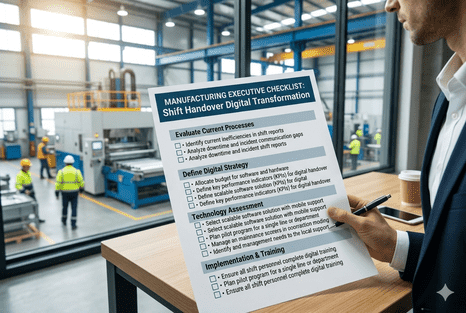
At 6:00 AM, the night shift supervisor at a spinning mill hands over to the day team. The verbal briefing takes eight minutes. Three issues are mentioned. Two are not — because the operator who noticed them left early, and no one wrote them down. By 9:00 AM, Ring Frame 12 has been running with a tension fault for three hours. With a structured digital handover system, every issue is captured, ranked, and pushed to the incoming supervisor before the shift even starts.
SHIFT HANDOVER · BEST PRACTICES GUIDE FOR 24/7 OPERATIONS
The Shift Handover Guide for Plants That Never Stop
In 24/7 textile and process manufacturing, the handover is the highest-risk moment of every day. This guide covers exactly what best-in-class shift handover looks like — and how digital tools eliminate the gap between what happened and what gets communicated.
62%
of shift issues lost at paper handovers
3×
shifts daily in most textile plants
-77%
handover time with digital logs
<3%
issues missed after digital handover
Why Shift Handover Is the Most Dangerous Moment in 24/7 Operations
Most quality failures, unplanned breakdowns, and safety incidents in continuous manufacturing plants do not originate during a single shift. They originate in the gap between shifts — in the information that should have transferred but did not. An operator notices a bearing running hot at 4 AM. The night supervisor writes it in the logbook. The day supervisor misses it in a rushed handover. By noon, the bearing has seized and a loom is down for four hours.
In textile manufacturing, where a production run moves through spinning, warping, weaving, dyeing, and finishing across multiple shifts and departments, this information gap compounds with every handover. A pH drift missed at the dyeing stage handover becomes a batch rejection at inspection. A yarn count deviation logged but not communicated becomes 600 metres of off-spec fabric.
Best-practice shift handover is not about doing the same verbal briefing more carefully. It is about restructuring the entire process so critical information cannot fall through the cracks — regardless of who is on shift, how rushed the changeover is, or how much happened in the previous eight hours.
?
The handover problem in numbers: In a plant running three shifts, 365 days a year, there are 1,095 shift handovers annually. If just 10% of those handovers miss one critical issue, that is 109 incidents per year that start the next shift already behind.
Book a demo to see how iFactory eliminates the handover gap in your plant.
The 6 Elements of a Best-Practice Shift Handover
A structured shift handover is not a longer verbal briefing. It is a system — with defined inputs, a defined format, a defined transfer moment, and a defined acknowledgement. These six elements separate high-performing 24/7 plants from reactive ones.
01
Complete and Continuous Event Logging During the Shift
The handover is only as good as the records behind it. Best-practice plants log events continuously throughout the shift — not in a rush at the end. Every machine fault, quality observation, safety near-miss, and process parameter deviation is recorded at the moment it occurs, with timestamp and asset link. This means the outgoing supervisor never has to reconstruct the shift from memory at 5:55 AM.
Real-time logging
Timestamped entries
Asset-linked records
02
Structured Handover Summary — Not a Free-Text Narrative
Verbal briefings and free-text summaries are the weakest form of handover. Best practice uses a structured format — machine status, open issues, pending actions, quality flags, safety items — that the incoming supervisor can scan in under five minutes and confirm receipt. In digital systems, this summary is auto-generated from the shift's logged events, ranked by priority, and pushed to the incoming supervisor's device before the shift starts.
Structured format
Priority ranking
Auto-generated brief
03
Formal Acknowledgement by the Incoming Supervisor
A handover is not complete until someone has confirmed they received and understood it. Best-practice plants require the incoming supervisor to formally acknowledge the handover summary — creating an accountable record of who took ownership of which open issues at what time. On paper, this is a signature. In digital systems, it is a timestamped one-tap acknowledgement that becomes part of the audit trail.
Formal acknowledgement
Ownership transfer
Audit record
04
Open Issue Tracking Across Shift Boundaries
Issues that are not resolved during a shift do not disappear — they carry forward. Best-practice handover systems maintain a live open-issue register that persists across shift boundaries. The incoming supervisor sees not just what happened in the last shift, but the full context of every unresolved issue — when it was first logged, what actions have been taken, and what is still pending. Paper logbooks cannot do this; every shift starts from a blank page.
Persistent issue log
Cross-shift visibility
Action tracking
05
Machine and Asset State at Handover
The incoming supervisor needs to know not just what events occurred, but the current state of every critical asset. Which looms are running? Which are stopped for maintenance? Which had an alarm in the last two hours? Best-practice handover includes an asset status summary — running, stopped, degraded, under maintenance — so the incoming team can start their shift with a clear picture of what they are inheriting, not discover it machine by machine.
Asset status board
Machine state log
Maintenance flags
06
Production and Quality Context for the Incoming Shift
The incoming shift needs to know where production stands — output against target, batches in progress, quality flags on current lots, and any special instructions for the next production run. Best-practice handover delivers this production context alongside the event log, so the incoming supervisor starts their shift oriented to both the operational state and the production plan — not just the problems.
Production count
Batch status
Quality flags
Want to see all six of these working in a live system? Book a 15-minute demo and we'll walk through a complete shift handover cycle on your asset types — looms, spinning frames, dyeing lines, or any process equipment.
The Textile-Specific Handover Challenge
Generic shift handover best practices apply to any 24/7 operation. But textile manufacturing has specific characteristics that make handover more complex — and more consequential — than most other industries.
⚠
Multi-Stage, Multi-Department Handovers
A single production run passes through 6–8 departments. Each stage handover is independent — but a missed observation at spinning becomes a defect at weaving becomes a rejection at inspection. No single supervisor sees the full chain without a connected system.
⚠
High Machine Count Per Supervisor
A single weaving supervisor may oversee 80–200 looms across a shift. Tracking the state of every machine at handover is impossible without a structured system — verbal briefings cover the top 3 problems and miss everything else.
⚠
Process Parameter Continuity
Dyeing recipes, sizing formulas, warp tension settings, and humidity parameters must be maintained precisely across shift changes. A missed handover note about a process adjustment means the incoming operator starts a batch on the wrong parameters.
⚠
Batch Traceability Requirements
Buyer audits and certifications (ISO, GOTS, OEKO-TEX) require a complete, timestamped record of what happened to every batch across every shift. Paper handover notes are not audit-ready — they are lost, incomplete, or illegible by the time an audit arrives.
BUILT FOR TEXTILE PLANTS
See iFactory Handle a Textile Shift Handover Live
From operator entry on the loom floor to AI-generated supervisor briefing — watch a complete multi-department handover cycle in 15 minutes using real textile plant scenarios.
Paper vs. Digital Handover: What Actually Happens
The difference between paper and digital shift handover is not just efficiency — it is structural. Paper-based handover has inherent failure modes that cannot be solved by asking people to be more diligent. Digital handover eliminates those failure modes by design.
PAPER HANDOVER — WHAT ACTUALLY HAPPENS
Outgoing supervisor writes up the shift from memory at the end — missing events that felt minor at the time
Incoming supervisor reads through handwritten notes during the briefing, often in poor lighting, under time pressure
No timestamp on observations — "sometime last night" is the context for a critical alarm
Issues from two shifts ago are buried in a logbook no one has time to search
No formal acknowledgement — "I told you" is the only evidence of transfer
Machine status at handover is word-of-mouth — the incoming supervisor discovers the reality by walking the floor
Audit trail is a stack of illegible logbooks that takes days to compile before an inspection
DIGITAL HANDOVER — WHAT CHANGES
Events logged continuously throughout the shift — AI compiles the handover summary automatically at shift end
Incoming supervisor receives a ranked, structured brief on their device before the shift starts
Every entry timestamped and linked to the specific asset — full context in seconds
Open issues persist across shift boundaries — the incoming team sees the full history, not just the last 8 hours
One-tap acknowledgement creates an accountable, timestamped handover record
Live asset status board shows machine state at handover — no surprises on the floor
Immutable audit trail — searchable in seconds, formatted for ISO, GOTS, and buyer audits
Shift Handover Checklist for 24/7 Textile Plants
Use this checklist to assess your current handover process and identify where the gaps are. Best-practice plants tick every item on this list — not just at the supervisor level but as a system-enforced standard across all departments and all shifts.
BEFORE SHIFT END — OUTGOING SUPERVISOR
MUST
All shift events logged with timestamp, asset reference, and severity — not reconstructed from memory
MUST
Open issues from previous shifts reviewed — actions taken during this shift documented
MUST
Machine status confirmed for all critical assets — running, stopped, degraded, or under maintenance
MUST
Process parameters for active batches documented — dyeing recipe, tension settings, humidity levels
BEST
Handover summary reviewed and priority-ranked before the incoming supervisor arrives
BEST
Maintenance team notified of pending observations that require action in the next shift
AT SHIFT CHANGEOVER — BOTH SUPERVISORS
MUST
Incoming supervisor reads the full handover summary — not just the verbal highlights
MUST
Critical open issues verbally confirmed with the outgoing supervisor before they leave
MUST
Incoming supervisor formally acknowledges receipt of handover — timestamped record created
BEST
Joint floor walk for any degraded or recently alarmed machines before outgoing supervisor leaves
FIRST 30 MINUTES — INCOMING SUPERVISOR
MUST
Open issues from handover summary assigned to specific team members with action and timeline
MUST
Maintenance team briefed on any pending observations that require action
MUST
Production targets for the shift confirmed against current batch status
BEST
Quality team notified of any quality flags from the outgoing shift affecting current production
BEST
Escalation threshold reviewed — any issue approaching critical level flagged for early watch
How many of these checklist items does your current handover process cover? Book a demo and we'll map your current handover process against best practice — and show you exactly where iFactory closes the gaps.
How iFactory Structures the Handover Process: Step by Step
iFactory does not just digitise your existing handover process — it restructures it into a five-stage system that ensures nothing falls through the gap between shifts.
STAGE 1
Continuous Event Capture During the Shift
Operators log events on mobile or tablet as they occur — machine faults, quality observations, safety near-misses, process deviations. Guided forms ensure every entry includes the asset reference, event type, severity, and a photo or voice note if needed. No end-of-shift reconstruction. No missed events because the operator forgot to write it up.
STAGE 2
Real-Time Asset Status Tracking
Every logged event updates the live asset status board automatically. The outgoing supervisor can see the current state of every machine in their section — which are running, which are stopped, which had alarms in the last two hours — without walking the floor. The incoming supervisor sees the same board before their shift starts.
STAGE 3
AI-Generated Handover Summary
At shift end, iFactory's AI automatically compiles a structured handover brief from all logged events. Open issues are ranked by priority — critical faults first, then quality flags, then pending observations. The outgoing supervisor reviews and confirms the summary in under two minutes. No writing, no reconstruction, no risk of forgetting the 2 AM alarm that felt minor at the time.
STAGE 4
Push Notification to Incoming Supervisor
The handover brief is automatically pushed to the incoming supervisor's device before the shift starts — while they are still on their way to the plant, or reviewing in the locker room. They arrive on the floor already briefed, not walking in blind. Critical items that require immediate attention are flagged with priority alerts.
STAGE 5
Formal Acknowledgement and Ownership Transfer
The incoming supervisor acknowledges the handover with one tap — creating a timestamped, immutable record of who took ownership of which open issues at what time. This acknowledgement becomes part of the audit trail. Open issues carry forward to the new shift's active issue register automatically — nothing is considered resolved until it is explicitly closed.
Shift Handover Metrics: What Good Looks Like
Best-practice handover is not just a qualitative standard — it produces measurable outcomes. These are the benchmarks that high-performing textile plants achieve with structured digital handover, and the results iFactory customers report within 90 days of go-live.
Issues Missed at Handover
-95%
Mean Time to Escalate Critical Issues
-99%
Audit Preparation Time
-94%
Overall Equipment Effectiveness (OEE)
+19%
Want to see what these numbers look like in your plant? Book a demo — bring your current handover time and defect rate and we'll model the improvement potential for your operation.
Common Shift Handover Mistakes in 24/7 Plants
Most shift handover problems in textile plants are not caused by careless people — they are caused by systems that make it structurally impossible to hand over information reliably. These are the most common mistakes, and why they happen.
1
Logging at Shift End Instead of in Real Time
When operators write up the shift in the last 15 minutes before handover, they are reconstructing from memory. Minor events from the first half of the shift are forgotten. The timing of alarms is approximate. The context — what was happening on the machine just before the fault — is lost. Real-time logging is the only way to capture events accurately.
2
Verbal-Only Handover Without a Written Record
Verbal briefings are fast and feel complete in the moment. But they have no audit trail, no way to verify what was communicated, and no persistence — if the incoming supervisor forgets a detail ten minutes into the shift, it is gone. Verbal handover should supplement a written record, not replace it.
3
No Cross-Shift Issue Tracking
Paper logbooks are organised by shift, not by issue. An intermittent fault on Ring Frame 7 that was noted by three different shifts appears as three separate isolated observations — no one sees it as a pattern. Digital systems that track issues across shift boundaries make cross-shift patterns visible automatically.
4
Inconsistent Handover Standards Across Departments
The weaving department does a thorough written handover. The dyeing department does a quick verbal briefing. The spinning department uses a different logbook format. Inconsistency means that the quality of information transfer depends on which department you are in — and buyers and auditors see the weakest link.
5
No Formal Acknowledgement of Handover Receipt
Without formal acknowledgement, there is no clear moment when accountability transfers from one supervisor to the next. When an issue escalates, the question "who knew what and when?" has no answer. Formal, timestamped acknowledgement creates a clear chain of custody for every open issue.
How It Integrates With Your Existing Plant Systems
A digital shift handover system delivers its full value when it connects to the rest of your plant stack — not as a standalone app, but as the communication layer between your operators, maintenance team, and management systems.
Frequently Asked Questions
How long does it take to implement a digital shift handover system in a textile plant?
Most textile plants complete pilot go-live in 2 weeks and full plant deployment in 4 weeks. The implementation starts with importing your asset registry from your existing CMMS or spreadsheet, then building handover templates for your specific machine types — looms, spinning frames, dyeing lines. Operators typically need 30 minutes of training before logging independently. Multi-site rollouts across multiple plants take 6–8 weeks.
Can operators use this if they have limited English or digital experience?
Yes. iFactory's mobile interface is designed for shop floor operators — large touch targets, guided dropdowns, voice-to-text for descriptions, and one-tap photo capture. Multi-language support is available for Hindi, Tamil, Telugu, Gujarati, and other regional languages used in Indian textile plants. Most operators are comfortable logging independently within one shift of training.
What happens to the handover if there is no internet connectivity on the shop floor?
iFactory supports full offline logging. Operators can capture events in areas with no connectivity — all data syncs automatically when the device reconnects. Handover summaries are pushed as soon as the outgoing supervisor's device comes back online. Critical alerts are queued and sent the moment network is restored. Connectivity gaps do not interrupt the shift record.
How does the system handle a 3-shift plant where supervisors change at 6 AM, 2 PM, and 10 PM?
iFactory is configured for your specific shift schedule — shift start and end times, overlap periods, and supervisor roles. Handover summaries are auto-generated at the configured shift end time and pushed to the incoming supervisor's device. The acknowledgement workflow is initiated automatically. If a shift runs over or is cut short, the system handles ad-hoc handovers as well as scheduled ones.
Does the handover record satisfy ISO 9001 and GOTS audit requirements?
Yes. Every handover entry is timestamped, user-attributed, and stored in an immutable audit trail. The handover acknowledgement record shows exactly who received what information at what time. Historical records are searchable in seconds. iFactory's shift records support ISO 9001, ISO 14001, GOTS, OEKO-TEX, and buyer-specific audit formats — with full-text search across months of records without manual compilation.
Can the handover system handle multiple departments with different supervisors simultaneously?
Yes. iFactory handles department-level handovers independently and simultaneously — the weaving supervisor hands over to the incoming weaving supervisor, the dyeing supervisor to the incoming dyeing supervisor, and so on. A plant-level summary is also available for the production manager or plant manager who needs a cross-department view. All handovers are visible in the management dashboard in real time.
STOP THE HANDOVER GAP FROM COSTING YOU
Every Shift Change. Fully Communicated. Fully Traced.
Join textile and process manufacturers across India who have eliminated the handover gap — and turned every shift change from a risk into a structured, auditable transfer of operational intelligence.