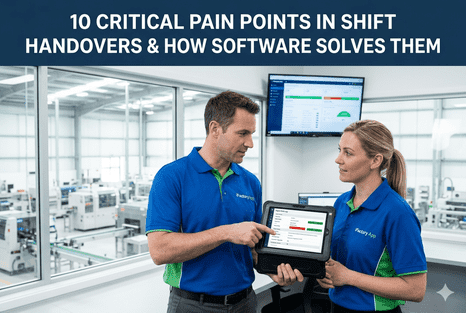
10 Critical Pain Points in Shift Handovers & How Software Solves Them
By Daniel Carter on May 27, 2026
Shift handover is the single most underestimated communication failure point in modern manufacturing. Up to 80% of serious workplace errors involve miscommunication during shift transitions and the catastrophic incidents that defined process safety — Piper Alpha, BP Texas City, the 2014 DuPont LaPorte methyl mercaptan release — each traced back in part to shift handover information loss. One automotive plant documented $840,000 in annual cost from duplicated troubleshooting alone. HSE observed 15 industrial shift handovers and found that none included all safe behaviors. The 10 pain points below describe what actually breaks at the crew change point — and how iFactory's Shift Logbook closes each gap. Book a Demo to walk through these pain points against your current handover process.
80%
Of serious workplace errors involve miscommunication at shift transitions
$840K
Annual duplicated troubleshooting cost documented at one automotive plant
0/15
HSE-observed handovers that included all safe behaviors
3 min
Average iFactory digital handover vs 15–20 minute verbal briefing
The 10 Critical Pain Points in Shift Handovers — and How Digital Shift Logbooks Solve Each
Manufacturing handover failures fall into ten consistent patterns. Each one is a process gap — not a character failure — and each one disappears when handover moves from verbal briefing and paper logs to structured digital capture. The cards below map each pain point to the specific iFactory capability that resolves it.
01. Information Omission Under Time Pressure
A 20-minute verbal briefing covering 30 items loses 40–60% of the detail. iFactory's structured templates force capture of every critical category — production, quality, safety, equipment, open issues — so nothing depends on recall.
02. Illegible or Lost Paper Log Entries
Handwritten notes blur, get coffee-stained, and disappear between shifts. Digital entries are timestamped, attributed, searchable, and permanent — no lost pages, no "what did this say?" moments at audit time.
03. Open Issues Dropped Between Crews
Outstanding maintenance flags, quality holds, and supplier concerns vanish at shift change. iFactory's automatic carry-forward ensures every open issue follows through to resolution with clear ownership and priority.
04. No Accountability for What Was Communicated
"I told them at handover" versus "I never heard that" goes unresolved on paper. E-signed digital acknowledgment by the incoming shift lead creates a verifiable record of what was passed and what was accepted.
05. Quality Trend Signals Missed
A 2% defect rate increase on Line 3 gets mentioned fourth in a verbal briefing and missed. Defect rate climbs to 6% before quality catches it. Structured digital templates surface quality trends visually, not buried in narrative.
06. Equipment Status Discovered Mid-Shift
Incoming crew runs for two hours before discovering a degraded asset. Real-time equipment status dashboards make the picture visible the moment a shift starts — green, yellow, red, with linked work order context.
07. Safety Events Underreported
Near-misses and minor exposure events get verbal mention and disappear. iFactory's mandatory safety capture fields with photo and biometric sensor integration make underreporting structurally impossible.
08. Inconsistent Categorization Across Crews
One shift codes a delay as "material issue," another codes the same event as "operator error." Structured tap-to-select categories eliminate variability so analytics actually mean something.
09. Handover Takes 15–20 Productive Minutes
Three shift changes a day at 20 minutes each is an hour of productive time lost daily. iFactory compresses structured handover to under 3 minutes per shift with e-signature acknowledgment, recovering hours per crew per week.
10. Audit Reconstruction Is a Manual Nightmare
Customer or regulatory audits require reconstructing what happened during specific shifts weeks or months later. Searchable, immutable, ALCOA+-aligned digital records make audit pulls a 10-second task instead of a 10-day binder hunt.
Verbal Handovers vs Structured Digital Handovers: The Capability Comparison
The cost difference between verbal/paper handovers and structured digital handovers is not subtle. The comparison below pulls together what changes operationally when each of the ten pain points is addressed in a single platform rather than left to crew discipline.
Handover Dimension
Verbal Briefing + Paper Logs
iFactory Digital Shift Logbook
Handover Duration
15 to 20 minutes per shift change, with major information loss between minutes 5 and 20.
Under 3 minutes with structured templates ensuring every critical category is acknowledged.
Information Capture Rate
40–60% of context retained; details progressively lost as briefing continues.
100% structured capture at the point of occurrence — no end-of-shift recall required.
Open Issue Carry-Forward
Dropped at shift change unless someone remembers. Weekend transitions especially fragile.
Automatic carry-forward with ownership and priority. Nothing closes until explicitly resolved.
Accountability and Attribution
Disputable. "I told them" vs "I never heard." Audits cannot reconstruct who knew what when.
E-signature acknowledgment with timestamp and user attribution creates verifiable record.
Equipment Status Visibility
Discovered 1–3 hours into the new shift through operational symptoms.
Live equipment status dashboard visible at the moment shift begins.
Quality and Safety Signal Detection
Buried in narrative briefing. Trend signals routinely missed.
Structured fields with mandatory capture and visual trend surfacing.
Audit and Compliance Reconstruction
Days to weeks of paper reconciliation. Attribution gaps common.
Searchable immutable record. ALCOA+, 21 CFR Part 11, OSHA PSM aligned by default.
Every Bad Handover Costs You. Every Good One Compounds.
iFactory's Shift Logbook fixes all 10 pain points with structured digital capture, automatic carry-forward, e-signature acknowledgment, and full ALCOA+ compliance — fully deployed in 1 to 2 weeks per site with no on-premise infrastructure required. Book a Demo to see structured handover applied to your specific shift patterns.
How iFactory Deploys to Eliminate Handover Pain Points
iFactory's deployment is structured to address the highest-impact handover pain points first, then expand into full shift logbook operation. Each stage produces measurable handover improvement rather than consulting deliverables.
Week 1
Current Handover Audit and Template Configuration
Observe current shift handovers across every line and area. Map the pain points actually occurring in this facility. Configure structured digital templates that capture what gets missed today — production, quality, safety, equipment, open issues — with mandatory fields aligned to the operation.
Week 2
Live Structured Handovers Begin
Operator training completed and first shifts logged digitally. E-signature acknowledgment, automatic issue carry-forward, and 3-minute structured handovers active across all crews. Supervisors see live equipment status and open issue dashboards immediately.
Weeks 3–4
SCADA, MES, and CMMS Integration
Direct connectors activated to SAP, Oracle, Dynamics, major MES, SCADA, and CMMS platforms. Equipment events auto-populate the handover record. Open work orders and quality holds carry-forward across shifts without manual transcription.
Weeks 5–8
Pattern Analytics and Multi-Site Rollout
Accumulated handover data becomes the input for pattern analytics — recurring handover gaps, repeat issues, shift-to-shift performance variance. Additional sites onboarded with site-tailored templates. Group-level handover compliance dashboard live for operations leadership.
MEASURABLE OUTCOMES FROM DAY 1: HANDOVER TIME COLLAPSES IMMEDIATELY
Manufacturers completing iFactory's deployment report Day 1 benefits in handover clarity and time savings. Handover overhead drops from 15–20 minutes to under 3 within the first week of operation, and structured capture eliminates 80%+ of the recurring information loss that drives duplicated troubleshooting and missed quality signals.
3 min
Average handover, down from 15–20 minutes
90%+
Operator adoption typically in first month
30%
Downtime reduction documented at deployed sites
Pain Points in Action: What Goes Wrong Without Structured Handovers
The use cases below reflect documented handover failure patterns from manufacturing facilities — illustrating how each pain point cascades from "small note missed" to "significant operational and financial impact" without the structured capture that digital shift logbooks provide.
Use Case 01
Quality Trend Missed in Verbal Briefing Becomes 90-Minute Defect Run
A discrete manufacturing plant ran Line 3 with a defect rate climbing from baseline 0.8% to 2% in the last 90 minutes of an evening shift. The outgoing operator mentioned it verbally to the supervisor mid-briefing. The supervisor relayed 12 different items in 10 minutes during handover, and the Line 3 quality signal landed fourth on the list. The incoming night crew did not catch it. Production ran full speed for 90 minutes before quality inspection caught a 6% defect rate during a routine round. After iFactory deployment, defect rate trends auto-surface on the handover dashboard as colored indicators, and similar misses dropped to zero in the first month. Book a Demo to see how visual signal surfacing changes handover dynamics in your plant.
6%
Defect rate at discovery vs 2% if caught at handover
90 min
Production run at elevated defect rate before discovery
Zero
Similar misses in first month after digital handover deployment
Use Case 02
Duplicated Troubleshooting Loops at an Automotive Plant
An automotive plant calculated $840,000 in annual cost from a single failure mode: incoming shifts rediscovering equipment problems that the outgoing shift had already diagnosed but not formally documented. Troubleshooting hours duplicated across shifts because the diagnostic notes lived in operator memory rather than the logbook. After deploying iFactory with structured equipment observation capture and shift-to-shift action carry-forward, the same troubleshooting work no longer repeated. New shifts inherited the diagnostic context from the prior shift through the digital logbook, and the duplicated-effort cost dropped substantially within the first quarter.
$840K
Annual cost of duplicated troubleshooting before digital handover
Hours
Of diagnostic work no longer repeated across shifts
1 Qtr
Time to measurable reduction in duplicated-effort cost
Use Case 03
Permit-to-Work Status Lost at Weekend Handover in a Chemical Plant
A chemical plant operating under OSHA Process Safety Management had an active hot-work permit covering Friday evening through Saturday morning. The Friday outgoing supervisor verbally mentioned the permit status to the incoming weekend supervisor in a 14-minute handover. The Saturday morning supervisor — three handovers removed from the original briefing — had no record of the permit's expiration window and authorized adjacent work that should have been deferred. No incident occurred, but the deviation surfaced during a TCEQ inspection. After iFactory deployment with structured permit capture and automatic carry-forward, every active permit follows the shift record with explicit expiration acknowledgment required. The compliance gap closed permanently. Book a Demo to see how permit and PSM data flows through structured handovers.
3 →1
Handovers between permit issuance and risk decision
100%
Active permits now captured in shift record after deployment
OSHA PSM
Compliance gap closed permanently
Expert Perspective: Why Handover Failures Are Process Failures, Not Operator Failures
Industry Review — Process Safety and Operations Communication Perspective
"Every plant manager I have worked with attributes handover problems to operator discipline — better training, more diligent supervisors, longer briefings. The data does not support that conclusion. HSE observed 15 industrial handovers and found none included all safe behaviors. The fundamental issue is that effective handover requires 20 to 30 minutes of detailed information exchange and most facilities allocate 10. Operators are doing what the system around them allows. You cannot fix that with another training session. You fix it by changing the system — replacing verbal recall with structured digital capture, making the handover record the source of truth instead of the conversation, and using e-signature acknowledgment to enforce that the incoming shift actually engaged with what was passed. Plants that do this stop seeing handover-related incidents within a quarter. Plants that don't keep adding training that doesn't change the outcome."
Process Safety Engineering Consultant — 22 Years in Refining and Specialty Chemicals (provided via iFactory deployment reference)
This perspective aligns with the pattern iFactory's customers consistently report: digitizing the handover is the single highest-leverage operational change a manufacturing plant can make in a quarter. It does not require new hires, longer briefings, or culture initiatives — only structured capture and acknowledgment in a platform built for the way shifts actually happen.
Fix Handovers Once. Stop Paying the Same Hidden Cost Every Shift.
iFactory's Shift Logbook eliminates all 10 handover pain points with structured digital capture, automatic carry-forward, e-signature acknowledgment, live equipment status dashboards, and full ALCOA+ compliance — fully deployed in 1 to 2 weeks per site.
Conclusion: The Handover Is Where Manufacturing Performance Lives or Dies
Every shift change is the moment where production knowledge either transfers cleanly or evaporates. The data is consistent: 80% of serious workplace errors involve handover miscommunication, automotive plants document hundreds of thousands of dollars in annual duplicated-troubleshooting cost, and the catastrophic incidents that define process safety history each trace back in part to handover information loss. None of that is a discipline problem. It is a process problem that disappears when handover moves from verbal recall to structured digital capture.
iFactory's Shift Logbook addresses each of the 10 pain points specifically: structured templates eliminate omission, digital entries eliminate illegibility, automatic carry-forward eliminates dropped issues, e-signature acknowledgment creates verifiable attribution, visual surfacing eliminates buried quality signals, real-time equipment dashboards eliminate mid-shift discovery, mandatory safety capture eliminates underreporting, structured categories eliminate coding variability, 3-minute structured handovers eliminate productive time loss, and immutable searchable records eliminate audit reconstruction effort. Deployment is 1 to 2 weeks per site with no on-premise infrastructure required, and Day 1 benefits show up in handover time and clarity. Book a Demo to receive a handover assessment specific to your shift structure.
Frequently Asked Questions About Shift Handover Pain Points and Digital Solutions
What are the most common shift handover pain points in manufacturing?
The 10 most common pain points are information omission under time pressure, illegible or lost paper log entries, open issues dropped between crews, lack of accountability for what was communicated, quality trend signals missed, equipment status discovered mid-shift, safety events underreported, inconsistent categorization across crews, 15–20 minute handover durations that consume productive time, and audit reconstruction effort when records are paper-based.
How much does a digital shift logbook compress handover time?
iFactory typically compresses shift handovers from 15–20 minutes to under 3 minutes through structured templates, e-signature acknowledgment, and automatic issue carry-forward. Across three shift changes a day, that recovers nearly an hour of productive time per crew member per day.
Does iFactory support OSHA PSM, FDA 21 CFR Part 11, and customer audit requirements?
Yes. Every shift entry is timestamped, attributed to a named user, immutable, and e-signed where required. The platform meets OSHA Process Safety Management, FDA 21 CFR Part 11, GMP, ALCOA+, and customer audit framework requirements out of the box — making audit reconstruction a 10-second search rather than a 10-day binder hunt.
How does iFactory integrate with our existing SCADA, MES, and CMMS systems?
iFactory provides direct connectors to SAP, Oracle, Microsoft Dynamics, major MES platforms, SCADA historians, and CMMS systems. Equipment events auto-populate the handover record, open work orders carry forward across shifts, and structured shift data flows into maintenance planning and analytics workflows without manual reconciliation.
How quickly can a facility deploy a digital shift logbook to fix handover pain points?
iFactory typically deploys in 1 to 2 weeks per site, with no on-premise infrastructure required. Day 1 benefits show up as faster, clearer handovers. Within the first month, operator adoption typically reaches 90%+ and the recurring information loss patterns that drive most handover pain points are structurally eliminated.
Stop Losing Information Between Shifts. Fix All 10 Pain Points in One Platform.
iFactory's Shift Logbook eliminates the recurring handover failures that drive defect runs, duplicated troubleshooting, missed safety events, and audit nightmares — deployed in 1 to 2 weeks per site with no on-premise infrastructure required.
3-minute handovers, down from 15–20 minutes
90%+ operator adoption in first month
100% structured capture with e-signature acknowledgment
Full ALCOA+, 21 CFR Part 11, and OSHA PSM alignment