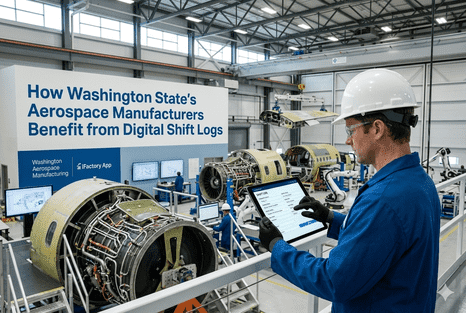
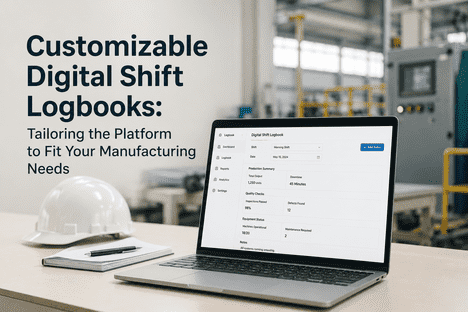
It’s 05:52 on a Wednesday at a Tier‑1 aerospace machine shop in Everett. The day shift has fifteen minutes before the bell. Spindle 4 on the five‑axis cell ran hot around 02:30, the night lead chalked a note on the whiteboard, and the AS9100 internal auditor is walking the floor at 09:00 asking for traceability on serial number 7K‑44218. Somewhere in a paper logbook is a smudged entry, somewhere in a supervisor’s memory is the actual story, and somewhere on a phone is a photo of the chip evacuation jam nobody remembered to upload. This is what Washington State aerospace manufacturers — Boeing’s 1,500+ suppliers across Snohomish, King, Pierce, and Spokane counties — are quietly trying to fix. A digital shift logbook turns that messy 05:52 handover into a structured, searchable, audit‑ready event timeline that the FAA, EASA, and the prime auditor see exactly the same way the next operator sees it. This guide walks through why Washington’s aerospace cluster needs digital shift logs, what they capture, and what changes on the shop floor. Book a demo with us to see your shift handover, your AS9100 traceability, your non‑conformance flow on iFactory’s Shift Logbook.
5‑Axis Cell A
Running
SN 7K‑44218 · in tolerance
Spindle 4
Flagged
Temp spike 02:30 · monitor
CMM Lab
Calibrated
NIST trace · due 14 days
AS9100 Audit
09:00
Records: ready
Spindle 4 thermal event · AI shift summary attached
Day shift acknowledgment pending · 18 entries · 4 photos · 1 NCR linked to SN 7K‑44218
Why Washington State Aerospace Cannot Run on Paper Logs Anymore
Washington is the densest aerospace cluster in the United States. The state houses Boeing’s commercial airplane assembly, more than 1,500 aerospace suppliers, and roughly half of all low‑earth‑orbit satellites built worldwide. Snohomish County alone is home to nearly half of Boeing’s Washington workforce. Every part that flows through this cluster — fuselage panels, wire harnesses, machined titanium brackets, composite skins — has to carry an unbroken trail of evidence: who touched it, when, what equipment was used, what was its calibration status, what deviations were noted, what corrective actions were taken. Paper logbooks cannot keep up with that traceability burden, and the auditors writing AS9100 Rev D non‑conformances know it.
Paper / Whiteboard Handover
The 2 AM Knowledge Gap
1
Night lead scribbles a note about Spindle 4 — half‑legible
2
Day operator arrives, skims the page, misses the chip jam history
3
AS9100 auditor asks for SN traceability — 4 hours scrambling through binders
4
Same defect recurs three weeks later — no cross‑shift learning
iFactory Digital Shift Log
Structured, Searchable, Audit‑Ready
1
Night lead logs Spindle 4 event with photo, machine ID, time, severity
2
AI generates shift summary; day shift acknowledges digitally before takeover
3
AS9100 auditor queries SN 7K‑44218 — full history pulled in seconds
4
Pattern engine flags recurring spindle events across shifts — closed‑loop fix
The 5 Things a Digital Shift Log Captures on a Washington Aerospace Floor
Aerospace shift logs aren’t just a list of who ran what machine. They are the connective tissue between operations, quality, maintenance, and compliance. iFactory’s Shift Logbook is built around five structured capture areas that map directly to AS9100, NADCAP, FAA, and Boeing flow‑down clauses.
01
Equipment Status & Calibration
Every CNC, autoclave, CMM, torque wrench, and special‑process oven logged with current status, calibration due date, and last verified reading — protecting the AS9100 traceability chain.
5‑axis · Autoclaves · CMMs · NDT
02
Part Serial & Lot Traceability
Each serialized part — fastener, panel, harness, machined detail — linked to operator, work order, FAIR, material certificate, and special process. One scan returns the full chain of custody.
SN · Heat lot · FAIR · Cert of Conformity
03
Non‑Conformance & CAPA Events
Every NCR, MRB tag, and rework loop captured in the shift it occurred, with photo evidence, disposition, and a direct link to the CAPA workflow — no end‑of‑week reconciliation.
NCR · MRB · Rework · CAPA link
04
Safety, FOD & Environmental
FOD walks, lockout‑tagout events, near misses, chemical handling, and clean‑room excursions logged with mandatory acknowledgment — meeting OSHA and Boeing D6‑series flow‑downs.
FOD · LOTO · Near miss · Clean room
05
Production & OEE Continuity
Cycle counts, takt adherence, downtime reasons, and changeover events captured per shift and rolled into an OEE view — so production planners see the same truth as the floor.
OEE · Takt · Downtime · Changeover
See it on your line
Walk through your specific shift handover, your AS9100 templates, your Boeing flow‑downs with our aerospace specialists in 30 minutes.
Book a Demo
Curious which of these five capture areas is leaking the most time on your floor? Book a demo with us and we’ll walk through your current handover process side‑by‑side with iFactory’s Shift Logbook.
Anatomy of a Shift Handover on iFactory — Three Steps, Under Five Minutes
The hardest constraint in shift handover is time. Operators have a 10–20 minute overlap window, and if the digital tool takes longer than scribbling on paper, they’ll revert to paper. iFactory’s Shift Logbook is designed around a sub‑five‑minute structured handover with conditional branches — operators only add detail to items flagged as exceptions.
Step 01
Structured Event Capture
Throughout the shift, operators log events directly from a tablet or phone — equipment status, NCRs, FOD finds, and rework events. Photos, voice notes, and SCADA readings attach automatically with timestamps and e‑signatures.
Spindle 4 · thermal event 02:30
WO #8821 · 2 photos · monitor disposition
Step 02
AI‑Generated Shift Summary
At shift end, iFactory’s AI assembles the top events, open NCRs, safety items, and production deltas into a concise summary. The outgoing supervisor reviews and adds context — no more typing two‑hour shift reports.
Top 3 for Day Shift
1) Spindle 4 monitor · 2) SN 7K‑44218 inspection · 3) FOD walk due 07:00
Step 03
Mandatory Acknowledgment
Incoming supervisor digitally acknowledges the handover before taking the floor. The record is immutable, timestamped, and ready for AS9100, FAA, or Boeing audits — no more “I didn’t know” conversations after an incident.
Acknowledged · Day Shift Supervisor
Immutable record · e‑signature · ALCOA+ compliant
What It Means for Washington Aerospace Operators in Numbers
The floor‑level value is straightforward: fewer surprise audits, fewer repeated defects, fewer 2 AM phone calls when an auditor lands on a serial number with no paper trail. The plant‑level ROI is documented across aerospace and manufacturing deployments.
40%
Of plant incidents tied to shift handover
Despite covering under 5% of operational time, shift transitions are the highest‑risk window in continuous manufacturing
76%
Shift handover time reduction
AI‑powered digital logbooks cut handover duration while improving information accuracy to 99.2%
80%
Audit preparation time saved
Unified digital quality records cut AS9100 audit prep dramatically in deployed MRO and Tier‑1 environments
194K+
Washington aerospace workers
Across Boeing, 1,500+ suppliers, and the satellite cluster — every one of them touches a shift handover record
From Paper Logs to Digital Shift Intelligence — in Days, Not Months
iFactory’s Shift Logbook ships with pre‑configured AS9100 templates for Washington aerospace shops, integrates with your existing MES, CMMS, and ERP, and goes live on tablets across all shifts in 1–2 weeks. AI shift summaries, mandatory acknowledgments, full audit trail — no rip‑and‑replace.
How iFactory Plugs Into Your Existing Aerospace Stack
Washington aerospace shops have invested years in their MES, ERP, CMMS, and quality systems — SAP, Solumina, Plex, IFS, Deltek, custom Boeing flow‑down tools. The last thing a Tier‑1 supplier needs is another platform that requires ripping out what works. iFactory’s Shift Logbook is built to sit on top of that stack, not replace it.
Operator & Supervisor Interface
Tablet & phone shift logging · AI handover summaries · Mandatory acknowledgments · Mobile FOD walks · Offline‑capable
iFactory Shift Logbook Layer
Structured templates · AI shift summaries · Serial‑number traceability · NCR/CAPA linking · AS9100 audit packs · Pattern engine
Your Existing Aerospace Stack — Untouched
MES (Solumina, Plex, SAP) · ERP (SAP, Deltek, IFS) · CMMS · QMS · SCADA · PLC · Calibration systems · Material cert databases
Wondering if iFactory speaks to your specific MES or CMMS vendor? Book a demo with us and bring your integration list — we’ll cover it in the same session.
Boeing Flow‑Downs, AS9100 Rev D, and NADCAP — All in One Audit Pack
The auditor’s favorite question on a Washington aerospace floor is some variant of “show me the record.” Show me the calibration history of CMM‑12 going back three years. Show me who operated press B during the run of heat lot 41‑Z. Show me the FOD walk for night shift on the date of the missing fastener report. With paper logs, the answer involves binders, supervisors’ memories, and a lot of luck. With iFactory, the answer is a query.
A1
AS9100 Rev D Documentation
Configuration management, traceability, non‑conformance, supplier flow‑down, and product safety records all captured in structured shift entries with e‑signatures and immutable audit trail.
Rev D · ALCOA+ · 21 CFR 11 compatible
A2
NADCAP Special Process Logs
Heat treat, NDT, chem processing, welding, and surface enhancement special processes get their own templates with parameter capture, operator certification, and pyrometry data linkage.
Heat treat · NDT · Chem · Welding
A3
Boeing D6 & Customer Flow‑Downs
Customer‑specific clauses — D6‑1276, D6‑51991, D33200 series — get pre‑configured fields in shift templates so flow‑down evidence is captured at the source, not reconstructed at audit time.
D6 series · Customer PO clauses
Expert Perspective
"The Washington aerospace cluster is older, more experienced, and more concentrated than anywhere else in the country — and that’s also its biggest digital risk. The people who know how the floor really runs are retiring, and the tribal knowledge they carry is locked in paper logbooks, whiteboards, and 30 years of muscle memory. A digital shift log is not about replacing those people. It’s about giving every shift after them the same context they had — so the auditor, the next operator, and the prime customer all see one consistent truth."
— Aerospace Operations Digitalisation Practice, 2026 industry insight
1,500+
Washington aerospace suppliers and vendors
~50%
of global LEO satellites built in Washington
1–2 wk
typical time from kickoff to first live shift
Conclusion: The 5:52 AM Handover Just Got a Lot Quieter
Washington aerospace doesn’t need another dashboard. It needs the next shift to start with the same context the last shift ended with — no smudged notes, no missing photos, no auditor surprises at 09:00. iFactory’s Shift Logbook turns that handover from a daily gamble into a structured, AI‑summarised, mandatorily acknowledged event timeline that the operator, the supervisor, the quality manager, and the AS9100 auditor all read the same way. The 40% incident reduction window, the 76% handover‑time cut, the 80% audit prep savings are downstream consequences. The upstream change is that the floor stops surprising the next shift, and the next shift stops surprising the customer. That is what turns Washington’s 100‑year aerospace heritage into the next 100 years of it. Book a demo with us to see it running on your floor.
Bring Digital Shift Logs to Your Washington Aerospace Floor
iFactory’s aerospace practice deploys in 1–2 weeks with AS9100‑ready templates, integration with your existing MES and CMMS, and AI‑powered shift summaries that capture tribal knowledge before it walks out the door. See your handover, your traceability, and your audit pack in a single working session.
Frequently Asked Questions
What is a digital shift logbook for aerospace manufacturing?
A digital shift logbook is a structured, searchable platform where operators, supervisors, and quality teams log shift events, equipment status, non‑conformances, FOD walks, special process parameters, and serial‑number traceability in real time from tablets or phones. For Washington State aerospace manufacturers, it replaces paper handover logs and whiteboards with AI‑generated shift summaries, mandatory digital acknowledgments, photo and voice attachments, and a permanent audit trail that meets AS9100 Rev D, NADCAP, FAA, and Boeing flow‑down documentation requirements — all without ripping out existing MES, ERP, or CMMS systems.
Why is shift handover such a high‑risk moment in aerospace plants?
Shift handover accounts for less than 5% of operational time but is associated with roughly 40% of plant incidents in continuous manufacturing environments. In aerospace specifically, the risk compounds because a missed entry — an unfinished FOD walk, an out‑of‑calibration gauge, a serial number that skipped an inspection — can break the traceability chain that AS9100 and FAA airworthiness rules depend on. Digital logbooks reduce this risk through structured templates, mandatory acknowledgments, AI‑generated handover summaries, and immutable timestamped records that survive personnel changes and audits.
Do we need to replace our MES, CMMS, or quality systems to use iFactory’s Shift Logbook?
No. iFactory’s Shift Logbook is designed to sit on top of your existing aerospace technology stack — Solumina, SAP, Plex, IFS, Deltek, custom Boeing flow‑down tools, your CMMS, your calibration system, your QMS. It reads from and writes to these systems through standard APIs, so shift entries automatically link to work orders, NCRs, FAIRs, material certificates, and calibration records. Nothing in your existing controls or quality stack is removed, and operators continue to use the tools they’re already trained on.
How long does it take to deploy a digital shift logbook in a Washington aerospace facility?
Most Washington aerospace deployments go live within 1–2 weeks. Cloud‑based platforms like iFactory require no on‑prem infrastructure changes — operators use tablets or phones already on the floor. The first few days cover template configuration against your AS9100 procedures and Boeing flow‑down clauses, the next few days cover MES and CMMS integration, and the final stretch is operator training across all shifts. Pattern recognition, AI shift summaries, and cross‑shift trend analytics typically activate within the first month once enough structured data has accumulated.
How does a digital shift log help with AS9100, NADCAP, and FAA audits?
Every shift entry in iFactory is immutable, timestamped, e‑signed, and linked to the relevant work order, serial number, special process, or non‑conformance. When an auditor asks for the calibration history of a gauge, the operator history on a heat lot, the FOD walk record for a specific night shift, or the disposition of an MRB tag — the answer comes back in seconds rather than days of binder searches. The platform pre‑generates AS9100 Rev D and NADCAP audit packs, and supports ALCOA+ data integrity principles required for FAA and EASA airworthiness expectations. Manufacturers typically report 80% reductions in audit preparation time after digitizing shift records.