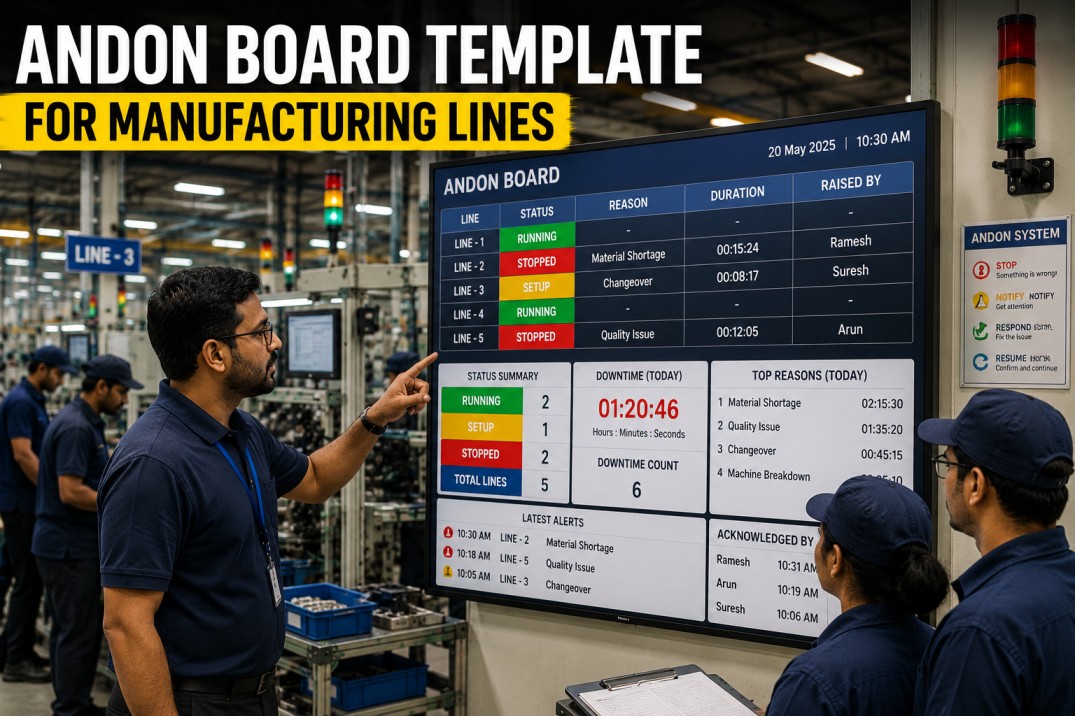
An andon escalation matrix is the structured backbone of every effective manufacturing andon system. It defines exactly who responds to each call type, how quickly they must respond, and what happens when response SLAs are missed. Without a clearly defined escalation matrix, andon alerts are routed inconsistently, response times vary unpredictably, and production disruptions last longer than necessary because the right person is not notified at the right time. This template provides a pre-built andon escalation matrix structure with seven essential components: an executive scoreboard of escalation health metrics, a call type by responder level coverage matrix with SLA times, detailed escalation tier role cards defining T1–T4 responsibilities, an SLA timer reference table with auto-escalation triggers, a visual escalation flow SVG pipeline showing the alert-to-resolution path, routing rules mapping trigger conditions to responders and channels, and volume and compliance cards tracking actual performance by call type. Each component is designed to help plant leadership, operations teams, and continuous improvement specialists design, document, and deploy a standardised escalation framework that minimises response time, maximises first-call resolution, and drives accountability across every shift and production line.
Visualise Your Escalation Matrix in Minutes
Pre-Built Andon Escalation Matrix Template — Map Every Call Type to the Right Responder with Defined SLAs and Auto-Escalation.
iFactory’s andon escalation matrix template gives you a ready-to-use framework for mapping call types to responder levels with clear SLA thresholds and automatic escalation rules. Configure each call type’s primary responder, response SLA, resolution timer, and escalation pathway through a visual interface — no coding required. The system enforces the matrix automatically, routing alerts to the correct tier, tracking response times against SLAs, and escalating to the next level when thresholds are missed. Deployment takes hours, and the matrix updates instantly as you refine your escalation rules.
Andon Escalation Health Scoreboard
The scoreboard provides a snapshot of your andon escalation system’s overall health through four critical metrics: the number of call types covered by the matrix, average Tier 1 response time across all call types, the percentage of alerts that require escalation beyond Tier 1, and SLA compliance rate for on-time responses. These metrics help plant leadership assess whether the escalation matrix is working effectively and identify areas requiring adjustment or additional training.
Call Type × Responder Level Matrix: Coverage and SLA Mapping
The escalation matrix maps each call type to the appropriate responder levels, showing which tiers are activated for each type of alert and the SLA response time at each level. Safety concerns engage all four tiers with the tightest SLAs, while material shortages resolve at Tier 1 or Tier 2. Filled dots indicate a defined response at that tier, and the SLA time appears beside each dot. This matrix serves as the single source of truth for escalation design and training documentation.
| Call Type | Tier 1–First Responder | Tier 2–Supervisor | Tier 3–Manager | Tier 4–Director |
|---|---|---|---|---|
| Quality Issue | 2 min | 5 min | — | — |
| Maintenance Fault | 5 min | 10 min | 20 min | — |
| Safety Concern | 1 min | 3 min | 5 min | 10 min |
| Material Shortage | 5 min | 10 min | — | — |
| Setup Delay | 3 min | 8 min | — | — |
Tier-by-Tier Escalation Role Definition
Each escalation tier has a defined role, SLA window, set of actions, notification method, and expected volume of alerts reaching that level. Tier 1 first responders handle 70% of alerts without escalation, while Tier 4 director-level intervention is reserved for critical safety and major outage scenarios that require executive authority or corporate resource deployment.
Configure Your Escalation SLAs with Pre-Built Templates
Standardised SLA Thresholds for Every Call Type — or Customise Your Own Based on Historical Response Data.
The escalation matrix includes pre-configured SLAs derived from industry benchmarks across discrete manufacturing and process industries. Safety concerns default to 1-minute Tier 1 response, quality issues to 2 minutes, and maintenance faults to 5 minutes. Each SLA is configurable per plant, line, or shift, and the system tracks compliance automatically, surfacing missed-SLA patterns for continuous improvement of the escalation framework.
SLA Timer Reference: Response, Resolution, and Escalation Thresholds
The SLA timer reference table specifies the complete timing framework for each call type: the time allowed for first responder acknowledgement, the maximum time allowed for resolution at Tier 1, the timer that triggers escalation to the next level, and whether escalation is automatic or manual. Safety concerns have the most aggressive SLAs with automatic escalation at every tier, while material shortages and setup delays allow longer windows with manual escalation options.
| Call Type | Response SLA | Resolution SLA | Escalation Timer | Auto-Escalate | Miss SLA Action |
|---|---|---|---|---|---|
| Quality Issue | 2 min | 15 min | 5 min | Yes | Notify next tier, log incident |
| Maintenance Fault | 5 min | 30 min | 10 min | Yes | Notify next tier, log incident |
| Safety Concern | 1 min | 10 min | 3 min | Yes | Notify next tier, log incidentManual escalation route |
Andon Escalation Flow Diagram: Visual Alert-to-Resolution Pathway
The escalation flow diagram visually traces an alert from initial trigger through all four responder tiers to final resolution. Each stage shows the responder role and the SLA window for acknowledgement. When a Tier 1 responder acknowledges and resolves the alert within SLA, the flow terminates at that stage. If the SLA expires without resolution, the alert automatically escalates to the next tier with a fresh SLA timer, ensuring no alert falls through the cracks.
Alert Routing Rules: Trigger Conditions, Assignment, and Fallback
Routing rules define the precise conditions under which an alert is triggered, who it is assigned to, which notification channels are used, what the fallback assignment is if the primary responder is unavailable, and the priority level. Critical alerts like safety concerns use audible alarms plus mobile and desktop notifications, while medium-priority material shortages use mobile-only alerts. Rules are configurable per line, shift, and plant to match operational requirements.
| Trigger Condition | Assigned To | Notification Channel | Fallback | Priority | Status |
|---|---|---|---|---|---|
| Quality: defect threshold >3% | Tier 1 Operator | Andon light + mobile push | Tier 2 Supervisor | High | Active |
| Maintenance: machine down >5 min | Tier 1 Technician | Andon light + desktop popup | Tier 2 Supervisor | High | Active |
| Safety: guard open / e-stop active | Tier 1 Operator | Audible alarm + mobile alert | Tier 2 Supervisor | Critical | Active |
| Material: bin empty at station | Tier 1 Material Handler | Mobile app notification | Tier 2 Supervisor | Medium | Active |
| Setup: changeover >10 min | Tier 1 Setup Tech | Andon light + mobile push | Tier 2 Supervisor | Medium | Active |
| Quality: repeat defect same line | Tier 2 Supervisor | Email + dashboard alert | Tier 3 Manager | High | Active |
| Safety: near-miss reported via andon | Tier 2 Safety Lead | Mobile + email + desk alert | Tier 3 Manager | Critical | Active |
| Maintenance: critical spare needed | Tier 2 Maintenance Lead | Email + SMS + phone | Tier 3 Manager | High | Active |
Alert Volume and SLA Compliance by Call Type
Tracking actual alert volume, average response time, and SLA compliance by call type reveals which areas of the escalation matrix are performing well and which require attention. Maintenance faults generate the highest volume but have slightly lower compliance than safety concerns, where near-perfect response times reflect the criticality-driven urgency and culture of immediate response to safety-related alerts.
Frequently Asked Questions
What is an andon escalation matrix?
An andon escalation matrix is a structured framework that defines how alerts and issues raised through an andon system are routed to the appropriate responder based on call type, severity, and duration. The matrix maps each call type to a primary responder tier, specifies response time SLAs, defines escalation triggers when SLAs are missed, and identifies notification channels for each level. A well-designed escalation matrix ensures that problems are addressed by the right person within the right timeframe, minimising production downtime, quality defects, and safety risks. The matrix typically includes four escalating tiers: first responder (operator or technician), supervisor, manager, and director, with each tier having defined response SLAs, resolution authority, and escalation pathways.
How do I determine SLA response times for each escalation tier?
SLA response times should be determined based on the criticality of the call type and the impact of delayed response on production, quality, and safety. Safety concerns should have the shortest SLAs (1–2 minutes for Tier 1) because delayed response directly affects worker safety. Quality issues typically have 2–5 minute SLAs because delayed response can result in significant defect generation. Maintenance faults can tolerate 5–10 minute SLAs depending on the equipment criticality. SLAs should be validated against historical response data — review the average time operators currently take to acknowledge alerts and set the Tier 1 SLA to match or slightly improve that baseline. Each subsequent tier should have progressively longer SLAs (typically 2–3x the previous tier) to allow sufficient time for resolution before triggering escalation. Review and adjust SLAs quarterly based on actual performance data.
What happens when an SLA is missed at any tier?
When an SLA is missed at any escalation tier, the andon system automatically triggers escalation to the next tier while logging the missed SLA as a performance event. For example, if a Tier 1 first responder does not acknowledge a quality alert within the 2-minute SLA window, the system auto-escalates to Tier 2 supervisor, sends a notification to the supervisor’s mobile device and desktop dashboard, and logs the missed SLA with timestamp, responder ID, and call type for later review. If the Tier 2 supervisor also misses their SLA, the alert escalates to Tier 3 manager. The system continues escalating until the alert is acknowledged or reaches the highest defined tier. Missed SLA events are aggregated into monthly reports that identify patterns — for example, specific shifts or lines with consistently high missed-SLA rates requiring process improvement or additional training. Critical alerts (safety concerns) additionally trigger immediate phone call notifications to the next tier when SLAs are missed.
Which call types should be included in an andon escalation matrix?
An effective andon escalation matrix should include all call types that operators can initiate from the andon system. The five most common call types are: Quality Issue (defect detected, specification deviation, non-conformance), Maintenance Fault (machine breakdown, equipment malfunction, tool wear), Safety Concern (guard open, e-stop active, spill, near-miss, unsafe condition), Material Shortage (bin empty, wrong material, WIP shortage), and Setup Delay (changeover taking longer than standard, tooling issue, setup parameter problem). Some plants also include additional types such as Maintenance Request (non-urgent maintenance need), Engineering Support (process or product design issue), and Environmental (waste spill, emission exceedance, utility interruption). Each call type should have its own SLA thresholds, escalation pathway, and notification channels defined in the matrix.
How do I implement an escalation matrix in an andon system?
Implementing an escalation matrix in an andon system involves five steps. First, define your call type taxonomy — identify every type of alert that operators can raise and group them into categories (quality, maintenance, safety, material, setup). Second, define your escalation tiers — determine how many responder levels your organisation needs (typically four: T1 first responder, T2 supervisor, T3 manager, T4 director). Third, assign response SLAs — for each call type and tier combination, define the maximum time before escalation triggers, using historical data to set achievable targets. Fourth, configure notification channels — define how each tier receives alerts (andon light panel, mobile push, SMS, email, desktop popup, phone call) based on the criticality. Fifth, configure auto-escalation rules — set the system to automatically notify the next tier when SLAs are missed, log all escalation events, and generate monthly SLA compliance reports. iFactory’s andon system includes a matrix configuration interface that supports all five steps with pre-built templates for standard manufacturing escalation structures.
Deploy the Andon Escalation Matrix in Your Plant
Stop Guessing Who Responds to Which Alert. Define, Document, and Enforce Your Escalation Rules with iFactory.
iFactory’s andon system includes a built-in escalation matrix configurator that lets you define call types, responder tiers, SLA thresholds, notification channels, and escalation rules through a visual interface. The matrix is enforced automatically — every alert is routed to the correct responder, response times are tracked against SLAs in real time, and missed SLAs trigger automatic escalation to the next tier. Deployment takes two to three weeks, and the matrix can be updated at any time as your operational requirements evolve. Book a demo to see the escalation matrix configurator in action.