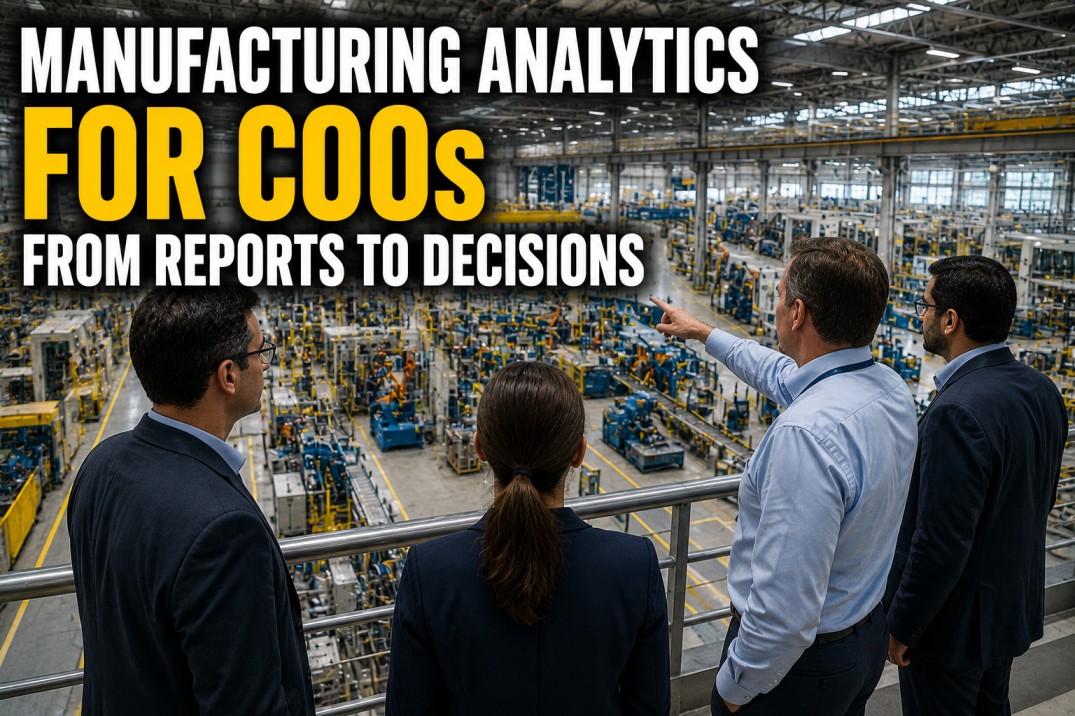
Cement and building materials manufacturing presents unique analytics challenges that differ fundamentally from discrete production. The process is continuous, thermally intensive, and operates under extreme conditions — kiln temperatures reach 1,450°C, and entire lines run 24/7. Energy accounts for 30–40% of production cost, making efficiency gains directly visible on the bottom line, while tightening emission regulations demand continuous compliance monitoring. Raw material chemistry varies with every quarry face shift, and product quality must satisfy stringent customer specifications across multiple cement types. This guide presents seven essential analytics components purpose-built for cement plants: an executive scoreboard, cement-specific KPI definitions, a five-stage process flow diagram, an eight-use-case reference table, six challenge cards, a sensor classification reference, and a five-step implementation roadmap.
Assess Your Cement Plant’s Analytics Readiness
Pre-Built Cement Analytics Framework — From Sensor Strategy to Production Optimisation, Deployed in Weeks, Not Months.
iFactory’s cement and building materials analytics solution provides a purpose-built framework for connecting your kiln, mills, coolers, and emission monitoring systems into a unified analytics platform. The framework includes pre-configured dashboards for thermal efficiency, mill throughput, quality prediction, and emission compliance, with role-based views for operators, engineers, and plant leadership. Data integration uses standard OPC-UA and Modbus protocols that connect directly to existing PLCs and sensors, so you can go from audit to live dashboard in under six weeks. The platform scales from single-line plants to multi-site cement groups with centralised KPI harmonisation and cross-plant benchmarking. Book a demo to see the cement analytics framework applied to a real plant dataset.
Cement Plant Analytics Scoreboard
The scoreboard provides an at-a-glance view of four critical cement manufacturing metrics that span production efficiency, energy intensity, output capacity, and environmental performance. Kiln utilisation measures the percentage of available time the kiln is producing clinker, directly reflecting thermal process reliability. Energy intensity tracks combined thermal and electrical energy per tonne of cement — the industry’s single most important cost driver. Mill output monitors finished cement grinding throughput, and CO₂ intensity captures the plant’s progress toward emission reduction targets. Together these four metrics give plant leadership a balanced view of operational, cost, and sustainability performance.
Cement-Specific KPI Definitions and Benchmarks
Effective cement analytics depends on tracking the right KPIs with standardised definitions, industry benchmarks, and known performance drivers. The six KPIs below cover the most critical dimensions of cement manufacturing performance: kiln availability (thermal process reliability), mill throughput (grinding capacity utilisation), energy consumption (both thermal and electrical intensity), clinker factor (raw material substitution rate for lower-carbon cement), Blaine fineness (product quality and customer specification compliance), and emission compliance (environmental regulatory adherence). Each KPI includes its formula, industry benchmark range, and primary operational drivers to guide analytics design and target setting.
Cement Production Process: Five-Stage Flow from Raw Mill to Finish Mill
Understanding the cement production process is essential for designing effective analytics. The process moves from raw material grinding in the raw mill through preheating to 850°C in the cyclone tower, clinkering at 1,450°C in the rotary kiln, rapid cooling in the grate cooler, and final grinding with gypsum in the finish mill. Each stage has distinct analytics requirements: temperature profiles and retention times in the kiln, vibration and power draw in the mills, pressure and gas analysis in the preheater, and flow and temperature in the cooler. The SVG diagram below maps the complete five-stage flow with typical operating temperatures at each stage.
Book a Cement Analytics Demo
See Your Kiln and Mill Data in a Unified Dashboard — Thermal Efficiency, Quality Prediction, and Emission Compliance in One View.
Request a personalised demo of iFactory’s cement analytics dashboard configured with your plant data. We’ll connect to your existing sensors via OPC-UA or Modbus, set up live dashboards for your kiln line and finish mills, and demonstrate how real-time thermal efficiency monitoring, quality prediction, and emission compliance tracking work in a single integrated platform. The demo runs on your data, on your timeline, and requires no upfront commitment or IT involvement beyond network access. Typical demo setup takes one week.
Cement Analytics Use Cases: Eight High-Impact Applications
The table below maps eight proven cement analytics use cases to their data sources, analytical methods, and expected operational impact. Each use case targets a specific dimension of cement manufacturing performance — from kiln thermal efficiency and mill throughput optimisation to emission compliance, quality prediction, inventory management, maintenance planning, and cost analysis. These applications are ordered by typical implementation priority, starting with the highest-ROI use cases that can be deployed using existing sensor infrastructure without significant capital investment.
| Use Case | Data Sources | Analytics Method | Expected Impact |
|---|---|---|---|
| Kiln Thermal Efficiency | Temperature sensors, fuel flow meters, O₂/CO analysers | Energy balance model, linear regression on specific heat consumption | 4–6% fuel cost reduction |
| Mill Throughput Optimisation | Mill motor amps, separator speed, feed rate, vibration sensors | Multivariate regression, target curve optimisation | 8–15 tph throughput increase |
| Energy Benchmarking | Power meters, production tonnage, weather data | Statistical benchmarking, CUSUM analysis for drift detection | 3–5% energy intensity reduction |
| Emission Tracking | CEMS gas analysers, baghouse DP, temperature sensors | Real-time exceedance alerting, rolling 24h average compliance | Zero regulatory fines, automated reporting |
| Quality Prediction | Laboratory test data, XRF analysers, mill parameters | Neural network / Random Forest predictive model for 28d strength | 30% fewer off-spec batches |
| Inventory Management | ERP stock data, weighbridge tickets, silo level sensors | Demand forecasting, reorder point optimisation, slow-mover flagging | 15% inventory cost reduction |
| Maintenance Planning | Vibration data, motor current, lubrication pressure, run hours | Condition-based threshold alerts, remaining useful life estimation | 20% reduction in unplanned downtime |
| Cost Analysis | ERP costing data, energy bills, maintenance records, production logs | Activity-based costing, variance analysis, margin dashboards | Transparent cost drivers, targeted reduction actions |
Six Critical Cement Manufacturing Challenges and Analytics Solutions
Cement plants face a distinct set of operational challenges driven by the industry’s continuous thermal process, energy intensity, and regulatory environment. High energy cost is the dominant financial pressure, followed by tightening emission compliance requirements and raw material quality variability. Equipment wear in high-temperature and high-vibration environments creates maintenance challenges, and production planning must balance multiple competing objectives across kiln, mills, silos, and shipping. Each challenge card below describes the problem, its business impact, and the analytics-driven solution that addresses it.
Cement Plant Sensor and Data Source Reference
Effective cement analytics depends on quality data from five primary sensor categories. Kiln thermocouples provide the temperature profile essential for thermal efficiency monitoring and refractory protection. Mill vibration sensors detect roller wear, bearing degradation, and separator imbalance before they cause unplanned downtime. Gas analysers at the kiln inlet and stack measure O₂, CO, NOx, SO₂, and CO₂ for combustion optimisation and compliance tracking. Power meters on every major motor drive enable energy benchmarking and anomaly detection. Conveyor scales provide the production accounting backbone for mass balance and yield tracking. The table below classifies each source with its measurement, typical frequency, and primary analytics application.
Five-Step Cement Analytics Implementation Roadmap
Deploying cement plant analytics follows a structured five-phase approach. The assessment phase audits existing instrumentation and data infrastructure. The connect phase installs data acquisition and establishes a centralised time-series data lake. The baseline phase builds current-state benchmarks and deploys foundational dashboards. The optimise phase introduces predictive models and optimisation algorithms. The sustain phase embeds analytics into daily operations and continuous improvement processes. Each phase has a defined duration, clear deliverables, and specific milestones for moving to the next phase.
Frequently Asked Questions
What makes cement analytics different from general manufacturing analytics?
Cement manufacturing poses unique analytics challenges due to its continuous thermal process, extreme temperatures (up to 1,450°C in the kiln), high energy intensity (30–40% of production cost is energy), and strict emission compliance requirements. Unlike discrete manufacturing where individual units are tracked, cement processes operate 24/7 with significant thermal inertia — changes in one stage affect downstream quality and emissions hours later. Analytics models must account for long time lags between process changes and quality outcomes (e.g., kiln feed chemistry today affects clinker quality 4–6 hours later). Additionally, cement plants must balance competing objectives: maximising throughput while minimising energy consumption and meeting tightening emission limits. Effective cement analytics requires domain-specific models that understand these dynamics rather than applying generic manufacturing dashboards.
Which cement KPIs should I track in an analytics dashboard?
The most impactful cement manufacturing KPIs fall into five categories. Thermal efficiency: kiln specific heat consumption (GJ/t clinker), preheater exit temperature, and cooler efficiency. Electrical efficiency: mill specific power consumption (kWh/t), separator efficiency, and fan power per tonne. Production: kiln availability (%), mill throughput (tph), clinker production rate, and cement dispatch. Quality: clinker free lime, Blaine fineness, 28-day mortar compressive strength, and SO₃ content. Emission: CO₂ kg/t cement, NOx ppm, SO₂ ppm, and particulate mg/Nm³. Financial: energy cost per tonne, maintenance cost per tonne, and contribution margin by cement type. Focus on leading KPIs (kiln feed chemistry, mill vibration) that predict lagging outcomes (clinker quality, unplanned downtime) rather than tracking lagging indicators alone.
How do I start collecting data for cement plant analytics?
Start by auditing your existing sensor infrastructure, which in most cement plants already covers kiln burning zone temperature, preheater pressure, mill motor current, gas analysers (O₂, CO, NOx, SO₂), and conveyor scales. The typical gap is not sensor availability but data capture and contextualisation. Install an edge gateway or industrial data collector to poll sensors via 4–20mA loops, Modbus TCP, or OPC-UA at appropriate intervals — 1–5 seconds for thermal parameters, 1 minute for production rates, and per-test for laboratory quality data. Establish a time-series data lake with standardised tag naming and unit conventions. Start with 30–50 critical tags covering the kiln line and finish mill, then expand to preheater, cooler, and auxiliary equipment. Most plants achieve meaningful analytics with data from fewer than 100 well-chosen tags.
How can analytics help reduce cement production energy costs?
Analytics reduces energy costs through four mechanisms. First, real-time thermal efficiency monitoring identifies when specific heat consumption deviates from the target, enabling immediate operational correction rather than discovering drift weeks later on a monthly report. Second, combustion optimisation uses O₂, CO, and temperature data to adjust the kiln air-to-fuel ratio continuously, maintaining complete combustion while minimising excess air that wastes heat up the stack. Third, predictive mill control uses feed rate, moisture, and separator data to maintain optimal grinding load — running mills at peak efficiency (typically 90–95% of rated throughput) reduces kWh per tonne significantly compared to under-loaded operation. Fourth, energy benchmarking across shifts and production runs reveals best practices that can be standardised, with top-quartile performers typically consuming 10–15% less energy per tonne than the plant average. Together, these approaches deliver 3–8% energy cost reduction within 6–12 months.
What is the typical ROI for implementing cement plant analytics?
Cement plants implementing structured analytics programs typically achieve ROI within 9–18 months, with annual benefits ranging from $500,000 to $2.5 million per production line depending on plant size and baseline efficiency. The largest benefit sources are: 3–8% energy cost reduction (50–40% of total benefit), 15–25% reduction in unplanned maintenance downtime (20–25%), 30–50% fewer off-spec quality batches (10–15%), and 1–3% throughput increase from optimised scheduling (10–15%). Implementation costs typically range from $150,000–350,000 for a single-line deployment including edge infrastructure, data platform setup, dashboard development, and change management. Beyond direct savings, analytics enables faster decision-making at all levels — operators shift from reactive to proactive control, and plant leadership gains data-driven confidence for capital allocation, production planning, and sustainability reporting.
Deploy Cement Analytics Across Your Plant Network
From Single-Line Pilot to Multi-Plant Rollout — Standardised Cement Analytics That Scales Across Your Organisation.
iFactory’s cement analytics platform supports deployment from a single kiln-line pilot through full multi-plant rollout with centralised KPI harmonisation, cross-plant benchmarking, and standardised dashboard templates that work across different kiln types, mill configurations, and cement product portfolios. The platform’s multi-tenant architecture means each plant has its own data namespace and user permissions, while corporate leadership gets a consolidated view with consistent definitions and roll-up hierarchies. Deployment follows the five-step roadmap above, with each additional plant taking less time and requiring fewer resources as the integration playbook matures. Talk to an expert to discuss your plant network’s analytics deployment strategy.