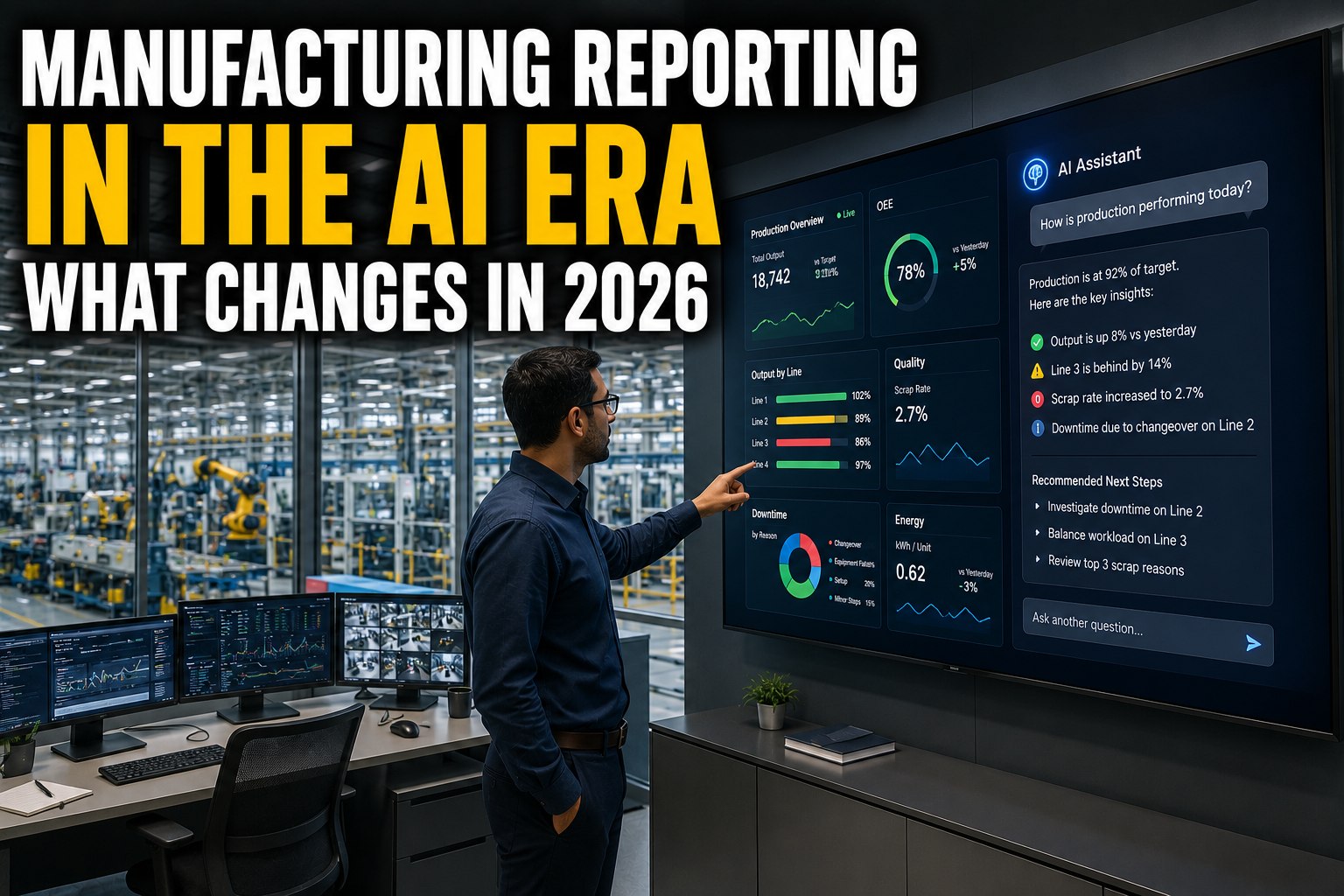
Artificial intelligence is fundamentally reshaping manufacturing reporting, moving the industry from dashboards you have to read to insights that find you. Instead of writing SQL queries, you ask questions in plain English. Instead of hunting for root causes across multiple systems, AI explains why metrics moved and what to do about it. Instead of static PDF reports emailed weekly, you get real-time, auto-generated narratives with prescriptive recommendations delivered to the right person at the right time. This transformation is not theoretical — by early 2026, over two-thirds of manufacturers have adopted some form of AI-powered reporting, with early adopters reporting 30–50% faster time-to-insight and 60–80% reduction in report creation time. This guide explores seven dimensions of how AI changes manufacturing reporting, from the way operators interact with data to how executives make strategic decisions, providing a practical framework for understanding what changes, what stays the same, and how to prepare your organisation for the AI era of manufacturing reporting.
Your Reports Are About to Become Self-Aware
AI-Powered Manufacturing Reporting That Finds Problems Before You Do.
iFactory’s AI engine transforms your manufacturing data into intelligent reports that automatically detect anomalies, explain root causes, and recommend corrective actions. Stop pulling data — let insights find you. Built on your existing infrastructure, deployable in weeks, usable by everyone from operator to COO. Book a demo to see AI-powered reporting in action with your own data.
Manufacturing AI Reporting Scoreboard: 2026 Adoption and Impact
The scoreboard captures four key metrics that define the state of AI-powered manufacturing reporting in 2026. Reports automated measures the percentage of routine reports now generated by AI without human intervention, reflecting the shift from manual authoring to automated narrative generation. Query time tracks how long it takes to go from a natural language question to an actionable insight. Anomaly detection precision measures the accuracy of AI models in identifying real production issues while minimising false positives. The AI adoption rate shows how broadly manufacturers have embraced AI reporting capabilities, with over two-thirds already deployed or piloting.
Six Ways AI Transforms Manufacturing Reporting in 2026
AI does not simply speed up existing reporting processes — it fundamentally changes how reports are created, consumed, and acted upon. The six transformations below highlight the most significant shifts from traditional methods to AI-powered approaches, each representing a leap in productivity, accuracy, and decision velocity. The impact ratings reflect the magnitude of change for manufacturing organisations.
Traditional vs AI-Powered Reporting: Side-by-Side Comparison
The table below compares traditional manufacturing reporting methods with AI-powered alternatives across eight critical dimensions. Traditional approaches rely on SQL queries, manual analysis, static formats, and human authoring, while AI-powered methods use natural language interfaces, automated detection, dynamic distribution, and self-generating narratives. The colour coding highlights how AI dramatically reduces friction in every step of the reporting workflow, from data access to insight delivery.
| Dimension | Traditional Reporting | AI-Powered Reporting |
|---|---|---|
| Query Method | SQL queries and drag-and-drop builders | Natural language questions answered in real time |
| Alert Type | Static threshold alerts with false positives | Contextual anomaly detection with root cause explanation |
| Root Cause | Manual investigation across multiple systems | Automated causal analysis with quantified impact |
| Data Preparation | IT teams prepare data; analysts clean it | Auto-ingestion, cleaning, and schema mapping |
| Report Creation | Days of drag-and-drop and formatting | Minutes with auto-generated narratives and visuals |
| Distribution | Email PDFs and scheduled exports | Personalised push to role-based dashboards and alerts |
| User Experience | Training required; complex navigation | Conversational interface; zero training needed |
| Insight Time | Hours to days from request to answer | Seconds from question to actionable insight |
Stop Reading Dashboards. Let Insights Find You.
Natural Language Queries, Auto-Generated Narratives, and Prescriptive Actions — All in One Platform.
With iFactory, you do not need to learn SQL or navigate complex menu structures. Ask questions in plain English, receive auto-generated report summaries, and get prescriptive recommendations that tell you exactly what to do. Your operators get voice-activated dashboards. Your managers get anomaly explanations. Your executives get predictive what-if scenarios. Book a demo and experience the difference in under 30 minutes.
The AI Reporting Evolution: From Traditional to Augmented to Autonomous
Manufacturing reporting is evolving through three distinct stages. Traditional reporting relies on manual processes: SQL queries, Excel manipulation, static PDFs, and email distribution. Augmented reporting introduces AI assistance: natural language querying, automated anomaly alerts, rich interactive dashboards, and real-time data. Autonomous reporting represents the frontier where AI not only generates insights but executes actions: self-healing responses to anomalies, predictive what-if simulations, voice-controlled interfaces, and auto-narrative reports that require zero human authoring. Most manufacturers are in the late Traditional or early Augmented stage in 2026.
Five Core AI Capabilities Reshaping Manufacturing Reporting
Five distinct AI capabilities are driving the transformation of manufacturing reporting, each at a different stage of maturity. Natural language query and automated anomaly detection are mainstream today, enabling conversational data access and real-time issue identification. Auto-generated reports are rapidly gaining adoption as language models improve. Prescriptive recommendations are emerging as the next frontier, while predictive forecasting represents the future state where AI models simulate production scenarios with high accuracy.
How AI Changes Reporting for Every Role on the Plant Floor
AI-powered reporting does not affect all roles equally. The impact varies by how each role consumes and acts on data. Operators gain hands-free, voice-activated access to real-time line data with AI-guided actions. Quality engineers spend less time investigating defects and more time preventing them. Plant managers get instant answers without waiting for reports. COOs receive cross-plant intelligence that reveals patterns invisible to single-plant analysis. Each role saves meaningful time per week — time that shifts from data gathering to decision-making.
Frequently Asked Questions
Will AI replace manufacturing data analysts and reporting teams?
No. AI augments analysts rather than replacing them. In practice, AI handles the repetitive, time-consuming tasks — writing SQL queries, formatting reports, generating commentary, and monitoring for anomalies — freeing analysts to focus on higher-value work like interpreting trends, designing data governance frameworks, coaching operational teams on using insights, and driving continuous improvement initiatives. Most manufacturers report that their analysts become more productive and engaged after AI adoption because they spend less time on drudge work and more time on strategic analysis. The role shifts from "report creator" to "insight translator," which typically increases job satisfaction and retention. AI also democratises data access, allowing operators and supervisors to answer their own questions without going through the analytics team, which further frees analysts for deep-dive investigations that truly require human judgment and domain expertise.
What data infrastructure do I need to support AI-powered manufacturing reporting?
You need a modern data architecture that provides clean, structured, well-governed data to the AI engine. The good news is that most manufacturers already have the foundational systems: a data warehouse or data lake (often cloud-based), an ETL/ELT pipeline that ingests data from ERP, MES, SCADA, CMMS, and quality systems, and a semantic layer that defines KPIs and business rules. AI-powered reporting layers on top of this existing infrastructure — it does not require a rip-and-replace. The key prerequisites are data quality (the AI is only as good as the data it trains on), consistent KPI definitions across plants, and reliable data freshness (sub-minute for real-time features, hourly for daily reports). Manufacturers that have invested in data governance and a unified analytics platform can enable AI reporting features in four to eight weeks. Those still relying on spreadsheet-based reporting may need a three- to six-month data modernisation phase first.
How accurate are AI anomaly detection and prescriptive recommendations?
Accuracy depends on data quality, model training, and the specific use case. In manufacturing environments, AI anomaly detection typically achieves 85–95% precision after an initial training period of two to four weeks, during which the model learns normal operating patterns for each line, machine, and product type. False positive rates are usually below 10% and decrease over time as the model ingests more data. Prescriptive recommendation accuracy is harder to quantify because it depends on how well the AI understands causal relationships in your specific process. Early deployments achieve 70–85% recommendation relevance, meaning the AI suggests an action that a domain expert would consider appropriate. The key best practice is to implement AI recommendations as decision support rather than automated actions initially — let operators and supervisors review recommendations before acting, which builds trust while the model continues learning. After three to six months, many manufacturers move to semi-automated execution for low-risk, high-confidence recommendations.
How long does it take to implement AI reporting features in a manufacturing plant?
Implementation timelines vary by scope and data readiness. A basic deployment with natural language querying and automated report generation on existing clean data takes four to six weeks for a single plant. Adding anomaly detection extends the timeline to eight to twelve weeks to allow for model training and tuning. Full autonomous capabilities like prescriptive recommendations and predictive what-if modelling require three to six months because they need sufficient historical data (ideally twelve months or more) and iterative model refinement. Multi-plant rollouts typically take three to four months per wave after the initial plant is live, with overlapping waves reducing total timeline. The fastest path to value is to start with NLQ and auto-generated narratives on your best-quality data source (often quality or production data), demonstrate ROI in six weeks, then expand to additional data sources and AI capabilities. Most manufacturers see meaningful time savings in the first month and full ROI within six to nine months of initial deployment.
What is the ROI of AI-powered manufacturing reporting and what metrics improve?
Manufacturers implementing AI-powered reporting typically see a 30–50% reduction in time-to-insight, meaning the time from asking a question to receiving an answer drops from hours to seconds. Report creation time decreases by 60–80% because AI generates narratives, charts, and summaries automatically. Anomaly detection catches issues two to four hours earlier on average than manual monitoring, reducing downtime impact and defect generation. Prescriptive recommendations improve first-time-right decision rate by 15–25% because operators get guided actions rather than raw data. Overall, manufacturers report a 20–40% faster problem resolution cycle and a 15–25% reduction in reporting overhead across the organisation. The financial ROI typically manifests as reduced operational losses from faster anomaly response, higher analyst productivity, lower training costs (because natural language interfaces reduce the learning curve for new users), and better strategic decisions enabled by predictive what-if modelling. Most deployments achieve payback within six to nine months.
The AI Era of Manufacturing Reporting Starts Here.
Transform Your Factory from Historical Record-Keeping to Predictive Intelligence.
iFactory’s AI-native reporting platform brings natural language querying, automated anomaly detection, prescriptive recommendations, and auto-generated report narratives to your manufacturing operations. Built on a modern data architecture that connects to your existing systems. No rip-and-replace. No lengthy migrations. Just smarter, faster, more actionable reporting. Book a demo and see what AI-powered manufacturing reporting looks like in practice.