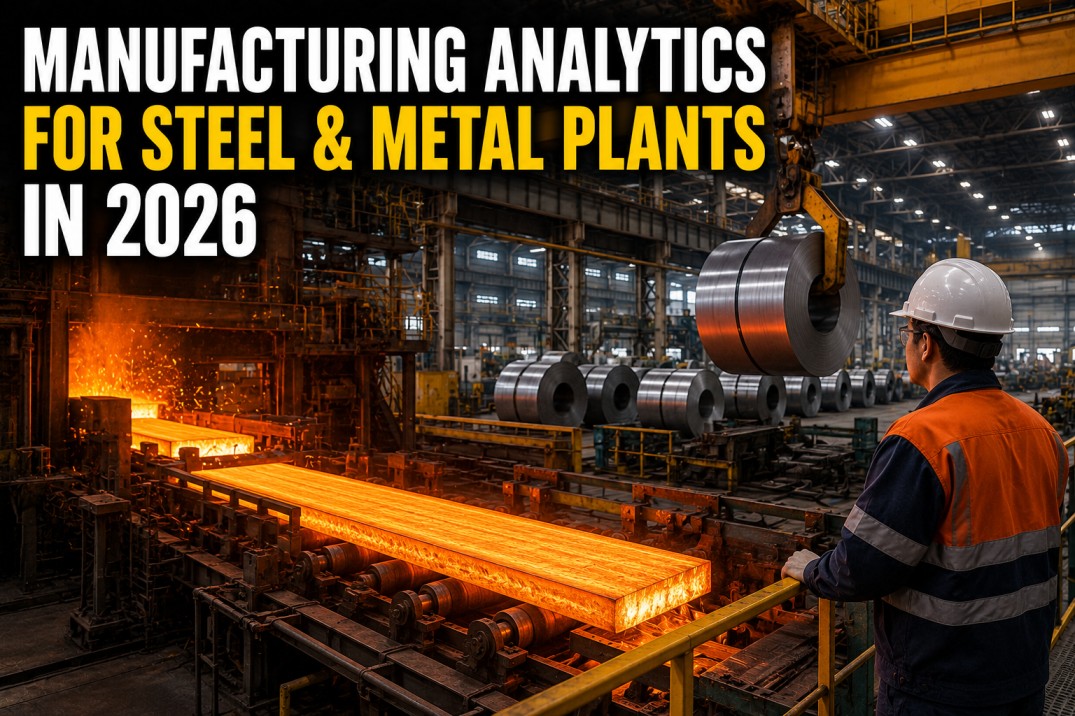
Steel and metal manufacturing demands analytics built for continuous high-temperature processes, extreme energy intensity (15–25% of COGS), and complex phase transitions from molten metal to finished coil. Generic analytics for assembly lines cannot capture electric arc furnace melting, continuous casting, hot rolling, or inline inspection dynamics. This guide presents seven steel-specific capabilities plant leaders can deploy to improve yield, reduce energy cost, minimise defects, and trace steel from scrap charge to dispatch.
Assess Your Steel Plant’s Analytics Readiness
Evaluate your current data sources, KPIs, and reporting against steel-specific analytics requirements.
Assess your steel plant’s data source maturity, KPI coverage, and analytics readiness against steel-specific requirements. iFactory’s assessment framework covers furnace sensors, rolling mill data, inspection systems, energy meters, and production logs. The output identifies gaps, prioritises use cases by ROI, and delivers a custom deployment roadmap aligned with your mill’s product mix and operating rhythm.
Steel Mill Analytics Scoreboard
The scoreboard tracks four headline metrics that define steel mill performance. Yield improvement target of +5% reflects the gap between current yield (86%) and top-quartile performance (91%) — every percentage point on a 500K-ton mill equals $2–3M. Energy cost at 18% of COGS is below the industry benchmark of 22%, achieved through furnace charge optimisation and waste-heat recovery. Surface defect rate at 2.3% represents the primary quality challenge, with top mills running below 1.5%. Furnace utilisation at 87% exceeds the OEE benchmark of 82% thanks to disciplined tap-to-tap management and predictive refractory maintenance.
Six Steel-Specific KPIs: Formula, Benchmark, and Improvement Opportunity
Steel manufacturing requires KPIs that reflect its continuous process nature and energy intensity. Yield % tracks the ratio of good product to total melted weight, with top mills achieving 92–95%. Energy intensity (MWh per ton) is the single largest cost driver. Surface defect rate measures the percentage of coil area with defects. Rolling mill OEE captures availability, performance, and quality at the bottleneck. Furnace utilisation tracks power-on time against calendar time. Scrap ratio measures the percentage of input material lost as scrap. Each KPI has a clear formula, benchmark target, and identified improvement opportunity.
Steel Manufacturing Process Flow: Melting to Dispatch
The steel manufacturing process spans five stages from scrap charging to finished coil dispatch. Melting in the electric arc furnace converts scrap and DRI into molten steel at 1,600°C. Continuous casting solidifies the melt into billets, blooms, or slabs. Hot and cold rolling reduces cross-section and shapes the steel to final dimensions. Finishing includes coating, cutting, heat treatment, and surface inspection. Dispatch covers storage, loading, quality certification, and shipping. Analytics opportunities exist at every stage, from melt optimisation in the EAF to surface defect detection in the finishing line.
See Steel Analytics in Action — Live Mill Dashboard
A demo showing real-time yield tracking, energy monitoring, and defect detection on iFactory.
A 30-minute live session with an iFactory steel specialist showing real-time yield tracking, energy intensity monitoring with furnace heat-by-heat breakdown, surface defect detection via inline camera AI classification, rolling mill OEE with cobble trending, and batch traceability from melt certificate to dispatched coil. See furnace sensors, roll force data, inspection cameras, and production logs unified in one platform with role-based dashboards for operators through executives.
Eight Steel Analytics Use Cases: Source, Approach, and Impact
Steel analytics covers eight high-impact use cases spanning the full production value chain. Yield optimisation uses machine learning on charge composition and casting parameters to improve recovery. Energy monitoring provides real-time intensity tracking and anomaly detection. Defect detection combines computer vision with process parameter correlation. Predictive maintenance models remaining useful life of furnace refractory and mill rolls. Quality tracking applies SPC to mechanical properties and surface finish. Production scheduling optimises furnace campaigns and caster sequencing. Cost analysis delivers per-ton breakdown by grade, route, and shift. Compliance reporting automates ISO and environmental audits from operational data.
| Use Case | Data Source | Analytics Approach | Impact Metric |
|---|---|---|---|
| Yield Optimization | EAF, Caster, Rolling Mill | Machine learning on charge composition, cast speed, rolling temperature to predict and improve yield | Yield +5%, scrap reduction 12% |
| Energy Monitoring | EAF power meters, oxygen sensors, furnace logs | Real-time energy dashboard with intensity tracking, peak demand forecasting, heat-loss anomaly detection | Energy cost -15%, intensity -0.12 MWh/ton |
| Defect Detection | Surface inspection cameras, ultrasonic testers | Computer vision on surface defects + predictive models linking process parameters to internal quality | Defect rate -40%, rework -25% |
| Predictive Maintenance | Vibration sensors, roll force transducers, thermocouples | Remaining-useful-life models on furnace refractory, mill rolls, caster segments with condition-based alerts | Unplanned downtime -35%, maintenance cost -20% |
| Quality Tracking | CMM, tensile testers, spectrometers | Statistical process control on mechanical properties, chemistry, surface finish with real-time out-of-spec alerts | Customer complaints -45%, scrap -18% |
| Production Scheduling | MES, order book, inventory system | Constraint-based scheduling optimisation balancing furnace campaigns, caster sequencing, rolling mill load | OTIF +12%, changeover time -22% |
| Cost Analysis | ERP, energy management, material tracking | Cost-per-ton breakdown by grade, route, and shift with variance analysis against standard cost model | Cost visibility 100%, margin variance +2.3% |
| Compliance Reporting | LIMS, emissions monitors, safety logs | Automated generation of ISO 9001, IATF 16949, environmental compliance reports from operational data | Audit preparation time -60%, compliance score +18% |
Six Steel Manufacturing Challenges and Analytics Solutions
Steel mills face six recurring challenges that analytics directly addresses. High energy cost (the largest variable cost) can be reduced through real-time monitoring and furnace charge optimisation. Yield variability (spanning 82–92%) closes with ML-driven process parameter recommendations. Surface defects (1.5–4% of production) are detected and classified by inline computer vision. Equipment wear on furnace refractory, caster segments, and mill rolls is predicted through condition-based models. Temperature control across the process chain is monitored with real-time drift alerting. Batch tracking from melt to dispatch is digitised with unique heat IDs and automated certificates of analysis.
Five Critical Sensor and Data Sources for Steel Analytics
Steel mill analytics depends on five core data sources. Furnace temperature sensors (bath thermocouples, infrared pyrometers) provide real-time melt temperature for quality and energy control. Roll force transducers measure force, torque, and vibration at each rolling stand for load optimisation and cobble prediction. Surface inspection cameras capture every square inch of strip at full line speed for AI-based defect classification. Energy meters at the furnace transformer and major drives enable granular intensity tracking. Production logs from MES and LIMS provide the transactional context — heat chemistry, cast parameters, rolling schedule, and quality results — that connects sensor data to business outcomes.
Five-Step Implementation Roadmap: Assess to Sustain
The steel analytics implementation roadmap follows five phases. Assess (2–3 weeks): audit existing data sources, KPI gaps, and analytics maturity. Connect (3–4 weeks): integrate furnace sensors, roll transducers, inspection cameras, energy meters, and production logs into the analytics platform. Baseline (2–3 weeks): establish current-state KPIs for yield, energy intensity, defect rate, utilisation, and scrap ratio per grade and route. Optimize (4–6 weeks): deploy yield prediction models, energy dashboards, defect detection, predictive maintenance triggers, and batch traceability. Sustain (ongoing): monitor trends, refine models, expand coverage, and institutionalise data-driven decision-making across the organisation.
Frequently Asked Questions
What makes steel manufacturing analytics different from other industries?
Steel manufacturing presents unique analytics challenges due to its continuous high-temperature processes, extreme energy intensity, and the physical complexity of phase transitions from molten metal to finished coil. Unlike discrete manufacturing where individual parts are tracked, steel analytics must trace material through liquid, semi-solid, and solid states across multiple process steps — each with its own measurement systems, time scales, and quality attributes. Energy cost (15–25% of COGS) is a dominant concern absent from most other manufacturing sectors. Defect detection requires specialised inline inspection (surface cameras, ultrasonic testing) because many defects are internal and only detectable through process parameter correlation. Yield optimisation involves complex trade-offs between melt composition, casting speed, rolling reduction, and finishing temperature. These factors demand steel-specific analytics models, dashboards, and KPIs rather than generic manufacturing analytics tools.
What is the single most impactful analytics use case for a steel mill?
Yield improvement consistently delivers the highest ROI for steel mill analytics programmes. A typical 500,000-ton-per-year mill operating at 87% yield loses 65,000 tons to melt loss, crop ends, cobbles, and reject coils. Each 1% yield improvement recovers 5,000 tons — worth $2–3M at current steel prices. Analytics-driven yield improvement combines multiple levers: optimising charge composition to minimise melt loss, adjusting caster parameters to reduce surface defects and internal voids, fine-tuning rolling temperature and reduction schedules to prevent cobbles, and using machine learning to predict final coil yield from upstream process data. Mills that deploy comprehensive yield analytics typically achieve 3–5% yield improvement within 6–12 months, representing $6–15M in annual savings for a medium-size mill. Predictive models that recommend optimal process settings per grade and dimension are the highest-value component of yield analytics.
How can steel plants reduce energy costs with analytics?
Energy cost represents 15–25% of steel production cost, with the electric arc furnace being the dominant consumer. Analytics reduces energy costs through four mechanisms. First, real-time energy intensity dashboards per heat, per grade, and per shift create visibility and accountability — mills consistently find 5–10% variation between shifts making the same grade. Second, machine learning models predict optimal furnace charge mix (scrap, DRI, pig iron, alloys) to minimise energy input per ton while meeting chemistry targets. Third, peak-demand forecasting and load-shedding algorithms reduce demand charges by scheduling high-power operations during off-peak periods. Fourth, waste-heat recovery analytics identify opportunities to capture and reuse thermal energy from furnace off-gases, cooling water, and hot rolled products. Typical energy analytics programmes deliver 10–18% reduction in energy cost per ton within the first year.
What sensor data is most critical for steel mill analytics?
Five sensor categories form the foundation of steel mill analytics. Furnace temperature sensors (bath thermocouples, infrared pyrometers, lance tip sensors) provide real-time melt temperature — the most critical parameter for steel quality and energy efficiency. Roll force transducers in the rolling mill measure force, torque, and vibration at each stand, enabling cobble prediction, roll wear tracking, and pass-schedule optimisation. Surface inspection cameras (line-scan infrared or visible-light) capture every square inch of strip surface at full line speed, feeding computer vision models that detect and classify defects in real time. Energy meters at the furnace transformer and major motor drives provide the granular consumption data needed for energy intensity tracking and peak management. Production logs from MES and LIMS provide the transactional context — heat chemistry, cast parameters, rolling schedule, and quality results — without which sensor data cannot be correlated to outcomes. The integration of these five data streams is the prerequisite for end-to-end steel analytics.
How does iFactory support analytics for steel and metal plants?
iFactory provides a purpose-built analytics platform for steel and metals manufacturing with pre-built connectors for furnace sensors (EAF, ladle, tundish thermocouples), rolling mill transducers (force, torque, vibration), surface inspection cameras, and energy meters. The platform includes steel-specific KPI templates (yield, energy intensity, defect rate, rolling mill OEE, furnace utilisation, scrap ratio) and pre-configured dashboards for melt shop supervisors, rolling mill operators, plant managers, and energy managers. Machine learning modules support yield prediction, energy optimisation, surface defect classification, and predictive maintenance for furnace refractory and mill rolls. The platform integrates with all major MES, LIMS, and ERP systems used in the steel industry (Siemens, ABB, Primetals, SAP). Deployment follows the five-step roadmap: Assess, Connect, Baseline, Optimize, Sustain — with typical time-to-value of 8–12 weeks for the initial dashboard deployment. iFactory also supports multi-plant rollouts for steel groups with multiple mills, providing consolidated executive dashboards with plant-level drill-down.
Deploy Steel Analytics on Your Mill Floor
iFactory connects to furnace sensors, rolling mill data, and inspection systems out of the box.
iFactory provides pre-built connectors for all five critical steel data sources: furnace thermocouples, roll force transducers, line-scan surface cameras, energy meters, and MES/LIMS logs. Steel-specific KPI templates, role-based dashboards for operators through executives, and ML modules for yield prediction, energy optimisation, defect classification, and predictive maintenance are included out of the box with 8–12 week time-to-value.