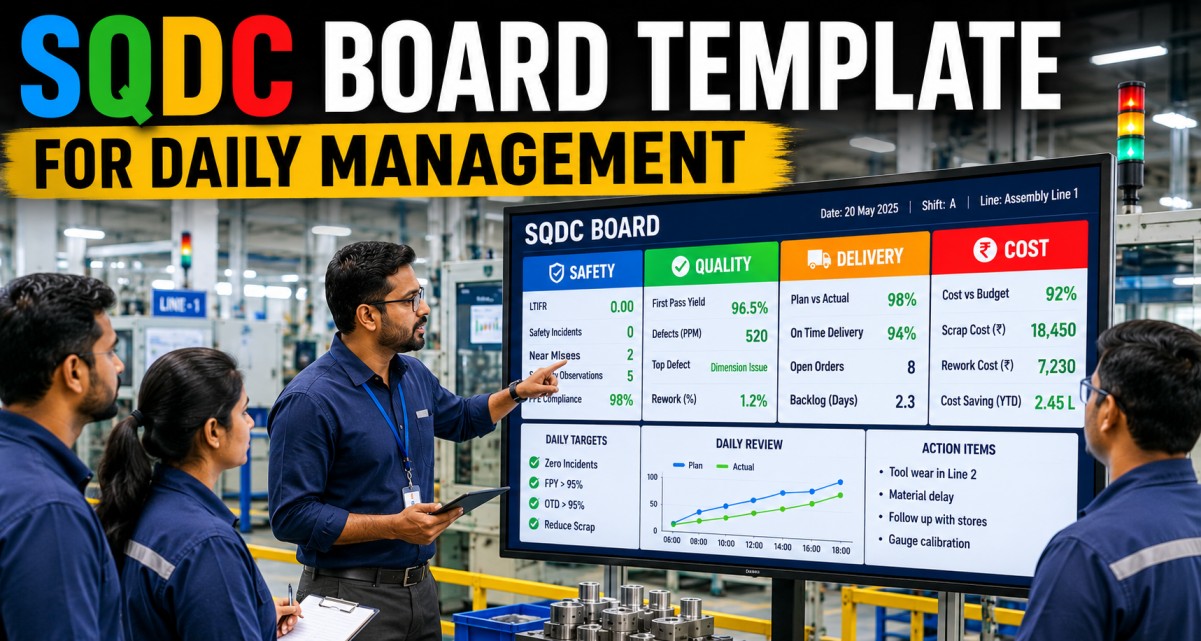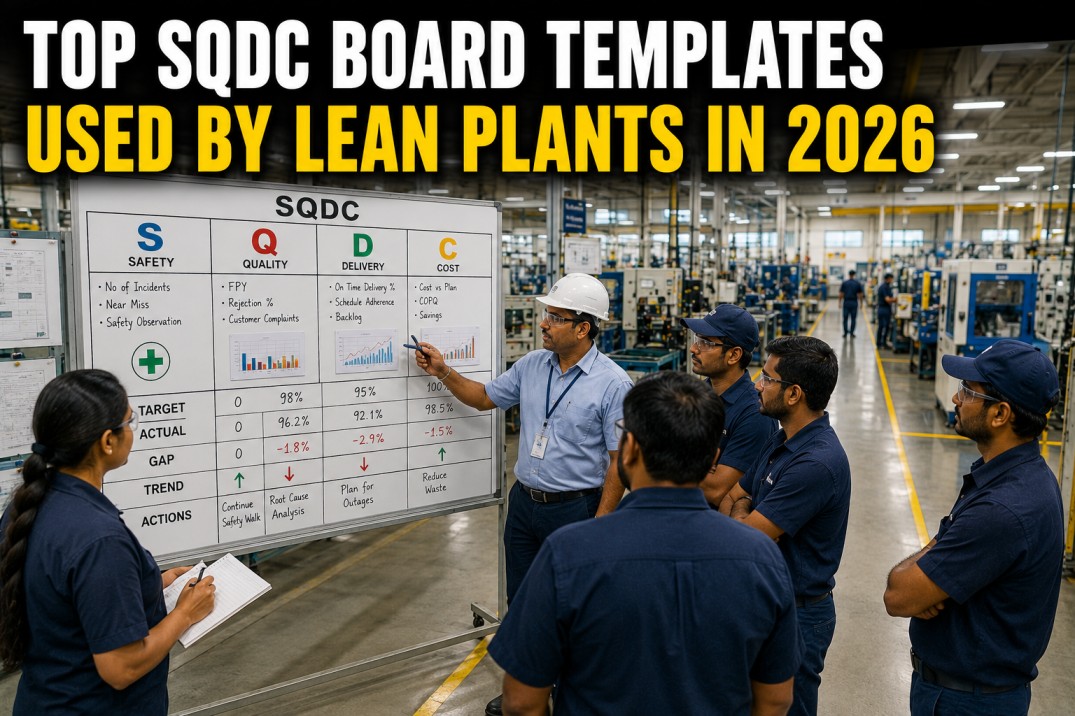
SQDC (Safety, Quality, Delivery, Cost) boards are the backbone of daily lean management in world-class manufacturing plants. These visual management tools bring cross-functional teams together at the gemba each day to review performance across the four critical operational dimensions, identify deviations from target, assign corrective actions, and track continuous improvement progress. But not all SQDC boards are created equal — the right template depends on your plant size, lean maturity, digital readiness, and the specific management rhythm you want to establish. This guide evaluates twelve SQDC board templates used across twenty-four lean manufacturing plants, distilling the best practices and structural patterns that drive measurable improvements in standup effectiveness, action closure rates, and SQDC dimension scores. From traditional whiteboards that cost under fifty dollars to fully digital SQDC boards with live MES integration and automated escalation alerts, we cover the spectrum of options available to plant leaders in 2026.
Which SQDC Board Template Fits Your Plant? Take the 3-Minute Assessment
A Quick Self-Assessment That Matches Your Plant Size, Lean Maturity, and Digital Readiness to the Right SQDC Template.
Not sure whether a physical whiteboard, digital dashboard, or hybrid board is right for your plant? Take our three-minute SQDC board assessment designed for plant managers and continuous improvement leads. Answer ten questions about your plant size, current data infrastructure, team lean experience, and standup culture. The assessment matches your profile to one of twelve SQDC board templates with a readiness score and implementation timeline tailored to your context.
SQDC Board Template Research Scoreboard
The scoreboard summarises the research behind this guide: twelve SQDC board templates reviewed, twenty-four lean manufacturing plants surveyed across discrete and process manufacturing, an average adoption score of 8.2 out of 10 based on operational performance impact ratings, and an average implementation time of three weeks from template selection to go-live. These metrics provide a benchmark for plants evaluating their current SQDC board maturity against industry peers and planning their next improvement cycle.
Six SQDC Board Templates Used by Lean Plants in 2026
Plants use a diverse range of SQDC board formats depending on their size, digital infrastructure, and lean maturity level. The six most widely adopted templates are the Traditional Whiteboard, Digital Dashboard, Hybrid Board, Tiered SQDC, Gemba Walk Board, and SQDC Plus Safety. Each template includes a type classification (Physical, Digital, or Hybrid), a description of its structure and use case, the plant sizes it best suits, and an adoption difficulty rating measured by ease of setup and team training requirements.
Classic whiteboard with hand-written SQDC sections updated during daily standup meetings. Low cost, highly visible, and immediately accessible at the gemba. Best for plants starting their lean journey or those with limited digital infrastructure.
Full-screen digital display showing real-time SQDC metrics pulled from MES, quality systems, and ERP. Live data eliminates manual updates and enables drill-down into root cause data behind each dimension.
Physical whiteboard paired with a small digital inset displaying live KPI feeds. Teams update manual sections during standup while automated data populates the digital zone for deeper analysis and trend tracking.
Multi-level SQDC structure where each tier (Operator, Supervisor, Plant Manager, Executive) sees a role-relevant view of the same SQDC dimensions. Ensures alignment from the gemba to the boardroom without information overload at any level.
Portable or wall-mounted SQDC board designed specifically for gemba walks. Each dimension has a lean metric, current status, and action section that guides leaders through a structured walk and discussion at each stop.
Extended SQDC board that adds a prominent Safety section as a fifth dimension (SQDCS). Safety metrics, near-miss tracking, and safety action items receive equal visual weight alongside productivity dimensions.
SQDC Dimension Deep-Dive: Safety, Quality, Delivery, and Cost
Each SQDC dimension has a distinct focus area, set of metrics, and board layout that drives a specific daily standup discussion. Safety tracks leading and lagging safety indicators with a green status dot and action list. Quality focuses on FPY, defect Pareto analysis, and quality alert tracking. Delivery monitors on-time delivery and schedule attainment with plan-versus-actual charts. Cost tracks production cost per unit, variance, and scrap cost with a variance waterfall. Understanding the structure and intent of each dimension is essential for designing an SQDC board that drives the right daily conversations.
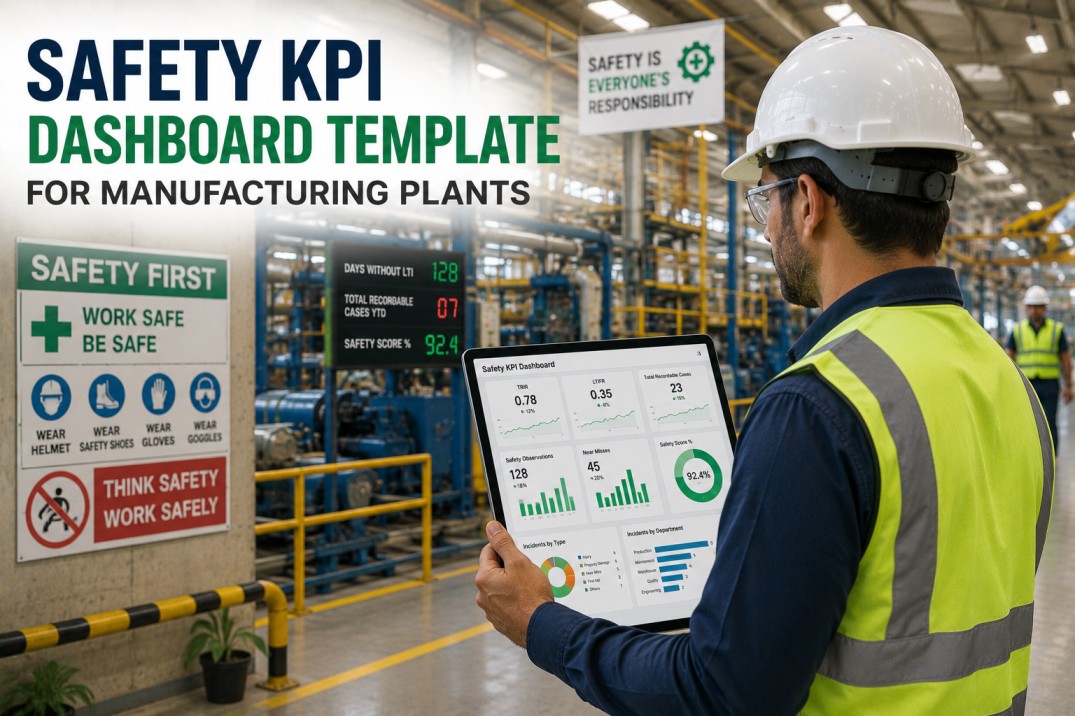
Safety is the foundation of the SQDC framework. The safety dimension tracks leading and lagging indicators including near-miss reports, safety observations, TRIR, days since lost-time incident, and safety action closure rates. The board section typically displays a safety KPI card, a trailing 12-month incident trend chart, open safety actions with owners and due dates, and a visible safety status indicator (green/amber/red). Daily standup reviews cover any safety events from the previous shift, open near-miss follow-ups, and safety observations logged during the past 24 hours.
The quality dimension focuses on first-pass yield (FPY), defect rates, scrap percentage, customer complaints, and DPPM. The board section typically displays current FPY against target, top defect Pareto chart, quality alert status, and open quality improvement actions. Daily standup discussion covers quality issues from the previous shift, any new non-conformances or customer complaints, progress on quality improvement projects, and escalation of unresolved quality concerns to the appropriate support functions.
The delivery dimension tracks on-time delivery (OTD), schedule attainment, production throughput versus plan, and backlog status. The board section typically displays current OTD percentage, daily production output versus target with variance, customer delivery status for orders shipping that day, and any delivery misses or expedite requests. Standup discussion reviews schedule attainment for the previous shift, identifies any customer delivery risks, and coordinates cross-functional response to material shortages or capacity constraints affecting delivery commitments.
The cost dimension monitors production cost per unit, waste and scrap cost, labour efficiency, energy cost per unit, and overtime percentage. The board section typically displays actual cost versus standard cost, cost variance by category (material, labour, overhead), scrap cost trend, and open cost-reduction actions. Daily standup reviews highlight any cost variances exceeding threshold, tracks progress on cost-reduction kaizen events, and identifies opportunities for waste elimination across material usage, energy consumption, and labour productivity.
See the Digital SQDC Board in Action — Live Demo
A 10-Minute Walkthrough of iFactory’s Digital SQDC Board Showing Real-Time Dimension Updates, Escalation Alerts, and Daily Standup Integration.
Join a focused ten-minute demo of iFactory’s Digital SQDC Board. See how live Safety, Quality, Delivery, and Cost metrics update automatically from your MES, quality, and ERP systems. Watch escalation alerts trigger in real-time when any dimension crosses its threshold, and learn how the board integrates into daily standup workflows with role-based views for operators, supervisors, and plant managers.
SQDC Board Template Comparison: Feature Coverage Matrix
The feature coverage matrix compares twelve SQDC board templates across six evaluation criteria: Real-Time Updates, Remote Access, Audit Trail, Cost-Effectiveness, Setup Time, and Lean Compliance. Digital and hybrid templates lead in real-time updates, remote access, and audit trail capabilities, while physical templates excel in cost-effectiveness and setup speed. The matrix helps plant leaders make an informed template selection by mapping their priority criteria against the coverage profile of each template option.
| SQDC Board Template | Real-Time UpdatesLive data refresh from source systems | Remote AccessView from off-site or mobile devices | Audit TrailHistory of changes and updates logged | Cost-EffectiveLow total cost of ownership | Setup TimeDays to implement and configure | Lean ComplianceAligns with lean daily management |
|---|---|---|---|---|---|---|
| Traditional Whiteboard | ||||||
| Digital Dashboard | ||||||
| Hybrid Board | ||||||
| Tiered SQDC | ||||||
| Gemba Walk Board | ||||||
| SQDC Plus Safety | ||||||
| Visual Factory Board | ||||||
| Daily Management Board | ||||||
| KPI Dashboard Board | ||||||
| Problem-Solving Board | ||||||
| Huddle Board | ||||||
| Digital Twin Board |
Physical SQDC Board vs Digital SQDC Board: Side-by-Side Comparison
The side-by-side comparison illustrates the structural and functional differences between a physical whiteboard SQDC and a digital dashboard SQDC. The physical board (left) uses hand-written section headers for each dimension, manual status entries, and a paper-based action log updated during the daily standup. The digital board (right) displays live KPI cards with real-time data, trend sparklines, cost variance breakdowns, and automated quality threshold alerts. The comparison highlights how digital boards reduce manual effort, improve data accuracy, and enable remote visibility while physical boards offer simplicity, low cost, and immediate gemba accessibility.
Six Best Practices for SQDC Board Adoption That Drive Results
Adopting an SQDC board successfully requires more than choosing the right template and installing it on the wall. The six best practices outlined below are drawn from the highest-adoption plants surveyed. Daily standup integration, owner assignment, visual standardisation, and data discipline emerged as high-impact practices, while escalation rules and periodic reviews provide medium-impact reinforcement. Plants that adopt all six practices achieve measurably higher SQDC dimension scores and action closure rates.
Integrate the SQDC board into the daily standup rhythm — review each SQDC dimension in sequence, discuss deviations from target, and assign action owners before the standup concludes. Plants that embed SQDC into their standup achieve 40% higher action closure rates.
Every metric, every action, and every escalation on the SQDC board must have a named owner. Owners are responsible for updating their assigned metric before each standup, driving corrective actions, and communicating status changes to the team.
Define a consistent visual standard for the SQDC board — colour coding (green/amber/red), icon conventions, data formatting, and update frequency. A standardised board is readable by anyone on any shift without interpretation ambiguity.
Establish data update discipline — metrics must be refreshed before the daily standup every day without exception. For manual boards this means updating by 07:00 each morning. For digital boards this means ensuring data pipelines are operational and validated.
Define clear escalation rules for each SQDC dimension — specify the threshold that triggers escalation, the person notified, and the expected response time. For example, if FPY drops below 90%, the quality manager receives an automatic alert and must respond within 30 minutes.
Conduct a structured monthly review of the SQDC board itself — assess whether the metrics, targets, and visual structure still align with current operational priorities. Update dimension metrics, adjust targets, and retire metrics that no longer drive decisions.
Five Steps to Implement Your SQDC Board Template
Implementing an SQDC board follows a five-step process designed to move from current-state assessment to go-live within three to four weeks. Each step has a defined duration and key objective: assess your existing board and team readiness, select the template that matches your plant profile, configure the SQDC dimensions and visual layout, train operators and supervisors on the board structure and standup rhythm, and launch with daily standup reviews and a thirty-day iteration window to refine the board based on real-world feedback.
Evaluate your existing SQDC board layout, metric selection, update frequency, and team engagement. Identify gaps in dimension coverage, data reliability issues, and visual standardisation needs.
Choose the SQDC board template that best matches your plant size, lean maturity level, and digital readiness. Consider physical, digital, or hybrid options based on your infrastructure and team capability.
Define the specific metrics for each SQDC dimension, set targets and thresholds for green/amber/red status indicators, and design the board layout to match your team’s standup flow and visual management principles.
Train operators, supervisors, and support staff on the new SQDC board structure, update procedures, standup review sequence, and escalation protocols. Conduct practice standups until the rhythm becomes natural.
Launch the SQDC board with a daily standup review cadence. Monitor adoption, collect feedback, and iterate on the board design during the first 30 days. Track action closure rates and dimension score trends.
Frequently Asked Questions About SQDC Board Templates
What is an SQDC board and why is it central to lean manufacturing?
An SQDC board is a visual management tool used in lean manufacturing to track four critical dimensions of operational performance: Safety, Quality, Delivery, and Cost. The board is typically reviewed daily during a team standup meeting at the gemba (where value is created). Each dimension displays current performance against target using simple visual indicators such as green/amber/red status dots, trend charts, and action trackers. The SQDC board is central to lean daily management because it creates a structured rhythm for reviewing performance cross-functionally, identifying deviations early, assigning corrective actions with named owners, and driving continuous improvement at every level of the organisation. Digital SQDC boards extend this concept by automating data updates, providing real-time drill-down capability, and enabling remote access for multi-site visibility.
What are the main differences between physical and digital SQDC boards?
Physical SQDC boards use whiteboards, magnetic sheets, or printed charts updated manually during or before the daily standup. They are low-cost, highly visible at the gemba, and easy to modify but require disciplined manual updating and provide no historical trend analysis or remote access. Digital SQDC boards display live data pulled from MES, ERP, quality systems, and other source systems on a screen or dashboard. They eliminate manual updating, enable drill-down into root cause data, provide automated trend analysis and escalation alerts, and support role-based views for operators, supervisors, and executives. Hybrid boards combine a physical whiteboard with a small digital screen showing live KPI feeds, giving teams the tactile engagement of physical boards with the data accuracy of digital updates. The choice depends on plant size, digital maturity, budget, and the team’s readiness for technology adoption.
Which SQDC metrics should I include for each dimension?
Safety metrics commonly include TRIR (Total Recordable Incident Rate), days since last lost-time incident, near-miss reports, safety observation count, and safety action closure rate. Quality metrics include first-pass yield (FPY), defect rate, scrap percentage, DPPM, and customer complaint count. Delivery metrics include on-time delivery (OTD), schedule attainment, production output versus plan, and backlog status. Cost metrics include production cost per unit, cost variance by category (material, labour, overhead), scrap cost, overtime percentage, and energy cost per unit. Each plant should select metrics that align with its strategic priorities — a plant focused on quality improvement might include more granular quality metrics while a plant launching new products might emphasise delivery metrics tracked against launch milestones.
How do I implement an SQDC board in my plant?
Implementing an SQDC board follows a structured five-step process. Step 1 – Assess: evaluate your current visual management practices, identify gaps in SQDC dimension coverage, and determine whether a physical, digital, or hybrid board best fits your plant size and digital maturity. Step 2 – Select: choose a template that matches your assessment — traditional whiteboard for small plants starting their lean journey, digital dashboard for mid-to-large plants with existing data systems, or hybrid board for plants that want the best of both approaches. Step 3 – Configure: define the specific metrics for each SQDC dimension, set targets and thresholds for green/amber/red status, and design the board layout to match your standup flow. Step 4 – Train: train operators, supervisors, and support staff on the SQDC structure, update procedures, and standup review sequence. Step 5 – Go Live: launch the board with a daily standup cadence, collect feedback, iterate on the design during the first 30 days, and track adoption metrics such as action closure rate and dimension score trends.
How do I measure the effectiveness of an SQDC board?
The effectiveness of an SQDC board should be measured through both process metrics and outcome metrics. Process metrics include daily standup attendance rate, SQDC dimension update timeliness (percentage of days all metrics were updated before standup), action closure rate (percentage of identified actions closed within the target timeframe), escalation response time for alerts triggered by SQDC dimension thresholds, and user feedback scores from operators and supervisors. Outcome metrics include improvement in each SQDC dimension score over time (reduced TRIR, improved FPY, higher OTIF, lower cost per unit), reduction in the number of days with any SQDC dimension in red status, and correlation between SQDC board adoption and overall plant performance indicators such as OEE and EBITDA. An effective SQDC board should show measurable improvement in both process discipline and operational outcomes within three to six months of deployment.
From Whiteboard to Live Digital SQDC — Deployed in Under a Week
iFactory’s Digital SQDC Board Replaces Manual Whiteboards with Live Metrics, Automated Escalation, and Role-Based Views — No Coding Required.
Transition your plant from manual whiteboard SQDC to a live digital SQDC board in under a week with iFactory’s pre-built template. Connect your MES, quality, and ERP systems to populate Safety, Quality, Delivery, and Cost dimensions in real time. Configure green/amber/red thresholds per metric, set automated escalation rules for threshold breaches, and assign role-based views for operators, supervisors, and plant managers — all through a visual configuration interface with no coding required. Book a demo to see the five-day deployment roadmap.