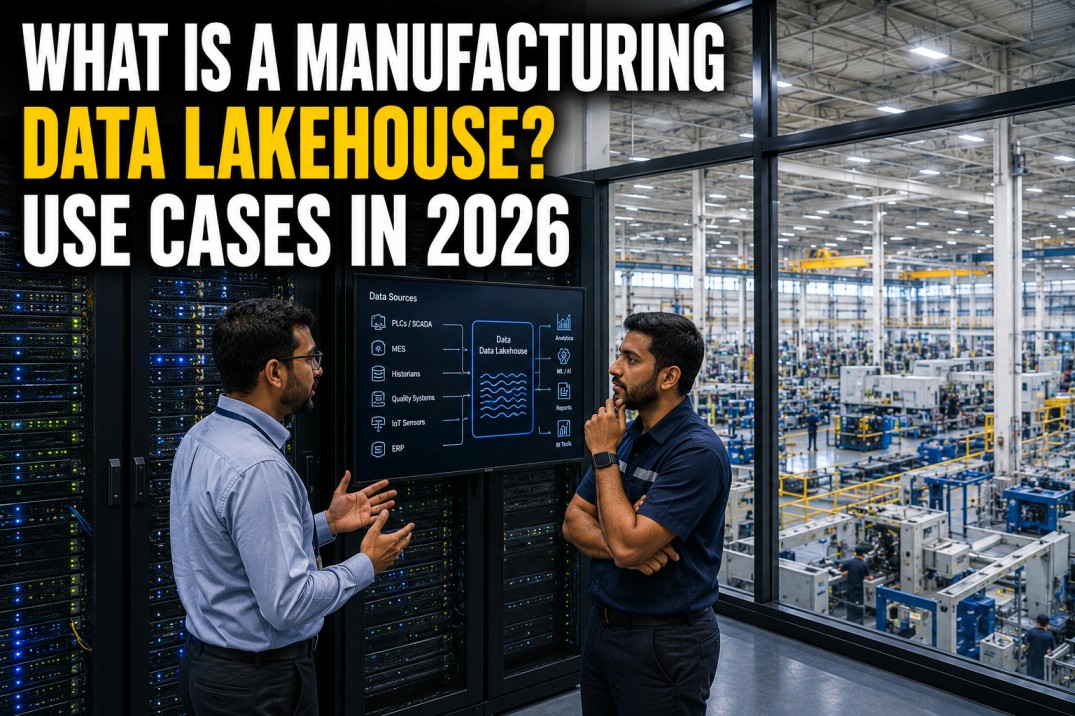
A data lakehouse is an open architecture that combines the flexibility, scalability, and low-cost storage of a data lake with the ACID transaction support, schema enforcement, and high-performance SQL query capabilities of a data warehouse. For manufacturing organisations, the lakehouse is rapidly becoming the preferred analytics foundation because it eliminates the traditional trade-off between storing vast amounts of raw operational data and running fast, governed analytical queries against that same data. In a typical plant environment, data arrives from PLCs, SCADA systems, MES platforms, ERP systems, CMMS tools, and IoT sensors at rates exceeding millions of data points per hour. A lakehouse ingests all of this data into a single object storage layer — without requiring separate systems for raw data exploration and structured BI reporting — and uses open table formats like Delta Lake, Apache Iceberg, or Apache Hudi to provide warehouse-grade query performance on petabyte-scale datasets. Manufacturing teams gain the ability to run real-time dashboards alongside deep historical analytics and machine learning model training on the same unified data platform, eliminating data silos, reducing infrastructure complexity, and cutting total analytics cost by 25–40% compared to maintaining separate lake and warehouse architectures. This article explores the six primary use cases where a data lakehouse delivers measurable value in manufacturing and provides a practical architecture framework for evaluating, piloting, and scaling lakehouse adoption in your plant environment.
Is Your Plant Ready for a Data Lakehouse?
Take the 5-Minute Assessment — Evaluate Your Current Data Architecture Against Lakehouse Readiness Criteria and Get a Personalised Migration Roadmap.
This self-assessment walks through your current data stack across five dimensions: data volume and variety, query performance requirements, real-time streaming needs, governance maturity, and infrastructure cost structure. Based on your responses, you will receive a custom readiness score, a recommended adoption approach, and a high-level migration roadmap aligned to your plant’s specific use cases, team capabilities, and timeline constraints. The assessment takes approximately five minutes and is designed for plant IT managers, data architects, and operations leaders evaluating analytics platform modernisation.
Manufacturing Data Lakehouse in Numbers
The scoreboard captures the key capabilities and adoption metrics that define the data lakehouse value proposition for manufacturing. Data volumes exceeding 10 terabytes, sub-100-millisecond query performance, six identified use cases spanning operations to finance, and 84% year-over-year adoption growth signal that the lakehouse is not a theoretical architecture — it is a proven platform choice being deployed across discrete and process manufacturing environments to unify analytics and eliminate data silos.
Data Lake vs Data Warehouse vs Data Lakehouse
Understanding the differences between these three architectures is essential for selecting the right analytics foundation for your manufacturing environment. The data lake offers unlimited scalability and low-cost storage but lacks transaction guarantees and query performance. The data warehouse delivers fast SQL queries and data consistency but at high storage cost and limited flexibility for raw or semi-structured data. The data lakehouse combines the best of both — lake-scalable storage with warehouse-grade performance and ACID transactions — on a single platform.
Stores raw data in native format
Schema-on-read for flexibility
Low-cost object storage tier
- Unlimited scalability for any data type
- Lowest storage cost per terabyte
- Ideal for data science exploration
- No ACID transaction support across writes
- No schema enforcement leads to quality issues
- Slow query performance without indexing
Stores processed structured data only
Schema-on-write for data quality
Optimised for fast SQL queries
- Best query performance for BI dashboards
- ACID compliance and data consistency
- Built-in indexing and partitioning
- Very expensive storage for large volumes
- Cannot store raw or semi-structured data
- ETL latency before data is usable
Combines lake storage with warehouse performance
ACID transactions on object storage
Single copy of data for all workloads
- Unlimited scalability with warehouse query speed
- Single source of truth for all analytics
- Real-time streaming plus batch in one platform
- Lower total cost than warehouse-only approach
- Newer technology with smaller ecosystem
- Requires careful table format selection
- Migration complexity from legacy architectures
The Five-Layer Data Lakehouse Architecture
A manufacturing data lakehouse is composed of five distinct layers that work together to ingest, store, process, analyse, and consume plant data. The ingestion layer handles batch and streaming data from PLCs, MES, ERP, CMMS, and IoT sources. The storage layer uses open table formats to provide ACID transactions on cost-effective object storage. The processing layer transforms and enriches raw data. The analytics layer provides SQL engines, ML frameworks, and streaming query capabilities. The consumption layer connects to BI tools, custom dashboards, and data science notebooks.
See the Lakehouse Architecture in Action
A 10-Minute Walkthrough of iFactory’s Lakehouse-Ready Architecture Showing Data Ingestion, Storage, and Real-Time Query Performance.
Watch how iFactory ingests live sensor data from a simulated production line, stores it in a lakehouse using open table formats, and runs sub-second queries across five years of historical data alongside real-time streaming metrics. The walkthrough covers the entire data pipeline from PLC to dashboard and demonstrates how the lakehouse eliminates data duplication while supporting concurrent analytics, reporting, and ML workloads on a single copy of data.
Lakehouse Use Cases Across Manufacturing: Capability Assessment
The comparison table evaluates six common manufacturing analytics use cases across eight criteria that determine how well each use case fits the lakehouse architecture. Real-time OEE and quality analytics score highest on refresh frequency and real-time support, while predictive maintenance and supply chain visibility require the greatest data volume and ML integration. Financial reporting demands the highest query complexity and cost efficiency but has minimal real-time requirements.
| Use Case | Data Volume | Query Complexity | Refresh Frequency | Real-Time Support | Historical Depth | Schema Flexibility | ML Integration | Cost Efficiency |
|---|---|---|---|---|---|---|---|---|
| Real-Time OEE | ||||||||
| Quality Analytics | ||||||||
| Predictive Maintenance | ||||||||
| Energy Optimization | ||||||||
| Supply Chain Visibility | ||||||||
| Financial Reporting |
Six Strategic Benefits of Adopting a Data Lakehouse in Manufacturing
Manufacturing organisations that adopt a lakehouse architecture report measurable benefits across infrastructure cost, data accessibility, analytics velocity, and platform scalability. The most significant gains come from eliminating duplicate data storage, reducing ETL pipeline complexity, and providing a single governed platform that serves all analytics use cases — from operational dashboards to data science — without data movement between systems.
Five-Stage Data Lakehouse Adoption Roadmap for Manufacturing
Migrating from a legacy data architecture to a lakehouse is a structured multi-stage process that typically spans 18–40 weeks from initial assessment to full-scale deployment. Each stage builds on the previous one, starting with a comprehensive architecture audit and ending with ongoing optimisation of partitioning, lifecycle management, and cost governance. The phased approach minimises operational risk and allows manufacturing teams to demonstrate value early with a focused pilot use case.
Frequently Asked Questions
What is a data lakehouse and how is it different from a data lake or warehouse?
A data lakehouse is a modern data architecture that combines the flexibility and low-cost storage of a data lake with the ACID transaction support, schema enforcement, and high-performance SQL query capabilities of a data warehouse. Unlike a data lake, which stores raw data in native formats without transactional guarantees, a lakehouse uses open table formats such as Delta Lake, Apache Iceberg, or Apache Hudi to provide ACID transactions, time travel, and schema evolution on object storage. Unlike a data warehouse, which requires data to be transformed and structured before loading (schema-on-write), a lakehouse supports both schema-on-read for raw data exploration and schema-on-write for governed datasets. This dual capability makes the lakehouse uniquely suited for manufacturing environments where you need to combine real-time sensor streams, unstructured IoT logs, and structured quality and production data in a single analytics platform without maintaining separate systems. The result is a single copy of data that serves all analytics use cases — from real-time dashboards to machine learning model training to enterprise financial reporting — eliminating data duplication and reducing infrastructure complexity.
What are the main use cases for a data lakehouse in manufacturing?
There are six primary use cases where a data lakehouse delivers significant value in manufacturing. First, real-time OEE analytics combines streaming machine data with historical production records to provide accurate, drill-down OEE calculations without data movement between systems. Second, quality analytics unifies in-process quality measurements, lab test results, and defect data for root cause analysis across multiple product runs and material lots. Third, predictive maintenance ingests high-frequency sensor data, maintenance logs, and equipment metadata into a single platform for training and serving ML models. Fourth, energy optimisation consolidates utility meter readings, production schedules, and weather data for consumption forecasting and anomaly detection. Fifth, supply chain visibility integrates tier-supplier data, inbound logistics, and internal production schedules for end-to-end transparency. Sixth, financial reporting combines operational metrics with ERP cost data for accurate product costing and margin analysis. Each use case benefits from the lakehouse’s ability to handle real-time streaming, unstructured data, and complex SQL queries on the same platform with a single copy of data.
How does a lakehouse improve manufacturing analytics performance?
A lakehouse improves analytics performance in four key ways. First, query performance is comparable to a data warehouse because open table formats use indexing, statistics collection, and data skipping to minimise data scanned during queries. Second, because all data resides in a single storage layer, there is no data movement between systems for different use cases — the same data serves real-time dashboards, ad hoc SQL analysis, and ML model training without additional ETL. Third, lakehouse architectures support concurrent reads and writes with ACID guarantees, so data ingestion from production systems does not block analytical queries and vice versa. Fourth, modern lakehouse query engines use vectorised execution and caching to deliver sub-second query response times on petabyte-scale datasets. For manufacturing, this means an OEE analyst can query five years of production data with sub-second response, while the same platform simultaneously ingests real-time sensor data from thousands of PLCs and serves an ML model training pipeline — all without performance degradation or data duplication.
What is the cost benefit of moving to a lakehouse architecture?
The primary cost benefit of a lakehouse architecture is eliminating the need for separate data lake and data warehouse systems, each with its own storage, compute, and licensing costs. In a traditional two-tier architecture, organisations pay for duplicated storage — raw data in the lake, transformed data in the warehouse — and separate compute resources. A lakehouse stores a single copy of data on low-cost object storage, typically 80–90% cheaper than cloud data warehouse storage per terabyte, and uses open table formats that avoid vendor lock-in and associated licensing fees. Organisations typically reduce their total analytics infrastructure cost by 25–40% when consolidating from separate lake and warehouse systems. Additional savings come from reduced ETL development and maintenance since data does not need to be moved and transformed for different use cases, and from lower data engineering overhead because governance policies, access controls, and data quality rules are defined once for the single platform.
How do I migrate from legacy data architecture to a lakehouse?
Migrating from a legacy data architecture to a lakehouse follows a structured five-stage approach. Stage 1 (Assess, 2–4 weeks): audit your current data architecture, catalog all data sources, identify which datasets are critical for lakehouse migration, and define success criteria. Stage 2 (Pilot, 4–8 weeks): select one high-value, low-complexity use case such as OEE analytics, set up the lakehouse ingestion pipeline from one or two production data sources, validate query performance against your existing warehouse, and train a small group of analysts on the new platform. Stage 3 (Migrate, 8–16 weeks): migrate priority datasets from legacy systems, establish data governance policies including naming conventions, access controls, and data quality rules, and configure lakehouse-native security and auditing. Stage 4 (Scale, 4–12 weeks): expand to additional use cases and plant sites, integrate with existing BI tools and ML workflows, and gradually decommission legacy parallel systems. Stage 5 (Optimise, ongoing): fine-tune table partitioning and clustering, implement automated data lifecycle and retention policies, and establish continuous cost monitoring and query performance optimisation. Throughout the migration, maintain parallel operation of legacy systems until the lakehouse is validated for all critical use cases.
Unify Your Plant Data on a Lakehouse Architecture — Deployed in Weeks
iFactory’s Lakehouse-Ready Platform Combines Data Lake Flexibility with Warehouse Performance — Purpose-Built for Manufacturing.
iFactory’s manufacturing analytics platform is built on a lakehouse-native architecture that ingests data from any plant-floor source, stores it in open table formats on your preferred cloud or on-premise object storage, and provides sub-second query performance across all your manufacturing data. Deployment typically takes two to four weeks for a pilot use case, and the platform scales organically as you add more plants, data sources, and analytics use cases. Book a demo to see the lakehouse architecture configured for your manufacturing environment.