Every empty shelf is a broken promise to your customer — and a direct hit to your revenue. In the FMCG industry, where product lifecycles are measured in days and consumer loyalty shifts with a single stockout, traditional demand planning is no longer enough. AI-powered demand forecasting is helping FMCG brands cut stockouts by 15–30%, reduce inventory waste by up to 50%, and unlock forecast accuracy levels that spreadsheets simply cannot match. The result? Leaner operations, fresher shelves, and stronger margins — without overstocking a single SKU. Book a free demo to see how iFactory brings AI-powered demand intelligence to your supply chain.
AI Demand Forecasting in FMCG (2026): Cut Stockouts by 15–30% & Reduce Inventory Waste
How Machine Learning Is Transforming FMCG Supply Chains — From Reactive Guesswork to Predictive Precision
Why Traditional Demand Planning Is Costing FMCG Brands Millions
Spreadsheets and gut instinct cannot keep pace with modern consumer volatility.
The Hidden Price of Getting Demand Wrong
In FMCG, every forecasting error triggers a chain reaction across your entire supply chain.
Stockouts
8% average out-of-stock rate in FMCG. 40% of affected customers switch to a competitor brand immediately. Retailers lose an estimated $984 billion annually from unavailable products globally.
Overstocking & Waste
Global supply chain waste is projected to reach $540 billion in 2026. For perishable FMCG goods, overstocking does not create a buffer — it creates spoilage, markdowns, and margin erosion.
Bullwhip Effect
One inaccurate forecast at the retail level amplifies into massive distortions upstream — overproduction at the factory, excess raw material purchases, and warehouse congestion across the entire network.
Eroded Consumer Trust
34% of consumers switch brands after just two stockout experiences. In FMCG where margins are below 2%, losing repeat customers is existential — not just inconvenient.
The AI Demand Forecasting Engine — What Powers Predictive FMCG
Machine learning models ingest diverse data signals to predict demand at a granularity spreadsheets cannot achieve.
Multi-Signal Ingestion
AI models consume historical sales, POS transactions, weather forecasts, social media trends, promotional calendars, economic indicators, and competitor pricing — simultaneously. This multi-variable analysis captures demand drivers that single-source forecasting completely misses.
Pattern Recognition & Learning
Machine learning algorithms identify non-linear relationships in demand data — promotional spikes, regional seasonality, cannibalization effects, and festival-driven surges. Models continuously self-correct with each new data cycle, improving accuracy over time without manual intervention.
Automated Replenishment Signals
Forecasts feed directly into inventory management and S&OP systems — triggering purchase orders, adjusting safety stock levels, and rebalancing distribution across warehouses. The gap between prediction and action shrinks from days to minutes.
What-If Scenario Planning
Run simulations before committing inventory: What happens if a heatwave hits next week? What if a competitor launches a 30% discount? AI lets you stress-test your supply chain against multiple demand scenarios and choose the optimal response.
Your Customers Expect Full Shelves. Your Supply Chain Should Predict That.
iFactory connects demand signals, maintenance intelligence, and production scheduling into one AI-powered platform — ensuring the right product reaches the right shelf at the right time.
What Feeds an AI Demand Forecasting Model in FMCG?
Transaction-level sales data by SKU, store, channel, and time period — the baseline foundation for any demand model.
Planned discounts, trade promotions, and marketing campaigns that create demand spikes AI must anticipate — not react to.
Temperature, rainfall, and seasonal patterns that directly influence beverage, ice cream, personal care, and seasonal product demand.
Social media sentiment, search volume spikes, and trending product interest that signal demand shifts before they appear in sales data.
Consumer confidence, inflation rates, and disposable income data that shape purchasing power and category-level demand elasticity.
Current stock levels, lead times, supplier capacity, and warehouse distribution data that converts forecasts into actionable replenishment.
What AI Demand Forecasting Actually Delivers
Measurable outcomes from FMCG brands that moved beyond spreadsheet forecasting.
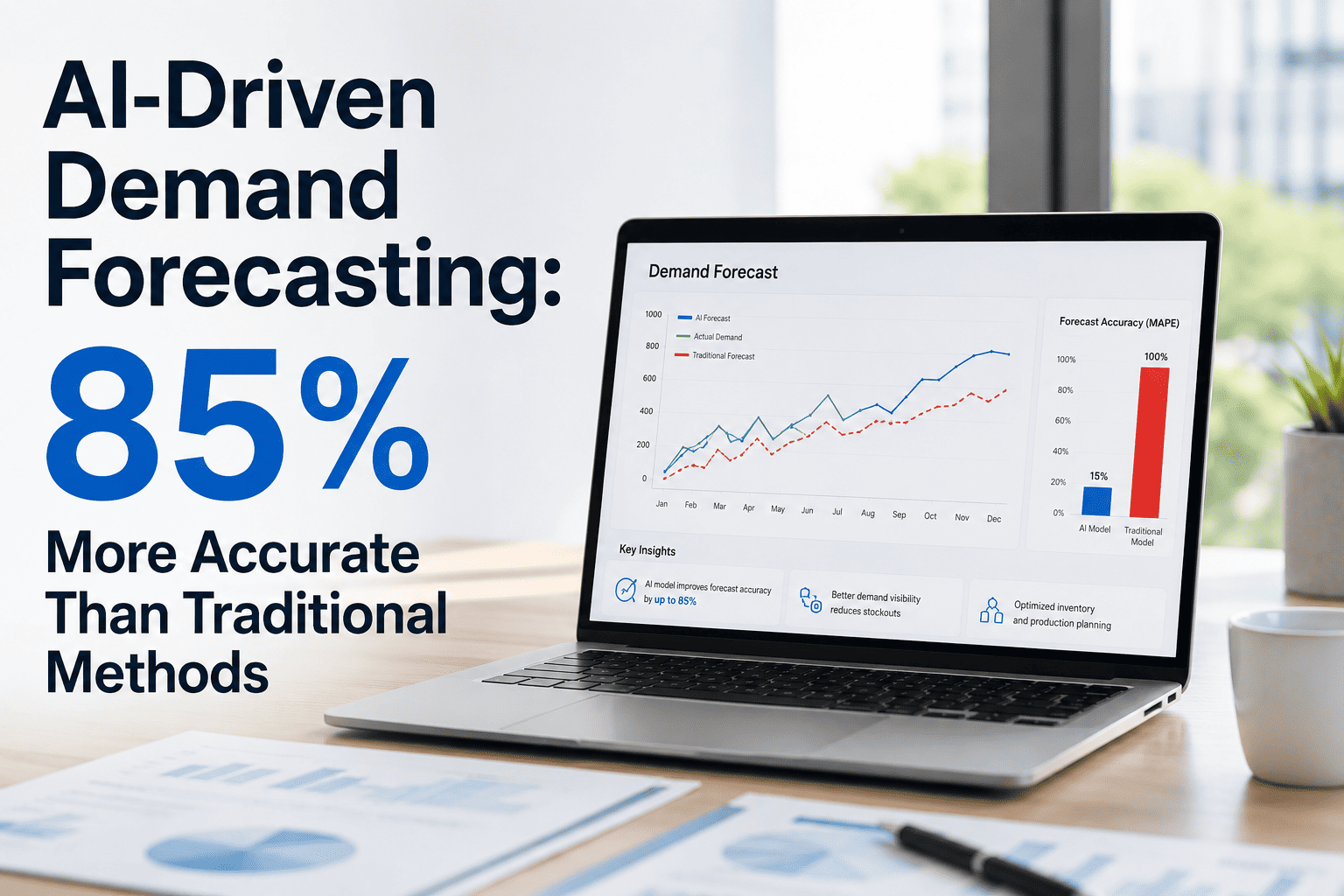
AI-driven models consistently cut forecast errors by 20–50% compared to traditional statistical methods, according to McKinsey research across retail and FMCG sectors.
Organizations implementing AI demand forecasting report up to 65% reduction in lost sales due to stockouts — by predicting demand surges before they happen.
Smarter demand predictions enable leaner inventory without sacrificing availability — cutting carrying costs, reducing waste, and freeing working capital for growth.
Major retailers implementing AI forecasting systems have improved prediction accuracy by 31–42% while reducing manual order placement time by 76%.
Across industries, AI forecasting investments pay back in under 12 months — with enterprise retailers exceeding $500M revenue recovering costs in just 7.5 months.
Industry research shows that just a 15% improvement in forecast accuracy translates directly to a 3% improvement in pre-tax profit — a massive margin lever for FMCG.
AI Demand Forecasting in Action — FMCG Scenarios
From shelf to warehouse to factory — where AI makes the biggest difference.
Promotional Demand Spikes
A beverage brand launches a buy-one-get-one promotion. AI analyzes past BOGO performance across regions, weather patterns, and competitor activity to predict the exact demand lift per store — preventing both stockouts on promotional SKUs and overstocking of non-promoted variants.
Seasonal & Weather-Driven Products
Ice cream demand surges 300% during unexpected heatwaves. AI models ingest 10-day weather forecasts and correlate them with regional sales patterns to trigger pre-positioning of cold-chain inventory — two days before the temperature spike hits.
New Product Launches
No historical data? No problem. AI clusters new products with similar existing SKUs based on attributes — category, price point, packaging, channel — and generates launch forecasts using analogue product performance curves with up to 30% better accuracy.
Perishable Goods & Expiry Management
For dairy, bakery, and fresh produce, AI balances demand prediction with shelf-life constraints. The system recommends optimal order quantities that maximize sell-through while minimizing waste — factoring in remaining shelf life across every distribution point.
Is Your FMCG Supply Chain Ready for AI Forecasting?
Score your organization. Each gap represents millions in recoverable margin.
Frequently Asked Questions
How much more accurate is AI forecasting compared to traditional methods?
Companies integrating AI into demand planning report 20–30% accuracy improvements on average. In supply chain operations specifically, AI models have reduced forecast errors by 30–50% compared to spreadsheet-based and basic statistical methods.
How long does it take to see ROI from AI demand forecasting?
Most FMCG companies see measurable improvements within 3–6 months of implementation. Full ROI payback averages 11.3 months, with larger enterprises recovering costs in as little as 7.5 months through inventory optimization and reduced stockouts.
Can AI forecast demand for new products with no sales history?
Yes. AI models use analogue clustering — identifying existing products with similar attributes (category, price, channel, packaging) — to generate launch forecasts. This approach has shown up to 30% better accuracy than traditional expert-judgment methods for new SKUs.
How does iFactory support AI-powered demand planning for FMCG?
iFactory provides real-time production and equipment health data that feeds directly into demand planning workflows. When your supply chain knows which production lines are running at peak efficiency, it can match manufacturing output to forecasted demand — preventing both supply shortages and overproduction.
Stop Guessing Demand. Start Predicting It.
iFactory connects production intelligence, supply chain data, and AI-powered forecasting into one platform — ensuring every SKU is produced, stocked, and delivered exactly when and where your customers need it.